Archive for February, 2011

CNN

February 7, 2011

I turned on CNN on Sunday. Don Lemon was interviewing one of the organizers of the Super Bowl half-time show. Lemon asked him if there was a danger of a “wardrobe malfunction” during the show. The organizer assured him there was no possibility of that happening, because they had managed to “merge fashion with technology”.

The night before I saw Piers Morgan interviewing a woman who claimed her mother had 10 exorcisms.

I’ve been told by some people that CNN is considered a serious news channel. Surely, they’re pulling my leg, aren’t they?

The Illusionist

February 6, 2011

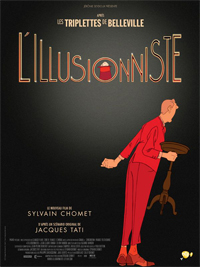
The Illusionist is a French animated film directed by Sylvain Chomet, based on an unproduced script that Jacques Tati wrote back in the 1950’s. He reportedly wrote it as a “personal letter” to an estranged daughter. It tells the story of an unsuccessful stage magician who goes on a tour of Britain. In a small town in Scotland, he meets a young girl, Alice, who believes he actually possesses magical powers. She runs away from the town and follows him to Edinburgh, where they develop a father/daughter relationship.

Anyone who has seen a Tati film will recognize his approach in this movie: understated comedy with moments of pathos. There is very little dialogue. The main character is a well-intentioned, but hapless, outsider who can never quite fit in wherever he goes.

This film is beautifully animated. There is a scene of Edinburgh seen from above that I found just breath-taking. Overall, I found this film enchanting and subtly moving.

Chris Williams

February 4, 2011

Chris Williams, a professor at Pace University, spoke at the University of Oregon recently. He was promoting his new book, Ecology and Socialism. He began by talking about the recent uprisings in Tunisia and Egypt. He pointed out those uprisings were in part a reaction to the rising cost of food, due to the rising cost of oil (one calorie of food requires ten calories of oil), and in part a reaction to the revelations in Wikileaks, which revealed the corruption in U.S. policy in the Middle East. He then went on to point out that Wikileaks documents show that the U.S. is not serious about fighting climate change. He criticized the U.S.’s behavior at the recent climate conference, pressuring countries to accept the U.S.’s terms. He pointed out that climate change is making the weather more unpredictable. “If you can’t predict the climate, you can’t grown any food,” he said, since farmers have to know when to plant their crops.

He discussed Obama’s State of the Union speech. Obama said his goal is to have 80% clean energy by 2035. Unfortunately, Obama considers “clean” coal and nuclear energy to be “clean energy”. In effect, the U.S. elite want to continue down a 19th century road to energy use. He pointed out that the Obama administration has approved zero solar energy projects and only one offshore wind project. The reason for the U.S.’s reactionary position is that the U.S. economy is based on the continual flow of cheap oil. There are plans to double oil production from the tar sands in Canada. He also talked about hydro-cracking, and it’s deleterious effect on the environment.

Williams went on to argue that capitalism is inherently anti-ecological and unsustainable. First of all, capitalism is based on continual expansion. Grow or die. This is a problem because we live on a finite planet. Also, under capitalism, exchange value is more important than use value. It’s more important to create things to sell than to create things for use. Also, because of the need to keep profits high, there is an incentive to cut corners, to build things that pollute.

Williams sees market solutions, such as cap and trade as false solutions. He was also dismissive of some technological solutions as capturing carbon in the ground. He was also opposed to the “blame ourselves” approach. He pointed out that only 2.5% of pollution is by individuals. The rest is by corporations and by the government. The U.S. military is the world’s biggest polluter. It produces more wast then the top 5 chemical companies.

Williams argues that by 2030 the world could be powered by renewable energy. In order, to achieve that, however, we need a world system that is not based on profit.
PETA’s “Veggie Love” Ad

February 3, 2011

PETA (People for the Ethical Treatment of Animals) is trying to run a commercial in the Super Bowl. Women’s groups have denounced it, saying it “demeans women”. (You can find it here.) Basically the ad shows a group of women in bikinis who lick phallic-shaped vegetables and insert them into their mouths. The production values for this ad are those of a pornographic film. It’s clear that the makers of this ad wanted to create that association in people’s minds. If PETA wants to put across the idea that “vegetarians have better sex”, there are more subtle and less sexist ways they can do that. (Think, for example, of the feminist film, Like Water for Chocolate, in which eating is associated with sex).

PETA tried to run a similar commercial in the Super Bowl last year, and it was rejected. I don’t doubt that this new one will meet the same fate. Of course, some will argue that that is the whole point. The idea is to generate controversy and so draw people’s attention. As someone who is sympathetic to the idea of animal rights, I must say that this is a bad strategy. Men who seek out this video on the Internet (and it’s clearly meant to appeal exclusively to men) are not likely to be interested in vegetarianism. And I can’t imagine anyone seriously considering becoming a vegetarian as a result of watching it. As a failed vegetarian, I can tell you that maintaining that diet requires a major commitment, something that is not likely to be created by watching this ad.

This ad shows an extremely cynical attitude on the part of PETA towards the people that they are trying to reach out to, so much so that it’s actually insulting. I know it’s wrong to generalize, but this fits in with an impression that I’ve gotten over the years, which is that people who obsess over animal rights are, to put it in the politest possible way, unreliable.

Unstoppable

February 2, 2011

I’ve always been something of a railroad buff. I remember when I was a kid, my father built a model railroad set on a pool table in the basement of our house. It was complete with paper-mâché mountains with a tunnel going through them, and a little town. I was heart-broken when my father got bored with it and threw it out. So I just had to see Unstoppable, which is inspired by a real incident of a runaway train.

Due to a mistake by an engineer, an unmanned freight train, carrying toxic chemicals, is sent rolling out of a train yard. On the same day, Will Colson (Chris Pine), a recently hired railroad worker, shows up for work and is teamed up with a grizzled veteran, Frank Barnes (Denzel Washington). Immediately the two men come into conflict. (Does this sound familiar?) However, when they learn about the runaway train, they work together to attach a locomotive to it to try to stop it.

I mostly enjoyed Unstoppable, the action sequences are well done, although the personal conflicts in it are a little pat and familiar. The film touches upon the issue of corporate greed. When the CEO of the railroad is told about the damage a toxic spill from the train could cause, his first question is what effect this would have on the company’s stocks. We learn that the company has been forcing experienced engineers into early retirement, so it can hire younger engineers for less money. The working class heroes have to struggle against the stupidity of the management to avoid a catastrophe.

As I said before, this film was inspired by a real incident that took place in 2001. Not surprisingly, the real story was not quite as dramatic as the film, though the real-life train did carry toxic chemicals. Interestingly, in the film the engineer whose mistake causes the incident is portrayed as a buffoon. In the real-life incident, the engineer was a 35-year veteran who had a good record. This should remind us that even good people can make very bad mistakes sometimes.

I remember seeing a made-for-TV movie about a runaway train many years ago. Does anyone else remember it?