Archive for the ‘Capitalism’ Category

Black Friday

November 21, 2012

It’s perhaps an indication of how corrupt our society has become that giant retail store chains are being allowed to effectively destroy a national holiday. Black Friday used to start at 9 AM on the Friday following Thanksgiving. Then they moved it up to 6 AM and then 5 AM. Last year it started at 10 PM on Thanksgiving evening. This year it’s going to start at 8PM on Thanksgiving. Black Friday is like the giant chicken heart in that famous radio play by Arch Oboler: it just keeps growing and growing until it starts crushing everything around it.

The only resistance that’s being offered to this hypertrophying monstrosity comes from the workers at Wal-Mart. They are rightly angry that their holiday has been taken away from them. Retail workers get paid low wages, and they usually get little or no benefits. Now they don’t even get Thanksgiving.

I suspect that one reason that this has been allowed to happen is that Thanksgiving isn’t as important to people as it once was. The purpose of Thanksgiving, we are told, is so we can give thanks for what we have. Since wages have been declining for decades, and millions of Americans are currently without jobs, it has become increasingly unclear to people what it is that they are supposed to be grateful for.

Nevertheless, we should support the Wal-Mart workers. And we should support all retail workers by sitting out this Black Friday madness.

Good Vibrations

September 27, 2012


Good, clean, wholesome fun. Plus backstabbing.

Just when you thought that the long, tortured saga of the Beach Boys couldn’t possibly get any more surreal, they are back in the news. That’s right, everyone’s favorite dysfunctional California family is at it again. Just recently, Mike Love, who owns the rights to the band’s name, fired fellow band members, Brian Wilson, Al Jardine, and David Marks. The reasons are pecuniary. You see, the Beach Boys have planned an upcoming reunion tour. Love explains:

    You’ve got to be careful not to get overexposed. There are promoters who are interested [in more shows by the reunited line-up], but they’ve said, ‘Give it a rest for a year’. The Eagles found out the hard way when they went out for a second year and wound up selling tickets for $5.”

I don’t know about you, but I wouldn’t even pay five dollars to see the Eagles. Lyin’ Eyes was the most overplayed song of the 1970’s. Seriously, if I ever hear that song again, it’s possible that I might get violent. Anyway, you would think that Love would imagine the Beach Boys to be more popular than the Eagles. I guess he must be a self-effacing guy. He is still planning on having the reunion tour, although he will be the only original member of the band. That’s right, Love will be having a reunion with himself. Several years ago, I saw a reunion of Jefferson Airplane. It had two original members of the band, so I guess it qualified as a reunion of sorts. What Love is doing, however, strikes me as being the musical equivalent of one hand clapping.

Not surprisingly, there has been some sour grapes about all this. Brian Wilson said:

    I’m disappointed and can’t understand why he doesn’t want to tour with Al, David, and me… We are out here having so much fun. After all, we are the real Beach Boys.

So, all Brian Wilson wants to do is have fun, whereas his cousin, Mike Love, wants to make money. Clearly, Love is the more serious person. I suspect that Wilson belongs to that 47% of the population that Mitt Romney says is sponging off the other fifty-three percent. (It’s perhaps worth noting here that Love is a Republican.) You can’t stop progress, Brian Wilson. If you don’t like it, start your own band.

Oh, wait…

(The author is currently working on a biography of the Beach Boys titled, Those Wacky Wilsons. Look for it at a finer bookstore near you.)

Mapping American Decline

September 11, 2012


1980


2010

USA Today has two maps on its website, showing which counties in the U.S. have substantial poverty rates. (You can find an interactive version of the maps here. One is for 1980 and the other is for 2010. The colored areas indicate a poverty rate of 20% or more. The dark brown areas indicate poverty among the elderly, the light brown areas indicate childhood poverty, and the gray areas indicate a combination of the two.

Overall, the maps give the impression that Americans are poorer today than they were thirty years ago. Also, there has been a shift from poverty among the old to poverty among children. This is perhaps because declining wages have resulted in more children being raised in poverty. One is also struck by the increase in the poverty rate in Western states (with the notable exception of Utah). This may indicate that the inland West is being largely passed over in the new globalized neoliberal economy.

One thing that is clear from these maps is that the southern half of the U.S. has always been poorer than the northern half. This is probably the legacy of slavery, Jim Crow, and so-called “right-to-work” laws. This shows what a sorry joke the much bally-hooed “New South” is. It’s worth noting that while the population of this part of the country has been steadily increasing, it has apparently not gotten any wealthier.

There are two large areas where poverty has not apparently increased substantially. One is a region that the French geographer, Jean Gottmann, called “Megalopolis”. It extends roughly from Boston along the Atlantic coast to Washinton, D.C. (Judging from these maps, one can add northern Virginia, Vermont, and New Hampshire to this.) This is the most densely populated region in the country. (Note how lightly populated counties in the West have gotten poorer.) It’s also a region with major port cities. This no doubt shows the importance of global trade to the economy. This region also has a good deal of high tech companies

The Great Lakes region has has also been relatively steady, with the notable exceptions of Michigan and Ohio, which have been hit hard by outsourcing in the automobile industry.

Also indicating the importance of trade and technology is the fact that the major West Coast ports, plus the Silicon Valley and Hawaii, have been doing comparatively well. Los Angeles and Long Beach appear to be the exceptions here, but bear in mind that Los Angeles County covers an enormous area, mostly desert and mountains, so this may be deceiving.

Note also that the poorer states tend to be what pundits call “red states”, that is, they tend to vote for the Republican candidate in presidential elections. Since Republicans don’t even pretend to care about the poor, one must assume that this is due to social conservatism. Clearly, we on the left have our work cut out for us.

Sun Myung Moon (1920-2012)

September 3, 2012

Sun Myung Moon was one of the greatest entrepreneurial geniuses of the twentieth century. Like L. Ron Hubbard, he grasped the essential truth that religion is a business. You promise salvation to people, and they pay you money for it. (Salvation is a special kind of commodity. Although it has no form or substance, it is nonetheless fungible.) His Unification Church is quite the corporate conglomerate. According to the Associated Press:

    The church’s holdings included the Washington Times newspaper; Connecticut’s Bridgeport University; the New Yorker Hotel, a midtown Manhattan art deco landmark, and a seafood distribution firm that supplies sushi to Japanese restaurants across the U.S. It acquired a ski resort, a professional football team and other businesses in South Korea. It also operates a foreign-owned luxury hotel in North Korea and jointly operates a fledgling North Korean automaker.

All in all, Moon didn’t do badly for a man who was sent to complete Christ’s work on Earth.

In 1991, Moon traveled to North Korea to meet with Kim Il Sung, who was himself a messiah of sorts. The two of them got along famously, no doubt because they had so much in common. Imagine Jesus and Mohammed meeting at a barbecue and talking shop. It must have been something like that.

When I was young, I attended a college in Boston. The place was lousy with Moonies. They had an office across the street from the campus. They were always trying to recruit people. One day, while I was sitting in the cafeteria eating lunch, a young East Asian man came up to me and started giving me the Moonie spiel. He talked about how corrupt our society is and how we need to do something about it. I finally got irritated, and I said to him, “If that’s the way you feel, why don’t you go back to your own country.” That was not a good thing to say, I admit. The guy had a humorless, monomaniacal air about him. Later on in my life, I would meet members of sectarian left groups who had that same quality about them.

Still, I would argue that Moon didn’t do nearly as much harm as Mitt Romney and his Bain Capital did. The worst that Moon did was make people take part in mass weddings that everyone else thought were creepy. I know a guy whose parents were married in one of these ceremonies, and he seems pretty normal. (Well, to me, any way.) Whereas Bain put people out of work and destroyed whole communities.

Paul Ryan

August 12, 2012

It used to be that the Republicans would run as the “no new taxes” party. Now we have a Republican ticket that is effectively promising to raise taxes on most Americans, while giving huge tax cuts to the richest Americans. At the risk of sounding portentous, I can’t help but wonder if we are entering a new phase of capitalism, one in which politicians no longer even pretend to care about the general welfare. Ronald Reagan pretended to be a friend of the working class, even as he attacked workers’ living standards. Romney and Ryan are effectively giving the finger to the working class. They are here to benefit the rich, and they want everyone to know it. The question is: how many Americans will buy this? True, there are a lot of people who have read Atlas Shrugged, but there are a lot more who haven’t. Not everybody has been indoctrinated into the Randroid zombie army. Not yet, anyway.

There must be a deep affinity between Romney and Ryan, for one can see no other reason why Romney would choose him. According to this article in the New York Times, Ryan doesn’t give Romney any electoral advantage. Being a Catholic, he won’t help the Mormon Romney with evangelicals, although he won’t hurt him either. The Catholic fanatic, Rick Santorum, had his strongest support during the primaries among Protestant fundamentalists. (Interestingly, Santorum tended to do poorly in states with large Catholic populations.)

Ryan’s proposed budget calls for cuts in Social Security and effectively scrapping Medicare. As I have pointed out before, attacking Social Security and Medicare is a losing argument for the Republicans, since their largest voting base consists of old people. Ryan has even echoed Rick Perry’s claim that Social Security is a Ponzi scheme. Perhaps Romney and Ryan are gambling that their supporters are too senile to know what they are talking about.

In this admiring article about Ryan from the Wisconsin Policy Research Institute (“Wisconsin’s Free Market Think Tank”), we learn: “With his father’s passing, young Paul collected Social Security benefits until age 18, which he put away for college.” Assuming that Ryan is a principled man, he would certainly want to return his ill-gotten gains from our national Ponzi scheme, wouldn’t he?

Some Thoughts on the Occupy Movement

July 8, 2012

At CounterPunch, Alexander Cockburn has an article about the Occupy movement. Although Cockburn makes some valid criticisms, I think he is too dismissive of the movement as a whole. He writes, “People have written complicated pieces trying to prove it’s not over, but if ever I saw a dead movement, it is surely Occupy.” In fact there are still Occupy groups all over the country, and many of them still hold regular meetings. It is true, however, that the movement doesn’t have as strong a presence as it did last winter. It’s possible, I think, that the movement might be in better shape if some things had been done differently.

In hindsight, I think it was a mistake not to put forward clear demands. The argument that I often heard for not doing so was that demands would lead to disagreements, which would lead to divisions. Yet disagreements and divisions happened anyway. Political clarity was sacrificed in order to attain an impossible ideal of group harmony. The greatest division, it seems to me, was, and is, between those who favor Black Bloc tactics and those who advocate Gandhian non-violent resistance. These two approaches are, in fact, mutually exclusive. This can not be covered up by platitudes about “diversity of tactics”. Some tactics are incompatible with others.

I suspect that this exaggerated fear of division is what drives the insistence upon a consensus approach to decision-making. The argument was that consensus, although time-consuming, will bring everyone into harmonious agreement. Yet some people became dissatisfied and left anyway, as would have happened under simple majority rule. So, what has been gained by having consensus? Nothing that I can see.

Then there is the pretense of “leaderlessness”. The truth is that some people become unofficial leaders, either because they are very good at making arguments, or because they possess specialized skills that are useful to the movement, or because they are simply both willing and able to devote an enormous amount of time and energy to the cause. Wouldn’t it make sense to acknowledge this and make these people directly accountable to the entire group?

Cockburn makes one point that strikes me as particularly salient. He writes:

    Where was the knowledge of, let along [sic] the respect for the past? We had the non-violent resistors [sic] of the Forties organising against the war with enormous courage. The Fifties saw leftists took [sic] McCarthyism full on the chin. With the Sixties we were making efforts at revolutionary organisation and resistance.
 
Yet when one [sic] raised this history with someone from Occupy, I encountered total indifference.

Typographical errors aside, what Cockburn says here is true of much of the U.S. left. How many American leftists have even heard of A.J. Muste? Or the Dodge Revolutionary Union Movement? Or C.L.R. James? (Although you can always find an anarchist who is willing to talk your arm off about Kronstadt.) On left-wing British websites you can find informed discussions about such topics as the Battle of Cable Street, the 1926 General Strike, or Trotsky’s conception of the united front. We have nothing quite like this here in this country. There is little effort among the U.S. left to learn from the successes and failures of the past. It’s as though we must continually re-invent the wheel. What’s more, this historical amnesia makes us vulnerable to all kinds of dishonesty, as when, in Capitalism: A Love Story, Michale Moore reminds us of the 1936 Flint sit-down strike – only to make the false claim that F.D.R. sent in National Guard troops to defend the strikers from the police. In fact, they were sent there to intimidate the strikers.

These are just some thoughts I have had about the Occupy movement and about the U.S. left in general. I would be interested to hear what other people have to say about these topics.

2011: A Glimmer of Hope

December 31, 2011

2011 was the best year of my life. True, this year had more than its share of tragedies, most notably the terrible tsunamis in Japan and the meltdown of the Fukushima reactors (we will be living with the consequences of the latter for generations). What I’m referring to here is that this year we saw mass demonstrations against the ravages of capitalism, beginning in Tunisia and spreading to various parts of the globe, most recently in China and in Russia. I have never seen anything like this before. The “anti-capitalist” upsurge of 1999 to 2001 was paltry compared to this.

Not everything has gone smoothly, of course. The demonstrations in Bahrain have been defeated (so far). The struggle is still uncertain in Syria. There has been an Islamist backlash in Tunisia and in Egypt. The National Transitional Council in Libya is dominated by former Khadafyites. Yet the problems that led to the initial uprisings in these countries are not going away.

The 99% movement has changed the political landscape here in the U.S. The Tea Party hoax is dead. The mainstream media have been forced to talk about issues such as economic inequality. Six months ago, all they were talking about was the need to cut government spending. What was perhaps most striking about the movement was the way it continued to grow in the face of savage police repression. The sight of cops beating and pepper-spraying people only seemed to make people want to join the resistance. The tactic of occupying public spaces seems to have run its course. However, new methods of stuggle are starting to emerge, such as occupying foreclosed homes.

This December, U.S. troops were pulled out of Iraq. This was, as I made clear in an earlier post, partly the result of the revelations provided by WikiLeaks, which also helped to fuel the uprisings in other parts of the world. We should support Private Bradley Manning as the government tries to railroad him. We owe a lot to this brave young man.

2012 should prove to be an interesting year.

Margin Call

December 17, 2011

Years ago I applied for a job as a financial advisor. The interviews went great. I seemed to be a shoo-in for the job. The hiring manager, however, told me that every applicant was required to take a personality test. He assured me that this was just a formality. I took the test, and several days later I received a phone call from the manager. I could tell from the tone of his voice that it was not good news. He said that they could not give me the position, because, according to the test results, I was “too nurturing”. I swear, I’m not making this up.

Today I have a job working in a warehouse. The company that told me that I was “too nurturing” was generously bailed out by the government following the 2008 financial crisis. No doubt they have given bonuses to their unnurturing employees.

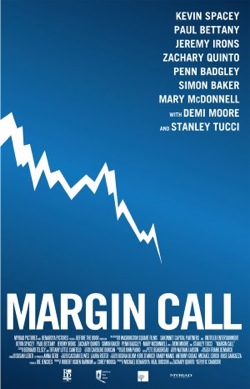
I was reminded of all this when I went to see Margin Call, written and directed by T.C. Chandor, a loosely fictionalized account of the collapse of Lehmann Brothers, which triggered the global economic meltdown in 2008. Eric Dale (Stanley Tucci) is laid off from his job at a financial firm. As he is being escorted from the building, he hands, as an afterthought, a thumb drive containing a program he has been working on to Peter Sullivan (Zachary Quinto), warning him to “be careful”. Puzzled by this enigmatic comment, Sullivan begins crunching numbers with the program, and late in the evening he discovers that the company is in immediate danger of becoming insolvent. Right away, he calls his fellow employee, Seth Bregman (Penn Badgley), and senior salesman, Will Emerson (Paul Bettany), who then tells the head of sales, Sam Rogers (Kevin Spacey), about this. By the early morning, a meeting has been convened with the top members of the company, including the head of risk, Sarah Robertson (Demi Moore), the head of securities, Jared Cohen (Simon Baker), and the CEO, John Tuld (Jeremy Irons). Tuld decides that the best thing they can do is sell off all of the company’s assets during the next trading day, even though this could cause a financial panic and put them out of business.

This film features fine ensemble acting. I especially liked Irons’s performance. He oozes smug complacency as he makes a decision that will ruin many people’s lives. Spacey is, as always, completely on the mark.

Margin Call quietly points out the insanity of an economic system in which bad decisions by one company can cause a global crisis. It also points out how non-productive and personally corrupting the financial system is. Rogers, for example, is strongly opposed to what the company is doing, but he ends up going along with it, because, as he explains, “I need the money”. The need for money guides the actions of all the characters in varying ways, while one gets the uncomfortable feeling that there is something lacking in their lives. In one scene, Tuld tries to console Rogers by telling him that he could have spent his life digging ditches. “If I had spent my life digging ditches, I would at least have holes in the ground to show for it,” Rogers says. This is one of the best lines I have ever heard in a movie. In another scene, Dale, a former engineer, reminisces about how he once designed a bridge. He inwardly yearns for a time when he made a positive contribution to other people’s lives. (Uh, would it be cynical to say that he wants to be “nurturing”?)

Margin Call is one of the best films of the year.

Alexander Cockburn Gets Peak Oil Theory Wrong

October 2, 2011

Yesterday, I turned to Alexander Cockburn’s CounterPunch Diary to see if he had anything to say about the highly critical comments people have been making about CounterPunch contributors Gilad Atzmon and Israel Shamir. Instead, I found a (mostly) good article about the Keystone XL pipeline. Cockburn rightly argues that the whole thing is a boondoggle. It will not make domestic oil cheaper, for the obvious reason that the whole purpose of the pipeline is to pump oil to refineries in Port Arthur, Texas, so the resulting products can be shipped overseas.

Unfortunately, Cockburn begins his article this way:

    I’ve never had much time for “peak oil” (the notion held with religious conviction by many on the left here, that world oil production either has or is about to top out – and will soon slide, plunging the world’s energy economies into disarray and traumatic change.) In fact there’s plenty of oil, as witness the vast new North Dakota oil shale fields, with the constraints as always being the costs of recovery. Oil “shortages” are contrivances by the oil companies and allied brokers and middlemen to run up the price.

    Contrary to the lurid predictions of declining US oil production, disastrous dependence on foreign oil and the need for new offshore drilling, not to mention the gloom-sodden predictions of the “peak oil” crowd, the big crisis for the US oil companies can be summed up in a single word that drives an oil executive to panic like a lightning bolt striking a herd of snoozing Longhorns: glut.

The fact that the global economic slump has resulted in an oil glut does not in any way disprove peak oil theory, which is concerned with a long-term trend. (One would think that a Marxist would be able to understand the concept of a trend.) Moreover, Cockburn gives the impression that the North Dakota oil shales are a new discovery. They aren’t. Geologists and engineers have known about them and the Canadian oil sands for decades. (The rate of new oil discoveries has been declining since the 1960’s, by the way.) For a long time, the high cost of recovering oil from these sources made it economically unfeasible to do so. In recent years, however, high oil prices have made such recovery profitable, which is why these sources are now being tapped. Also, it’s because of the high price of oil that companies like BP are willing to undertake risky off-shore drilling ventures – such as the one that led to the Gulf oil spill – especially since the price is expected to continue rising in the future.

Domestic oil production has increased during the Obama administration, yet gasoline prices have remained high in the midst of the worst recession since the 1930’s. This is because the technology required to recover the remaining oil in largely tapped out wells has become increasingly expensive. That’s why it’s delusional for Michele Bachmann to claim that she can bring back $2 a gallon gasoline by allowing more oil drilling. Barring a total collapse of the world economy, we will probably never see $2 a gallon gasoline again.

Cockburn should stay away from scientific issues. From global warming to anti-vaccine quackery, he has shown that he doesn’t understand science. He even seems to have an animus toward science. Every time, for example, that evolution comes up, he starts droning on about how William Jennings Bryan didn’t believe in evolution, which has nothing to do with anything.

And don’t get me started on Atzmon and Shamir.

Occupy Wall Street

September 28, 2011

There seems to be an almost total media blackout on this. So far as I know, only MSNBC has covered it at all.