Archive for the ‘Capitalism’ Category

Feeding at the Trough at the University of Oregon

September 5, 2011


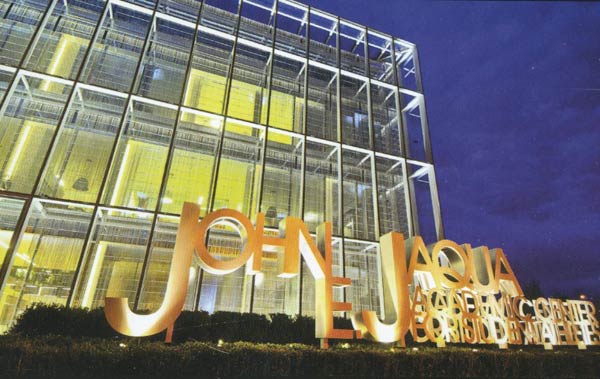
The John E. Jaqua Academic Center, whose upper floors are off limits to most students. A result of the brilliant planning of UO administrators.

The Register-Guard has just revealed that three months ago the University of Oregon awarded raises totaling $1.9 million a to 390 administrators. This is after university staff were forced to take a pay cut. The is at a time when the state of Oregon is in the midst of a budget crisis, and the official unemployment rate in Oregon is 9.5%. (The real unemployment rate is no doubt higher.)

What have these administrators done to deserve this raise? Let’s look at some of the things they’ve done in recent years. They spent almost a quarter of a billion dollars to build a new basketball arena that the school doesn’t need. They spent $41 million to build the gaudy and pretentious Jaqua Center, which serves no real purpose. They built the Ford Alumni Center, which, according to its website, is intended to serve as “the gateway to the university” (whatever that means). They also built an ugly and garish electrical sign in of front the new basketball arena facing busy Franklin Boulevard. (This thing is so bright that it hurts your eyes when you look at it at night. Seriously, you could use this thing instead of a lighthouse to guide ships at sea.) They wanted to create a huge neon sign saying “University of Oregon” in the middle of Portland, which is over a hundred miles from the main campus. (The people of Portland rightly stopped this.) They devised a scheme to gradually privatize the school, which will make a college education more inaccessible to people in Oregon. They have demanded that the campus police be allowed to carry guns and tasers that they don’t need. Meanwhile, the athletic department has been plagued by scandals.

And these people think they deserve a raise for all this.

One is reminded here of the banksters who gave themselves raises and bonuses after they wreaked the economy. It seems that in twenty-first century America, the way to succeed is to fail. What is important is no longer the results one gets, but one’s ability to hype oneself. (No doubt this explains the aforementioned idiotic plan for a neon sign.)

The 135-year history of the University of Oregon has followed an interesting trajectory. The place was originally conceived as a sort of mini-Harvard for people too lazy to take the week-long train ride to the East Coast. Although the school had academic pretensions (some faculty members belonged to the Klu Klux Klan), it was an open secret that the place was really a playground for the pampered sons of Oregon’s rich. These future captains of industry would amuse themselves by devising elaborate hazing rituals that invariably involved spankings. (I will leave it to the reader to try to figure out why budding capitalists would enjoy spankings.) Things changed drastically after the Second World War, largely as a result of the G.I. Bill. The university was forced to throw open its doors to members of the lower orders. The school’s fine old traditions were smashed as a result of the place being flooded by vulgar, coarse youths who actually wanted to learn about things like physics and art history. It became necessary to hire professors and instructors who knew something about the topics they were teaching. As a result, the concept of a “college education” acquired a weight and gravity that it had never previously possessed. Now, however, as tuition continues to rise and privatization looms, the university seems to be coming full circle. It appears to be becoming once again a playground for the rich.

Perhaps the idea that education is something valuable and important was merely the fleeting result of a transitory phase in the evolution of capitalism. Just look at the current campaign to destroy public education through standardized testing and charter schools. Perhaps we are returning to a situation like that in the Middle Ages, when learning was something done by a few oddballs in monasteries.

My advice to young people who want to get a college education is that they had better have a lot of money.

And it will help if they learn to enjoy being spanked.

The Libyan Revolution

August 26, 2011

Some on the left (Glen Ford, for example) have taken the view that the Libyan revolution is nothing more than a NATO-driven coup d’etat. I cannot share this view. Clearly, the rebels could not have succeeded without support from a substantial portion of the Libyan population. One thing we learned from the Afghanistan war is that dropping a lot of bombs and sending in special operations forces do not guarantee a victory. Civilian support – which the U.S. clearly lacks in Afghanistan – is an important factor.

No doubt the Western governments will try to profit as much as they can from the current situation in Libya. Some members of the ruling class are openly calling for a U.S. occupation of Libya. Richard Haas has written in the Financial Times:

    Nato’s airplanes helped bring about the rebel victory. The “humanitarian” intervention introduced to save lives believed to be threatened was in fact a political intervention introduced to bring about regime change. Now Nato has to deal with its own success. Some sort of international assistance, and most likely an international force, is likely to be needed for some time to restore and maintain order. Looting must be prevented. Die-hard regime supporters will have to be defeated. Tribal war must be averted. Justice and not revenge need to be the order of the day if Libya is not to come to resemble the civil war of post-Saddam Iraq in the first instance, or the chaos (and terrorism) of Somalia and Yemen down the road.

Haas, a diplomat, apparently did not notice that the U.S. military completely failed to stop the sectarian civil war in Iraq. I suspect Haas’s real concern is guaranteeing for the U.S. easy access to Libyan oil. Despite his knowing use of quotation marks, it is clear that Haas is actually making a more sophisticated version of the “humanitarian intervention” argument. I doubt, however, that Obama will take Haas’s advice. Among other things, the current political mood in the country is not favorable for such a move.

Is the revolution an unqualified victory for the U.S.? Bear in mind that the U.S. did not get everything it wanted in Iraq, and it certainly did not get what it wanted in Afghanistan. The U.S. may find Libya also hard to control.

More Thoughts about Obama’s Budget Deal

August 7, 2011

The raucous debates that preceded the budget deal have led some to the conclusion that the U.S. ruling class is in a state of crisis. The wars in Iraq, Afghanistan and Libya have not gone they way they hoped. The recovery from the last recession has been extremely weak. They are desperately trying to find a way to increase profits while maintaining the empire, but they are divided on how to do it. Some, like the Koch Brothers (the driving force behind the Tea Party), want to simply destroy whatever is left of workers’ living standards, effectively making the U.S. into a “Third World” country. Others favor less drastic measures. The people at Standard & Poor’s are trying to impose their own ideas on the government by downgrading their credit rating. None of these people seem to see unemployment as a problem, even though the more intelligent members of the ruling class must realize that chronic unemployment will eventually lead to social unrest. (The Wisconsin uprising may be a foreshadowing of this.) Yet they are unwilling to accept any New Deal-type reforms that might assuage public anger.

Again, what we need is a movement of unemployed people.

Obama’s Budget Deal

August 4, 2011

Readers of my blog know that I have never been keen on conspiracist thinking, but I’m starting to get a bit paranoid after these recent budget negotiations. Watching them was like watching that old magician’s trick, in which the audience is made to look in one direction while the important thing that’s happening is in the other direction. For weeks we listened to one Tea Party Republican after another talk about how they must wreak the economy just to spite Obama. Meanwhile, few noticed that Obama actually proposed making cuts in Social Security and Medicare.

Think about it, and the conspiracy makes sense. First, find the stupidest members of the white middle class. Tell them that Obama is a socialist and a fascist and a Muslim. Then organize them into demonstrations and let them make fools out of themselves. So the rest of the country gawks at these people and no one pays attention to what Obama is doing. They don’t realize just how conservative Obama is, and how he is waging war on the working class and the poor.

It is becoming clear that the ruling class have decided that they can live with a permanent state of high unemployment. Indeed, they may even view that as preferable. And if it is fine with them, it is fine with Obama.

What we need in this country is a movement of unemployed people.

The Price of Sugar

July 23, 2011

I recently saw the 2007 documentary, The Price of Sugar, which was directed by Bill Haney. It depicts the plight of Haitian farm workers on sugar plantations in the Dominican Republic. These workers have no legal status, and they live in appalling conditions in small villages called baretes, which are guarded by goons hired by the plantation owners. These Haitians are regarded with suspicion and sometimes hostility by many Dominicans, even though they perform work that the Dominicans refuse to do. Does this sound familiar? This is similar to the situation of Mexican and Central American farm workers in the U.S. It seems that the practice of demonizing the lowest paid workers in order to more thoroughly exploit them and other workers is not confined to the U.S. Indeed, I would not be surprised if this is a common practice in the capitalist world.

The film focuses on a Catholic priest, Christopher Hartley, who brought volunteer doctors from the U.S. to treat the Haitians, and who urged the Haitians to organize to make demands for better working and living conditions. This brought him into conflict with the Vicini family, who own many of the sugar plantations in the Dominican Republic, and who are a powerful political force in that country. The Vicinis organized demonstrations in which people accused Hartley of bringing Haitians into the country and of trying to “Haitianize” the Dominican Republic. (Again, doesn’t this sound familiar?) I have learned that after this film was made, Hartley was relieved of his position by the Catholic Church. I suspect this was in response to political pressure.

At one point in this film, we are told by the narrator, Paul Newman, that the U.S. has a trade agreement with the Dominican Republic, which stipulates that U.S. will buy sugar from that country at twice the world market price. I saw this film with a law professor who specializes in trade issues. I asked him why the U.S. would want to buy sugar at twice the market price. He told me that by making sugar prices artificially high, the U.S. government creates a demand for corn syrup. In effect, this is a subsidy for U.S. agribusiness, one that is carried out on the backs of Haitian workers.

I highly recommend seeing this film.

Arianna Huffington Reloaded

June 18, 2011

As you may have guessed from my last couple of posts, I’m in the mood for hating on Arianna Huffington. I could talk about how her website, The Huffington Post habitually refers to Hugo Chavez as a “dictator”, or how it’s filled with inane celebrity gossip, or how it tirelessly promotes Sarah Palin and her family. (When Palin’s husband won a fishing contest, the HuffPo featured an article about it.) Instead, I’m going to talk about what Huffington really cares about: money.

The Newspaper Guild and the National Writers Union have called upon bloggers not to contribute to the Huffington Post, until it agrees to pay them. This is what is known as a strike. So far, Huffington has refused to meet with the union leaders about this. It appears that Mrs. Huffington doesn’t like people telling her how to run her plantation.

It’s not a new thing for companies to try to get people to do things for no pay. I remember when I was working for Universal Studios, they were always trying to get employees to “volunteer” to do things, such as construct a float for the Tournament of Roses Parade. HuffPo has, however, carried this to a new level, because it was built upon unpaid labor, a fact acknowledged by the site’s new owner, AOL:

    In a Forbes magazine article, AOL executives were quoted as saying that AOL CEO Tim Armstrong “talked a lot about the importance of recruiting hordes of free bloggers…. “It was always, ‘Arianna does it. That’s what she’s built her business on. Why don’t we do it, too?’” says a former AOL editor-in-chief.”

This is what makes the HuffPo so poisonous. People see what Huffington has done, and they get the idea that maybe they too can make money by not paying people. This idea becomes like a cancer that spreads.

The Confederacy was abolished over 140 years ago, but the struggle for unpaid labor goes on.

Shepard Fairey Reloaded

June 17, 2011

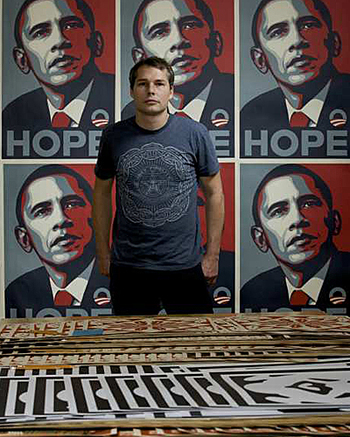
I started this blog by writing about Shepard Fairey. There hasn’t been much new on the Fairey front for a while, so I was pleased to find this. TMZ has a video of him churlishly admonishing his wife after she effectively tells someone that he no longer does his own wheatpasting. Does this surprise anyone? Fairey rakes in so much money, he can afford to hire a whole army of wheatpasters. Hell, I’m so desperate for work, I’d be willing to do it myself. (Shep, my hours are flexible.)

Mat Gleason, a critic for Coagula Art Journal, has a snarcky article about this in the Huffington Post. It begins:

    What is the difference between graffiti and paparazzi? Both are annoying invasions of public space. Whenever a cry to regulate either of these behaviors is heard, civil society acknowledges that it would take too much erosion of personal liberty to stop one or both. Therefore we tolerate and occasionally celebrate these rogue exercises on the fringes of free speech.

One should never criticize graffiti without also criticizing outdoor advertising. The latter is a far more pervasive and annoying invasion of public space. I’m no fan of Shepard Fairey, but I would rather look at one of his silly “Obey” signs than an advertisement for deodorant or toothpaste. When I lived in Los Angeles, I spent a large chunk of my time sitting in traffic with nothing to look at except enormous billboards urging me to watch Judge Judy (“Gotcha!”) or Dr. Phil (“You’ve Got Your Battles, He’s Got Your Back!”) or some other insipid TV show. So, no, you’re never going to hear me complaining about graffiti, not even when it’s done by a pompous fraud like Fairey.

Gleason ends his article with this:

    If cash-starved local governments look up their own old laws still on the books and, having seen Fairey’s own wife confirming on the record that the family fortune was based on advertising in these civic-controlled public spaces, will cities and counties all across America unite to collect fees from the Obey Empire with her admission as a pretext to write up an invoice? Imagining this were your empire, would you tell her to shut the fuck up?

This is high-minded talk coming from someone who writes for the Huffington Post, which is notorious for not paying people, while its owners get rich. People who live in glass houses…

The Greatest Movie Ever Sold

May 28, 2011

I was working for Coca-Cola when the first Harry Potter movie came out. Coca-Cola had a tie-in agreement with the producers of the film. They had big cardboard displays up in supermarkets with pictures of the films’ characters and the words, “Taste the Magic”. The idea was, apparently, that just by drinking a bottle of Coca-Cola, you could experience the magical world of Harry Potter. Nobody seemed bothered by the obvious absurdity of this. It seems that people have become so used to the ludicrous claims of advertising, that nobody even thinks twice about them any more.

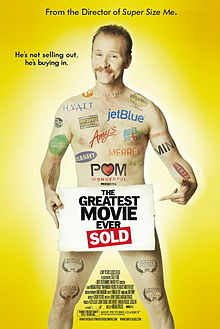
Morgan Spurlock set out to make a film that would be funded entirely by corporate sponsorship. His aim was to explore the effects that advertising have on our world. There are scenes of advertising executives sitting around with straight faces spouting bullshit terms like “brand collateral” and “brand personality”. Some film directors make candid admissions about the use of product placement in films. (An advertising executive boasts to Spurlock about how he once forced a movie studio to re-write a scene that showed Alka-Selzer in an unflattering light.) There’s a creepy segment about “neuromarketing”. People are placed in MRI machines, and their brain activity is studied as they watch various commercials. Spurlock visits a cash-strapped school in Broward County, Florida. The school administrators are desperately trying to raise funds by placing advertisements around the school grounds. (Spurlock gives them a list of his sponsors. They seem very grateful.)

There’s an interesting segment in which Spurlock visits Sao Paulo, Brazil, where the city government has banned outdoor advertisements. Interestingly, nobody seems to miss the old billboards. I couldn’t help but contrast this with the scenes in New York’s Times Square, with its clutter of distracting advertisements. Would our lives be any poorer without this visual noise? I don’t think so.

Throughout the film, Spurlock keeps his tongue firmly planted in his cheek. He hints to us that he may have sold out. (He prefers to say “bought in”.) In one scene, he even tries to get Ralph Nader to buy shoes from one of his sponsors. I found this film amusing to watch, but it lacked any sense of urgency. Spurlock failed to make me feel that I should care about this topic.

Bin Laden

May 4, 2011

It seems these government officials just can’t resist the urge to lie about military operations. Initially, we were told that Bin Laden took part in a firefight with the Navy Seals and that he used his wife as a “human shield”. The government now admits that never happened. Moreover, we are now told that Bin Laden was unarmed. If it is true that the Seals were to try take Bin Laden alive, then their killing him has to be considered a blunder.

Bin Laden was an evil man, and he caused nothing but suffering in the world. Some have pointed out that the U.S. military have killed more people than Bin Laden did. This is true, but it was Bin Laden who provided them with a convenient excuse to carry out their wars. Without the September 11th attacks, it would have been a lot harder for the U.S. government to persuade people to support the invasion of Iraq. Of course, that is what Bin Laden wanted: the U.S. sending its troops into Muslim countries. No doubt he derived satisfaction from this, though the only people who have benefited have been corporate CEO’s.

Will this change anything? The Arab revolutions have made Al Qaida largely irrelevant. With Bin Laden’s death, however, the emotional justification for the U.S.’s interventions in the Muslim world is gone. I have heard a number of people say that the U.S. should leave Afghanistan now. The Stratfor website has speculated that Obama may start pulling troops out of Afghanistan soon. I hope that they are right, though I fear that the government will find some other excuse to continue the occupation.

Noam Chomsky

April 23, 2011

Noam Chomsky spoke at the University of Oregon earlier this week. An estimated 2000 people turned up to hear him. Chomsky admitted he had left his notes in his hotel room, so he would have to wing it. The title of his talk was “Global Hegemony: Its Facts and Images”. Chomsky began by quoting Adam Smith’s “Vile Maxim of the Masters of Mankind”: “All for us, nothing for everyone else.” Chomsky believes that this is increasingly how the ruling class thinks. From this he proceeded to talk about how economic power increasingly determines political power. He quoted Thomas Ferguson to the effect that elections are when investors gather to control the state. Obama’s victory in the presidential election was due to support from financial institutions. The result of this financial control of the government is that the country is at its highest level of inequality ever. The richest one tenth of one percent of the population have become spectacularly wealthy.

Chomsky argued that the Bretton Woods agreement resulted in a period of unparalleled economic growth in the years following World War II. However, Bretton Woods was abandoned during the 1970’s, one result of which was a sharp growth in the size of financial institutions. This has resulted in the weakening of banking regulation in the U.S. Chomsky argued that the concentration of wealth leads to a concentration of political power. Bush’s tax cuts, for example, were designed so that half of them went to the richest one percent of the population. He pointed out that during the last months of 2010, Obama imposed a pay freeze on federal employees, which amounts to a tax increase for them. He renewed the Bush tax cuts, and he reduced funding for Social Security, which, Chomsky believes will eventually lead to its privatization. He pointed out that the Savings and Loan scandal of the 1980’s resulted in criminal prosecutions. There have been no prosecutions of the criminal behavior that caused the financial meltdown of 2008. Bankers now have no incentive to obey the law, because they know they will not be punished.

Smith’s “Masters of Mankind” want the government to focus on cutting the deficit, not on stimulating the economy. Public education is being dismantled. Why this attack on Social Security and on education? They’re based on the principle that one should care about other people. This violates the Vile Maxim. Half the deficits are from military spending, but the rich don’t want this cut.

To some extent, this is built into our political system. James Madison, one of the founding fathers, said that power must be in the hands of the wealthy, because they are the most “responsible” members of society. Madison, according to Chomsky, was “pre-capitalist”. He imagined the wealthy to be benevolent aristocrats. He failed to foresee the rise of corporations that no longer care about the welfare of the country.

The market is based on the theory that consumers make rational choices. Business undermines this through advertising, which gets people to make irrational choices. They undermine democracy the same way.

The problem of capitalism has become an existential one, because corporations regard the survival of the species as an externality, meaning that is of no concern to them because it has nothing to do with them making a profit.