Archive for the ‘Cinema’ Category

Two Early Films by Werner Herzog: Heart of Glass and The Engima of Kaspar Hauser

October 28, 2012

Werner Herzog’s 1976 film, Heart of Glass, can charitably be described as a failed experiment. This film is most notorious for the fact that Herzog had the actors hypnotized before each scene. He claimed this enabled them to express themselves more freely, although you would never guess that from watching this film. The actors seem stiff and wooden. They look past each other, and at times they seem to be about to fall asleep.

Another problem is that this film doesn’t have much of a story. It is set in a Bavarian village during the 18th century. The town has gotten wealthy by manufacturing ruby-colored glass. The factory foreman, Muehlbeck, is the only person who knows how to make the special glass. He dies without revealing the secret to anyone. (This is far-fetched, to say the least. The story is reportedly based on a German legend.) Realizing that their livelihood is now threatened, the townspeople become increasingly prone to violent or extreme behavior. The factory owner, Huttenbesitzer (Stefan Güttler) goes mad. He convinces himself that the secret ingredient in the ruby-colored glass is human blood, so he kills his servant, Ludmilla (Sonja Skiba). Immediately after that, he sets fire to his factory. Oh, and there is a seer named Hias (Josef Bierbichler, who was fortunate enough to be the only actor who wasn’t hypnotized), who makes apocalyptic prophecies. That’s pretty much all that happens. Herzog fills out the film to feature length by including long, brooding shots of the Bavarian countryside. There is also an interesting scene of glassblowers working in the factory that will teach you some things about making glass objects.

Strong performances might have compensated for the weakness of the story, but Herzog made sure that wouldn’t happen with his hypnotism. One can only conclude that the hypnosis was a gimmick. Herzog has always been a bit of a huckster (which is actually part of his aesthetic), but in Heart of Glass his carny impulses went a bit too far.

The Enigma of Kaspar Hauser, made two years earlier, is a superior film in many ways, not least because there was no hypnosis. The German title for this is Jeder für sich und Gott gegen alle (Every Man for Himself and God against Everyone). Herzog has said that he “loved” this title, but nobody else seemed to like it. (I side with the nobody else.) As the American title indicates, this film is based on the life of Kaspar Hauser, the foundling who was reportedly raised without any human contact. This film presents Hauser’s account of his life as true, although many historians have come to believe that he was a clever impostor. The abrupt and mysterious nature of Hauser’s death does not lend itself to tragedy, so Herzog tries to play it for irony. At the end, we see doctors performing an autopsy on Hauser’s body. They find that his cerebellum and part of his liver are enlarged, and that the left side of his cerebrum is smaller than the right side. (Strangely, the doctors don’t seem to notice that his brain looks as though it is made out of moldy cheese.) A government official writes all this down and then gleefully scurries off, satisfied that the mystery of Kaspar Hauser has finally been “solved”. As a satire of bureaucracy, this seems merely contrived and tacked on.

Herzog cast Bruno Schleinstein (also known as Bruno S.) as Kaspar Hauser. (Even though Scheinstein was 41, and Hauser was only 17 when he was “found”.) Schleinstein was a Berlin street performer who was said to suffer from severe psychological problems. Herzog once claimed that he found Schleinstein when the latter broke into his car and fell asleep in it. Later, it turned out that Herzog had actually learned about Schleinstein from a documentary about Berlin artists. This just goes to show that Herzog has a bit of Kaspar Hauser in him. Anyway, Schleinstein, who allegedly had no previous acting experience, gives a very strong performance in this film; he is the main reason to watch it. He had what Hollywood types call “presence”. Perhaps this is something he acquired from his experience as a street performer. It’s hard to take your eyes off him. He makes his character’s odd behavior completely convincing. Unfortunately, Schleinstein only appeared in a few films (one was Herzog’s Stroszeck), reportedly because he was difficult to work with. A shame.

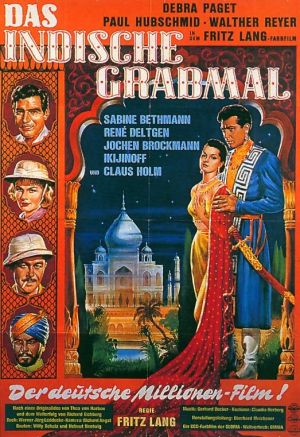
The Tiger of Eschnapur and The Indian Tomb

October 24, 2012


These can perhaps be regarded as typical of German movie poster art of the 1950’s.


It was left to the Italians to show them how to do it right.

By the late 1950’s, Fritz Lang’s Hollywood movie career had come to end. There were no more studio executives left for him to piss off. It was at this time that the German film producer, Artur Brauner, approached Lang and suggested he do a remake of his silent film The Indian Tomb, (which had been completed without Lang’s supervision). Lang agreed, and the resulting work was released as two films: The Tiger of Eschnapu and The Indian Tomb. They were two of the last three films that Lang made before he retired due to failing eyesight.

Lang regarded film as a visual art form rather than as a form of literature, so he had no reservations about using “genre” subject matter: science fiction, detective stories or, in the case of these two films, Orientalist fantasy. In this respect, he is similar to such contemporary directors as George Lucas, Steven Spielberg, and James Cameron. Unlike them, however, Lang’s films are never coy or campy. He always treats his subject matter seriously and with respect. For that reason, I consider Lang’s work to be artistically superior to that of these other directors.

From the moment one begins watching The Tiger of Eschnapur, one can see right away that this is an example of what the late Edward Said called “Orientalism”. More than once some character mentions that Europeans can never really understand India. (It doesn’t help that most of the Indian roles are played by Europeans in brown face.) This “Mysterious Orient” nonsense was, of course, used to justify Western imperialism. (The “clash of civilizations” is a more sophisticated, contemporary version of this argument.) This film is based on a 1918 novel written by Lang’s former wife, Thea von Harbou, who wrote the silly story for Metropolis and who later joined the Nazi party (although, interestingly, she secretly married an Indian man). One can, however, enjoy these films on their own terms without worrying about the politics of it. It is simply a remnant from a defunct way of looking at the world.

Harold Barger (Paul Hubschmid) is a German architect who has been hired by Chandra (Walter Reyer), the maharajah of Eschnapur, to design public buildings for his kingdom. On his way to Chandra’s palace, Harold meets Seetha (Debra Paget), a temple dancer with whom the maharajah has fallen in love. The carry out a secret affair, which Chandra eventually discovers. Chandra throws Harold into a pit with a man-eating tiger, but Harold manages to kill it. (The tiger is obviously fake. Don’t worry, no animals were harmed in the making of this film.) Chandra then tells Harold that he has until sunrise to leave Eschnapur. Harold, however, has an assignation with Seetha in a temple, and the two of them flee into the desert. There, they are overcome by the heat and dust. Harold deliriously shoots at the sun just before he collapses. A message then flashes across the screen promising that we can see the miraculous rescue of the lovers in the sequel, which will be “more grandiose” than the first film.

The Indian Tomb is, indeed, more grandiose. Seetha and Harold are rescued by a caravan. Shortly afterwards, however, they are captured by Chandra’s soldiers. True love eventually wins out, though not without a lot of people getting killed in the process.

These are not among Lang’s best films, but they are nonetheless entertaining movies to watch. Lang directed them in a beautiful manner, although he clearly had to deal with a limited budget. Some of the sets and costumes are not quite convincing. And some of the special effects are embarrassing, such as the fakest looking cobra you will ever see. On the other hand, Debra Paget gives not one, but two, erotic dances. Paget, an American, was, like Lang, a refugee from Hollywood. She had refused to abide by the rules of the studio system, so she was blacklisted. She had to go to Europe to find work. I’m told that in her later years Paget became a born-again Christian, and she had her own religiously themed TV show. I wonder if she ever discussed temple dancing on her show.

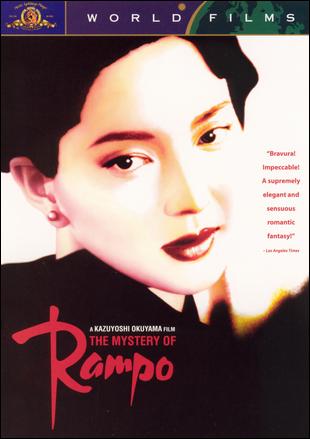
Rampo (The Mystery of Rampo)

October 20, 2012

The Japanese novelist, Edogawa Rampo, is one of my favorite writers, so I was naturally curious when I heard about a 1994 Japanese film that features him as the hero of a fictional story.

The film is set in Japan in the 1920’s. When the film begins, Rampo (Naoto Takenaka) has had one of his novels banned by the government as being too disturbing for the public. In this work, a woman kills her husband by locking him in a trunk and suffocating him. Shortly afterwards, Rampo learns of a recent murder case that resembles the one in his novel. A shop owner has been found dead in a trunk. The police suspect that his wife, Shizuka (Michiko Hada), was the one who locked him in, but they are forced to release her due to lack of evidence. Out of curiosity, Rampo goes to visit her shop. She seems to take an immediate liking to him. She gives Rampo a music box, while refusing to take any payment for it. Rampo becomes obsessed with her, tentatively beginning a romantic relationship with her. When Rampo becomes convinced that Shizuka really did murder her husband, this only deepens his attraction to her.

Inspired by this, Rampo begins writing a new novel. Kogoro Akechi (Masahiro Motoki), Rampo’s detective hero and alter ego, is told to investigate Shizuko (Michiko Hada again), a wealthy widow who is rumored to have murdered her husband. She is now the mistress of the fabulously rich Duke Okawara (Mikijiro Hira), a sometime transvestite who likes to watch bondage films. (Yes, Rampo’s novels are like that.) Akechi manages to insinuate himself into Okagawa’s household, where he becomes romantically involved with Shizuko. At this point, as often happens in a Rampo story, the border between fantasy and reality starts to get blurred.

Rampo (also known as The Mystery of Rampo) is an erotic and strangely moving film. It does a very good job of capturing the dark, brooding flavor of Rampo’s writings. More than a little of the film’s power comes from Michiko Hada’s brilliant performance as Shizuko. She manages to convey an icy strength underneath her character’s seeming vulnerability.

Cottage Grove, Oregon

October 18, 2012


During the six and a half years that I lived in Oregon, I always saw this sign along the I-5 whenever I was driving from Eugene to Cottage Grove. I’ve wondered if anyone ever satisfied this man’s tremendous need for fill dirt.

Due to some unforeseen circumstances, I had to delay my move to Los Angeles for a few days, so I decided to drive to Umpqua National Forest, which I had never been to before. It is a gorgeous wilderness that extends from the Willamette Valley up into the Cascade Mountains. I walked along a hiking trail that went alongside a creek. The forest was extremely dense. There were thick clumps of moss growing all over the tree branches. It was all a bit gloomy, albeit in a beautiful way. I kept thinking this place would make a good setting for an H.P. Lovecraft story.

On my way back home, I decided to swing by the funky little town of Cottage Grove. This place is most famous for the fact that Buster Keaton’s The General was filmed here. (Animal House was also filmed here, although, not surprisingly, nobody feels proud about that.) The town has an annual Buster Keaton Day. It also has a mural of Keaton located on its Main Street.

Keaton is not the only person honored by a mural in Cottage Grove. Another is Opal Whiteley, who is the most famous person to ever come from this town. In the early twentieth century, Whiteley published what she claimed was a diary that she kept as a child growing up in a lumber camp near Cottage Grove. In it, she claims, among other things, that animals could talk to her, and that she sometimes met “little people” in the woods. She also wrote a nature book titled The Fairyland Around Us. The title of this work is meant to be taken literally. It is a curious mixture of scientific facts, poetry, and just plain fruitiness. I’m told that only five copies of the first edition still exist. One of them is at the University of Oregon (which Opal attended for a couple of years, though she didn’t graduate). It is kept in a locked vacuum chamber that is surrounded by armed guards. Although I would like to think that this indicates a firm commitment to preserving Oregon’s literary history, I have, however, a dreadful foreboding that the university will one day sell it in order to pay for more uniforms for the football team. (Okay, I’m kidding about the armed guards. However, I’m not kidding about the uniforms.)


Opal Whiteley prominently featured in a mural honoring Cottage Grove.

I find it a bit ironic that Cottage Grove has chosen to honor Whiteley in this way, considering that Whiteley disdained her Oregon background and upbringing. She devoted a large amount of time and energy to claiming that she was the daughter of a French aristocrat, Henri, Prince of Orléans, and that she had been sent away to be raised in a lumber camp in Oregon. (I guess that this sort of thing happens all the time to the daughters of the French aristocracy.) She spent the last fifty years of her life in a nursing home in London, where the staff referred to her as “the Princess”. She was buried under the name, Françoise Marie de Bourbon-Orléans. One of the reasons for the ongoing fascination with Opal’s life is that it is not clear whether or not she was a fraud. My guess is that she was probably suffering from a mild form of schizophrenia.


Mount David

Located near Main Street is a long narrow hill that Cottage Groveans (I don’t know what else to call them) call Mount David. This is the most striking physical feature of the area, and I assumed they would have made it into a public park. However, I was surprised to learn several years ago that there were plans to build houses on the hill. This struck me as a bad idea, because, among other things, the sides of Mount David are extremely steep and are almost like cliffs in some places. I once climbed this hill, and even though it’s not that tall, it was only with a great deal of effort that I managed to make it to the top. I was sweating profusely when I got there, even though the hill is not especially high. These plans have apparently been abandoned, which may have something to do with the fact that local residents formed a “Friends of Mt. David” society to preserve the hill. (I suspect that the recession may have been another factor.)

Mt.David is interesting in a number of ways. There is a pioneer cemetery at the foot of the hill. There were cougar sightings on the hill last year. And, according to this reputable website, the hill is haunted:

    Said to be a some kind [sic] of spirit that will chase you off of the hill at night time. Around the graveyards there are said to be many apperinces [sic] of the ghostly kind. Beware of the thing that will chase you off the mountain at night time.

When I climbed the hill, I did go back down at sunset, although I am not aware that I was being chased by anyone or anything. Besides, I think I would be more frightened to run into a mountain lion than into a ghost. One thing I did notice as I was walking along the ridge was an almost perfectly circular impression in the ground, about twenty feet across. I have since learned that there used to be an oil well on top of the hill, which perhaps explains that odd formation.


Another fine mural.


Another mural on a similar theme.


There used to be a gun store at this location. This is progress.


If I lived in Cottage Grove, I would definitely go to this place for all my automotive needs.


Public art, or a bench? You decide.


The Bohemia Mining Museum may be closed, but this would-be capitalist is determined to follow that fine old American tradition of trying to get rich quick and failing at it.


This sign is on a building which used to be Cottage Grove’s City Hall, but which now houses a ballet school and some small businesses. I used to see signs like this all over the place when I was growing up. Yes, this actually gave me a twinge of nostalgia for the Cold War. Does that make me a bad person?

The Master

October 1, 2012

Scientology was a logical product of post-World War II America. In a society flush with an extraordinary military victory and enjoying an unprecedented economic prosperity, it seemed inconceivable to anyone that there could be any excuse for not being prosperous and happy. It was not unreasonable then for people to look for the solutions to their problems inside themselves. Psychoanalysis enjoyed its greatest popularity in the U.S. during this period. Scientology, with its roots in pulp fiction (Hubbard was sometimes called the “King of the Pulps”), was a sort of pop culture Freudianism, albeit with religious overtones that were understandable to Americans who had been exposed to evangelical Christianity.

Paul Thomas Anderson’s new film has a character who is obviously modeled after L. Ron Hubbard, although Anderson insists that the film is not actually about Scientology. Fred Qwell (Joaquin Phoezix) is a World War II veteran who suffers from Post-Traumatic Stress Disorder. (In those days, it was called “combat fatigue”.) He is severely alcoholic, and he is unable to hold down a job. One night, hungry and desperate, he stows away aboard a yacht on which a party is taking place. When people on the yacht discover him, they treat him kindly. They take him to the yacht’s “commander”, Lancaster Dodd (Philip Seymour Hoffman). Dodd takes a liking to Qwell, and he begins to treat Qwell as though he were another one of his guests. We learn that Dodd is the leader of a movement known as The Cause. He has developed a form of analysis that he believes can make people achieve happiness and ultimately solve all of mankind’s problems It becomes clear to the viewer that Dodd is suffering from megalomania, but Qwell finds him charming, likable, and impressive. Dodd uses Qwell as a test-subject for his theories. Qwell develops a strong emotional attachment to Dodd, so much so that he sometimes physically assaults people who criticize “The Master”. The film subtly suggests that Dodd, for his part, develops a psychic dependence on the fiercely loyal Qwell.

When I went to see The Master, I was under the impression that it was going to be mainly about Dodd. The advertising seems to indicate that. In fact, it turns out to be essentially about Qwell and his efforts to make sense out of the world. I’m afraid some people may find it disappointing for that reason. However, I found it fascinating to watch and emotionally compelling. Hoffman’s performance is amazing. This is the best American film I have seen so far this year.

Random Thoughts on the Current Troubles

September 15, 2012

The growing inter-connectedness of the world does not always redound to our advantage. Case in point: a cheesy movie made in a strip mall in Monrovia, California, causes riots and the deaths of four people on the other side of the world. We are living in the Global Village, and just as Marshall McLuhan warned, it is filled with “panic terrors, exactly befitting a small world of tribal drums, total interdependence, and superimposed co-existence.” Fear increasingly becomes people’s normal state of existence, because they are increasingly bombarded with ideas and facts that they don’t understand or only partially understand.

Reading the comments on threads on other sites, I am struck by how many people have no desire to try to understand what is happening. We have an amazing informational tool in the form of the Internet, yet some people would prefer to use it for spewing hate and parading their ignorance. Sad.

Nakoula Basseley Nakoula, alias “Sam Bacile” is the auteur responsible for that blood and sand epic, Desert Warrior Innocence of Muslims. Nakoula is a Coptic Christian from Egypt, yet he told the Wall Street Journal that he is an Israeli and that the film was funded by Jewish donors. The kindest thing one cam assume here is that Nakoula wanted to prevent any blame for the film being placed on Egypt’s Coptic community, yet there is something sinister about the fact that Nakoula invented a story about non-existent Jewish donors. One has to question what game Nakoula is really trying to play.

The cast and crew of the film say they were duped, and I believe them. The 14-minuste clip on Youtube is heavily (and badly) dubbed. These people will be haunted by this for the rest of their lives. They were used by Nakoula, Steve Klein, Terry Jones and other right-wing Christians to advance their twisted political agenda.

Mad Russians and the American Left

August 31, 2012


Soon to be a contributor to CounterPunch and Dissident Voice.

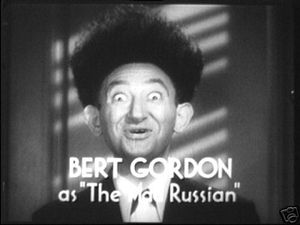
Back in the 1930’s, there was a radio comedian named Bert Gordon, who was billed as the Mad Russian. His tagline was “How do you dooo!”, which you can hear in some Warner Brothers cartoons from that period. Gordon was enormously popular in his time, but, alas, he is largely forgotten today. Yet, the spirit of the Mad Russian lives on at some left-wing websites. At CounterPunch, Israel Shamir has become their resident authority on Russia, the Dreyfus Affair, and conspiracy theories.

Not to be outdone, CP’s rival, Dissident Voice, have their own mad Russian, Andre Fomine. His latest article is entitled Pussy Riot, the CIA, and Cultural Terrorism. In this article, we learn the shocking truth about Pussy Riot:

    No doubt it was not a single spontaneous act by a group of dissolute individuals but an episode of a much wider global campaign to shake and eventually ruin traditional societies and institutions. It is being carried out by the same powerful circles which inspired — e.g. offensive caricatures of Prophet Muhammad in a Danish newspaper in 2005.

Oh, my. From Pussy Riot to Danish cartoons. Who could possibly be behind this fiendish global conspiracy? Need you ask?

    It is an open secret that avant-gardism became popular in the West in 1950-1960s thanks to unprecedented support from the CIA and was used by the United States as a powerful ideological weapon.

The CIA. Why, of course! Aren’t they behind everything?

Fomine ends his article with a dire warning: “The puppeteers of Modern Art and Cultural Terrorism keep carrying out their mission.” [Emphasis in the original.]

Modern Art! Run! Flee! Hide!

In another article, entitled The Last Victory of Muammar Gaddafi, Fomine exposes the sordid truth behind the “Arab Spring”:

    First, there was nothing spontaneous in the wave of 2011 North Africa and Middle East revolutions. The popular unrests in Tunisia, Egypt, Libya, Bahrain, etc were carefully prepared, organized, financed and supported through international media. Quite surprisingly, Al-Jazeera played a critically important role in fueling the conflicts within Arabic societies spreading disinformation and blocking truthful and sober voices.

The media did it! And, as we all know, media = CIA. Fomine, however, ends his article on a cheerful note:

    Thus we are entering very interesting, perhaps decisive times. Muammar Gaddafi has won his last battle despite eluding vigor and insolent pressure from everywhere. Will there be any new Gaddafis born by Muslim mothers to resist the new world order? We hope and pray for that.

More Gaddafis! That’s exactly what we need! The comments on the thread for this article were adulatory. (“Excellent article. I am glad that the author had the courage to write it.” I’m not sure that “courage” is the right word.) When one commenter was churlish enough to point out that Fomine offers no evidence to support his claim about the Arab revolutions, he was promptly smacked down by another commenter who wrote:

    How do you expect the writer can supply you with what you call proof?!
    Do you expect him to hack computers or bulglarise certain offices and displays the documents here for you to see??!! Is that make sense?!
    There is something called commonsense combined with knowledge of history, precedents and good analytical ability!

Yeah, who needs evidence?

As you can imagine, I wanted to learn more about this truly original thinker, Andre Fomine. I found out that he edits a web journal called Oriental Review. There, you can find excerpts from a book by Nikolay Starikov entitled Who Made Hitler Attack Stalin. The latest installment is titled Leon Trotsky, Father of German Nazism. Lest you think that this title is meant as a joke, here is how the article begins:

    Who organized the February and October revolutions in Russia and the November revolution in Germany? The Russian and German revolutions were organized by British intelligence, with the possible support of the United States and France.

That’s right, British intelligence must have engineered the Russian Revolution, since it was a strategic defeat for the British empire. This is common sense. Displaying his extraordinary narrative skill, Starikov tells us:

    Dropped into Russia by British intelligence, thanks to a secret agreement with German secret services aboard the “closed wagon,” the Bolsheviks refused to leave the political scene.

That’s right, the Bolsheviks (all of them) were parachuted into Russia inside a sealed train car. (It must have been awfully uncomfortable, but they were willing to endure anything for the revolution.) Later, we learn:

    The main funding supplied to the Russian Revolution from American bankers was transferred through accounts in neutral Sweden and briefcases of inconspicuous figures stealthily entering the country.

Because there’s nothing bankers love more than a government that’s dedicated to abolishing capitalism.

Just by clinking on certain links on the Dissident Voice website, you can find this treasure trove of occult knowledge.

How do you dooo!

The Campaign

August 21, 2012

In a post earlier this year, I deplored the dearth of good movie comedies in recent years. It seems I spoke too soon, for I’ve seen four good comedies this year: Damsels in Distress, Moonrise Kingdom, Bernie, and now The Campaign. Although broad in its humor, this film is nevertheless a shrewd satire of the corruption and moral hypocrisy that pervade our political system.

Cam Brady (Will Ferrell), a priapic Democratic congressman from North Carolina, is running unopposed for re-election, until he comes into the cross-hairs of the billionaire Motch brothers (Dan Ackroyd and John Lithgow), whose factories in China employ child labor. They want to open up similar factories in Brady’s congressional district. To this end, they persuade Marty Huggins (Zach Galifianakis), the well-intentioned, but not terribly bright, scion of a wealthy family, to run against Brady as a Republican. When Brady humiliates Huggins in their first debate, the Motches decide to bring in Tim Wattley (Dylan McDermott), an unprincipled political operator, to run Huggins’s campaign. Under Wattley’s tutelage, Huggins becomes an increasingly ruthless campaigner. Soon he and Brady are in a tight race.

The Campaign accurately parodies the shallow rhetoric of election campaigns in this country, including pandering to religious prejudice, spouting about “family values”, and making cheap appeals to patriotism. This movie’s cynicism, however, goes overboard sometimes. When, for example, Brady releases a video of himself having sex with Huggins’s wife, Mitzi (Sarah Baker), it causes Brady to pull ahead of Huggins in the polls. Would this happen in real life? Obviously not.

This film has a happy ending that seems tacked on and unconvincing. It seems that that the screenwriters, Chris Henchy and Shawn Harwell, and the director, Jay Roach, wanted to reassure us that “the system works”, despite having just demonstrated that the system does not work. Still, this movie will provide a welcome relief to those who are weary of this interminable and depressing presidential election.

Alphaville

August 14, 2012

Jean Luc Godard’s 1965 film, Alphaville, is a mixture of film noir, science fiction, and surrealist fantasy. At some time in the future, Lemmie Caution (Eddie Constantine) is sent as a secret agent to a city called Alphaville. Although Alphaville is located on another planet, Caution is able to drive there in his Ford Mustang (identified as a “Galaxie” in the film). Caution’s mission is to find a man named Leonard Nosferatu (Howard Vernon) and bring him back to Caution’s home planet. This task turns out to be harder than Caution anticipated, for it turns out that Nosferatu, who has changed his name to Prof. Von Braun, has taken over Alphaville, which he runs using a super computer called Alph 60. Von Braun has outlawed emotions such as love, as well as art and poetry. The government is continually eliminating words from the language, so it has to continually issue new dictionaries without the proscribed words. Von Braun believes that he is making the people of Alphaville into a “superior race”, who will be able to conquer the universe. Caution meets, and falls in love with, Von Braun’s daughter, Natacha (Anna Karina). She ends up risking her life to help him.

Alphaville is Godard’s protest against what he sees as the coldness and cultural vacuity of modern life. It is also an attack on totalitarianism. (These three things are apparently interrelated in Godards’s view.) The talk of a “superior race” is clearly meant to remind us of Hitler. The outlawing of words is meant to remind us of Stalin. (It’s also similar to Orwell’s notion of “newspeak”.) Von Braun is obviously named after Wernher Von Braun, the engineer who designed rockets first for the Nazis and then for the United States. He was seen by many people as the epitome of the amoral technocrat. For Godard, such a person acts an enabler for the political and social forces that are destroying our world.

My one criticism of this film is a lack of continuity in the character of Caution. In some scenes, he behaves like a cold-blooded killer, as well as a bit of a misogynist. Yet in other scenes, he talks about the power of love and of poetry. This inconsistency may due to the fact that the film was largely improvised.

Alphaville is prescient in some ways. Randianism, which calls for a world of self-interest without human connections, is becoming the unofficial philosophy of the U.S. ruling class. Welcome to Alphaville.

Beasts of the Southern Wild

August 7, 2012

Beasts of the Southern World tells the story of Hushpuppy (Quvenzhané Wallis), who lives with her father, Wink (Dwight Henry) in a bayou community called Bathtub on the Gulf Coast. Wink, who has a terminal blood disease, is a stern father who wants Hushpuppy to be able to live on her own after he dies. A hurricane comes, and their home is engulfed by water. They and other residents of Bathtub then live in a house built on high stilts. They eventually succeed in blowing up a levee that is keeping the flood waters from draining away. Emergency personnel then show up and take them to a shelter. They eventually escape and return to Bathtub. Wink’s illness gets worse, and he appears to be dying. Hushpuppy and some friends then swim towards a light over the ocean, which Hushpuppy believes is where her mother is at.

The performances of Quvenzhané Wallis and Dwight Henry are what carry this film. They are so strong and so interesting to watch that you can almost overlook the coyness of the story. Of the various fantasy elements in this film, the one I found most annoying was some business about antarctic ice melting and releasing aurochses that then chase Hushpuppy. (The aurochses are depicted as looking like gigantic wild boars. They were actually the ancestors of modern cattle.) This struck me as nothing more than a destraction from the main story.

In an interview with Film Comment, the director, Benh Zeitlin, explains what he was trying to do with this film:

    When I first came here [Louisiana] a year after the storm, it was a totally surreal place,” says Zeitlin, who credits the phantasmagoric films of Emir Kusturica with inspiring him to become a filmmaker. “It seemed just like Biblical apocalypse, and whether or not that was every individual experience, it was important to me to kind of elevate the story, as I did with Glory, to the level of a myth or a folktale. Look, the politics of any event is always incredibly divisive: ‘It was all Bush’s fault.’ Or: ‘It was the local government.’ Black people. White people. None of which actually gets at the real tragedy or the real emotion of the event. To me, that’s sort of the purpose of myth and folklore, to be able to talk as an entire culture about something. So we have the story of the West, and there’s this cowboy, and we can revise the story of the cowboy depending on how we want to interpret our culture.

I’m not keen on this whole idea of creating “myths”. First of all, it shows a misunderstanding of the function that myths serve in primitive societies. Myths are a way for people to try to understand the world. Beasts of the Southern Wild is amusing to watch, but it doesn’t in any way help us to understand Hurricane Katrina. What’s more, this idea of “myths” seems to me to be a way of avoiding dealing with complex and possibly unpleasant topics. Moreover, I don’t understand Zeitlin’s aversion to the idea of assigning blame for the destruction of New Orleans. His argument smacks of that hippy-dippy-feel-good-kumbaya philosophy that forbids the idea of judging other people, which is the most pernicious legacy of the 1960’s counterculture.

Zeitlin shows talent as a director. I just wish he would drop this “myth” nonsense.