Archive for the ‘Cinema’ Category

Chronicle

May 25, 2012

Chronicle, directed by Josh Trank from a screenplay by Max Landis, gives a clever twist to the superhero formula. Andrew (Dane DeHaan) is a high school student who lives with his abusive father (Michael Kelly) and his terminally ill mother (Bo Peterson). At school, Andrew is bullied by other students. He buys himself a video camera, and begins taping all of his experiences. His cousin, Matt (Alex Russell) takes him to a rave party. Matt gets bored with the party, so he and his friend, Steve (Michael B. Jordan) go wandering in the woods outside, where they find a cave. They persuade Andrew to videotape them exploring it. Inside they find some glowing rocks. Days later, the three find that they can move objects with their minds. Their powers increase over time, until they can fly through the air. Instead of dressing up in costumes and fighting super-villains, however, they play pranks on people. Then they try becoming performers. Things start to unravel, however, when Steve is killed by lightning while flying. Andrew then begins using his powers to get even with the school bullies and then with his father. When Andrew is unable to pay for a prescription that his mother desperately needs, he goes on a crime spree to raise the money. This has tragic results.

The film is done in a “found footage” style similar to that used in The Blair Witch Project and in the Paranormal films. This seems gimmicky at first, but it ends up giving the film a degree of verisimilitude that is unusual for this type of fantasy film. (Though when Matt flies in through Andrew’s bedroom window, it seems a bit too much like something out of the old Superman TV series.)

This film could be interpreted as being about Lord Acton’s dictum that “power corrupts”, but it is actually Andrew’s powerlessness that drives his rage and his growing megalomania. It could be argued that powerlessness actually corrupts as well.

The Raid: Redemption

May 21, 2012

One of the many perks of being a film buff is that you’re always learning something new. (Another one is that you have an excuse to eat a lot of popcorn.) For example, as a result of seeing Gareth Evans’s film, The Raid: Redemption, I now know that Indonesia has its own style of martial arts known as pencak silat. (Bet you didn’t know that, did you?) It’s origins are shrouded in mystery. (I’ve waited many years for an excuse to use the phrase, “shrouded in mystery”.) For centuries, it was handed down as an oral tradition among the tribesmen of Indonesia. According to Wikipedia:

    The earliest evidence of silat being taught in a structured manner comes from the Sumatra-based empire of Srivijaya where folklore tells that it was created by a woman named Rama Sukana who witnessed a fight between a tiger and a large bird. By using the animals’ movements, she was able to fend off a group of drunken men that attacked her. She then taught the techniques to her husband Rama Isruna from whom they were formally passed down.

That Rama Sukana must have been a tough cookie, for pencak silat is one badass way of fighting. It’s so badass, that the characters in this film often prefer to use it instead of simply shooting one another. That is badass.

Jakarta’s biggest crime boss, Tama Riyadi (Ray Sahetapy), has his headquarters in a huge apartment building, in which most of the units are rented out to criminals who work for him. Lieutenant Wahyu (Pierre Gruno) is a corrupt and not too bright police officer who orders a SWAT team to break into the building and capture Tama. This turns out to be not a good idea, since most of the cops are killed within a few minutes. One of the few who are left alive is Rama, played by Iko Uwais, who is considered one of the best pencak silat fighters in Indonesia. He and the other survivors must figure out a way to get out of this death trap.

Although it has the requisite amount of double-crossing, The Raid: Redemption has a fairly simple story. It basically serves as an excuse for almost two hours of fight scenes. If you like martial arts movies, you will thoroghly enjoy this movie. If you don’t care for martial arts movies, not so much. Needless to say, I liked it.

Why I’m Not Keen on Seeing ‘The Dictator’

May 17, 2012

I’ve been debating in my mind whether or not I should go see Sacha Baron Cohen’s new film, The Dictator. Judging from what I’ve seen and heard about it, it doesn’t look very promising. First of all, the main character, Aladeen, is obviously modeled after Muammar Gaddafi: the sunglasses, the gaudy uniforms, the female bodyguards. The movie poster shows him posing on the back of a camel. (Gaddafi might have done this, but I can’t imagine any other Arab leader doing it.) The problem with this is that Gaddafi is dead. It would be just as timely for Baron Cohen to do a parody of Hitler or Stalin. It would be more relevant to make a film parodying the government of Saudi Arabia or Bahrain or the army generals who are trying to reverse the gains of the Egyptian revolution. One can only assume that Baron Cohen decided to make a film about Gaddafi because his notoriously eccentric personal behavior makes him an easy target.

And then there’s the trailer:

It starts with film clips of Barack Obama, Hillary Clinton, and David Cameron. This is apparently meant to make the obvious Gaddafi connection even more obvious. However, it leaves out the fact that these leaders were all cozying up to Gaddafi until the uprising in Benghazi, when they suddenly decided to dump him. Western leaders do not oppose dictators unless they decide it is politically expedient to do so.

The synopsis on Wikipedia doesn’t make it sound any more promising:

    For forty years, the North African Republic of Wadiya has been ruled by Admiral General Aladeen (Sacha Baron Cohen), a lecherous, anti-western and antisemitic despot who surrounds himself with female bodyguards and intends to develop nuclear weapons. After the United Nations Security Council resolves to intervene militarily, Aladeen travels to the UN Headquarters in New York City to address the council. During his stay, he is kidnapped and shaven by a hitman (John C. Reilly) hired by his traitorous uncle Tamir (Ben Kingsley). Tamir intends to replace Aladeen with a political decoy, who he can manipulate into signing a document democratizing Wadiya and opening the country’s oil reserves for business. Aladeen escapes and is discovered by activist Zoey (Anna Farris), who offers him a job at her co-op. Following the advice of his ally Nadal (Jason Mantzoukas), Aladeen accepts the offer, as Zoey’s employees have access to the UN headquarters. Aladeen manages to acquire a new beard taken from a corpse, and infiltrates the headquarters, tearing up Tamir’s document in front of the UN delegation. Upon seeing Zoey in the room, he declares his love for her and vows to democratize his country. Upon returning to Wadiya, he marries Zoey, but is shocked when she crushes a glass and reveals herself to be Jewish.

If Tamir wants to open up the country’s oil reserves, why the hell would he want to democratize it? Instead, he would want all power for himself, so he could cut deals with trans-national oil corporations (as Gaddafi was doing). And how do you “democratize” a country just by signing a document?

Also, I find it interesting that Baron Cohen thinks he has to explain Aladeen’s opposition to Israel by making him an anti-Semite. It apparently doesn’t occur to him that there might be other reasons why an Arab leader would be opposed to Israel. (By the way, Gaddafi was warming up to Israel during the final years of his life.)

I suppose this is what happens when someone who isn’t interested in politics tries to make a political satire.

Now, maybe I would enjoy this film despite its problems. Maybe. But somehow I just can’t get enthusiastic about it. I would sooner see The Avengers again. At least it doesn’t pretend to be about anything other than itself.

The Avengers

May 16, 2012

I must confess to being a sucker for superhero movies. I even enjoyed The Green Lantern, which is considered silly even by the standards of this genre. Maybe it’s because they make me feel like a kid again. Or maybe it’s because they are just fun to watch.

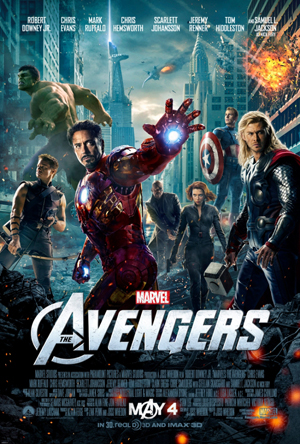
Nick Fury (Samuel L. Jackson) is the head of a super secret and well-funded intelligence agency, SHIELD (Strategic Homeland Intervention, Enforcement and Logistics Division). The agency has a physicist, Erik Selvig (Stellan Skarsgård), who is carrying out experiments on a an object called a tesseract, which is a source of unlimited power. Things are going along swimmingly until Loki (Tim Huddleston), a Norse god with defective social skills, shows up. He steals the tesseract while turning Selvig and Hawkeye (Jeremy Renner) into his mental slaves. Loki has made a deal with a group of beings called the Chitauri (they appear to be robots, although the film is not clear about this). In return for giving them the tesseract, they will make him ruler of the world.

Fury decides to activate “Avengers Initiative”, a gathering of superheroes dedicated to saving Earth from extraterrestrial threats. They are: Iron Man (Robert Downey Jr.), Captain America (Chris Evans), Thor (Chris Hemsworth), and Black Widow (Scarlett Johansson). They also include Bruce Banner (Mark Ruffalo), who, when he gets angry, turns into an enormous green monster called the Hulk. Not surprisingly, he has deeply mixed feelings about this.

There is an element of moral ambiguity in the film. The Avengers see themselves as being on the side of good, but they discover that Fury isn’t what he appears to be, and the people he works for are downright sinister.

Joss Whedon has written and directed a stylish and entertaining movie. My one criticism is that I thought the characters spent too much time arguing with one another. I guess this is meant to make them seem more complex, but it just got confusing and annoying.

Whedon has been a very busy man lately. He also co-wrote and produced the horror film, The Cabin in the Woods, which I also enjoyed a great deal. Whedon seems determined to become some kind of pop culture colossus.

In his curiously sour review of The Avengers, Roger Ebert – who thinks Horrible Bosses is a good movie – makes some snippy comments about the film’s lone superheroine:

    Then there’s Natasha (Scarlett Johansson), aka the Black Widow. After seeing the film, I discussed her with movie critics from Brazil and India, and we were unable to come up with a satisfactory explanation for her superpowers; it seems she is merely a martial artist with good aim with weapons. We decided maybe she and Hawkeye aren’t technically superheroes, but just hang out in the same crowd.

In an early scene in the movie, Black Widow beats up three beefy guys while being tied up in a chair. No mere martial artist can do that. Later, she fights off robotic monsters from Outer Space without even breaking a sweat. I’d like to see Ebert try to do that.

Ebert ends his review with this:

    “Comic-Con nerds will have multiple orgasms,” predicts critic David Edelstein in New York magazine, confirming something I had vaguely suspected about them. If he is correct, it’s time for desperately needed movies to re-educate nerds in the joys of sex. “The Avengers” is done well by Joss Whedon, with style and energy. It provides its fans with exactly what they desire. Whether it is exactly what they deserve is arguable.

Jeez, what a grouch. He can’t even see that Edelstein’s comment was meant jokingly. If anyone needs to be re-educated, it’s Ebert.

The Kid with a Bike

May 12, 2012

Jean-Pierre and Luc Dardenne’s The Kid with a Bike received the Grand Prix, the second highest award at the Cannes Film Festival. It is similar to Truffaut’s The 400 Blows in that it is about a child confronting a cold and brutal world, although its story is less harsh than Truffaut’s masterpiece.

Cyril (Thomas Doret) is a twelve-year-old boy whose father (Jérémie Renier) places him in foster care and then disappears. Cyril can’t believe that his father would leave him. He escapes and goes to his father’s apartment, but he finds it empty. Cyril also learns that his father sold his bicycle. By chance, he meets Samantha (Cécile de France), who is moved when she learns of Cyril’s predicament. She finds the bicycle and buys it, then she returns it to Cyril. He asks her if she will take him in on weekends, and she agrees. Samantha helps Cyril look for his father. They eventually find him working as a cook in a restaurant. He tells Cyril that he never wants to see him again. Cyril is emotionally crushed, but Samantha comforts him.

One day Cyril’s bicycle is stolen by a boy who is a gang member. Cyril pursues him to the gang’s hideout and fights him with him. The gang’s leader, Wes (Egon Di Mateo), is impressed by Cyril’s fierceness. He gives Cyril his bicycle back and makes friends with him. He eventually persuades Cyril to carry out a violent robbery for him. Samantha becomes alarmed when she learns that Cyril is involved with Wes. The night the robbery is supposed to take place, Samantha forbids Cyril from going out. They get into a fight. Cyril cuts her with a knife and runs away. Cyril carries out the robbery, in which he injures two people with a baseball bat. He then goes to the restaurant where his father works and offers him the money he stole. He literally tries to buy his father’s love. His father rejects him once again. Cyril returns to Samantha and asks her forgiveness. She does so. She then takes him to the police, so he can take responsibility for his crime.

The Kid with a Bike is a well-made and moving film about a troubled child. My only criticism of the film is that we never really get a sense of what motivates Samantha. She is unwaveringly devoted to Cyril, even though he only causes problems for her. She seems almost too good to be true. Cyril, on the other hand, comes across as complex and believable. We sense the agony he feels at his father’s coldness.

A City of Sadness

May 8, 2012

Hou Hsiao-hsien’s A City of Sadness, released in 1989, was the first Taiwanese film to deal with the “White Terror” that Chiang-kai-shek’s Kuomintang imposed upon Taiwan. In that sense, it is a politically courageous work, but it also happens to be beautifully made and moving to watch.

This film has a large cast of characters, but it mainly revolves around three brothers: Wen-heung (Sung Young Chen), Wen-leung (Jack Kao), and Wen-ching (Tony Leung Chiu Wai), who live in a port city in northeastern Taiwan. In the film’s opening scene, we hear the radio broadcast of Hirohito announcing Japan’s surrender, ending World War II, while a woman is giving birth. The symbolism of this is obvious: Taiwan, which has long been under Japanese occupation, is being reborn. Hope, however, soon turns to bitterness. The allies, without consulting the Taiwanese, turn the island over to China, which was then under the control of Chiang, who placed the country under the rule of his general, Chen Yi. The latter begins dismissing Taiwanese from government positions and replacing them with mainland Chinese. This, combined with rampant corruption, causes resentment from the people that ultimately explodes into violence.

During the Japanese occupation, the brothers’ father resorted to criminal activity to support his family. After the war, Wen-heung tries to run a legal business. Wen-leung, however, becomes involved with smugglers from Shanghai. Wen-ching, who is deaf, works as a photographer. Although the brothers are non-political, they are eventually drawn into – and ultimately destroyed by – the political convulsions wracking their country. (Trotsky: “One cannot live without politics any more than one can live without air.”)

A City of Sadness has a non-linear narrative that can be hard to follow sometimes. Nevertheless, if you stay with it, this film is deeply rewarding to watch.

Damsels in Distress

May 6, 2012


Greta Gerwig in Damsels in Distress

These are dark times for movie comedy. In the past year, I’ve only seen three good comedies: the Irish film, The Guard, and two British comedies, West is West and The Trip. (I am speaking, of course, of films that are intentionally funny. Melancholia doesn’t count.) I mostly enjoyed Super, but I didn’t like the ending. And I found parts of The Cabin in the Woods funny, but that is primarily a horror film. Needless to say, I won’t go to any piece of crap with Adam Sandler or Will Ferrell in it. (Although I did like Ferrell in the drama, Everything Must Go.)

Into this wasteland comes Whit Stillman’s latest comedy like a gentle spring rain. Damsels in Distress is set in Seven Oaks University, an academically undemanding institution whose student body largely consists of clueless frat boys and suicidally depressed misfits. Three female students take it upon themselves to help their fellow students and to lift the standards of this dreadful place. They are: the moody and philosophical Violet (Greta Gerwig), the sharp-tongued and hyper-critical Rose (Megalyn Echikunwoke) and the idealistic Heather (Carrie MacLemore). They persuade the university to allow them to establish a Suicide Prevention Center, where they lure in chronically depressed students by offering them free doughnuts and then try to cheer them up by teaching them tap-dancing. They recruit a new student, Lily (Analeigh Tipton), to help them.

Violet advocates that women should go out with men who are inferior to them in order to elevate the latter. According to her, a woman should go out with a man “who doesn’t live up to his potential” or who “doesn’t even have much”. Acting upon this idea, these women go through a series of truly atrocious boyfriends, including two dim-witted frat boys, Frank and Thor (Ryan Metcalf and Billy Magnussen), a would-be intellectual with strange religious beliefs, Xavier (Hugo Becker), and a disingenuous operator, Charlie (Adam Brody).

Although much of the humor is dark, Damsels in Distress nonetheless has a sweet goofiness about it. In that sense, it harkens back to classic 1930’s comedies such as Million Dollar Legs and International House.

Damsels in Distress is a delicious treat.

West is West

May 3, 2012

This past weekend they had the Disorient Film Festival here in Eugene. It is dedicated to films by and about Asian-Americans. The best film I saw at the festival, however, is West is West, which is not about Asian-Americans, but British Pakistanis, but it nonetheless deals with similar themes as the other films at the festival, such as problems of cultural identity and tradition, so its inclusion is appropriate.

West is West is a sequel to a British film titled East is East, which I haven’t seen. You do not, however, need to have seen the earlier film to enjoy this one. The film tells the story of George Khan (Om Puri), a Pakistani immigrant, who, with his wife, Ella (Linda Bassett), runs a fish and chips shop in Salford, outside of Manchester. He believes that his son, Sajid (Aqib Khan), has no respect for his Pakistani heritage, so he decides to bring him along on a trip to Pakistan.

There, George is re-united with his first wife, Basheera (Ila Arun), whom he abandoned thirty years ago to go to England. She has never forgiven him for leaving her, which makes the situation awkward for everyone. What’s more, Sajid rebuffs his father’s attempts to teach him about Pakistani culture. Things get really complicated when Ella suddenly shows up.

West is West is a funny, bittersweet comedy about people caught between two cultures. It gets a bit “feel good” in the second half, but not objectionably so.

At the screening I attended, the film’s producer, Leslee Udwin, spoke. She said she had been having trouble finding an American distributor for the film. One company had almost picked it up, but they backed out at the last minute. They told Udwin that they didn’t think Americans would be willing to see a film about Pakistanis, because they see Pakistan as “Enemy Number One”. I find this sad. I think it also shows a condescending view of American audiences. Surely, the success of A Seperation has shown that Americans are interested in seeing films that show Muslims in a sympathetic light.

Two Films about Japanese Artists

April 28, 2012


A scene from Jiro Dreams of Sushi.

Eugene’s Bijou Art Cinemas just hosted the Cinema Pacific Film Festival, which is devoted to films from Asia and from the Pacific Northwest. This annual festival is just one of the many benefits of living in Eugene. (If I seem to be on a civic boosterism kick, it’s because of a recent ESPN article that portrays Eugene as a warren of zonked-out hippies with questionable grooming habits.) I regret that because of previous commitments I was not able to attend all of the films. Based on the ones I did see, however, I was impressed by the selection job that the festival organizers did. I found every film I saw interesting in some way. Two that particularly stood out for me were documentaries about two artists in Japan.

Jiro Ono is Japan’s most famous sushi chef. He runs a sushi bar in a Tokyo subway station. The Michelin guides have given the place a three star rating. People make reservations months ahead of time just to eat there. David Gelb’s film, Jiro Dreams of Sushi examines the life and work of this cook who, at the age of 85, says he will never retire. He dislikes taking days off. He is assisted by his son, Yoshikazu, and by a small, hard-working staff that he trained himself. An apprentice at Jiro’s restaurant has to train for ten years before he is considered a shokunin (chef).

Yoshikazu is destined to take over the restaurant after his father’s death. However, a sushi chef tells us that because of his father’s reputation, Yoshikazu would have to be twice as good just to be considered his equal.

Jiro tells us that he arranges his meals like music. He starts with light, subtle flavors and gradually works his way to heavier ones. Gelb builds upon this idea with a shrewdly constructed musical soundtrack. As we watch Jiro and his assistants, they at times almost seem to be moving in sync with the music.

On a somber note, both Jiro and Yoshikazu report that they have seen both the quality and quantity of fish sold in markets decline over the years. Yoshikazu blames this on over-fishing. He is particularly critical of the way tuna are caught, saying that many of these fish are captured before they are mature.

I thoroughly enjoyed this film. It made me hungry for sushi.

I watched Astro Boy on TV when I was growing up. This show would likely strike contemporary children as crude (it was in black & white, for one thing), but to me it was magical. I remember I was puzzled at how his feet would suddenly disappear and flames would shoot out of his legs when he would fly through the air.

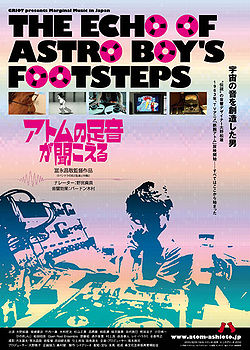
So my curiosity was piqued when I heard that the festival was showing a film titled The Echo of Astro Boy’s Footsteps. This movie is about Matsuo Ohno, who did the sound effects for Astro Boy. Actually, he was the sound designer. He would actually get mad at people if they said that he did sound effects. Instead of trying to imitate noises, he would create whole new sounds. The title refers to the curious sound for Astro Boy’s footsteps, which he created by manipulating recording tape.

Ohno became interested in electronic music in the 1950’s, when he heard a Stockhausen recording. He continues to compose and perform to this day, trying to create what he calls “ethereal music”. A traditionalist, he continues to use reel-to-reel tape players and oscillators, instead of computer programs.

Ohno has a reputation for being irascible and difficult. Yet he devotes a large part of his time to teaching music to mentally disabled persons. He says that we can all learn from such people. However, this film will not dispel the stereotype of artists as eccentric people. A friend of Ohno’s tells us that when the latter was young, he preferred to enter buildings by climbing through windows.

I highly recommend seeing this film.

Two Films about Dance: Pina and Crazy Horse

April 19, 2012


A scene from Pina.

I recently saw two documentaries about two very different approaches to dance. I find it very hard to write about dance, since I don’t know very much about it, though I like to watch it. Last year, I saw a production by the Eugene Ballet of Prokofiev’s Romeo and Juliet. I found it deeply moving, but I don’t know how to explain in words why it affected me so much.

I’ve never been very good at dancing. Many years ago, I was, for a brief time, a theatre major in college. The department head told me that I was required to take a dance class, so I would “know how to use my body”. So I signed up for a ballet course. There were 25 people in the class, and I was the only male, besides the teacher and the piano player. I learned how to plié and stretch. I got to be pretty good at it, or so I thought. One day the teacher made us do this exercise, in which one by one each of us would run across the room and jump in the air. After I finished my turn, the woman behind me started to follow, but the teacher immediately stopped her, saying that she wasn’t moving in time to the music. She protested that she was following my moves.

“Oh, don’t pay any attention to Austin,” he said casually. “He follows his own beat.”

I dropped the class.

The people we meet in Pina clearly had happier experiences with their first dance classes than I did. This documentary by Wim Wenders is about Pina Bausch, who was the choreographer for the Tanztheater Wuppertal. Bausch died while this film was being made, so it is really a memorial to her. The film starts with an amazing performance of The Rite of Spring. Later, we see members of the troupe dancing in the streets of Wuppertal, as well as on the city’s elevated railway, the Schwebebahn. (Now, why can’t they build something like that in LA?) There are also interviews with the dancers, who come from all over the world. They all talk about how Bausch inspired them. They describe a woman who was patient and understanding with them. This is in striking contrast to the popular notion of dancing masters as barking autocrats. (An idea that is vulgarly portrayed in the critically acclaimed potboiler, Black Swan.)

I highly recommend seeing this film.

Crazy Horse, a documentary by the legendary filmmaker, Frederick Wiseman, is about the famous club in Paris that features nude dancing. This place is not like your ordinary strip club, however. The people who work here all take what they do very seriously. They regard their work as art, just like the dancers at the Tanztheater Wuppertal. (The artistic director says that the government should require everyone in France to visit the club.) As with his previous films, Wiseman has no narration. Instead, his camera follows people around as they carry out their business, leaving it to the audience to draw their own conclusions from what they see. Of the various people we meet in this film, the one I found the most affecting was the head costume designer. She agonizes over every detail of the skimpy outfits the dancers wear. Crazy Horse seems to take us into another world, where things like wigs and g-strings acquire enormous importance.

This is another film I highly recommend seeing.