Archive for the ‘Cinema’ Category

The Millenium Trilogy

February 6, 2012

I recently saw all three of the films in the Millenium trilogy, which were released in 2009 in Sweden. These films are based on the bestselling novels by Stieg Larsson, who was a Trotskyist journalist in Sweden. These movies deal with issues of violence against women and of right-wing extremism.

The first film, The Girl with the Dragon Tattoo, directed by Niels Oplev, is the most satisfying of the three, because it has the most tightly constructed story. A rich industrialist hires an investigative reporter named Michael Blomkvist (Michael Nyqvist) to solve the 40-year-old disappearance of his teenage niece. Michael ends up being assisted by a computer hacker, Lisbeth Salander (Noomi Rapace), who has a complicated back story that serves as a springboard for the next two films. The movie gradually builds suspense through the gradual accumulation of detail. It has some genuinely unnerving moments.

The next two films were directed by Daniel Alfredson. In The Girl Who Played with Fire, Michael has become the editor of a magazine called Millenium. He uncovers a human trafficking ring that involves members of the Swedish government. Meanwhile, Lisbeth is implicated in three murders. Michael is convinced that Lisbeth is innocent and that the murders are related to the human trafficking ring.

The Girl Who Kicked the Hornets’ Nest is the least satisfying of the films, even though it ties up loose ends from the first two. Lisbeth stands trial for murder, and Michael is racing against time to prove her innocence. in the middle of the film, a special government police forces suddenly appears like a deus ex machina to save them. Part of the fun of the first two films was watching Michael and Lisbeth battling their way through difficulties by themselves. There is also a subplot about Lisbeth’s deranged half-brother roaming the Swedish countryside killing people, which mostly jsut serves as a distraction from the main story.

I didn’t like some of the graphic violence in the first film, but after seeing the whole series, I have to admit it makes sense in terms of the over-arching themes and plot. I could nitpick about implausible details and lapses of logic, but I enjoyed the movies overall, especially because of their political overtones. Larsson implies that men with right-wing political views are inclined towards misogyny (this has something in common with Corey Robin’s “reactionary mind” thesis.). Think of Nietzsche and Newt Gingrich. The films also examine the corrupting influence of secrecy in government, a topic that has a good deal of relevance to the US.

The Descendents

February 5, 2012

The Descendents, directed and co-written by Antony Payne, has garnered high praise, but I was not all that impressed by it. It is a so-so family comedy/drama that aims for moments of emotional catharsis and falls short each time. Matt King (George Clooney) is a lawyer living in Honolulu. His wife, Elizabeth, is left in a coma after a motorboating accident. A doctor tells Matt that the coma is permanent and that according to Elizabeth’s living will they must take her off life support. Matt is left to take care of his two daughters, Alex (Shailene Woodley) and Scottie (Amara Miller), whom he has largely ignored up until now. Matt learns from Alex that Elizbeth was having an affair during the months before the accident. Matt becomes obsessed wit the idea of finding the man she was sleeping with, Brian Speer (Matthew Lillard). When he learns that Brian is on the island of Kaua’i, Matt goes there, dragging along his daughters and, inexplicably, Alex’s boyfriend, Sid (Nick Krause), who says incredibly stupid things.

This film has a subplot that is slightly more interesting than the story of Matt’s stalking of Brian. Matt and his extended family of cousins are all descendents of a Hawaiian princess who married a white man (hence the film’s title). They have inherited a large tract of land on Kaua’i, which is held in trust. They are negotiating to sell the land to a developer, although some members of the family are opposed to this. Matt initially supports the sale, but he eventually decides against it. He realizes that he wants the land to remain pristine.

This film has some funny moments, but it also has overwrought “dramatic” speeches, many of them addressed to Elizabeth’s comatose body. (There are numerous close-up shots of Elizabeth’s face, the purpose of which is not clear to me.) This film might have worked better as a straight comedy, rather than as a “comedy/drama”.

In between scenes there are numerous shots of the beautiful Hawaiian countryside, with Hawaiian music playing on the soundtrack. Payne apparently thought that he should continually remind us that the story takes place in Hawaii. The effect is as though you were watching a travelogue. I was reminded of those old travel films I watched on Saturday afternoon TV when I was a kid. (And now we come to the enchanted land of Hawaii, with its happy natives…) One thing these shots do is pad out the film: it is almost two hours long. A feeling of exhaustion starts to set in towards the end. I began wishing that Elizabeth would hurry up and die, so the whole thing would finally be over. Does this make me a bad person? I prefer to think I am just a frustrated moviegoer.

A Dangerous Method

January 29, 2012

David Cronenberg’s new film, A Dangerous Method, is about the founders of psychoanalysis. Carl Jung (Michael Fassbender) is asked to treat a young woman suffering from hysteria, Sabina Spielrein (Keira Knightley). Under his treatment, Speilrein starts to improve. She begins studying psychoanalysis. She eventually makes sexual advances on Jung, but he rejects her, partly because he feels it would violate his professional ethics, and partly because of his devotion to his wife, Emma (Sarah Gadon). At about this same time, Jung meets the founder of psychoanalysis, Sigmund Freud (Viggo Mortensen), who makes a strong impression on him. Freud persuades Jung to take as his patient, Otto Gross (Vincent Cassel), who is also a psychoanalyst and who advocates free love. After analyzing Gross, Jung decides to accept Speilrein’s advances. However, when Freud says that he has heard rumors that Jung is having an affair with one of his patients, Jung decides to end his relationship with Speilrein. The latter takes this badly. She eventually announces that she wants to study under Freud. This alarms Jung, who is afraid that Freud will find out about his unethical behavior.

The characters all come across as deeply flawed, and the film does not take sides. Overall, however, Jung seems more sympathetic than Freud. The latter comes across as rigid, narrow-minded, and domineering. In one scene he reveals his hand by saying that he wouldn’t discuss one of his dreams with Jung because he didn’t want to compromise his “authority”. There is also a complacency about Freud’s world-view. He tells Speilrein that “the world is what it is”, and that pyschoanalysts shouldn’t try to change it. Yet one cal also see why Freud eventually became disenchanted with Jung; the latter was fascinated with irrational ideas, such as a belief in telepathy. The revelation of his affair with Spielrein becomes the last straw.

One point this film makes is how psychoanalysis was rooted in nineteenth-century romanticism. Jung and Spielrein both admire the music of Richard Wagner. Spielrein finds inspiration in the story of Siegfried, which influences her ideas about psychology. (Themes from Wagner’s music are subtly interwoven into the soundtrack.)

The acting in A Dangerous Method is very good. I especially liked Mortensen’s performance as Freud. He subtly conveys the character’s arrogance and authoritarianism, without turning him into a caricature.

At the end of this film, we are told that Spielrein, who was Jewish, was murdered by the Nazis during World War II. This is a disturbing reminder that our lives are ultimately shaped by political and economic forces that psychoanalysis can do nothing to address.

Shame

January 22, 2012

Steve McQueen’s film, Shame, deals with the topic of sex addiction. I must admit I’ve always been skeptical about whether such a condition actually exists. However, I suppose if a person can become addicted to gambling, then it’s possible for someone to be addicted to sex.

Brandon (Michael Fassbender) is an executive at a company in New York. He engages in casual sex with prostitutes and women he meets in bars. He downloads pornography from the Internet. He even masturbates in the john at work. He seems incapable of having sex unless it’s impersonal. When, for example, he begins seeing a woman who works in his office, Marianne (Nicole Beharie), he ends up rejecting her.

Brandon’s life gets complicated when his emotionally unstable sister, Sissy (Carey Mulligan), suddenly moves into his apartment with him. The film implies that they had a traumatic experience in their childhoods, although we are never told what it was. When Sissy has sex with Brandon’s boss, David (James Badge Dale), Brandon becomes angry with her. Brandon seems to have a madonna/whore complex, which is no doubt related to his obsessive attitude towards sex and to his inability to have a relationship.

Fassbender gives a powerful performance. With his looks and gestures, he’s able to suggest complicated thoughts and emotions going on inside his character’s head. Shame contains graphic sex scenes; McQueen apparently wanted to make clear the joylessness of Brandon’s approach to sex. This film’s ending does not offer any redemption for Brandon. He seems trapped in his behavior. This is an interesting, if somewhat bleak, character study.

Revenge of the Electric Car

January 12, 2012

This is an incredibly shallow film. It spends ninety minutes talking about how wonderful electric cars supposedly are, yet it says almost nothing about how electricity is generated. Fifty-seven percent of the electricity generated in the United States comes from the burning of coal. So it is simply false to claim that electric cars do not pollute, as some of the people in this film do. Of all the “experts” interviewed in this film, only one, Thomas Friedman, even touches upon the issue of power generation. He glibly assures us that as the power grid becomes “cleaner”, so will electric cars. (Friedman is the only person in this film who acknowledges that electric cars are not “clean”.) Considering that the government is touting the fraudulent notion of “clean coal”, I cannot share Friedman’s complacent optimism.

There is a quick discussion of solar power at the end of this film, but, if you blink, you will miss it.

The development of electric cars needs to be done alongside developing renewable energy sources to the exclusion of all other types of sources. This is the only rational policy, but our for-profit system will not allow this to happen.

House of Pleasures

January 9, 2012

Bertrand Bonello’s film, L’Apollonide: Souvenirs de la maison close, has been showing at my local art house movie theatre under the title, House of Pleasures. (It has also been released under the title, House of Tolerance). It depicts the lives of women living and working in a brothel in Paris at the beginning of the twentieth century. Their lives are hard. One woman, Madeleine (Alice Barnole), has her face slashed by a client and is permanently disfigured. Another, Julie (Jasmine Trinca) contracts syphilis and eventually dies. Clotilde (Céline Sallette) becomes an opium addict. The fate of the other women is uncertain, since the madame (Noemie Lvovsky) cannot afford to pay the increased rent demanded by the landlord.

Despite its grimness, this film is not strictly realistic, for there are fantasy sequences. In some scenes, for example, there is late twentieth century pop music, such as the Moody Blues’ Nights in White Satin, playing on the soundtrack. In one scene, we see semen coming out of Madeleine’s eyes. This struck me as completely gratuitous.

House of Pleasures is two hours long, but it seems much longer than that. What’s really frustrating about this movie, though, is that one senses that buried somewhere in this sprawling, confused, and sometimes repulsive mess is what could have been a good film. When they’re not dancing to anachronistic pop music, the characters sometimes come across as complex and interesting. House of Pleasures does show a sense of class consciousness in that the women all come from factory worker or peasant backgrounds, whereas their clients all come from wealthy families. Unfortunately, Bonello’s self-conscious artiness and heavy-handed efforts to shock the audience ultimately rid this work of any emotional power. It simply leaves you feeling numb.

Martha Marcy May Marlene

January 7, 2012

Sean Durkin’s first feature-length film, Martha Marcy May Marlene, is billed as a “psychological thriller”, which is misleading, for the film is actually a character study. There is suspense in the story, but it is never resolved.

The film begins with Martha (Elizabeth Olsen) running away from a Manson-like “cult” she has belonged to for the past two years. She moves in with her sister, Lucy (Sarah Paulson), and Lucy’s husband, Ted (Hugh Dancy). The rest of the film interweaves scenes of Martha living with Lucy and Ted, and Martha’s life in the “family”. In the latter, she lives with a group of men and women who live on a farm in the Catskill mountains. The leader of the group is Patrick (John Hawkes), who spouts psycho-babble and plays mind games with the others. Female newcomers to the group are drugged and then raped by Patrick. One of the disturbing things about the film is how the group’s “family” feel masks a brutal male supremacy, and how Martha and the other women find ways to accept this.

To support themselves, members of the “family” sometimes break into peoples’ houses and steal from them. During one break-in, they kill the owner. This incident is apparently what causes Martha to leave, although the film is a little bit vague on this point.

Lucy and Ted are mostly kind to Martha, although they come across as emotionally cold. (It is implied that Martha joined the cult to get away from her family’s coldness.) It doesn’t help that Martha is unable to bring herself to talk about her experiences. She also begins to suffer from a fear that the “family” is pursuing her. Her behavior increasingly causes friction between her and Lucy and Ted, and it also creates strains in the latter’s marriage.

This film is well-made, and it has some powerful moments, but overall I found it claustrophobic and frustrating to watch. Because Martha never opens up to her sister about what happened to her in the “family”, they never interact in a way that is dramatically interesting. Durkin has said in interviews that he wanted to make the point that people who go through experiences with “cults” often have difficulty talking about them immediately afterwards. (Some psychologists and sociologists consider the term “cult” to be problematic. Durkin’s casual use of this word strikes me as a bit glib.) For all I know, this is true, but it’s a small point to make in a feature-length film. The story would have been more interesting if it took place over a longer period of time, and if it showed Martha finding some way to come to terms with her traumatic experiences.

I hope that in his next film Durkin is able to tell a more dramatically satisfying story.

Melancholia

December 25, 2011

I have never been a huge admirer of Lars von Trier. His films have always struck me as being both portentous and pretentious. (Two of my least favorite words beginning with the letter “p”.) He is a sort of bargain basement Ingmar Bergmann. I wasn’t sure whether I wanted to see his latest film, until some of my friends told me they found it depressing, and others said they found it hilarious. This piqued my curiosity, so I went to see it. I did not find it depressing, but I did not quite find it hilarious.

At the beginning of this film, the prelude to Wagner’s Tristan und Isolde is played in its entirety. (Bits and pieces of this music will be played now and then during the rest of the film.) We see dreamlike scenes that foreshadow events in the film’s story.

Part One of this film is titled “Justine”. Justine (Kirsten Dunst) suffers from depression, but she nevertheless has just married Michael (Alexander Skarsgård). They arrive late at the reception held at the home of Justine’s sister, Claire (Charlotte Gainsbourg), and brother-in-law, John (Kiefer Sutherland), who are evidently filthy rich, because they live in an enormous mansion with stables and an eighteen-hole golf course. (The film was shot at Tjolöholm Castle in Sweden.) We’re told that John is a “scientist”. We meet Justine’s father (John Hurt) and mother (Charlotte Rampling). After meeting all of her family, one can see why Justine is depressed, since it would be hard to imagine a more unlikeable group of people, although Justine is no better herself. During the reception, Justine has an attack of depression, with disastrous results. By the time dawn arrives, she has had sex with her boss’s nephew, she has been fired by her boss, and Michael has left her. Although she has gotten hardly any sleep, in the morning she goes horseback riding with her sister through a foggy landscape with Tristan und Isolde playing in the background.

Part Two is titled “Claire”. Some time after the wedding reception, Justine has a mental breakdown, so she goes to live with Claire and John. Justine mopes around and cries a lot. The plot thickens when a rogue planet emerges from behind the sun and heads towards Earth. John, who reminds everyone that he is a scientist, cheerfully asserts that this planet will miss Earth, even though it has the ominous name of “Melancholia”. Claire worries that this might be the end of the world, but Justine seems to welcome this possibility. “The Earth is evil,” she says. “No one will miss it.” Justine and Claire then have a debate over whether there is life in the universe besides that on Earth. (I’m not making this up.) The ever-cheerful Justine takes the “No” position. On the night when Melancholia passes closest to Earth, Justine, John, Claire, and Claire’s son, Leo, sit in their vast (and I mean vast) front yard to watch it. When Claire experiences shortness of breath, John assures her that this is only because Melancholia’s gravity has ripped away part of Earth’s atmosphere, and it will soon pass. (Yeah, this doesn’t make sense to me either.) Before the night is over, it becomes clear that Melancholia is receding from Earth.

Ah, but you can’t have a happy ending in Trierland. The next morning, John looks through his telescope and discovers that Melancholia has reversed course and is now heading towards Earth. (I’m not a physicist, but it seems to me that this would be impossible.) John then goes to the stable and kills himself. Claire finds his body and covers it with hay. She then fixes breakfast for Justine and Leo. Oh, why the hell talk about these people any more? All you really need to know about this film is that it ends with the world being destroyed. We see Justine, Claire and Leo sitting on a hillside, with Melancholia looming in the background. You guessed it, Tristan und Isolde is playing on the soundtrack. Just before Melancholia smashes into the Earth, the volume of the music increases to an almost earsplitting level. You have to actually experience this scene to know what I’m talking about, but this is unintentionally funny. (I think it safe to assume that Trier didn’t mean this to be funny.)

If Trier wanted to make a film about the end of the world, why does he subject us to two hours of unappealing characters saying things like “The Earth is evil”? To try to answer this question, I turned to the ever-helpful Wikipedia. According to the article, “A therapist had told Trier that depressive people tend to act more calmly than others under heavy pressure, because they already expect bad things to happen.” Justine is indeed more calm than the other characters, but since all life on Earth is wiped out, it doesn’t make any difference.

It’s too bad that Mystery Science Theatre 3000 isn’t on TV any more. This would be a perfect film for that show.

Margin Call

December 17, 2011

Years ago I applied for a job as a financial advisor. The interviews went great. I seemed to be a shoo-in for the job. The hiring manager, however, told me that every applicant was required to take a personality test. He assured me that this was just a formality. I took the test, and several days later I received a phone call from the manager. I could tell from the tone of his voice that it was not good news. He said that they could not give me the position, because, according to the test results, I was “too nurturing”. I swear, I’m not making this up.

Today I have a job working in a warehouse. The company that told me that I was “too nurturing” was generously bailed out by the government following the 2008 financial crisis. No doubt they have given bonuses to their unnurturing employees.

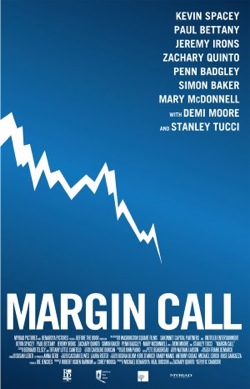
I was reminded of all this when I went to see Margin Call, written and directed by T.C. Chandor, a loosely fictionalized account of the collapse of Lehmann Brothers, which triggered the global economic meltdown in 2008. Eric Dale (Stanley Tucci) is laid off from his job at a financial firm. As he is being escorted from the building, he hands, as an afterthought, a thumb drive containing a program he has been working on to Peter Sullivan (Zachary Quinto), warning him to “be careful”. Puzzled by this enigmatic comment, Sullivan begins crunching numbers with the program, and late in the evening he discovers that the company is in immediate danger of becoming insolvent. Right away, he calls his fellow employee, Seth Bregman (Penn Badgley), and senior salesman, Will Emerson (Paul Bettany), who then tells the head of sales, Sam Rogers (Kevin Spacey), about this. By the early morning, a meeting has been convened with the top members of the company, including the head of risk, Sarah Robertson (Demi Moore), the head of securities, Jared Cohen (Simon Baker), and the CEO, John Tuld (Jeremy Irons). Tuld decides that the best thing they can do is sell off all of the company’s assets during the next trading day, even though this could cause a financial panic and put them out of business.

This film features fine ensemble acting. I especially liked Irons’s performance. He oozes smug complacency as he makes a decision that will ruin many people’s lives. Spacey is, as always, completely on the mark.

Margin Call quietly points out the insanity of an economic system in which bad decisions by one company can cause a global crisis. It also points out how non-productive and personally corrupting the financial system is. Rogers, for example, is strongly opposed to what the company is doing, but he ends up going along with it, because, as he explains, “I need the money”. The need for money guides the actions of all the characters in varying ways, while one gets the uncomfortable feeling that there is something lacking in their lives. In one scene, Tuld tries to console Rogers by telling him that he could have spent his life digging ditches. “If I had spent my life digging ditches, I would at least have holes in the ground to show for it,” Rogers says. This is one of the best lines I have ever heard in a movie. In another scene, Dale, a former engineer, reminisces about how he once designed a bridge. He inwardly yearns for a time when he made a positive contribution to other people’s lives. (Uh, would it be cynical to say that he wants to be “nurturing”?)

Margin Call is one of the best films of the year.

Into the Abyss

December 16, 2011

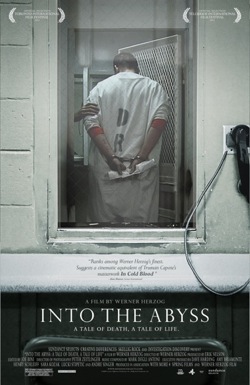
Werner Herzog’s latest documentary is an examination of murder and capital punishment. Although Herzog makes no secret of the fact that he is opposed to the death penalty, he resists the temptation to editorialize in this film, instead telling the story through interviews and leaving it to the audience to draw their own conclusions. The result is a deeply moving and deeply disturbing work.

The film revolves around Michael Perry and Jason Burkett, who were accused of murdering three people. Perry was given the death penalty and Burkett was given a life sentence. As teenagers, Perry and Burkett decided they wanted to steal a red Camaro that belonged to Sandra Stotler, who was the mother of a friend of theirs, Adam Stotler. On October 24, 2001, they went to her house in a gated community near Conroe, Texas. They killed her and then dumped her body in a nearby lake. When they went back to get the Camaro, they found that the gate was closed. They waited around, hoping that someone might let them in. As luck would have it, Adam Stotler and his friend, Jeremy Richardson both showed up. Perry and Burkett told them that a friend of theirs had been injured in a hunting accident and they needed help. They led Stotler and Richardson to a wooded area and then shot them. They took the clicker from Stotler so they could open the gate. They also took the Isuzu Rodeo that Stotler had been driving, as well as Stotler’s wallet. They then went to the house and took the Camaro. (You can find a more detailed account of these events here.)

It was a stupid crime that was carried out in a stupid manner. Within a few day, both Perry and Burkett were arrested. There is no doubt about their guilt. Immediately after his arrest, Perry confessed to the murders and told where the bodies of Stotler and Richardson were. (Perry later claimed that the police coerced his confession. This is quite possibly true, but it begs the question of how he knew where the bodies were.) There were dozens of witnesses who saw Perry and Burkett with the stolen vehicles. Some said they heard them talk about the killings.

A large portion of this film is devoted to interviews with people who knew Perry and Burkett. Herzog takes us into a world where crime and punishment are everyday facts of life. While Burkett was growing up, his father was in and out of prison. The elder Burkett is currently serving a 40-year prison sentence for multiple felonies. One of Burkett’s friends tells us that he learned how to read while in prison. Jeremy Richardson’s older brother served time in prison. While he was attending Jeremy’s funeral, the police arrested him for violating his parole.

There are extensive interviews with both Perry and Burkett. They seem like human opposites. Perry smiles a lot and tells us that he will go to Heaven. (Herzog interviewed him eight days before his execution.) Burkett is poker-faced, and he only discusses things relating to his case. It’s hard to imagine these two plotting a murder together. Neither one of them discusses the killings, no doubt because they were both appealing their convictions. I suppose this shouldn’t be surprising, but it is nonetheless disappointing. The essential mystery of this story – why two seemingly sane persons would commit such terrible acts – remains unknowable.

In one scene, Herzog visits a yard where the red Camaro sits slowly rusting in the open air. “Three people died for this car,” a police detective observes. The sense of waste is palpable.

There are extensive interviews with relatives of the murder victims. Their grief is heartrending. There is also an interview with Burkett’s father, who turns out to be an interesting and articulate person. He blames himself for what his son did, and he expresses his sorrow for the victims’ families. He talks about how at one time he and his son were hand-cuffed together on a prison bus. He tells us that this moment made him feel like a “failure”. There is also an interview with a woman who married Burkett after he was convicted and who claims that she is pregnant with his child. In all honesty, I have no idea what to make of this person. And there is an interview with a man who supervised over 125 executions in Texas. After the execution of Karla Faye Tucker in 1998, he began seeing the faces of all the people whose deaths he presided over. He resigned from his job, even though it cost him his pension. “No one has a right to take another person’s life,” he tells us.

This film makes it clear that the execution of Perry accomplished nothing. It also shows the unfairness of our criminal justice system: Burkett didn’t get the death penalty, even though he was just as guilty as Perry, if not more so. At Burkett’s trial, his father gave an emotional speech asking the jury for leniency, which resulted in Burkett getting a life sentence. Perry had no one to speak for him, so he was killed.