Archive for the ‘Cinema’ Category

Paul Goodman Changed My Life

December 12, 2011

One rarely hears Paul Goodman’s name any more. You have to be of a certain age to have likely heard of him. Back in the 1960’s, he was, with the possible exception of Marshall McLuhan, the most famous intellectual in the United States. (The only comparable present-day figure is Noam Chomsky.) His Growing Up Absurd was a national bestseller. The book is a merciless critique of social institutions, exposing their inadequacy and arguing that people were becoming increasingly alienated from them. It helped inspire the counterculture movement of the 1960’s. It has long been out of print, but it is soon to be released on Kindle.

Goodman was a sort of thinker that we never see nowadays. He wrote on politics, sociology, psychology and urban design. He also wrote novels, short stories, poetry and plays. Jonathan Lee’s documentary tries to do justice to all these aspects of Goodman’s prolific writings, with uneven results.

Goodman came of age during the Great Depression of the 1930’s. He became an anarchist after reading Kropotkin, and this remained his basic philosophy for the rest of his life. He was a pacifist during World War II, a difficult time in which to be a pacifist. I would have liked it if the film had discussed this chapter in his life in more detail, but instead it moves on to Gestalt therapy, which Goodman developed with Fritz and Laura Perls. To give us some idea of what this is about, Lee shows us a clip from a film of Fritz Perls conducting a session. He invites a woman into his office and tells her to sit down. She lights a cigarette, smiles nervously, and tells him she feels “scared”. Perls tells her that because she smiled when she said she was “scared”, she was a “phony”. Not surprisingly, the woman takes offense at this. They go back and forth about this for a while, then Perls says, “So, now we are getting somewhere”. In all honesty, I couldn’t see the point of all this.

Fortunately, Goodman devoted his attention to other matters as well. Goodman had very strong views on education. He advocated creating small schools with no more than 25 or 30 students in each. (There is some logic in this idea. Any teacher will tell you that students tend to do better in small classes, because they receive more personal attention.) Goodman became an outspoken and eloquent opponent of the Vietnam War and of the nuclear arms race. He frequently spoke at college campuses during the sixties. However, Goodman’s traditional anarchism eventually brought him into conflict with the New Left of that period. He abhorred the ultra-leftism of the S.D.S., and he disapproved of the drug culture. By the time of his death in 1972, his influence on the left had begun to dwindle.

A large chunk of this film is devoted to Goodman’s sex life. There is reason for this, since Goodman was openly bisexual at a time when gays were often subject to legal harassment. However, this film told me more about this topic than I really wanted to know. Goodman was married and had three children, yet he spent a good deal of time having brief, meaningless affairs with men he met in bars, at the beach, and on airplanes. Just as you would expect, this behavior sometimes created strains between Goodman and his family. This is interesting – up to a point. I would have liked to learn more about Goodman’s anarchist and pacifist ideas, as well as about his troubled relationship with the New Left. Lee clearly wants to get people to read Goodman’s writings, but I don’t see how dwelling on the sordid details of his personal life is supposed to do this.

Hugo

December 8, 2011

Hugo is a film by Martin Scorcese, based on the novel, The Invention of Hugo Cabret by Brian Selznick. Set in Paris during the 1920’s, it tells the story of Hugo (Asa Butterfield), who inhabits the Montparnasse train station in a manner similar to the way the Phantom inhabits the Paris Opera House. He keeps the clocks in the station running, a job that his missing uncle is supposed to be doing. He supports himself by stealing food and other goods from stores and cafes in the station. His life is made precarious by the presence of a Dickensian villain, Inspector Gustave (Sacha Baron Cohen), who want to put him in an orphanage. (Personal disclosure: as a film goer, I have a low tolerance level for Dickensian villains.) Hugo is caught stealing by Georges (Ben Kingsley), a toymaker who has a shop in the station. Georges makes Hugo work for him to make up for what he has stolen. Hugo meets Georges’s goddaughter, Isabella (Chloë Grace Moretz), and the two of them become friends. Through an elaborate series of events, Hugo and Isabella learn that Georges is actually Georges Méliès, the pioneering filmmaker whose works are now largely forgotten. Hugo and Isabella become determined to restore Georges’s reputation as an artist.

This film is a fond tribute to Méliès, one of the first film directors, who began making movies in the 1890’s. Towards the end, there is a montage of scenes from Méliès’s films. Even in this jaded age of CGI effects, they are fascinating to watch. Méliès had a visual imagination that makes most modern directors seem anemic. He was also a great technical innovator. (Among other things, Méliès made the first color films. Each frame was tinted by hand.) He made 500 films, most of which have, alas, been lost. I hope that this film will encourage a new generation to discover his work.

The film’s central conceit, that Méliès doesn’t want to be reminded of his past, is a bit thin and hard to believe. The main problem with this movie, however, is that at 126 minutes, it is too long. During the first half, the story unfolds with agonizing slowness, although the tempo does pick up during the second half. Also, the film is padded out with chase scenes that don’t advance the story, as well as numerous unfunny “funny” scenes featuring Inspector Gustave. (I know I’m not the only person who felt this way. The audience was mostly quiet during these scenes.) This character is played charmlessly by Baron Cohen, who at times seems to be doing an unsuccessful imitation of Peter Sellers as Inspector Clouseau.

I would have liked this film better if there had been more scenes from Méliès’s films, and fewer scenes of Baron Cohen trying to be funny.

Here is Melies’s A Trip to the Moon. (Unfortunately, the tinting is washed out in this version.)

The Way

December 5, 2011

The Way is a film starring Martin Sheen, written and directed by his son, Emilio Estevez. Thomas Avery (Sheen) learns that his son, Daniel (Estevez), has died in France. He goes to retrieve his son’s remains. There, he learns that Daniel died in a freak storm while trying to cross the Pyrenees as part of the Camino de Santiago, a centuries-old pilgrimage route through northern Spain. It ends at the Cathedral of Santiago de Compostela, which purportedly contains the remains of St. James. While examining his son’s backpack, Thomas is suddenly seized with the idea of walking the route himself while carrying his son’s ashes. He embarks on the journey. Right away he meets a group of eccentric characters: a Dutch gourmand, Joost (Yorick van Wageningen), an angry Canadian who smokes a lot named Sarah (Deborah Kara Unger), and an annoying Irish writer named Jack (James Nesbitt). The film alternates between scenes of the characters engaging in not quite convincing dialogue and scenes of them walking through the Basque and Spanish countryside with obtrusive pop music blaring away on the soundtrack. (I thought the purpose of going on a pilgrimage was to get away from this sort of thing. I guess not.)

Just as you expect, the characters evolve over time. Thomas becomes less of a dick, Joost becomes less of a hedonist, Sarah becomes less angry and Jack becomes less annoying. Yes, this film will uncomfortably remind you of The Wizard of Oz (which is intentional, by the way), except that in this case the man behind the curtain is never revealed. When the group arrive at the Cathedral of Santiago de Compostela, Thomas kneels in front of a silver casket that may or may not contain the remains of St. James. He and the others then look on in awe as a large, porous metal container full of incense is swung back and forth. The significance of this is never explained. Indeed, the significance of the Camino de Santiago is never really explained, except that it is good exercise for people who can afford expensive backpacks, as well as a plane ticket to France.

This film does touch upon issues such as Basque nationalism and prejudice against the Roma. And it does contain breathtaking shots of the Basque and Spanish countryside. All in all, though, I found this movie less interesting than one of those travel documentaries on PBS.

The Hedgehog

December 1, 2011

The Hedgehog is a film by Mona Achache, based upon the novel, The Elegance of the Hedgehog, by Muriel Barbery. Paloma (Garance Le Guillermic) is a precocious 11-year-old girl who lives with her wealthy parents in an apartment building in Paris. She believes that the people around her are shallow and stupid, so she decides to kill herself on her twelfth birthday, which is coming up in a month. A new neighbor, Mr. Ozu (Togo Igawa), a rich, retired Japanese businessman, moves in. Paloma meets him on the elevator. He is impressed to learn that she knows some Japanese. He begins inviting her to his apartment, and they become friends. (Paloma’s parents don’t seem concerned about a stranger showing such an intense interest in their daughter.) When the concierge, Mrs. Michel (Josiane Balasko), quotes Tolstoy to him, Ozu is immediately taken with her. He begins inviting her out to dinner and buying clothes for her. Paloma also gets to know Michel. She discovers that Michel has a room full of books, and she spends much of her time reading. She keeps her literary interests hidden from other people. (Michel is the “hedgehog” of the film’s title.) Paloma decides not to kill herself. When Michel is struck and killed by a van, Paloma and Ozu console each other.

The main problem with this film is that Paloma never really develops as a character. The only thing that has really changed at the end of the film is that she now knows an adult, Ozu, who is capable of amusing her. In all honesty, she struck me as cold and selfish. True, she does care about Michel, but the film makes it clear that she admires the latter for being withdrawn and secretive. As for Michel, she does begin to open up and become less misanthropic when she starts seeing Ozu, but since she is suddenly killed, this doesn’t lead to anything. Ozu is too perfect to be believable. He is clearly a Westerner’s idealized notion of a wise, old Oriental man. We are never told how Ozu made his fortune, no doubt because the filmmakers didn’t want to soil him with any mundane or unsavory details. (We are apparently not supposed to see anything incongruous about an admirer of Tolstoy having a musical toilet installed in his apartment.) The film does show some class awareness, in that the building’s rich residents largely ignore Michel. (The owner of the building fails to recognize Michel after the latter has had her hair done.) However, this is undermined by the presence of the inexplicable Ozu.

The Hedgehog is a “feel good” movie that doesn’t really make you feel good.

Take Shelter

November 30, 2011

Take Shelter, written and directed by Jeff Nichols, is a powerful and disturbing film about a man struggling to keep his sanity. Curtis (Michael Shannon) works for a sand mining company in Ohio. He and his wife, Samantha (Jessica Chastain), struggle to make ends meet, while raising their daughter, Hannah (Tova Stewart), who is deaf. Samantha has to struggle to get their insurance provider to pay for Hannah’s treatment. (Sound familiar?) Curtis begins having vivid and disturbing dreams about storms. In some of them, he and Hannah are physically attacked. Curtis begins to believe that the dreams are a sign that a terrible storm is coming. He becomes obsessed with the idea of expanding a storm shelter in his backyard. He takes out a risky loan to pay for it, even though he and Samantha already owe a lot of money. He “borrows” equipment from his workplace to carry this out, which results in his being fired. This strains his marriage almost to the breaking point. Curtis begins to question his own sanity. His mother suffers from paranoid schizophrenia, so Curtis begins to wonder if he is beginning to develop this illness himself. However, the growing hostility of his neighbors, who believe he is crazy, merely cause him to convince himself that his fears are correct. When a storm hits the town, Curtis believes that his dreams are coming true. He and his family rush into the storm shelter. After a good deal of time has passed, Samanth tells Curtis the storm has passed, but Curtis refuses to believe it. It is with a great deal of difficulty that she persuades him to open the shelter door.

Nichols is very good at creating a sense of foreboding. He has a remarkable ability to give the impression that a lot more is going on than what we see on the screen. In one of the dream scenes, for example, we basically see Samantha standing next to a kitchen counter with a knife on it. Somehow this scene conveys such a feeling of menace that it creeped me out. (I swear, I still get goosebumps when I think about it.) Shannon and Chastain give excellent performances. Shannon makes his character’s extreme behavior completely believable.

My criticism of this film is that it goes on too long. It should end right after Curtis and his family emerge from the shelter. Instead, it goes on to a “trick” ending that I found unconvincing and a bit too cute. Also, the family’s financial concerns, which are enormous, inexplicably seem to disappear towards the end.

Still, I highly recommend seeing Take Shelter.

The Skin I Live In

November 24, 2011

The Skin I Live In was written and directed by Pedro Almodóvar, based upon the novel, Tarantula by Thierry Jonquet. Robert (Antonio Banderas) is a plastic surgeon who is haunted by the death of his wife, Gal, who committed suicide after being severely burned in a car accident. Robert is determined to develop a new type of skin that cannot burn. He carries out his experiments on Vera (Elena Anaya), a woman he holds captive in his mansion. The only other person who knows about this is Robert’s servant, Marilla (Marisa Paredes). Robert succeeds in giving Vera burn-proof skin, but then he realizes that he can’t tell anyone without revealing his criminal methods. (Apparently, he never thought of this before.) At this point, Vera starts making sexual advances towards Robert, but he resists her. One day, while Robert is out, his criminally inclined half-brother, Zeca (Roberto Álamo), shows up, finds Vera and tries to rape her. Robert arrives home at this point and kills Zeca. (Robert doesn’t know that Zeca is his half-brother. This gets really complicated. I will try to stick to the bare essential details.) Afterwards, Robert and Vera sleep together.

The film then jumps six years back in time. Robert goes to a wedding party with his daughter, Norma (Blanca Suárez). She meets Vicente (Jan Cornet), and they go out in the woods together. Vicente tries to rape Norma. When she resists, he hits her and knocks her unconscious. He then flees. Robert finds Norma and brings her to. However, Norma, who who is on drugs, thinks Robert tried to rape her. She has a mental breakdown and eventually kills herself. Robert decides to take revenge on Vicente. (He supposedly knows that Vicente is the culprit simply because he saw him riding away on a motorcycle.) He tracks down Vicente (the film doesn’t explain how) and abducts him. He then performs a sex-change operation on him. If you think that’s perverse, Robert then performs surgery on Vicente’s face to make him look exactly like his dead wife, Gal. (Why? The film never indicates what his motive is for doing this.) You guessed it: Vicente becomes Vera. The film then returns to the present. Matters come to a head when one of Robert’s medical colleagues figures out what Robert has been doing.

What lifts this above your average, run-of-the-mill mad scientist movie are the skilled direction, camera work and acting. (The performances of Banderas and Anaya carry the film.) Yet, for all his cleverness, Almodóvar can’t disguise the fact that the story is basically a lurid melodrama. What’s more, the dialogue leaves something to be desired. The characters say things like “I will report you to the scientific community”. (I swear, this line actually occurs twice.) The idea that Vera has burn-proof skin is never really used in any way. And, not surprisingly, the depiction of Vicente’s transformation into Vera is not convincing.

Some humor would have helped this film, yet Almodóvar plays it straight, despite the story’s absurdities. It might have been better if he had gone over the top and made the movie into something Ed Wood might have written. All in all, this is a disappointing film, especially after seeing Almodóvar’s brilliant Broken Embraces.

J. Edgar

November 14, 2011

Clint Eastwood has certainly come a long way from Dirty Harry. His new film about J. Edgar Hoover, from a screenplay by Dustin Lance Black, will upset many right-wingers. I wish I could give this movie an unqualified endorsement, but I have some reservations about it.

The film portrays Hoover (Leonardo DiCaprio) as a repressed homosexual, and it suggests that this repression was the source of his obsessive behavior. He and his number two man, Clyde Tolson (Armie Hammer), have a relationship similar to that between Burns and Smithers on The Simpsons. When Hoover tells Tolson that he intends to propose to Dorothy Lamour, the two of them have what amounts to a lovers’ quarrel. Their relationship, however, is never consummated. Hoover is portrayed as being obsessed with his domineering mother (Judi Dench), while being emotionally estranged from his father. Some will no doubt make the valid complaint that this reproduces an all too common “explanation” of homosexuality. You must admit, however, that this fits with what we know about Hoover.

Hoover is portrayed as petty and jealous. He deliberately wreaks the career of an F.B.I. agent named Melivin Purvis, because the latter has received more publicity than he has. He is also extremely prone to self-delusion. He says things like “love is the most powerful force in the world” without the least trace of irony. He tells people that he saved the U.S. from a “Bolshevik” revolution in 1919. In one scene, Hoover complains that newly elected president Richard Nixon wants him to do things that are illegal, oblivious to the fact that he has been doing illegal things all his life.

The film reminds us that Hoover began his career as a librarian. (Yes, it’s true.) He helped the Library of Congress develop a new system of organizing books. In one particularly eerie scene, the young Hoover tells his future secretary, Helen Gandy (Naomi Watts) that he wishes he could organize and identify people the same way he does books. “Information is power”, he tells her.

I found this movie fascinating to watch and even darkly funny at some moments. The acting is very good (DiCaprio is brilliant). However, it seemed a bit over-long. One weakness of the film is that it devotes far too much time to the Lindbergh kidnapping. Eastwood and Black apparently wanted to make the point that Hoover claimed to have solved the case when he actually hadn’t. (All the F.B.I. proved, really, was that Bruno Hauptmann was somehow connected to the crime.) This is a valid argument, but it skews the film towards a relatively minor episode of his career. For that matter, the film devotes too much time to the “Hoover was a closet queen” theory. This would have been a better film if it had spent more time on COINTELPRO and the way it destroyed people’s lives.

The posters for this movie call Hoover “the most powerful man in the world”. This is an enormous exaggeration. Hoover was actually an extremely ruthless and shrewd courtier, one who built his own fiefdom inside the U.S. government. This film attributes Hoover’s power to his knack for blackmailing people. There is a good deal of truth to this, but there was more to it than that. Many powerful people defended Hoover (or at least looked the other way), because they knew he was defending the interests of the ruling class. This could have been a more powerful film if it had made this point in some way.

Bellflower

November 9, 2011

Bellflower is one of the most remarkable films I have seen in recent years. Indeed, it’s not quite like any other film I have ever watched.

Woodrow (Evan Glodell) and Aiden (Tyler Dawson) are friends who have recently moved from Wisconsin to Southern California. There, they indulge in apocalyptic fantasies. They imagine that a war will one day destroy most of the human race. They will then form a gang called “Mother Medusa”, which will use flame throwers and other weapons to conquer the world. (They are both fans of the Mad Max movies.) To prepare for this eventuality, they build a flame thrower in Aiden’s garage. When they’re not tinkering with weapons and motor vehicles, they spend most of their time getting drunk and stoned. Neither one of them has a job, yet they have plenty of money to spend on weapons and cars. Although the film never makes it explicit, they clearly come from wealthy families. (Their names suggest that they are from upper class backgrounds.)

When I was young, I knew people like the characters in this film. No, they didn’t build flame throwers, but they did practice other types of obsessive behavior (such as forming untalented rock bands). These people didn’t have jobs, yet they seemed to always have money. They spent much of their time getting drunk and stoned (“partying” as they called it).

Woodrow meets a girl, Milly (Jessie Wiseman), who shares his inclination towards impulsive, reckless behavior. They go on a road trip to Texas, and when they get back, Milly moves in with him. One day, however, Woodrow discovers her having sex with Mike (Vincent Grashaw), which immediately leads to a fight. Afterwards, Woodrow is injured in a motorcycle accident. While he is recovering, he begins to have a relationship with Milly’s best friend, Coutney (Rebekah Brandes). There is a growing spiral of violence as Woodrow seeks to get even with Milly. I won’t say much else about the story except that this is one of those films in which part of what you are seeing is being imagined by one or more of the characters. Although some things in this film are far-fetched, the characters nevertheless come across as thoroughly believable.

Bellflower is a criticism of our society’s fascination with violence, with weaponry, with apocalyptic fantasies, and with revenge fantasies.

This film, written and directed by Glodell, has a unique look to it. This is partly because the cinematographer, Joel Hodge, used a new type of camera that Glodell built from scratch.

This is Glodell’s first feature film. It is a most impressive debut. It is the kind of movie that you just have to talk about after you see it. Glodell has a promising future as a director.

You can find a trailer for this film here.

The Future

November 7, 2011

I was not familiar with the work of Miranda July before I saw The Future. She is a filmmaker, performance artist and short story writer. Her work has provoked sharply divided reactions from people. Some critics have dismissed her work as shallow and empty, while her defenders say that her work is “whimsical”. This a word that makes me wary. Americans are not good at whimsy. When Americans try to be whimsical, the results are usually abominations such as Forrest Gump. Americans should leave whimsy to the French, who have given us directors such as Jacques Tati and Jean-Pierre Jeunet. The only American director who has even come close to being good at whimsy is Terry Gilliam – and he can be unbearable at times.

The Future is about a thirty-something couple, Sophie (Miranda July) and Jason (Hamish Linklater). They decide to adopt a cat in one month. They talk about this as something that will change their lives as much as having a baby would. Perhaps this is meant to be a joke, but it isn’t funny; it merely makes them seem vacuous and shallow. They decide that they have one month to “experience life” before their lives become slavishly devoted to a feline. They do this in different ways. Jason gets a job selling trees, while Sophie has an affair with another man. (Clearly Sophie is the more ambitious of the two.) Sophie begins her seduction by calling up a man she has never met – Marshall (David Warshofsky) – and asking him strange questions over the telephone. She then pretends to be a client for his sign-making business. Right away, she leaves Jason and moves in with Marshall and his young daughter, Gabriella (Isabella Acres). Not surprisingly, this arrangement doesn’t last very long. One evening, Gabriella buries herself up to her neck in the backyard and announces that she is going to spend the whole night like that. Sophie tries to talk her out of this (as any human being would), but Marshall says that this is okay. Later that night, an enormous shirt crawls into the house. This clearly symbolizes Sophie’s past life. Sophie puts the shirt on with her legs through the sleeves and pulls it over her head. When Marshall sees her like this, he is shocked and horrified. This is a man who finds nothing wrong with the idea of his daughter spending the night buried up to her neck in dirt, yet he is repulsed by the sight of a woman with a shirt over her head. I guess this is supposed to be whimsical.

As for Jason, he has the ability to stop time. (Or at least he thinks he does. The film is not really clear about this.) He also talks to the Moon, and the Moon talks back to him. (Again, this could be imaginary.) Oh, and there’s a talking cat. Since I watched too many Disney movies when I was growing up, the last thing I want to see in a film is a talking cat, especially if it’s a film about a thirty-something couple having a mid-life crisis. It’s interesting to note here that July is married to Mike Mills, whose film, Beginners, which I saw earlier this year, has a talking dog in it. (Well, he doesn’t actually talk. Subtitles appear in front of his face.) So, are talking or semi-talking animals the hip new thing in movies nowadays? Someone please tell me this isn’t so.

There are a few surreal moments in this film, as when we see Gabriella buried up to her neck in her father’s backyard. For the most part, however, this is simply a tepid romantic comedy with some fantasy elements and some pretentious dialogue in it. It can safely be said that I am not one of Miranda July’s fans.

The Oregonian

October 26, 2011

Oregon has a reputation for being home to some, well, odd people. (Here is one decidedly odd person. Here is another one. Oh, and there’s this guy). I suppose it was inevitable that somebody would make a film that’s basically about meeting strange people in Oregon.

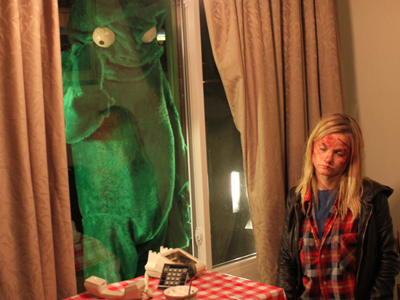
Calvin Lee Reeder’s new film, The Oregonian is billed as an “experimental horror” film. Aside from some faint echoes of Carnival of Souls, however, there is not much horror in it. It is actually a surreal fantasy. A young woman who is identified only as “the Oregonian” (Lindsay Pulsipher) is living on a farm and involved in an abusive relationship. One day she gets into a car accident on a lonely country road. Although she is injured, she can still walk, so she goes looking for help. She never finds it. Instead, she wanders through a deserted town and meets some strange characters. These include a creepy old woman, a man who urinates in different colors and who obsesses over making omelettes, a man wearing a furry green frog costume, a group of hippies who drink gasoline, and various women who scream for no apparent reason.

Some parts of this film work better than others. The scenes of the Oregonian arguing with her husband are unconvincing and only detract from the trippy feel of the rest of the film. At times the film seems to be making fun of hippies, although I’m not sure that was the intention. (I know I’m not supposed to say these things, but this might be a good movie to watch when you’re stoned.)

The Oregonian has gotten a hostile response from some people. I’m told that at its premiere at the Sundance Film Festival, a quarter of the audience got up and walked out. The main complaint made against the film is that it doesn’t “mean” anything. Well, I would argue that it isn’t necessary for a film to “mean” something. Andre Breton once defined surrealism as: “Dictation of thought in the absence of all control exercised by reason, outside of all aesthetic and moral preoccupation.” That certainly describes this film. I found this movie interesting enough to want to watch it all the way to the end, which is more than I can say of some critically acclaimed films (for example: Chariots of Fire, Forrest Gump, Never Let Me Go).

People who don’t like this movie need to, as we say in Oregon, chill out.