Archive for the ‘Cinema’ Category

How the Fire Fell

October 15, 2011

In 1902, a man named Edmund Creffield showed up in Corvallis, Oregon. He began to preach a militantly fundamentalist form of Christianity. He quickly attracted a small, but intensely devoted group of followers, most of them women. He named his sect the “Bride of Christ Church”. Rumors started to circulate that Creffield was having sex with his female followers. Creffield eventually announced that Esther Mitchell, who came from one of Corvallis’s most respected families, would become the “Second Mother of Christ”. To make a long story short, Esther’s brother, George, shot Creffield in the back of the head while the latter was walking down a street in Seattle. Although there was no doubt as to whether he did the killing, a jury found George Mitchell not guilty. (This was clearly a case of an “honor killing”.) Later, as George was boarding a train, Esther shot him in the back of the head, exactly as he had shot Creffield.

This story is true. You can read about it here. You can find a more colorful telling here.


Edmund Creffield, while he was serving a prison sentence for adultery.

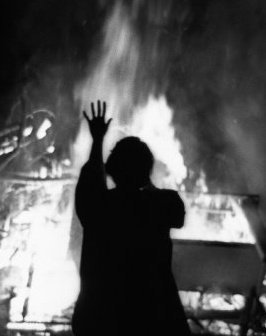
The Portland-based filmmaker, Edward P. Davee, has written and directed a film based on these events, How the Fire Fell. The film is in black & white, and much of it was shot in Corvallis. There is not much dialogue, although there are numerous scenes of Creffield (Joe Haege) preaching. The film is atmospheric, with lingering shots of forests, fields, and people lost in thought. Some of the imagery is clearly meant to be symbolic. In one scene, for example, while Creffield is preaching to his flock, there is a cutaway shot to flies caught in a spider’s web. Haege is quite good as Creffield. Davee was clearly limited by a very low budget in what he could do, but nevertheless there are some powerful scenes.

I found this film fascinating to watch, though I wish I could have learned more about the characters. Why were they so attracted to Creffield? At the screening I attended, there was a question-and-answer session with Davee and with the film’s director of photography, Scott Ballard. Davee said he wanted to “keep a sense of mystery alive” about the Creffield story. He also said he preferred to tell stories using images rather than dialogue. He expressed no strong feelings either for or against religion. (He said that some of the actors in the film are devout Christians.) Davee did say he found it disturbing that people could blindly follow a leader.

As I watched How the Fire Fell, I was reminded of the undertone of eroticism in many of the practices of evangelical Christian groups. (I remember H.L. Mencken commenting about this in one of his articles.) It may be that Creffield simply crossed a line that other evangelicals (apparently) do not cross.

How the Fire Fell has had a very limited release, mainly being shown at film festivals and at scattered venues in the Pacific Northwest. Let us hope that this film gets the wider audience it deserves.

You can find a trailer for the film here.
The Return of Navajo Boy

October 11, 2011

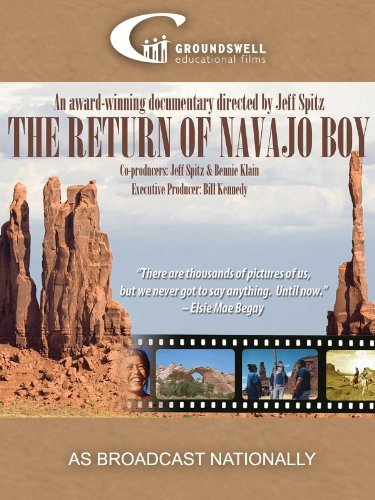
The Multicultural Center at the University of Oregon recently held a screening of the documentary, The Return of Navajo Boy. The director, Jeff Spitz, spoke beforehand. He told about how in the late 1990’s a man named Bill Kennedy approached him with a film that his recently deceased father had made in the 1950’s. It was a half-hour documentary about the Navajos (Diné) called Navajo Boy. Kennedy asked Spitz to help him preserve his father’s work. Spitz could make no sense out of the film, which had no sound. He took the film to a library in Chicago that had an extensive collection of literature and films related to Native Americans. The people at the library told him that the film showed a ceremony that, according to Navajo religious belief, should never be filmed. They advised him to destroy the movie. Spitz couldn’t bring himself to do this. Instead, he and Kennedy decided to locate the people in the film and ask them what should be done with it.

The documentary begins with Kennedy talking with Lorenzo Begay, a descendent of the family in the film. (We’re not told how Kennedy managed to locate him.) He lives with his family on a reservation in the austerely beautiful Monument Valley in Utah. He takes Kennedy to meet his uncle and his mother, Elsie Mae Cly Begay, both of whom appear as children in the film.


Elsie Mae Cly Begay in the 1950’s.

He shows the movie to the Begay family. They seem pleased to see themselves in it. We are then told about the family’s history. During the 1950’s, they supported themselves by raising sheep, which they still do today. They were also paid by a local merchant to pose for photographs that would be used for postcards. (They also appeared as extras in John Ford’s The Searchers). Elsie Mae’s mother, Happy Cly, was believed to be the most photographed woman in America at that time.


Happy Cly

Some members of the family also worked in the uranium mines. The Navajo workers were not warned about the health hazards of radiation exposure. One of Elsie Mae’s brothers worked in the mines, and he later developed cancer. The film discusses his efforts to get compensation from the government. Also, radioactive tailings from these minds contaminated the ground water. Elsie Mae’s hogan was built using rocks from the mines. Later it was found to contain 80 times the acceptable level of radiation, so it was destroyed. Two of Elsie Mae’s sons died of cancer, and a third has recently developed it. Happy Cly died from cancer. It turns out that the ceremony shown in the documentary by Bill Kennedy’s father is that of a medicine man trying to cure her.

Elsie Mae had a baby brother, John Wayne Cly, who also appears in Kennedy’s movie. When Happy Cly died, the family was unable to take care of him, so they gave him to white missionaries who promised to bring him back when he was older. They never did. When Kennedy’s documentary is shown at a Navajo museum, John Cly, who was then living in New Mexico, reads about it in a newspaper. The film ends with an emotional reunion between him and his family. There is also a postscript that relates how Elsie Mae now travels the country and to other countries to tell people about what uranium mining did to the Navajo nation.

This is an interesting and important film. Incredibly, the government wants to reopen some of these mines to provide fuel for a new generation of nuclear reactors. This is more evidence that nuclear energy is a bad idea.

You can learn more about this film at NavajoBoy.com.

Magic Trip

October 4, 2011

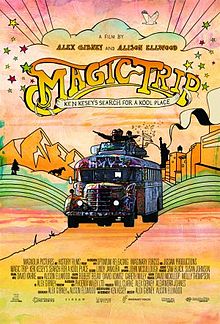
In the early 1960’s, Ken Kesey and the Merry Pranksters decided they would make a film about a cross-country trip they would undertake. After the journey, when they tried to edit the film, they found they couldn’t synchronize the sound and the images. Perhaps this had something to do with the fact that they were tripping on LSD most of the time they were filming. Recently, Alison Ellwood and Alex Gibney used the surviving footage as the basis for a documentary about Kesey and about the 1960’s.

In 1964, Kesey and a group of his friends, inspired by Jack Kerouac’s On The Road, decide to travel across the country from California to New York. They renovate an old school bus and paint it bright colors. They name it “Further”, and they call themselves “The Merry Pranksters”. They manage to get Neal Cassady – the “Dean Moriarty” from On The Road – to be their bus driver. Cassady is on speed much of the time, so he talks incessantly and is constantly gesturing with his arms. The trip is largely a success, but it is not without problems. A woman has a mental breakdown and has to be sent home. Another woman, who is pregnant, eventually decides that she is not enjoying herself and eventually drops out. When the pranksters reach New York, they seek out their hero, Jack Kerouac, only to get a decidedly chilly reception from him. They go to the World’s Fair, thinking it will be a good place to trip, only to find it a bit dull. They then travel to upstate New York, where Timothy Leary has a mansion, where he and others carry out experiments with LSD. When the Pranksters arrive, however, most of the people there, including Leary, hide from them. (One of the Pranksters comments that these people seem “upper class”.) The only one who talks to them is Richard Alpert (“Ram Dass”), who creeps them out.

When the Pranksters return to California, they begin holding parties called “acid tests”. These start to attract large numbers of people. The Pranksters become disenchanted with Cassady, who seems to be all talk and nothing else. One day he is found dead lying alongside a railroad track in Mexico. Kesey eventually seems to sour on the drug culture he helped create, although he never expresses any regrets about what he did. He moves to Oregon, where he settles down on a farm with his wife and children.

It’s funny how society tries to appropriate artists after they die. A statue of Kesey now stands in downtown Eugene, where environmental activists have sometimes been brutalized by the police. At least one of these incidents took place across the street from the statue.

Magic Trip is part road movie, part cultural history, and part morality tale. I highly recommend seeing it.

Louder Than A Bomb

September 25, 2011

Every year over six hundred teenagers from schools in Chicago and its suburbs take part in a poetry competition. I find this amazing. At the rich, white high school I attended, if you had suggested having a poetry competition, you would have been laughed at. It was the considered opinion of my classmates – some of whom went on to Ivy League schools – that only “faggots” read poetry. These students from Chicago clearly don’t have such preconceptions.

The students are formed into teams representing their individual schools. The teams have coaches. At the competition, which is called “Louder Than A Bomb”, audience members clap and cheer almost as if they are at a sporting event.

This documentary by Greg Jacobs and Jon Siskel follows several students during the six month period when they are preparing for the competition. Perhaps the most affecting of them is Nova, who was physically abused by her alcoholic father, and who is intensely devoted to her developmentally disabled younger brother. Her poems have an honesty about them that is deeply moving. Much of the film is devoted to the team from Charles Steinmetz High School, who call themselves the “Steinmenauts”. Their mentor, Coach Sloan, is a stern disciplinarian who nonetheless genuinely cares about his students. At one point, the team undergoes a crisis when three members act up at a meeting, resulting in their being kicked off the team. They are readmitted after they deliver an emotional apology. The high point of the film comes when some members of this team perform a group poem about gang violence. Overall, I was deeply impressed by how talented the students in this film are. Their poems are much better than anything I could have written when I was their age.

Louder Than A Bomb is not for everyone. It will be deeply offensive to people like Barack Obama and Michelle Rhee, as well as the producers of Waiting for “Superman”. No doubt they will angrily demand that these students should be studying for standardized tests instead of writing poetry.

I highly recommend seeing this film.

The Trip

September 24, 2011

In Michael Winterbottom’s film, The Trip, the British comedians, Steve Coogan and Rob Brydon, play fictionalized versions of themselves. Coogan has been hired by the Guardian to do a series of articles about restaurants in the North of England. He plans to bring his girlfriend, Mischa (Margo Stilley), along on a five-day trip. At the last minute, however, she decides that they need a break in their relationship, and she leaves for America instead. Coogan asks several different people to come along, but they all turn him down. He then reluctantly asks Rob Brydon to join him.

The film doesn’t have much of a story. It is mostly concerned with the give-and-take between two men who are similar in many ways, but nonetheless have very different personalities. Rob Brydon seems perfectly happy with his modestly successful show business career. (He hosts a radio quiz show.) Steve Coogan, a well-known comic actor in Britain, feels dissatisfied with his life. He aspires to become a “serious” actor. He wants to make what he calls “art house films”. Yet he is merely offered a role in a fatuous TV series. Interestingly, Coogan is willing to portray himself in a negative manner. He worries that his girlfriend might be cheating on him, yet he engages in a couple of one-night stands. One senses that he finds these encounters unsatisfying, but he feels compelled to do them anyway. At times, he is a bit churlish towards Brydon. The latter, on the other hand, seems well-adjusted and content in his marriage. As the film goes on, however, one begins to get the uncomfortable feeling that there is some truth to Coogan’s insinuations that Brydon’s approach to life is shallow and complacent. Yet there are moments when Coogan seems to wonder if perhaps Brydon knows something he doesn’t.

This film deals, in an oblique manner, with the age-old question of whether one should accept things the way they are, or strive for something better. The film offers no definitive answer to that question. Instead, it suggests that there are serious consequences for whichever choice one makes.

I’m told that this film was cobbled together from a TV series that appeared on the BBC. No doubt that explains why some of the scenes make no sense chronologically. There are, however, no contrived scenes of the kind that one finds in the typical Hollywood road movie. There are, though, some spectacular shots of the Northern English countryside. (I had no idea that some of these places existed in England.) There is an amazing deadpan scene in a ludicrously pretentious restaurant. The film’s ending seems anti-climactic at first, but then you realize it makes sense. At the screening I attended, there was a moment of silence, then the audience burst out in applause.

I highly recommend seeing this film.

Rise of the Planet of the Apes

September 16, 2011

I initially did not intend to see the latest Planet of the Apes movie. I saw the original series when I was a kid, and I don’t remember much about it, except for that famous iconic scene in which Charlton Heston screams “God damn you all to Hell” at the Statue of Liberty. (Nowadays he would be investigated by Homeland Security for doing that.) I figure the movies probably weren’t that good if that’s all I remember. (I didn’t see Tim Burton’s remake of Planet of the Apes. I have always been somewhat ambivalent about Burton, and the thought of him doing a remake sent me into ambivalence overdrive.) However I heard a lot of good things about this new Planet of the Apes movie. A friend of mine told me he thought it was a better film than X-Men: First Class. So I knew then I should check it out.

Will Rodman (James Franco) is a scientist working for Gen-Sys, a pharmaceutical company. (The film grounds itself in reality by portraying a pharmaceutical company as a cynical and corrupt place.) Rodman is trying to develop a viral cure for Alzheimer’s Disease, which his father (John Lithgow) suffers from. After an experiment involving chimpanzees goes seriously awry, the company’s CEO, Steven Jacobs (David Oyelowo) orders Rodman to have the chimps killed. However, Rodman’s assistant, Robert Franklin (Tyler Labine) persuades him to spare the life of a baby chimp. Rodman takes the chimp home and his father, an admirer of Shakespeare, names him “Caesar”. Right away, Caesar exhibits signs of extraordinary intelligence. Rodman realizes that Caesar has in his blood the viral agent that his mother was given. However, when Caesar attacks a neighbor who threatens Rodman’s father, he is taken away by the authorities and placed in a primate shelter.

I won’t say much more about the story except to say that Machiavelli would have admired the way that Caesar makes himself into the leader of the other apes at the shelter. And there is something deliriously entertaining about the sight of apes running amok through the streets of San Francisco. (Not many people get hurt, except for some who deserve it.) Oh, and there is an evil capitalist (the aforementioned Jacobs) in it. It always improves a film immeasurably when you add an evil capitalist to it. (Back in the 1990’s, it seemed as though every movie had a serial killer in it. Boring. Evil capitalists are a lot more fun.)

I’m told that this film has all sorts of references in it to the earlier Planet of the Apes films, but I didn’t pick up on any of them. This is just as well, since I hate these sorts of inside jokes in movies. (Nobody screams “God damn you all to Hell” at the Statue of Liberty. I suppose this would have been hard to fit in, since the movie takes place in San Francisco.)

By the way, when I was a kid, I read the Pierre Boulle novel on which the original Planet of the Apes movie was based. The ending is different from the movie’s. Instead of the hero finding that he has been on Earth all along, he returns to Earth and finds that apes have taken it over while he was on the other planet. It’s always something, isn’t it?

I have been told that a sequel is planned. I find this ominous, since sequels are (almost) never as good as the first film. This movie would be pretty hard to top. However, I did not think that this is a better movie than X-Men: First Class; the latter has more interesting characters and a more complex story. Still, Rise of the Planet of the Apes meets and exceeds all other expectations.

Another Earth

September 10, 2011

Another Earth, directed by Mike Cahill and written by Cahill and Brit Marling, is an unusual type of science fantasy film, one that is mostly concerned with human relationships rather than with telling an adventure story. Rhoda (Brit Marling) is a teenager who has just been accepted into M.I.T. However, she gets into a drunk driving accident in which she hits a car with a family in it, killing a mother and her son. After spending time in prison, she is released. She gets a job working as a janitor at a high school. She goes to the house of the father who survived the crash, John (William Mapother) to apologize. He doesn’t recognize her, because he was in a coma at the time of her trial. She can’t bring herself to apologize, so instead she makes up a story about looking for work as a maid. He hires her, and she begins going to his house every week to clean, still unable to bring herself to tell him the truth.
Eventually, they become romantically involved. At the same time this is going on, a previously unknown planet appears in the sky. It looks like the Earth, and it turns out to be an exact replica of this planet. Fascinated with the idea of meeting another version of herself, Rhoda enters a contest for people who wish to travel to this second Earth. Now and then there are voiceovers discussing the philosophical implications of a second Earth.

I mostly liked this film. The relationship between Rhoda and John develops in a believable manner. The scenes with an Earth in the sky have an eerie beauty to them. And I liked Brit Marling’s performance as Rhoda. However, the philosophizing gets woozy at times; the movie would have been better without it. And there is a subplot about one of Rhoda’s fellow janitors deliberately blinding himself that doesn’t really work.

A flawed but nonetheless enjoyable film.

Incendies

September 6, 2011

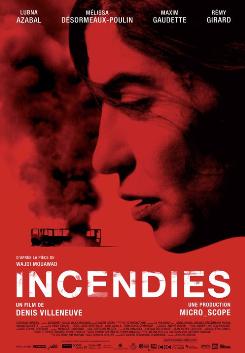
Incendies is a film by Canadian director, Denis Villeneuve, based on the play, Scorched, by Wajdi Mouawad. It is in French and Arabic. It was nominated for an Academy Award for best foreign language film, but it lost to In a Better World. I find this baffling, for Incendies is clearly a vastly superior film.

Nawal Marwan (Lubna Azabal) is a Lebanese immigrant living in Montreal, where she works as a secretary for a notary, Lebel (Rémy Girard). After Nawal dies, Lebel reads her will to her twin children, Jeanne (Mélissa Désormeaux-Poulin) and Simon (Maxim Gaudette). She tells them that their father is still alive and that they have a brother. They had previously not known about these things. She tells them that before they can place a marker over her grave, Jeanne must find her father and Simon must find his brother. Simon refuses to go along with this, but Jeanne decides to go to Lebanon to find her father. The film jumps back and forth between scenes from Nawal’s life and Jeanne’s search. The story is complicated, and I won’t go into any more detail about it except to say that it combines the themes of how the past remains with us, the desire for revenge, and the need to find love. I found this film powerful and moving, and quite unlike any other movie I’ve seen.

In his critique of this film, As’ad AbuKhalil claims: “Arabs in the movie come across as barbarians”. That was not the impression that I got from watching this film. Yes, there are some Arab Christian militiamen who do behave like barbarians. (“Barbarians” is actually putting it mildly.) However, most of the Arab characters in this film come across as sympathetic. Nawal is actually portrayed as a heroic person. (Strangely, AbuKhalil says nothing about the fact that this film is based on a play by a Lebanese.) AbuKhalil also complains that the characters never mention Israel. This is true. It is, for example, implied that the prison in which Nawal is raped and tortured is run by the Israelis, but the film never makes this explicitly clear. I suspect that these omissions may have something to do with the fact that most of the scenes were shot in Jordan, which has a tense, but “friendly”, relationship with Israel. (I suspect that the reason this film failed to win an Academy Award is that some academy members picked up on the anti-Israeli implications of the prison scenes.) AbuKhalil also complains that the film contains “disturbing thoughts and twists”. Well, yeah, but the same could be said about King Lear and The Sound and the Fury. We live in a world in which disturbing things happen, so art inevitably reflects this. AbuKhalil often makes valid criticisms of the way Arabs are portrayed in the Western media, but in this case I think he went off the rails.

I highly recommend seeing this film.

In a Better World

August 21, 2011

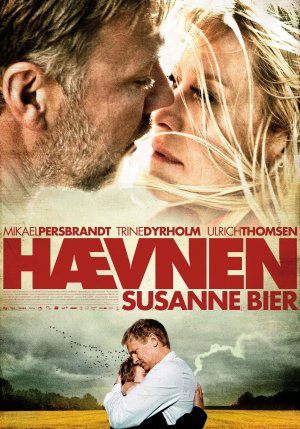
The Danish film, In a Better World, directed by Suzanne Bier, was awarded this year’s Oscar for best foreign language film. However, in all honesty I must say that I was not all that impressed by it. (I thought Biutiful was a better film.) Although I liked some of the early scenes, I ultimately found it disappointing.

Anton (Mikael Persbrandt) is a Swedish doctor who does volunteer work in a Sudanese refugee camp. He is estranged from his Danish wife, Marianne (Trine Dyrholm). She lives with their son, Elias (Markus Rygaard), in a small village in Denmark. Elias is bullied by some of his classmates. A new student, Christian (William Jøhnk Nielsen) arrives, and he immediately takes sides with Elias. He severely beats one of the bullies and threatens him with a knife. The bullying then stops. This convinces Christian that the way to deal with conflicts is to use force. He and Elias later see Anton get into an argument with Lars (Kim Bodnia). When Lars slaps Anton, the latter refuses to hit back, because he is a pacifist. Christian then decides to build a bomb and blow up Lars’s van, to teach him a lesson. He persuades Elias to help him. However, Elias is injured in the blast.

This film’s central conflicts are resolved in a manner that struck me as too familiar and contrived. I actually began to feel as though I were watching one of those After School Specials that they used to show on TV when I was growing up. It ends up being just another story about mixed-up adolescents. This was a comedown, because the early scenes seem to promise something more than this.

This film has a subplot that takes place in Africa. The refugees are terrorized by a local warlord, who commits shocking crimes. One day, he shows up in the camp and demands that Anton treat his wounded leg. This could have been an interesting dramatic situation. Unfortunately, the warlord is such a cartoonish character that he simply isn’t convincing. These African scenes are apparently meant to serve as a dramatic counterpoint to the scenes in Denmark, but they end up being merely a distraction.

All in all, a disappointing film.

X-Men: First Class

August 13, 2011

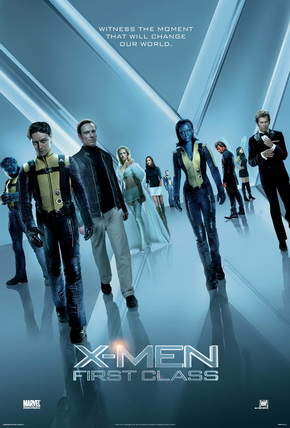
After watching such highbrow fare as The Tree of Life and Hobo with a Shotgun, I felt the need for something light, so I went to see X-Men: First Class. I have to admit that I was never really into the whole X-Men thing. I belong to a generation for whom Spiderman and the Fantastic Four were the really cool superheroes. So I probably didn’t get all the in-jokes, although I noticed some moments that clearly had that in-joke feel to them. Personally, I don’t like it when they put in-jokes in movies, but they seem to be a requirement with these genre films.

X-Men: First Class gets off to a slow start. The problem is that it spends too much time establishing the origins of the main characters. About twenty minutes in, however, it starts to take off, and soon it’s like a roller coaster ride. I won’t go into too much detail about the story. Basically it takes place in the early 1960’s, and it’s about a group of evil mutants who try to start a nuclear war between the United States and Russia. They want to destroy non-mutants so that they and other mutants can rule the world. They are opposed by a group of good mutants, who at the end become the “X-Men”. As you may have guessed by now, the words “mutants” and “mutations” get tossed around a lot in this film. I guess this is supposed to sound scientific, although I’m not aware that it’s possible for a mutation to allow one to violate the laws of physics, as the characters in this film frequently do.

One of the things I liked about this film is that some of the characters are remarkably complex for an action movie. Indeed, the characters in this film have more depth than the characters in some supposedly “adult” movies such as Horrible Bosses. Even though they have super powers, they can't help feeling like misfits who aren't wanted. I suspect this is the secret to the comic books' success: they appeal to adolescents who feel they aren't appreciated for their talents.

This film mixes historical events with fictional ones in a manner that I did not find objectionable. Indeed, I was struck by the fact that the movie makes it clear that it was the U.S.'s decision to place Jupiter missiles in Turkey that led to the Cuban missile crisis. When I was young, if you had pointed that out to someone, he might very well have called you a "traitor". It's funny how things have changed since the end of the Cold War.