Archive for the ‘Cinema’ Category

Hobo with a Shotgun

August 5, 2011

Years ago, I had a group of friends who liked to watch bad movies. No, I don’t mean “so bad it’s good” movies like Plan 9 from Outer Space or Robot Monster. I mean movies that are just bad. I’m talking about low budget exploitation films that make you feel unclean while you’re watching them. The idea seems to have been that these guys would get together and share a common feeling of smug superiority towards the people who made these films, sneering at the bad acting and the inept camera work. Try as hard as I could, I was never able to buy into this aesthetic. I would sit squirming in my chair, wanting to say, “ Wouldn’t it be more fun to watch a good movie?”

Hobo with a Shotgun seems to belong to a similar aesthetic, although the attitude here seems to be one of morbid fascination rather than smug superiority. The main reason I went to see this film is because I thought the trailer was funny. Considering that even the trailers for Hollywood “comedies” aren’t funny, I thought this had to be a promising sign. I have since learned that it originally was one of a series of joke trailers that were made for the Robert Rodriguez-Quentin Tarantino concoction, Grindhouse, which I haven’t seen. I have, however, seen Rodriguez’s Machete, which also started out as one of these joke trailers. Although I liked that this film takes the side of immigrants, I must admit that I didn’t think it was very good. The characters were too cartoonish to be interesting, and the action sequences weren’t well done. (Well-done action sequences, in my opinion, are the bare minimum requirement for a good action film.) I suppose some would argue that this film’s badness is the whole joke, although, in my opinion, it is a joke that wears thin pretty quickly.

Hobo with a Shotgun, directed by Jason Eisener and written by John Davies, is the second of these Grindhouse spin-offs. The film has a 1970’s look and feel to it. (I take it the seventies were a sort of Golden Age of exploitation films.) The basic plot is an example of a peculiarly American genre. It’s that type of story in which a stranger arrives in a corrupt city or town and, using ruthless methods, proceeds to clean the place up. (The best example of this type of story is Dashiell Hammett’s Red Harvest.) One morning, a hobo (Rutger Hauer) arrives in Hope Town, which is known by its residents as either “Scum Town” or “Fuck Town”. (In keeping with the rules of the genre, we are never told the hobo’s name, just as we are never told the name of Hammett’s Continental Op.) The hobo finds that there is rampant crime in the city. The place is run by The Drake (Brian Downey), who is a combination gangster, preacher and carnival barker. The Drake holds public executions of people who displease him, including his own brother. The police are completely under The Drake’s control. The hobo befriends a prostitute, Abby (Molly Dunsworth), who is far and away the most sympathetic character in the film. When he sees a robber threatening to kill a baby, the hobo snaps. He gets a shotgun, and soon the bodies start to pile up.

Hobo with a Shotgun is the most violent film I have ever seen. Eisener and Davies cram as much gratuitous violence as they can into each scene. There are depictions of torture, disembowelment, mutilation and people being burned alive. Yet the film has a Grand Guignol feel to it that makes it hard to take seriously. Everything is so ridiculously overdone that I couldn’t help laughing at times. Other people in the audience reacted the same way. However, several people got up and left.

I have deeply mixed feelings about this film. I can’t say that I didn’t find it entertaining, yet I can’t really recommend it. It has no redeeming value, even though Eisener and Davies try to inject some social consciousness into it. In one scene, for example, Abby makes a speech defending homeless people. The problem is that when you present an argument like that in the cynical context of an exploitation film, it rings hollow.

I have a suggestion for Rodriguez, Eisener and Davies: wouldn’t it be more fun to make good movies?

Forks Over Knives

July 31, 2011

Recently I was diagnosed with diabetes. My doctor recommended I eat more fruits and vegetables and less meat and processed foods. I changed my diet accordingly, and since then my blood sugar level has gone down and I feel more energetic. So I was naturally interested when I heard about Lee Fulkerson’s documentary, Forks Over Knives, which argues that if people were to switch to a plant-based diet, the incidence of heart disease, cancer and diabetes would go down. The film mainly follows the careers of two doctors, T. Colin Campbell and Caldwell Esselstyn. Campbell did a nutrition study in the Phillippines, where he discovered to his surprise that children from wealthy families had a higher incidence of liver cancer. He noted that these children tended to consume more meat and dairy products than poorer children did. He later conducted a study in China, in which he found that in areas where people had adopted a “Western diet” – increased consumption of meat, dairy products and processed foods – there was a higher incidence of cancer. This led him to the conclusion that large amounts of animal protein can trigger the development of cancer cells in some people.

Esselstyn was a surgeon who specialized in coronary bypass surgery. His work with heart attack patients led him to the conclusion that a plant-based diet reduces the incidence of heart disease. He argues that improved diet can reduce the need for surgery (hence the film’s title: “forks over knives”.) The film features various interviews with people who have adopted plant-based diets. It also follows Fulkerson as he tries this same diet.

It has been largely forgotten that up until the twentieth century most people did not consume a lot of animal protein. I remember years ago reading Karl Marx’s The Eighteenth Brumaire of Louis Bonaparte. At one point Marx says that Bonaparte bribed the soldiers in the French army by giving them sausages. I remember thinking that those soldiers were awfully easy to please. What I didn’t realize at the time was that in nineteenth century France sausages were probably a luxury for most people. Go into any supermarket nowadays and you will find row after row of sausages in the meat section. What has changed is that modern refrigeration has made it cheaper and easier to store and transport meat and dairy products. Also the development of factory farms has made these foods cheaper. The result is that many people now eat more animal protein than is really good for them.

I highly recommend seeing this film.

The Price of Sugar

July 23, 2011

I recently saw the 2007 documentary, The Price of Sugar, which was directed by Bill Haney. It depicts the plight of Haitian farm workers on sugar plantations in the Dominican Republic. These workers have no legal status, and they live in appalling conditions in small villages called baretes, which are guarded by goons hired by the plantation owners. These Haitians are regarded with suspicion and sometimes hostility by many Dominicans, even though they perform work that the Dominicans refuse to do. Does this sound familiar? This is similar to the situation of Mexican and Central American farm workers in the U.S. It seems that the practice of demonizing the lowest paid workers in order to more thoroughly exploit them and other workers is not confined to the U.S. Indeed, I would not be surprised if this is a common practice in the capitalist world.

The film focuses on a Catholic priest, Christopher Hartley, who brought volunteer doctors from the U.S. to treat the Haitians, and who urged the Haitians to organize to make demands for better working and living conditions. This brought him into conflict with the Vicini family, who own many of the sugar plantations in the Dominican Republic, and who are a powerful political force in that country. The Vicinis organized demonstrations in which people accused Hartley of bringing Haitians into the country and of trying to “Haitianize” the Dominican Republic. (Again, doesn’t this sound familiar?) I have learned that after this film was made, Hartley was relieved of his position by the Catholic Church. I suspect this was in response to political pressure.

At one point in this film, we are told by the narrator, Paul Newman, that the U.S. has a trade agreement with the Dominican Republic, which stipulates that U.S. will buy sugar from that country at twice the world market price. I saw this film with a law professor who specializes in trade issues. I asked him why the U.S. would want to buy sugar at twice the market price. He told me that by making sugar prices artificially high, the U.S. government creates a demand for corn syrup. In effect, this is a subsidy for U.S. agribusiness, one that is carried out on the backs of Haitian workers.

I highly recommend seeing this film.

Katia Kabanova

July 21, 2011

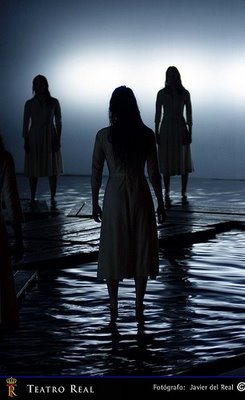
Recently I saw a film of Leoš Janáček’s opera, Katia Kabanova. It was a production by the Teatro Real in Madrid, directed by Robert Carsen. The opera is based upon a nineteenth century Russian play, The Storm, by Alexander Ostrovsky. The theme of the work is the destructive effect of middle class moralism on people’s lives. This has renewed relevance for our time, thanks to the Tea Party.

The opera takes place in a Russian village on the Volga River. Katia (Karita Mattila) is married to a merchant, Tichon, whose widowed mother, Marfa, is constantly lecturing him about how he must assert his authority over his wife, or she will be unfaithful to him. (This is not far-fetched. From Phyllis Schlafly to Michele Bachmann, the fiercest advocates of patriarchy have been women.) Katia, however, has caught the eye of Boris, who is constantly being berated by his uncle, Dikoj, who controls his inheritance. When Tichon goes away on a trip, Varvara, a foster daughter of Tichon’s family who is sympathetic to Katia, persuades her to secretly meet with Boris. Katia does so several times, and she and Boris make love. Not surprisingly, Marfa turns out to be a hypocrite (isn’t that always the way?), for she is having a torrid affair with Dikoj at the same time. When Tichon returns, Katia is seized with guilt, and she confesses her infidelity before the entire village. Dikoj orders Boris to leave for Siberia. Overcome with grief, Katia drowns herself in the Volga.

Carsen has the stage covered with water. An important motif in the opera is the dual nature of water, which can bring both life and death. The actors stand and walk on narrow wooden platforms, which are moved around by women dancers wearing white dresses. The narrowness of these structures represents the constricted nature of the character’s lives. Janáček’s music is agitated and sometimes harsh, reflecting the inner turmoil of the characters. Yet there are passages of soaring lyricism, which not only reflect the fleeting moments of happiness in these people’s lives, but also hint at the possibility of a better way of life. I highly recommend seeing this film if you get a chance.

Saint Misbehavin’: The Wavy Gravy Story

July 17, 2011

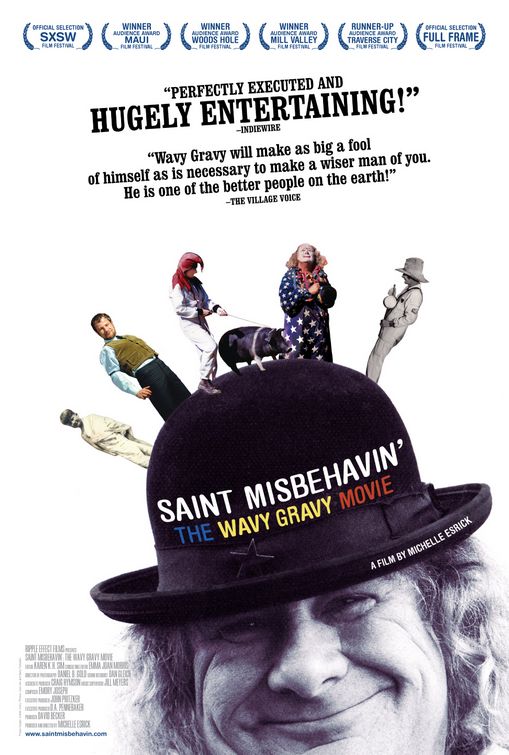
Michelle Esrick has directed a documentary about Hugh Romney, better known as Wavy Gravy, the peace activist, clown and archetypal hippy. Romney’s early career is in many ways highly representative of how hipsterism evolved from the 1950’s to the 1970’s. In the fifties, he was reciting poetry at the Gaslight Cafe in Greenwich Village. Inspired by Lenny Bruce, he began doing stand-up comedy, and he released a comedy album. In the early sixties, he moved to California. There he met Ken Kesey. He joined the Merry Pranksters and experimented with LSD. (He gives good advice on how to deal with someone who’s having a bad trip: keep telling the person that what he’s seeing isn’t real and that it will soon end.) He then founded a commune outside of Los Angeles called the Hog Farm. While touring with fellow members of the Hog Farm, he was asked to help organize the Woodstock music festival, and he became the MC. It was shortly after this that B.B. KIng gave him the name “Wavy Gravy”. He took part in numerous anti-war demonstrations. On at least one occasion he was severely beaten by the police, with the result that he suffers back problems to this day. W.G. found that if he dressed as a clown, the police would not hurt him. So that is the public persona he has adopted to this day.

Wavy Gravy comes across as a likable person in this film, but for all his supposed zaniness and irreverence, he seems strangely bland and – dare I say it? – even a bit dull at times. The problem is that, aside from the Vietnam War (which he rightly calls genocide), he never expresses any really strong opinions about anything. There is, strange to say, no discussion in this film of any of the U.S.’s military interventions since Vietnam. An extraterrestrial watching this film might well get the impression that human history came to an end during the 1960’s. (I’ve met some elderly hippies who seemed to believe this.)

A lot of this has to do with Wavy Gravy’s concept of spirituality. The film begins with W.G. entering a room that is filled all sorts of religious icons – Christian, Buddhist, Hindu, with toys mixed in. (There is a multi-armed Donald Duck figurine. No doubt this represents the multiple aspects of Donald’s powers.) W.G. then recites a prayer in which he names all sorts of famous religious figures (including Lenny Bruce). It’s a spirituality in which various religious traditions are mixed together in a sort of feel good froth. W.G. emphasizes the importance of providing food and shelter to the poor and unfortunate. He argues that if we are kind and decent to people, it will create a ripple effect that will eventually spread through the whole world.

Wavy Gravy does some good things. He helped found a charity that provides eye care to poor people. He runs a children’s summer camp called Camp Winnarainbow that, judging from this film, looks as though it’s a hell of a lot more fun than the fascistic summer camp I went to as a kid. Still, we live in a world that’s being destroyed by capitalism, in which imperialist wars are being fought. Just being nice to people is not enough.

Horrible Bosses

July 11, 2011

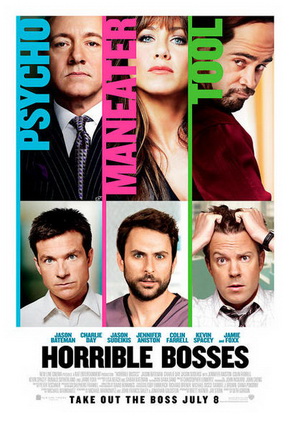
Imagine a bad TV sitcom that lasts an hour and a half and which has raunchy language in it. That’s pretty much what Horrible Bosses is like.

Nick (Jason Bateman) has a sadistic boss, Dave Harken (Kevin Spacey), who likes to play mind games with people. Dale (Charlie Day) is a dental assistant whose boss, Julia Harris (Jennifer Aniston) is continually coming on to him and tries to blackmail him. Kurt (Jason Sudeikis) is a chemical company executive who gets along with his boss (Donald Sutherland). However, when the latter dies, the company is taken over by his obnoxious cokehead son, Bobby Pellitt (Colin Farrell). Nick, Dale and Kurt like to get to together at a bar and commiserate with one another. They are so desperate that they decide to kill their bosses. They hire a “murder consultant”, Jones (Jamie Foxx), to help them.

I was hoping this film would be a satire on corporate life, but instead it’s a slapstick comedy and not a very good one. The main problem with this film is that the characters are so cartoonish that you simply don’t believe them. Of course, comedy inevitably involves a certain amount of exaggeration, but the characters have to be believable on some level. The only characters in this film who are at all believable are Harken and Jones. The rest one couldn’t care less about. I also had a problem with the way this film trivializes the problem of sexual harassment in the workplace. (And would an executive at a chemical company hang around with a dental assistant? This is an example of Hollywood’s tone deafness when it comes to matters of class.)

One of the reasons I went to see this film is because Roger Ebert gave it three and a half stars. Perhaps I should ask Ebert to reimburse me for the cost of my ticket.

The Tree of Life

July 4, 2011

Terrence Malik’s latest film has been the source of a great deal of controversy, provoking sharply divided opinions. (Several days ago, a friend of mine posted on Facebook about how much he hated it.) My own feeling immediately after watching this film was similar to how I felt after watching Enter the Void, which was that what I had just seen was perhaps too much to absorb in a single viewing. There are many different kinds of images in this film, and their meanings and connections to one another are not always clear. Malick seems to be using them to try to convey philosophical and possibly even religious ideas.

The film is basically about an architect, Jack (Sean Penn), who sometimes reflects upon his experiences in life, sometimes thinks about the creation of the Earth and the origins of life, and at other times is simply fantasizing. A large chunk of the film is devoted to Jack’s experiences growing up in Waco, Texas during the 1950’s. (It so happens that Malick grew up in Waco during the 1950’s. It seems reasonable to assume that this film is at least partially autobiographical, though Malick is clearly trying to do more than just depict scenes from his life. By the way, Sean Penn is a little young for his role, but that’s not a big problem.) Jack’s father (Brad Pitt) is a stern disciplinarian, while his mother (Jessica Chastain) is indulgent and forgiving. Young Jack (Hunter McCracken, who looks like an adolescent Sean Penn) sometimes thinks about killing his father, while feeling close to his mother. What lifts this above Freudian cliché is that the characters seem real and complex. (Chastain and Pitt both give very good performances.)

As I mentioned before, part of the film is devoted to a depiction of the creation of the Earth and the evolution of life. (The special effects, which are very good, were partly done by Douglas Trumbull, who worked on 2001: A Space Odyssey over forty years ago.) The juxtaposition of this with the scenes from Jack’s childhood is a bit jarring. It seems to me that Malick is trying to do two different things at the same time here. First, he is trying to convey the idea that Jack’s efforts to make sense out of his childhood are part of his efforts to try to make sense out of existence itself. Second, Malick is trying to reconcile evolution with an essentially religious view of the world. (This puts him in opposition to a lot of people in our society.) The film is peppered with religious ideas. It opens with a quote from the Book of Job. Both of Jack’s parents are deeply religious. His mother sounds almost mystical at times. In what I can only assume is one of Jack’s fantasies, we see his mother giving water to a man who has just been arrested by the police. (It may be that Jack’s parents represent the dual nature of religion, which is both judgmental and a source of solace.)

The film ends with a scene of Jack wandering on a beach, where he meets his parents and other people from his past. No doubt this represents Jack’s reconciliation with his past.

The Tree of Life is a great film. It shows that cinema can be more than just a storytelling medium. It can also be meditative, evocative and impressionistic. Films can challenge us and make us think as well as entertain us. I highly recommend seeing this film.

If A Tree Falls

June 27, 2011

Marshall Curry and Sam Cullman have made a film about the Earth Liberation Front. This group was very active in Eugene, Oregon, where I currently live; so I was naturally interested in seeing this film. Marshall Curry says he learned from his wife one day that the police had arrested an employee at her company for being an “eco-terrorist”. He immediately became interested, and he eventually decided he wanted to make a film about this person. The employee was Daniel McGowan, whose story serves as the central thread of this film. A round-faced, soft-spoken man, he seems an unlikely person to become a violent criminal. The son of a New York cop, he grew up on Rockaway Beach. In his youth he became interested in environmental issues. He eventually gravitated towards Eugene, a hotspot for environmental activism. The film does a short history of the environmental movement in the Pacific Northwest, recounting how non-violent protests have sometimes been met with police violence. Faced with such a response, it was inevitable that some activists would conclude that they should resort to violence themselves. A cell of the Earth Liberation Front was formed in Eugene, and McGowan, frustrated by the lack of progress by environmentalists, was eventually drawn into it.

McGowan’s first job was to serve as a lookout when ELF torched the offices of a lumber company. His second job was helping ELF destroy a tree farm that was allegedly growing genetically modified trees. Only it turned out afterwards that the trees were not GMO’s. At the same time ELF set fire to the office of a University of Washington professor who was involved in genetic engineering. The fire grew out of control and did a lot of damage that ELF didn’t intend. In the aftermath, the cell underwent a crisis and disbanded. McGowan became disillusioned with ELF’s methods, while still retaining his radical environmental views. He returned to New York, where he got a job with a group dealing with domestic violence issues.

The film then deals with police efforts to solve the crimes. For years they got nowhere. Then, by sheer dumb luck, they stumbled upon Jacob Ferguson. He just happened to be the weakest link in the ELF cell, since he was a heroin addict and therefore vulnerable to legal pressure. The police outfitted him with a wire and flew him to different parts of the country to have conversations with his former comrades. He showed up in New York to talk to a surprised McGowan. The latter thought there was something odd about this, especially since Ferguson seemed “talkative”, whereas McGowan remembered him as being quiet. McGowan spoke to him any way, which was a fatal mistake. McGowan was later arrested and found himself facing a possible sentence of life plus 350 years. He eventually made a plea deal in which he confessed to the arsons but did not name any accomplices. He was sentenced to eight years, but received a “terrorism enhancement”, meaning that he was put in a special high security prison built for “terrorists”. He can only receive one fifteen minute phone call a day and one visitor a month. The film documents the emotional anguish that this experience has inflicted upon McGowan and his family.

The filmmakers interview many people involved in these events, including the prosecutor and police detectives who pursued the ELF members. People with different viewpoints are allowed to state their positions. Although the filmmakers maintain a neutral tone, it’s clear that they feel that McGowan and other members of ELF were dealt with unfairly. Ferguson, who was involved in more arsons than anyone else, did not receive a prison sentence. He betrayed his friends solely to save himself, and the system rewarded him for that. Someone makes the point that capitalists who destroy the environment, such as the executives at BP, are never punished for what they do.

I highly recommend seeing this film.

Bill Cunningham New York

June 23, 2011

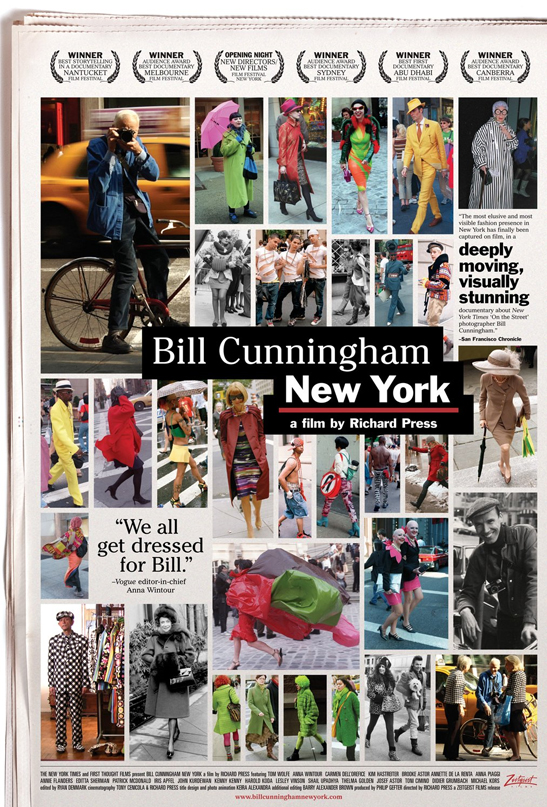
Richard Press has made a documentary about Bill Cunningham, the fashion photographer and writer. Since I have never been terribly keen on fashion, I was not sure I would find this film interesting, but I found Cunningham an engaging and likable person. He is now about eighty-years-old, yet he still rides around Manhattan on a bicycle, looking for people wearing striking clothes.

In the film, Cunningham defends the concept of fashion by saying that he regards clothing as “armor” that helps people deal with the vicissitudes of life. Cunningham’s own armor consists of a plain blue jacket that he seems to wear at all times. His non-descript appearance is in sharp contrast to the flamboyantly dressed people he likes to photograph on the streets of New York. (As a photographer myself, I was pleased to see that Cunningham still uses film.) No doubt Cunningham tries to draw as little attention to himself as possible, so as to get the candid pictures that he is famous for.

Cunnigham is a deeply private person, and Press respects this – perhaps too much so, because by the end of this film Cunningham is still something of a mystery. He claims, for example, that he doesn’t accept money for his work, so as to maintain his independence. Where then does he get the money to support himself? We’re never told. His friends all believe that he comes from a wealthy background, but Cunningham says his family is working class. We’re told that he once worked as a milliner, but we’re not told why he left that. We learn that Cunningham goes to church every Sunday, but he refuses to discuss religion. He refuses to discuss his love life. The closest we get to a personal revelation is when Cunningham tells us that his parents disapproved of his interest in fashion, because they didn’t think it was a proper pursuit for a man.

Cunnigham often takes pictures at fancy dinner parties where many of New York’s rich and famous people go, yet he leads a Spartan life. He lives in a studio crammed with filing cabinets full of negatives. He sleeps on a mattress on top of milk crates. We see him in a deli eating a bacon-and-egg sandwich. “They have such good sandwiches here,” he enthuses. When a party is held in his honor in Paris, he shows up with his camera and takes pictures as if he were on another one of his assignments.

At the time this film was made (2010), Cunningham was living in the Carnegie Hall Studios. The film discusses how he and other residents were about to be evicted, so their studios could be turned into office spaces. We see Cunningham with a couple of other residents of the studios, who have lived there since the 1940’s. (I’m not making this up.) This gives the film a bittersweet feel; Cunningham seems to belong to a world that is coming to an end.

The Best and the Brightest

June 19, 2011

It’s funny how the people who are trying to shove the standardized testing snake oil down our throats send their children to fancy private schools that encourage personal growth rather than rote learning. President Obama sends his children to such a school. Could this be because he knows better than to believe his own nonsense?

I was thinking about this when I went to see the new comedy The Best and the Brightest, directed by Michael Shelov, and written by Shelov and Michael Jaeger. Jeff (Neil Patrick Harris) and Samantha (Bonnie Somerville) are a young couple who have just moved to New York from Delaware, along with their five-year-old daughter, Beatrice (Amelia Talbot). Not trusting the public schools in New York, they decide to enroll their daughter in a private school. They hire an agent, Sue Lemon (Amy Sedaris) to help them get their daughter into an elite school. Sue learns that a school run by the snooty headmistress, Katharine Heilmann (Jenna Stern), has one remaining available space. Sue persuades Jeff and Samantha that they should try to impress Heilmann by telling her that Jeff is a poet. Jeff and Samantha leave their daughter with their idle rich friend, Clark (Peter Serafinowicz) while they go to the interview. Their meeting with Heilmann goes well, and the latter seems inclined to admit their daughter. However, in a completely nonsensical scene, Clark appears out of nowhere, and, for no apparent reason, calls Heilmann a “douche”, causing her to reject their application. (This is simply bad writing.) Sue then tells Jeff and Samantha that their only hope now is to persuade the members of the school board that Jeff is an important up-and-coming poet. This leads to a series of increasingly humiliating impostures. At one point, Jeff and Samantha get disgusted with what they are doing and decide to move back to Delaware. It would have made sense if the film had ended with that. Instead, for no clear reason, they change their minds. They eventually resort to blackmailing one of the board members to get their daughter into the school.

So Jeff and Samantha end up completely buying into the rotten values that this film is supposedly satirizing. This wouldn’t be a problem were it not for the fact that we are clearly supposed to sympathize with these two. Indeed, we are supposed to root for them as they degrade themselves. This is not good comedy, and it certainly isn’t good satire.

For the most part, this film just is not funny. The characters are too broadly drawn to be believable for one minute. The actors do the best they can with their one-dimensional roles, although I must say that I found Amy Sedaris extremely annoying. Every time she appears on the screen, it’s almost as if you’re getting punched in the face. The problem is that she never modulates her voice. She delivers every line in the same in-your-face manner.

A woefully misguided film.