Archive for the ‘Cinema’ Category

Phil Ochs: There but for Fortune

May 6, 2011

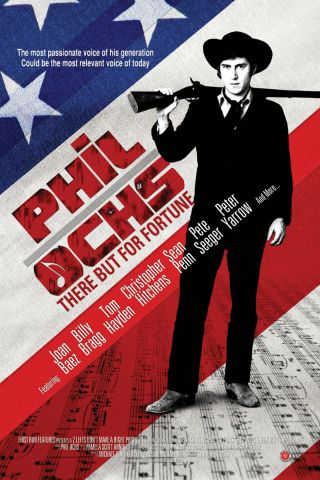
Phil Ochs (1940-1976) was a folksinger and brilliant songwriter who gave us such songs as “I Ain’t Marching Anymore”, “There but for Fortune”, “Love Me, I’m a Liberal” and “The War is Over”. Kenneth Bowser has put together a film documenting Ochs’s life and career. Ochs (pronounced “oaks”) came from a non-political middle class family that moved around the country as he grew up. Ochs attended a military academy, which is a bit ironic, in view of his later anti-military views. While he was still very young, he simultaneously became interested in politics and in the burgeoning folk music scene of the early 1960’s. He moved to Greenwich Village, where he met Pete Seeger and Bob Dylan, and where he began to perform in coffee houses. Ochs was initially a supporter of John F. Kennedy, but in response to the civil rights and anti-war movements, he became increasingly radicalized, especially after the police riot at the 1968 Democratic convention in Chicago.

Ochs was associated with the Yippies for a time, but he eventually came to the conclusion that their tactic of carrying out public pranks was divisive and counterproductive. He believed that the Left needed some way to reach out to a wider range of people, including the working class. He argued that what the country needed was a “combination of Elvis Presley and Che Guevara”. He tried to find ways to broaden the appeal of his act, at one point going so far as to wear a gold lamé suit in imitation of Presley. These efforts yielded mixed results, but I think Ochs was right in believing that the Left has to find new ways to reach out to people.

Ochs supported the Allende government in Chile. The military coup in that country was a great emotional blow to him, especially since his friend, the folksinger Victor Jara, was brutally murdered by the army. (Ochs rightly suspected that the CIA was involved in Allende’s overthrow.) Ochs suffered from bipolar disorder and from alcoholism, and these conditions began to worsen at this time. His behavior became increasingly erratic, and he eventually stopped performing. He committed suicide when he was only 35-years old.

The film has many interviews with people who knew Ochs. Inexplicably, it also has an interview with Christopher Hitchens, who is precisely the sort of warmongering liberal that Ochs despised. Aside from that, Bowser’s film is a moving tribute to a remarkable human being. I highly recommend seeing it.

Into Eternity

April 25, 2011

Nuclear energy has always struck me as a bad idea. The idea that you can simply bury radioactive waste in ground and forget about it (I once heard an MIT professor make this very argument) has always struck as naive. This stuff remains radioactive for one hundred thousand years. We have no idea what the world will look like in one hundred thousand years.

In his documentary, Into Eternity, Michael Madsen investigates the construction of the Onkalo nuclear repository in Finland. (Onkalo means “hiding place” in Finnish.) It is a massive underground tunnel blasted out of granite bedrock. It will be used to store radioactive waste from nuclear plants. It will be closed off after one hundred years, sealed forever (one hopes).

The film is filled with interviews with scientists and engineers working on the project, as well as with the man responsible for detonating the explosives that carve the tunnel out of solid rock (I must say, he is poetic in his observations). They all come across as intelligent and well-intentioned. They discuss the problem of trying to deter people in the future from disturbing the tunnel and its contents. The idea of putting up warning markers, in all the world’s major languages, is the preferred solution. Someone suggests putting up ominous jagged sculptures to frighten people away. Someone else actually suggests that they should simply “forget” about the structure after its done, though this idea is (wisely, I think) rejected.

There are lingering shots of the inside of the tunnel. There is something eerily beautiful about the place, especially since one knows that it will eventually be sealed from human sight forever.

When Madsen asks an engineer if perhaps nuclear energy is more trouble than it’s worth, the latter replies that it is better than global warming. This assumes that our only choice is between nuclear and coal. Madsen doesn’t make the argument that what we need to do is develop renewable energy sources. This would be a far better plan than riddling the Earth’s surface with radioactive tunnels.

The Conspirator

April 18, 2011

Robert Redford’s new film tells the story of the trial of Mary Surratt (Robin Wright), who was accused of being one of the conspirators in the assassination of Abraham Lincoln. Surratt owned the boardinghouse where the conspirators met. Surratt’s assigned attorney, Reverdy Johnson (Tom Wilkinson) persuades a young lawyer, Fredrick Aiken (James McAvoy) to take over the case. Aiken, who was wounded while serving in the Union army, is at first reluctant, but he becomes convinced that Surratt, who is being tried by a military tribunal instead of a civilian court, is being treated unjustly. His attempts to get a fair trial for Surratt are opposed by the Secretary of War, Edwin Stanton (Kevin Kline), who argues that “swift justice” is necessary to keep the country together after the shock of Lincoln’s death.

The parallels with recent events are obvious. This film is an argument for the need to maintain the right to a fair trial even during a national emergency. The film is honest in that it doesn’t try to make a heroine out of Surratt. It makes clear that Surratt knew that the conspirators were up to something, even if she didn’t know all the details. However, the film also makes the point that if Surratt’s son, John (Johnny Simmons), who was one of the conspirators, had been captured right away, she probably would not have received the death penalty. Also, it shows that some of the witnesses against Surratt were not completely honest.

This film’s greatest strengths are the intelligent script and the fine performances. Wright is especially good as Surratt, making the character human without seeming pitiful. Kline exudes a brutal earnestness as Stanton. I recommend seeing this film.

Sidney Lumet (1924-2011)

April 17, 2011

Sidney Lumet has died. He was a prolific director who made films of varying degrees of quality, but he will always be remembered for Dog Day Afternoon, which was one of the best American films of the 1970’s. Lumet was a type of director that we don’t see that much of any more. At a time when the emphasis in Hollywood has been on special effects and on “high concept” stories, Lumet was known as an “actor’s director” who liked to make socially relevant films. His ability to work with actors was justly praised. Even in a creaky Agatha Christie vehicle like Murder on the Orient Express, the performances are fun to watch. He will be greatly missed.

Nostalgia for the Light

April 10, 2011

Nostalgia for the Light the latest film by the Chilean director, Patricio Guzmán, is about the Atacama desert in Chile. It is widely considered to be the driest place in the world. Because of its perpetually clear skies, Atacama is the home to a number of astronomical observatories. It is also of great interest to archaeologists, because of the ruins and numerous petroglyphs left by pre-Columbian peoples.

The place is also the site of a concentration camp used by the Pinochet government. It was originally an abandoned mining camp, but the government found it could easily be converted to a prison. (The point here being that the miners were little more than prisoners themselves.) We meet a former inmate. He talks about how he and other prisoners formed a club devoted to learning about astronomy. Thinking about the vastness of the universe made him feel free. (Interestingly, the film tells us that the Pinochet government was hostile towards science.)

We meet women who spend their time digging in the desert, looking for the bodies of people killed by the Pinochet regime. We also meet an employee at one of the observatories, whose parents disappeared under Pinochet.

Nostalgia for the Light is a meditation on the nature of the past and of the importance of memory. In some ways, it is a subtle rebuke to those Chileans who want to forget the dark moments from their country’s history. In various ways, the film makes the point that the past is always with us.

Of Gods and Men

April 10, 2011

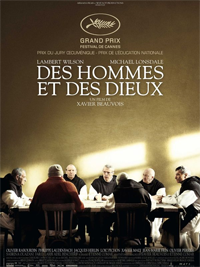
Of Gods and Men, a French film directed by Xavier Beauvois, is based on a real incident. It tells the story of a group of Trappist monks living in a monastery in the Atlas mountains during the Algerian Civil War of the 1990’s. The leader of the monks is Christian (Lambert Wilson). One of the monks, Luc (Michael Lonsdale), is trained as a doctor. He provides treatment for people from the nearby impoverished village. They learn that Islamist rebels have been targeting foreigners. An official urges the monks to return to France, because the government cannot guarantee their safety, but the monks refuse. Luc treats the wounds of one of the rebels. After that, the government suspects the monks of providing aid to the rebels. (In one scene, we see the look of disgust on an officer’s face when he sees Christian praying over the dead body of a rebel.) The monks try to maintain the routines of their existence, despite the pressures on them.

The film mostly depicts the daily lives of the monks. We see their rituals, their prayers, their chores, their dealings with the villagers. The slow pacing of this film may test some people’s patience, but Beauvois wants us to get a sense of how these monks experience time. They grapple with the question of whether they should stay or leave. Although they are afraid, they feel obligated to remain. They have completely committed themselves to their way of life.

In the film’s last scene, we see seven of the monks being led away by the rebels. In the end, faith, duty and honor are not enough to protect us in this world.

Rabbit Hole

March 31, 2011

Rabbit Hole is a film directed by John Cameron Mitchell, based on the Pulitzer Prize winning play by David Lindsay-Abaire. It tells the story of a married couple, Becca (Nicole Kidman) and Howie (Aaron Eckhart), whose very young son was killed in a car accident. The film depicts the differing ways in which they try to deal with their shared grief, and how the differences threaten to tear their marriage apart.

Rabbit Hole tells a story that could easily have become maudlin. Instead, it challenges the commonly accepted notion that tragedy brings people together. It shows how tragic events can bring feelings of guilt, suspicion and jealousy that actually drive people apart. It also points out that there is no easy answer to the question of how and when one should “let go” of the past.

There are some moments in which the story comes dangerously close to melodrama, but Lindsay-Abaire’s script manages to remain rooted in the real world. (This film may not appeal to the sort of sophomore who thinks that The Kids Are All Right is great drama.) The acting is all very good. Nicole Kidman’s performance is searing in its honesty. (I now think that she should have won the Best Actress Oscar instead of Natalie Portman.) Dianne Wiest is subtly touching as Becca’s mother. Eckhart is convincing as Howie.

Mitchell and Lindsay-Abaire have a done a skillful job of bringing this play to the screen. It feels like a real movie, rather than a filmed play.

I highly recommend seeing this film.

Elizabeth Taylor (1932-2011)

March 29, 2011

I feel obligated to note the recent death of Elizabeth Taylor. Although I was never a huge fan of Miss Taylor’s, she appeared in a number of important films, some of which have become classics. I seem to recall Taylor as a ubiquitous presence in the mid-twentieth century American culture that I grew up in, yet when I recently looked at her filmography, I was dismayed to realize that I’ve actually only seen a few of her films. It perhaps says something about Taylor that she seemed such a presence to me despite the fact that I rarely actually saw her in anything.

When I was in high school, I had a 300-pound English teacher who had a twisted sense of humor. One day he had the class watch Suddenly, Last Summer, which was the closest that Tennessee Williams ever came to writing a Grade B horror movie. I don’t remember much about Taylor’s performance, although I vividly recall the scene in which she flounders around in the surf wearing a skin-tight bathing suit. As you can imagine, this made quite an impression on the hormonal teenager I was in those days. (I must say though, what made a greater impression on me was Katherine Hepburn’s profoundly creepy performance as Violet Venable. The moment in which she suddenly turns to Montgomery Clift and exultantly semi-shouts “We saw the face of God!” almost made me fall out of my chair.)

Taylor was never a favorite with critics, though she managed to win two Academy Awards. One of them was for Who’s Afraid of Virginia Woof? I saw this film several years ago, and I must say that I was not that impressed by it. Ernest Lehman’s screenplay pads out Edward Albee’s play, merely making obvious what Albee wisely only hinted at. Again, I don’t remember much about Taylor’s performance, except that she wore a not quite convincing wig, and she yelled a lot. I did, however, like the performance of Richard Burton, who inexplicably failed to win an Oscar. His portrayal of a cynical, jaded college professor was cruelly accurate. (I can say that having known many cynical, jaded college professors in the course of my life.)

Interestingly, Taylor unintentionally had a profound impact on Los Angeles, one of the great cities of the world. (Snicker all you want, you New York snobs.) Taylor starred in the 1963 film, Cleopatra, which, although a huge box office success, cost so much money that 20th Century Fox could only fend off bankruptcy by selling off part of its backlot. (Taylor was paid $7 million – which went a lot farther in those days compared to now – and had 65 costume changes.) Century City was then built in its place. I once had a job working in an office building there. I remember the area as a striking example of bad urban design. It mainly consists of non-descript buildings surrounded by vast, empty lawns. The latter are criss-crossed by cement sidewalks that lead to bleak, charmless concrete plazas. Even in the middle of the day, when there are hundreds of office workers going to lunch, the place seems empty and impersonal. What’s more, there’s no place to park your car, except for a few expensive parking garages. (The company I worked for refused to reimburse me for parking.) I’m told that this place was deliberately meant to be a “city within a city”. The result is that it has no connection to the surrounding urban landscape. You’re in the second largest city in the U.S., yet you might as well be in an office park in Lower Bumfuck, New Jersey.

But I digress.

As too often happens with hugely successful celebrities, Taylor became something of a joke in her later years. Her messy personal life increasingly overshadowed her career. The fact that she put on weight in middle age (something that most people tend to do) was, for some reason, considered hilarious. I remember a Saturday Night Live sketch about an ‘interview” with Taylor (actually John Belushi in a wig and a dress). The “joke” was that Belushi/Taylor was ravenously stuffing his/her face the whole time. The “satire” in this sketch struck me as hypocritical, considering that Belushi was no stranger to carbohydrates himself. Our society seems take a perverse pleasure in seeing the inevitable decline of its once popular idols.

Somewhere

March 19, 2011

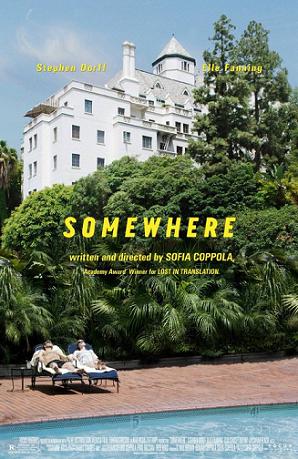
Several years ago, I saw Sofia Coppola’s critically acclaimed film, Lost in Translation. Although it had some funny moments, I nevertheless found it a bit dull. So I had some trepidations about seeing her latest film, Somewhere.

It portrays several weeks in the life of a film actor, Johnny Marco (Stephen Dorff). Like the Bill Murray character in Lost in Translation, Johnny is a celebrity who lives in a state of ennui. (He is so jaded that he falls asleep while making love to a woman he just met.) His estranged wife suddenly leaves his daughter, Cleo (Elle Fanning), with him, telling him he must take care of her until it is time for her to go to summer camp. The two of them spend time together. After he sends her off to camp, Johnny undergoes a crisis. The experiences he had with his daughter made him realize how emotionally empty his life is. Johnny decides to change his life, though the ambiguous ending doesn’t make clear how he will do that.

As in Lost in Translation, there are many scenes in which little or nothing happens. The danger in making a film about a bored character is that boredom is, well, boring. The Japanese setting of Lost in Translation provided that film with some exotic color. Since Somewhere mostly takes place in Los Angeles, it lacks that quality. However, the pacing is a little quicker, so it doesn’t drag the way the previous film sometimes did.

I’m told that Coppola’s film, Marie Antoinette (which I didn’t see), also deals with ennui. I must admit that my empathy for bored rich people is limited. Coppola clearly possesses skill as a director. It would be nice if she were to make a film that deals with a more engaging and compelling topic.

The Fighter

March 16, 2011

The Fighter, directed by David O. Russell, is based on the real-life story of “Irish” Micky Ward, who was a junior welterweight boxer in the 1990’s. The film is set in Lowell, Massachusetts; where Ward is from. I went to school in Lowell for a time. I remember it as a harsh place. It was once a center of the textile industry, but it is now economically depressed. It is one of a number of deindustrialised cities in Massachusetts. In such places that have almost nothing going for them, one of the few sources of local pride are residents who manage to be successful, or semi-successful, in sports. In the film, Micky’s older brother is known as “The Pride of Lowell”, because he once fought Sugar Ray Leonard. (I remember when I was young, Marvin Hagler, who was from Brockton – another faded city in the Bay State – was proudly touted by the local media as the “Brockton Bomber”.)

Micky (Mark Wahlberg) is a fighter who is being trained by his crack-addicted, older half-brother, Dicky (Christian Bale). His career is managed by his domineering mother (Melissa Leo). Dicky’s criminal exploits cause problems for Micky and for his girlfriend (Amy Adams). After an up and down career, however, Micky gets a chance to fight for the world welterweight title.

The Fighter mostly has a realistic feel to it. (There is a lot of hand-held camera work, a sure sign that a film is trying to be “realistic”.) It was mostly shot in Lowell, and the performances are believable. However, there were a few things I found far-fetched. (In one scene, for example, Micky slaps a man in a crowded bar and no one reacts.) And it inevitably runs up against the clichés of the boxing film genre, as the wayward brother redeems himself and the hero gets his shot at the title in the final scene. As boxing films go, however, it is better than Rocky and much better than Cinderella Man. I recommend seeing The Fighter.