Archive for the ‘Cinema’ Category

Waste Land

March 13, 2011

Waste Land is a documentary by Lucy Walker, João Jardim and Karen Harley about the efforts of the Brazilian artist, Vik Muniz, to collaborate with trash pickers in Brazil. Muniz is known for making artworks using unusual materials (wire, chocolate, earthworks, etc.) and then photographing them. He went to one of the world’s largest landfills, Jardim Gramacho, outside of Rio de Janeiro. There he sought out people who make their living by picking out recyclable materials from the garbage and selling them. He made giant portraits of some of them out of trash, which he then photographed.

The film introduces us to several pickers, and we learn about their lives. Not surprisingly, they express mixed feelings about what they do. They defend the way they make a living, and they say it is better than becoming criminals or prostitutes, yet they would clearly rather be doing something else. Some of them were once middle class but have fallen on hard times. Muniz, who comes from a lower middle class family, reflects that with different luck he could have ended up as picker himself. One particularly engaging person is an old man who gives philosophical advice to the other pickers. One gets a sense of a feeling of community among the pickers, who often look out for one another. We meet a young man named Tias who is trying to organize the pickers. What is most remarkable about this film is that it conveys a sense that there is dignity in the way these people make a living.

The film ends on an upbeat note. Muniz donates the money he makes from selling his photographs to the group Tias has organized. Among other things, they use the money to create an educational center. There is even talk of Tias running for President of Brazil some day. I have to admit, I found this film deeply moving (despite the guy sitting behind me who kept laughing at inappropriate moments). With so much bad news, it’s nice to see a documentary that ends on a hopeful note. I especially like that the film suggests that there are ways that art can be used to better the world.

Barney’s Version

March 10, 2011

Barney’s Version, directed by Richard J. Lewis, with a screenplay by Michael Konyves, based on a novel by Mordecai Richler, is essentially the life story of Barney Ponofsky (Paul Giamatti). His first marriage, to an emotionally unstable actress, Clara (Rachelle Lefevre) ends tragically. He then marries another woman (Minnie Driver). At the wedding reception, Barney gets drunk and sees Miriam (Rosamund Pike). He immediately falls in love with her and begins pursuing her aggressively. Eventually, he is able to get divorced and marry Miriam. They have children. When their children are grown, they drift apart. Miriam divorces Barney and marries another man. The film turns sentimental at the end when Barney develops Alzheimer’s disease.

I found Barney’s Version amusing, but there were things in it that I found unbelievable. First of all, I simply didn’t believe that an intelligent woman like Miriam would fall for a dorky character like Barney (who isn’t even good-looking), especially since he makes a complete ass out of himself at their first meeting. And he makes an ass out of himself at their second meeting as well. Yeah, this is another movie about a woman who falls for a guy who is a jerk. If all one had to go by were movies, one would think that the way to win a woman’s heart is annoy the hell out of her while humiliating oneself.

Also, when one of Barney’s friends disappears, a police detective becomes convinced that Barney murdered him. Now when the police want to pin a crime on someone, they can do so easily. Yet the murder accusation is never more than a passing inconvenience for Barney. Again, I just didn’t buy it.

I would have enjoyed this film more if it had been more plausible and less sentimental.

Casino Jack

March 7, 2011

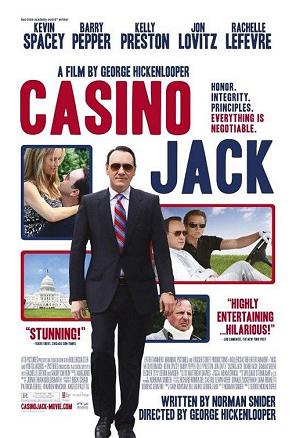
Casino Jack directed by George Hickenlooper (who died just before the film was released) with a screenplay by Norman Snider, is a fictionalized depiction of the Jack Abramoff scandals, with Kevin Spacey in the role of the unscrupulous lobbyist. (Spacey is very good, by the way, as are the other actors in this film.) I thoroughly enjoyed this movie, so I was surprised that Rotten Tomatoes only gave it a 40% fresh rating. The most common complaint in the comments section was that the film doesn’t really explain what makes Abramoff tick. That is true, but a similar criticism could made of many other films. Does The Social Network really explain what makes Mark Zuckerberg tick? I don’t think so. Another complaint that some made was that they found it confusing. I didn’t. Others complained about making a comedy about a man whose actions hurt other people. That argument seems strange to me, when I consider that one of the most popular and critically acclaimed comedies ever made, Dr. Strangelove, is about nuclear holocaust. It doesn’t get any darker than that.

I suspect that what really bothers people about this movie is its frank depiction of the pervasive corruption in our political system. Indeed, the film suggests that Abramoff’s real crimes in the eyes of the government were that he was reckless, indiscreet and actually not very bright. In one scene, a fellow lobbyist warns Abramoff that K Street (where many lobbying firms are located in Washington) is afraid that his relentless self-promotion will draw people’s attention to what they are doing. When Abramoff is called before a Senate committee, he notes that some of the Senators condemning him received money from groups that he represented.

I suspect what may also bother people about this movie is its depiction of religious hypocrisy. Abramoff considers himself to be a devout orthodox Jew. He uses some of his ill-gotten gains to fund the building of a religious school. Some of his partners in crime, such as Tom DeLay, consider themselves to be devout Christians. The film doesn’t explain this behavior, but that is not the point. The point is to show the human capacity for self-delusion. It is also to warn us that we shouldn’t be taken in by politicians who talk about their belief in religious values.

I highly recommend seeing Casino Jack.

White Material

March 3, 2011

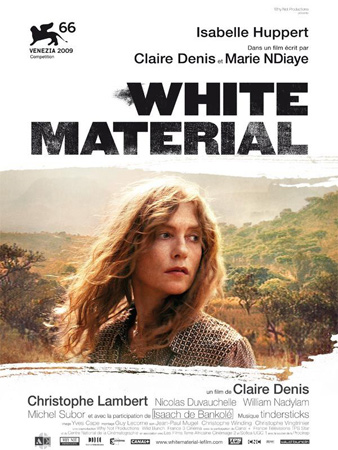
White Material, a film by the French director, Claire Denis, tells the story of a white family living in an unidentified African country. Maria (Isabelle Huppert) runs a coffee plantation along with her husband, André (Christopher Lambert), her indolent son, Manuel (Nicolas Duvauchelle), and her ailing father-in-law (Michel Subor). A civil war is raging in the country, and the French army has pulled out. The soldiers tell her to leave, but Maria is determined to harvest the coffee beans that are ripening. The workers on the plantation leave, but Maria finds new ones. A wounded man shows up on her farm. Maria gives him shelter. She is apparently unaware that he is actually a rebel leader known as “The Boxer” (Isaach de Bankolé).

Denis lived in several different African countries during the time she was growing up. Her films often deal with the relations between Europeans and Africans. White Material is about the futility of European attempts to colonize Africa. Maria and her family have lived in this country all their lives, yet they are basically outsiders. There is clearly a certain amount of self-delusion in the way they see themselves. Maria likes to think of herself as charitable and understanding, yet the workers on her plantation live in squalor. As one watches this film, one has a slowly mounting feeling of dread, because one can clearly sense the looming disaster that Maria desperately tries to deny.

The film never gives much detail about the civil war. We’re never told what the underlying issues are, or who exactly the antagonists are. I suppose this is meant to give us a sense of Maria’s isolation from the society around her. Unfortunately, however, it fits into a pattern in the Western media of depicting African conflicts as incomprehensible. I liked this film, but I thought it would have been stronger if it had given more background information.

The Academy Awards

March 1, 2011


Thank you, peasants, for this award, which is mine by divine right!

I did not watch the Academy Awards. I find awards shows dull. (Although I would have watched if Ricky Gervais had been the emcee.) By all accounts, I didn’t miss anything. Everyone says that James Franco was boring. (Serves him right for bad-mouthing Gervais.) So instead I used the Internet to keep score.

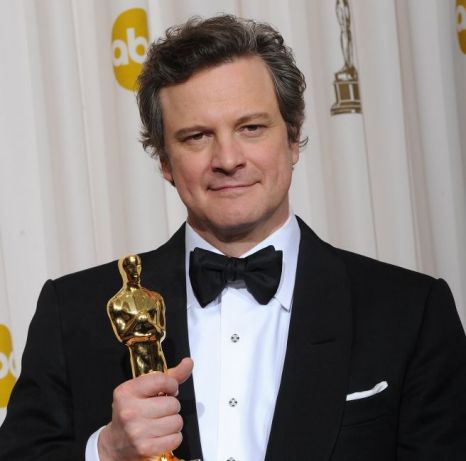
Just as I feared, The King’s Speech won for Best Picture, even though Winter’s Bone and The Social Network are both better films. It also won for Best Director (Tom Hooper), Best Actor (Colin Firth) and Best Historical Falsification – er, I mean Best Original Screenplay (David Seidler). As I said before, the colonials are still in awe of the monarchy. If you don’t believe me, then how do you explain the fact that the 1998 award for Best Supporting Actress went to Judi Dench, for what was merely a cameo role as Queen Elizabeth in Shakespeare in Love? (Dench herself was astonished that she won.) It seems that one merely needs that aura of royalty to impress the members of the Academy.

I can’t really fault the Academy for giving the Best Actress award to Natalie Portman, even though I thought Black Swan was bombastic and silly. However, I would have given the award to Jennifer Lawrence for Winter’s Bone. (I’m told that Black Swan won the Independent Spirit Award for Best Film. I guess this shows that people who make indie films are just as clueless as the the people who work for the studios.)

I can’t judge Christian Bale (Best Supporting Actor) or Melissa Leo (Best Supporting Actress), because I haven’t yet seen The Fighter. Rotten Tomatoes calls it “predictable, but entertaining”. That hardly makes me want to rush out to see it.

I haven’t yet seen any of the Foreign Language films that were nominated. I will have to wait for them to come to my local art house theatre. Best Live Action Short went to the unfunny comedy, God of Love – unfunny comedies being the only kind that Hollywood recognizes. However, Best Animated Short went to The Lost Thing, so they got that right. And I was glad to see that Inside Job won for Best Documentary.

All in all the Academy didn’t embarrass itself too badly. The King’s Speech may not be a great film, but at least it’s not mind-numbing drivel like Forrest Gump (Best Picture, 1994).

Oscar Nominated Shorts

February 24, 2011

Recently I saw the short live action and short animated films that have been nominated for Academy Awards this year. Overall, I liked the animated films better than the live action ones. Animation seems to work better in the short format.

The best of the animations was an Australian film, The Lost Thing. It tells the story of a boy who finds a creature who is half animal and half machine and of his efforts to find a home for it. The story is very simple; the film succeeds mainly because of its depiction of an amusing fantasy world. Also good was Day & Night, a Pixar film, about two humanoid creatures, one embodying day and the other night, and their competitive relationship. (I read afterwards on Wikipedia that the voice-over in the film is from a lecture given by the pop psychologist, Wayne Dyer. Funny, I had completely forgotten there was a voice-over.) The French film, Madagascar, a Journey Diary, is, as the title suggests, an animated travel film about Madagascar, charmingly done. The Gruffalo, a British adaptation of a children’s picture book, is a bit dull, apparently because they padded it out to a half hour, so it could be shown on TV. The weakest of the animated shorts was the American Let’s Pollute, a heavy-handed attempt at satire.

The worst of the live action was an Irish film, The Crush. In it, a school boy develops a crush on his teacher. He becomes jealous when he learns that she is engaged. He gets a gun, and in front of the teacher, he threatens to kill her fiancée. While pleading for his life, the man reveals himself to be an asshole. She cuts off the engagement. The film ends with her showing her gratitude towards the boy for saving her from a bad marriage. I found this ludicrous, and other people in the audience seemed to react the same way I did. Why this film was nominated is a mystery to me.

A little more believable was The Confession, which is from Britain. A boy, Sam, is about to have his first confession. He can’t think of what he has to confess. A pamphlet his priest gives him lists playing pranks as a sin. So Sam decides to play a prank, so he will have something to confess. Sam and his friend, Jacob, steal a scarecrow and leave him in the middle of a road, so it will look like a human body. A driver nearly hits it, swerves off the road, and is killed. Later, Jacob suspects that Sam will tell what they did. They get into a fight and Sam kills Jacob. In the final scene, Sam goes to confession, but he is unable to admit what he did. This film seems to be a criticism of religion, although it’s not clear to me exactly what it’s trying to say. Judging from this film and The Crush, it seems that the Academy likes melodramatic stories about children.

Wish 143, another British film, is about a teenager with terminal cancer, who wants to experience sex before he dies. When he is unable to get a girl to sleep with him, a priest fixes him up with a prostitute. However, the boy merely asks her to hold him. Again, I just didn’t buy it.

The best of the live action films is Na Wewe, which is a Belgian production. A bus going through Burundi is halted by a Hutu militia, who are looking for Tutsis. One by one, each of the passengers has to convince the Hutus that he or she is not a Tutsi. The fear and humiliation of each character is palpable. The film is disturbing, without being melodramatic.

Then, there’s the American film, God of Love. It’s like your typical Hollywood comedy, except instead of being two hours long and unfunny, it’s only fifteen minutes long and unfunny. I suppose this is progress of sorts.

Marwencol

February 19, 2011

Marwencol, a documentary by Jeff Malmberg, is about an artist, Mark Hogancamp, who was attacked and severely beaten by five men outside of a bar one night. He suffered brain damage and lost most of his memory. He also lost his ability to draw, which had been one of his favorite past-times. (Interestingly, Hogancamp had been an alcoholic before the attack, but afterwards lost all desire for drinking.) While recovering, Hogancamp begins buying dolls and constructs a 1/6 scale town in his backyard. He names it “Marwencol” and imagines it to be a village in World War II-era Belgium, where American, British and German soldiers gather to find respite from the war. Through photographs, he creates a series of stories about the residents of the village, who are threatened by SS soldiers. These stories are clearly revenge fantasies, usually ending with Hogie (Hogancamp’s alter ego) being rescued by beautiful women. He also shows a tendency to dote on his female dolls.

Hogancamp is discovered by a local photographer, who bring his work to the attention of an art magazine. They arrange for his photographs to be exhibited in an art gallery in New York. Hogancamp is nervous about the opening, but he finds his work well received. The film ends with Hogancamp having Hogie create his own miniature village within a miniature village.

Although the film doesn’t use the term, Hogancamp’s work can be considered an example of what critics call “outsider art”. This is art that is created outside the boundaries of official culture. Jean Dubuffet, an advocate of this type of art – which he called art brut – once described it this way:

    Those works created from solitude and from pure and authentic creative impulses – where the worries of competition, acclaim and social promotion do not interfere – are, because of these very facts, more precious than the productions of professionals. After a certain familiarity with these flourishings of an exalted feverishness, lived so fully and so intensely by their authors, we cannot avoid the feeling that in relation to these works, cultural art in its entirety appears to be the game of a futile society, a fallacious parade.

Whether or not one agrees with that last sentence, one must admit that there is a growing interest in outsider art, and that it is motivated, at least in part, by a dissatisfaction with the current state of contemporary art: a feeling that art has become too mannered and self-conscious. (The highly entertaining documentary, Exit Through the Gift Shop, touches upon this theme.) In Marwencol, a critic who discusses Hogancamp’s work, notes the complete lack of irony or parody in it. Hogancamp’s fantasy world is meant to be accepted entirely on its own terms.

Marwencol is a celebration of the creative impulse. I highly recommend seeing it.

You can find examples of Hogancamp’s work here.

Four Lions

February 13, 2011

I suppose the fact that people can make a comedy about terrorists is an indication of how far we’ve come since the hysteria following the September 11th attacks. Four Lions was directed and co-written by Chris Morris, who, I’m told, is sort of an English version of Jon Stewart. This film is often called a “satire”, though satirizing terrorism is a bit like satirizing Nazism: an exercise in demonstrating the obvious. Morris more accurately calls it a “farce”, though I would use the term “dark comedy”. As I watched this movie, I was reminded of the classic British comedy, The Ladykillers, although the latter is a much funnier film.

Omar (Riz Ahmed), Barry (Nigel Lindsay), Waj (Kayvan Novak), Faisal (Adeel Akhtar) and Hassan (Arsher Ali) are Islamist terrorists in Sheffield, in the North of England. We’re never told why they became terrorists. The film mostly revolves around their plot to attack a marathon in London. The comedy arises from the stupidity of these characters. Although the film never becomes The Three Stooges Meet Osama Bin Laden, it comes perilously close at times. However, the terrorists are not the only ones who are dense. Everyone they meet is oblivious to the obvious signs that they are planning an attack. And the police are even more stupid than the terrorists are. Interestingly, the only characters in this film who don’t come across as completely clueless are some jihadists that Omar and Waj meet in Pakistan.

As in The Ladykillers, the main characters get themselves killed off, one by one, during the course of the film. What makes the ineptitude of the protagonists in The Laydkillers funny, however, is precisely the fact that we know that they are not stupid. Watching the characters in Four Lions getting killed is a bit like watching stray animals wandering across a freeway. Also, I found their continual bickering a bit wearing at times.

Four Lions does have some funny moments in it. However, Tamara Drewe remains, far and away, the funniest comedy to come out of 2010.

Spirited Away

February 11, 2011

Spirited Away, by the Japanese director, Hayao Miyazaki, is a 2001 anime film. It tells the story of Chihiro, a young girl who is moving to a new town with her parents. On the way, they get lost and stumble upon what appears to be an abandoned amusement park. They find a food stand with hot food but no one around. Chihiro’s parents start eating, but Chihiro is frightened and runs away. When night falls, it becomes clear that the place is populated by spirits. Chihiro finds that her parent have been transformed into pigs. She runs into a boy, Haku. With his help, she gets a job working at a bath house that serves 8 million gods. It is presided over by a sorceress named Yubaba. She renames Chihiro Sen. By taking away her name, Yubaba makes it impossible for Chihiro to return to the human world. Chihiro is determined to rescue her parents and escape from Yubaba.

Spirited Away is a fantasy that touches upon themes of environmental degradation, the corrupting influence of consumerism, and the malleability of identity. In one scene, for example, Chihiro has to prepare a bath for a spirit who is covered with filth. She notices a thorn in his side. When she removes it, a stream of discarded trash (old tires, washing machines, etc.) comes pouring out. The spirit is then revealed to a river god who has been purified of the human waste that has built up in his river.

The characters are complex, none of them are completely bad or completely good, unlike your typical Disney movie. The result is that this film offers a richer and more satisfying experience than your typical fantasy adventure. Spirited Away is beautifully made. Some of the scenes are just gorgeous. At the end of it, one feels as though one has emerged from a dream.

Another Year

February 8, 2011

Another Year, a film by the British director, Mike Leigh, portrays events in a one-year period in the lives of several people. The central characters are an elderly married couple, Tom (Jim Broadbent) and Gerri (Ruth Sheen). Their house serves as the setting for most of the film. Here we see the various people who drift in and out of their lives: Mary (Lesley Manville), a lonely divorcée; Ken (Peter Wight), who eats, drinks and smokes too much; Ronnie (David Bradley), Tom’s brother, who is mourning the recent death of his wife; and Joe (Oliver Maltman), their son. Tom and Gerri seem content and well-adjusted, yet they are unable to be of much help to the unhappy people around them.

I’m told that Leigh’s approach to making a film is to first have his actors improvise scenes, and then he constructs a script based on these scenes. This approach is clearly very effective in Another Year. Everything in this film seems real and convincing. There is none of the contrived melodrama of The Kids Are All Right (which has received four Academy Award nominations, believe it or not). I found myself caring about the characters and what happens to them. This film is subtly tragic, yet there are also funny moments.

The screening I went to was sold out. The audience was mostly older people. I think this shows that there is an audience for films that aren’t just about young people.