Archive for the ‘Cinema’ Category

The Illusionist

February 6, 2011

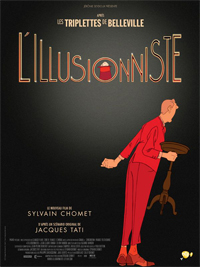
The Illusionist is a French animated film directed by Sylvain Chomet, based on an unproduced script that Jacques Tati wrote back in the 1950’s. He reportedly wrote it as a “personal letter” to an estranged daughter. It tells the story of an unsuccessful stage magician who goes on a tour of Britain. In a small town in Scotland, he meets a young girl, Alice, who believes he actually possesses magical powers. She runs away from the town and follows him to Edinburgh, where they develop a father/daughter relationship.

Anyone who has seen a Tati film will recognize his approach in this movie: understated comedy with moments of pathos. There is very little dialogue. The main character is a well-intentioned, but hapless, outsider who can never quite fit in wherever he goes.

This film is beautifully animated. There is a scene of Edinburgh seen from above that I found just breath-taking. Overall, I found this film enchanting and subtly moving.

Unstoppable

February 2, 2011

I’ve always been something of a railroad buff. I remember when I was a kid, my father built a model railroad set on a pool table in the basement of our house. It was complete with paper-mâché mountains with a tunnel going through them, and a little town. I was heart-broken when my father got bored with it and threw it out. So I just had to see Unstoppable, which is inspired by a real incident of a runaway train.

Due to a mistake by an engineer, an unmanned freight train, carrying toxic chemicals, is sent rolling out of a train yard. On the same day, Will Colson (Chris Pine), a recently hired railroad worker, shows up for work and is teamed up with a grizzled veteran, Frank Barnes (Denzel Washington). Immediately the two men come into conflict. (Does this sound familiar?) However, when they learn about the runaway train, they work together to attach a locomotive to it to try to stop it.

I mostly enjoyed Unstoppable, the action sequences are well done, although the personal conflicts in it are a little pat and familiar. The film touches upon the issue of corporate greed. When the CEO of the railroad is told about the damage a toxic spill from the train could cause, his first question is what effect this would have on the company’s stocks. We learn that the company has been forcing experienced engineers into early retirement, so it can hire younger engineers for less money. The working class heroes have to struggle against the stupidity of the management to avoid a catastrophe.

As I said before, this film was inspired by a real incident that took place in 2001. Not surprisingly, the real story was not quite as dramatic as the film, though the real-life train did carry toxic chemicals. Interestingly, in the film the engineer whose mistake causes the incident is portrayed as a buffoon. In the real-life incident, the engineer was a 35-year veteran who had a good record. This should remind us that even good people can make very bad mistakes sometimes.

I remember seeing a made-for-TV movie about a runaway train many years ago. Does anyone else remember it?

The King’s Speech

January 29, 2011

I went to see the British film, The King’s Speech. (I mistakenly believed the title was The King’s English. Personally, I think my title is more clever.) It was directed by Tom Hooper, based on a screenplay by David Seidler.

Prince Albert, Duke of York, the future King George VI (Colin Firth), suffers from a severe stammer. Since he is required to make speeches, this causes him some embarrassment. At the urging of his wife, Elizabeth (Helena Bonham Carter), he seeks the help of a speech therapist, Lionel Logue (Geoffrey Rush). With Logue’s help, George VI’s speech improves. However, his biggest test comes when he has to give a long radio address to the nation after Britain declares war on Germany in 1939.

As mediocre British films go, I found this one painless to watch. It helped that the acting was mostly very good. Firth and Rush were especially convincing. The only bad performance was by Timothy Spall as Winston Churchill. He looked as though he had a severe case of gas, so much so that I almost expected him to explode.

There was one scene in this film that really bothered me, however. When Stanley Baldwin (Anthony Andrews) resigns as prime minister, he tells George VI that appeasement can’t possibly work and that war with Germany is inevitable. In reality, both Baldwin and George VI were firm supporters of appeasement (the real aim of which, by the way, was to get Germany to attack the Soviet Union). Now, it’s one thing if people want to make sentimental movies about the British royals, but it’s another thing when they falsify history. Clearly the film’s makers wanted to make George VI and Baldwin look better than they actually were. I think it’s legitimate to ask why they would want to do that.

Also Churchill is shown criticizing Wallis Simpson (Eve Best). He wonders what Edward VIII (Guy Pearce) sees in her. In reality, Churchill supported Edward’s right to marry her. Again, one has to wonder what is the reason for this falsification.

Another odd thing is that while Logue’s children grow older during the course of the film, Princesses Elizabeth and Margaret appear to remain the same age.

The King’s Speech has been nominated for twelve academy awards, including best screenplay. It seems that after all these years the colonials are still in awe of the British monarchy.

Monsters

January 21, 2011

As a child, I considered myself a connoisseur of giant monster movies. King Kong and Godzilla were the two classics, but there were various giant insect films from the 1950’s, the best of which was Them!, which is about giant ants that infest the sewers of Los Angeles (perhaps they were hoping to break into the film business.) I also remember one with a giant preying mantis. And there was Reptilicus, about a giant lizard that throws up acid on people. Then there was The Monolith Monsters, about these giant rocks that absorb people. (I remember I found this particularly disturbing for some reason.) And there was The Monster That Challenged the World, which was actually about giant snails that challenge a section of the Salton Sea. (Anyone who has ever been to the Salton Sea knows that’s a pretty good place to set a horror film.) The one that I found the scariest, however, was Kronos (I had nightmares about it), which is about a giant robot from outer space. (And what could possibly be scarier than a giant robot from outer space? Yeah, a Sarah Palin presidency, ha ha. I knew you were going to say that.)

With Monsters, the British director, Gareth Brooks, has bravely attempted to resurrect this beloved genre. A NASA probe has found samples of life outside Earth. While returning to the U.S., it crashes in Mexico. (Great, another reason for the Mexicans to hate us.) Giant creatures grow. Eventually most of northern Mexico becomes an “infected zone”. The U.S. builds a wall along its border to keep the monsters out. Now, I know that this is starting to smell like a political allegory. That’s not quite the direction this film goes in.

Andrew Kaulder (Scoot McNairy) is a photojournalist working in Mexico. His boss has charged him with the task of bringing his daughter, Samantha Wynden (Whitney Able) back to the U.S. Andrew takes her to Mexico’s Gulf coast, where she buys a ferry ticket to the U.S. Through Andrew’s stupidity, however, her ticket and their passports get stolen. (Yeah, this is another movie in which the guy is a total jerk, but the woman falls in love with him anyway.) In desperation, they hire some men to lead them through the infected zone to the U.S. border. Now, this is where the movie started to bug me. They then enter a rain forest. (Even a tea bagger knows that northern Mexico is arid.) What’s more, near the U.S. border they stumble upon a Mayan temple. Porter apparently assumes that most people don’t know anything about Mexico.

After a couple of horrific encounters with the monsters, which look like giant octopuses, Andy and Sam make it across the border. They find a town that has been completely destroyed. The monsters have entered the U.S. They find an abandoned gas station, where they call for help.

Spoiler Alert: I am about to give away the ending. While hiding in the gas station, Andy and Sam observe two of the monsters mating. They then realize that they love each other. I guess there is nothing more romantic that two octopoid creatures trying to reproduce.

At one point in the film it is suggested that the monsters attack people because the U.S. war planes keep bombing them, though this idea is never really developed. And it’s not clear what, if anything this film is trying to say about the current situation along the U.S.-Mexico border.

As giant monster movies go, I would say this film is much inferior to Them! and Kronos.
Made in Dagenham

January 17, 2011

Made in Dagenham is a dramatization of a 1968 strike by women sewing machine workers in Britain. The women made seat covers for Ford Motor Company. The strike led to the passing of the Equal Pay Act in 1970.

When the 187 women who work at the Dagenham Ford plant learn that they’ve been re-classified a unskilled workers and that they are being paid less than male workers, they decide to go on strike. Rita O’Grady (Sally Hawkins) becomes the leader of and spokeswoman for the strike. Their shop steward, Albert Passingham (Bob Hoskins), is supportive of the strike, but his superiors in the union are hostile and they go along with it with deep reluctance. Rita and a group of the strikers eventually meet with Barbara Castle (Miranda Richardson), First Secretary of State in the Harold Wilson government. Castle negotiates a deal in which the women receive 92% of the wage rate that the men receive.

I liked Made in Dagenham, but I thought it could have been a better movie. First of all, it devotes way too much time to Rita’s relationship with her husband, Eddie (Daniel Mays). I would have liked it if we had learned more about the other women on strike. Also, there is a sub-plot about an older worker, Connie (Geraldine James), whose husband, a World War II veteran, commits suicide. This sets up a scene in which Rita gives a patriotic speech to justify the strike. I didn’t buy it. Also, Rita finds an unlikely ally in the wife of one of the Ford executives. I found this far-fetched. And there are also too many scenes of Barbara Castle berating her dim-witted male aides. I guess this is supposed to be comic relief, but it just isn’t funny.

Still, it’s always good to see a film that celebrates the ability of workers to change things.

Note: I’m told that this film was released in Germany under the title We Want Sex. I guess something was lost in the translation.

Face of Another

January 15, 2011

Face of Another is a 1966 film directed by Hiroshi Teshigahara, with a screenplay by Kōbō Abe, based on his own novel.

Okuyama (Tatsuya Nakadai) is a man whose face was severely burned in an industrial accident. He suspects that his wife, Mrs. Okuyama (I’m sorry, but that’s how her name is listed in the credits; played by Machiko Kyô), no longer desires him. He persuades his psychiatrist, Hira (Mikijiro Hira), to contruct a life-like mask for him. The mask looks so real, that people think it is actually his face. Okuyama plans to seduce his wife without her knowing his real identity. He contrives a “chance” meeting with her on the street. The two have tea together, and eventually they go back to an apartment he has rented. After they make love, Okuyama decides to reveal himself to her. Just as he starts to remove the mask, however, she tells him she has known it is really him all along. She thought they were playing a joint masquerade. She is disgusted to learn that he thought he was fooling her. She leaves.

Okuyama goes beserk. He goes out and tries to rape a woman on the street, but the police stop him. They can find no identification on him, only a card with his psychiatrist’s phone number. When they call Hira, he tells them that Okuyama is an escaped mental patient. Hira comes to the police station and they turn Okuyama over to him. Hira and Okuyama walk down the street and enter a crowd of people wearing masks. They have a philosophical discussion. Hira says, “Some masks can’t be removed.” They leave the crowd. Okuyama embraces Hira in a manner that is almost sexual. The latter slumps to the ground. We then see that Okuyama has actually stabbed him. The film ends with a close-up shot of Okuyama pulling at his face. He can no longer remove his mask.

This story is interspersed with scenes from the life of a woman (Miki Irie), whose face was partially burned during the atomic bombing of Nagasaki. I could not see how these scenes related to the main story. They merely seemed like a distraction. It would have been much better if Teshigahara had made a separate film about an atomic bombing survivor.

This film deals with two themes: how our sense of identity influences our behavior, and how our sense of our physical appearance influences our sense of identity. After he dons the mask, Okuyama goes out and buys flashy clothing that are unlike what he usually wears. Hira tells him that the mask is telling him what to do. It is “taking over”.

This film has some creepy moments in it. The effect is not unlike the feeling one gets from reading an Edogawa Ranpo story. Hira, for example, has a “mad scientist” air about him. In one scene, he speculates that if he were to give every person a mask, it would “destroy morality”. He seems to find this prospect enticing. Hira’s office is a bleak, seemingly formless space that could have come out of a Dali painting. At times it seems to exist in a dream world. It raises the question of whether Okuyama is actually imagining things. (This is very Ranpoesque.)

Face of Another is the third of a trilogy of films, the first two being Pitfall and The Woman in the Dunes. I’m told that when Face of Another was released, critics argued that it was inferior to the previous films. I have not seen Pitfall, but The Woman in the Dunes has a very straightforward feel to it. By comparison, Face of Another seems confusing and full of obscure symbolism, such as the crowd wearing masks. Still, I liked the film’s creepy and surreal touches.

Enter the Void

January 13, 2011

Enter the Void is a film by the French director, Gaspar Noé. It tells the story of Oscar (Nathaniel Brown), an American drug dealer who lives in Tokyo with his sister, Linda (Paz de la Huerta), who works as a stripper. At the urging of his friend, Alex (Cyril Roy), Oscar has been reading The Tibetan Book of the Dead. During a police raid, Oscar is shot to death. (It appears that Japanese cops are every bit as trigger-happy as American cops.) We then see things from the perspective of Oscar’s soul floating above the city. He observes Linda and Alex and other people he knows. He also relives experiences from his past, observing himself from behind his shoulder. Noé has said that the film should be viewed as a dream rather than a depiction of life after death: “the whole movie is a dream of someone who read The Tibetan Book of the Dead, and heard about it before being [shot by a gun]. It’s not the story of someone who dies, flies and is reincarnated, it’s the story of someone who is stoned when he gets shot and who has an intonation of his own dream.”

I’m not sure what Noé means by “an intonation of his own dream.” However, it is clear to me that being familiar with The Tibetan Book of the Dead helps to understand this movie. (Noé says he is non-religious.) For example, towards the end of the film there is a series of scenes of people having sex. I could see no reason for this as I watched the movie. I have since learned, however, that according to The Tibetan Book of the Dead, just before the soul is reborn it has a series of hallucinations, typically of men and women passionately entwined. I suspect that if I were to read The Tibetan Book of the Dead, other things in the film would make more sense to me. However, I’m not keen on reading religious texts, so I’m not inclined to read one just to understand a movie.

Noé has said that the visual style of the film was influenced by his use of hallucinogens in the past. There are, indeed, scenes that look very much like things one would see under the influence of hallucinogens. At times this film comes remarkably close to reproducing the sensation of tripping.

What struck me most about the film, however, is its unrelentingly grim view of life. We’re never shown any scenes of people of laughing or enjoying themselves, except for a few brief scenes of Oscar’s early childhood. What’s more, Noé tends to dwell on scenes of human suffering. The impression this film gives is that the only times when people aren’t miserable is when they’re getting high or having sex. (It turns out that the title actually refers to the experience of being born.) Noé has said that the subject of the film is “the sentimentality of mammals and the shimmering vacuity of the human experience.” Clearly, this is not meant to be a “feel good” movie.

The relationship between Oscar and Linda is strange. For example, Oscar is supposedly deeply attached to his sister, yet he shows no concern when she gets a job as a stripper. The film hints at an incestuous relationship between the two. In one scene, Linda nibbles on Oscar’s ear in a sexually suggestive manner. In another scene, they quarrel like lovers.

Some humor would have helped this film. (After all, I’ve been told that even Buddha had a sense of humor.) Perhaps Noé was afraid this wouldn’t convey “the shimmering vacuity of the human experience.”

I found Enter the Void visually fascinating, but I didn’t care for its ponderously bleak view of life.

The Social Network

January 12, 2011

The National Society of Film Critics picked The Social Network as the best film of 2010, so I felt obligated to go see it. I didn’t think a movie about rich, nerdy college students could possibly be that good. It is based on the true story of the founding of Facebook.

The film begins in 2003 when Mark Zuckerberg (Jesse Eisenberg) is an undergraduate student at Harvard. A computer stunt that crashes the school’s computer system makes him a notorious man on campus. The Winklevoss brothers (both played by Armie Hammer) hire him to build a social network site for Harvard students. Zuckerberg takes the idea and runs with it – but without the Winklevoss brothers. He gets his friend, Eduardo Saverin (Andrew Garfield), to put up the money to start his new business. Zuckerberg calls his new social networking site “The Facebook”, and Saverin becomes its CFO. Zuckerberg eventually meets Sean Parker (Justin Timberlake), the founder of Napster. Parker becomes Zuckerberg’s Mephistopheles, helping him to aggressively expand Facebook. He and Zuckerberg conspire to force Saverin out of the company. The film is mainly told through flashbacks during discovery meetings for lawsuits brought by the Winklevoss brothers and by Saverin against Zuckerberg. The film has a “money can’t buy happiness” ending.

Zuckerberg comes off as not really a bad person, just self-absorbed and insensitive. There is an implied irony in the fact that a man with poor social skills creates the world’s most successful social networking site. Since the film is a fictionalized account, I don’t know whether or not it fairly represents any of the people involved. The acting is pretty good though. Eisenberg is believably geeky as Zuckerberg. Timberlake exudes a devilish charm as Parker.

I found The Social Network funny and entertaining, but I do not think that it is a better film than A Prophet or Winter’s Bone. I can only guess that film critics like to watch movies that portray rich people as back-stabbing assholes. So it appears that film critics do have class consciousness.

The Woman in the Dunes

January 7, 2011

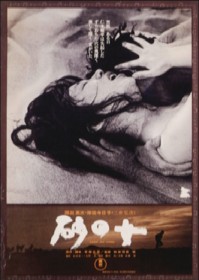
The Woman in the Dunes is a 1964 film directed by Hiroshi Teshigahara, with a screenplay by Kōbō Abe, based on his own novel. Junpei Niki (Eiji Okada) is an amateur entomologist who is collecting insects in dunes near the sea. He misses his bus back to town, so he asks some people from a nearby village if there is a place where he can spend the night. They take him to a pit with a house at the bottom of it. They tell him the woman who lives there (Kyoko Kishida) will put him up for the night. Junpei doesn’t find anything strange or suspicious about this. He climbs down a rope ladder into the pit. He learns that the woman (we’re never told her name) digs sand, which is then hauled up with a rope. The villagers sell the sand. The next morning, he finds that the villagers have pulled up the ladder. They want him to remain in the pit and dig sand with the woman. He refuses to dig and demands that they let him go. The villagers withhold water from him for several days until he finally gives in.

Junpei and the woman develop a sexual relationship. (I can’t really call it a romance, especially since he never asks her what her name is.) Junpei escapes from the pit, but he gets stuck in quicksand and the villagers capture him. Months go by and Junpei becomes resigned to his situation. One day he asks the villagers if he can be allowed to leave the pit for a half hour at a time, so he can look at the sea. They tell him they will let him do it on one condition: that he and the woman have sex in front of them. The woman is revolted by this idea. Junpei, however, is so debased at this point that he tries to rape her – but he is unable to go through with it.

Later Junpei discovers a way to draw water from the sand. He feels immensely pleased with himself. The discovery gives him a sense of self-respect in his humiliating situation. One day, the woman becomes ill. Junpei displays genuine concern for her. He persuades the villagers to take her to a doctor. They lift her out of the pit with a rope. When they are done with this, they forget to pull up the rope ladder. Junpei climbs out of the pit. He walks along the beach for a while, and then he climbs back into the pit. He gazes admiringly at his water trap. He tells himself that he will one day tell the villagers about this discovery, then he will escape. The film ends with a shot of a police bulletin saying that Junpei has been missing for seven years.

The message of this film is that we don’t try to free ourselves because we take consolation in petty achievements. I think there is some truth in this idea. An office worker prides himself on getting the corner office, instead of trying to get rid of the capitalist system that exploits him.

This film is beautifully done. There are many shots of shifting sand. I never before realized that sand can move in surprisingly complex and interesting ways. The sex scenes are subtly erotic and tastefully done.

Tamara Drewe

January 5, 2011

Tamara Drewe is a British comedy directed by Stephen Frears, with a screenplay by Moira Buffini, based on a graphic novel by Posy Simmonds. The film opens at a writers’ colony in Dorset. It is run by Beth Hardiment (Tamsin Greig), who is married to a philandering crime novelist, Nicholas Hardiment (Roger Allam). The lodgers include an American academic, Glen McCreavy (Bill Camp), who is writing a book about Thomas Hardy. Beth is assisted around her farm by a handyman, Andy Cobb (Luke Evans). When Tamara Drewe (Gemma Arterton), a comely young woman sporting a recently surgically shortened nose, moves into the farmhouse next door, Andy (her erstwhile boyfriend) and the lecherous Nicholas both take notice. However, Tamara launches into a romance with a rock star, Ben Sergeant (Dominic Cooper). This draws the attention of two bratty teenagers, Jody and Casey (Jessica Barden and Charlotte Christie), who are obsessed with Sergeant. Their attempts to intrude into the lives of Ben and Tamara set off a chain of events that have consequences for the other characters that are both comic and tragic.

Tamara Drewe is a thoroughly delightful comedy. There is a light-heartedness about it that is just wonderful. Even when, towards the end, the tone of the film suddenly turns serious, there is still a feeling of joie de vivre about it. It never sinks into melodrama, the way The Kids Are All Right does. The acting is uniformly good. I especially liked Roger Allam and Tamsin Grieg. Allam does a very good job of conveying his character’s smug cynicism and complacency. Grieg makes the long-suffering wife very real and sympathetic.

There is a touch of class consciousness in the film, in that Andy’s family was forced to sell the house that Tamara now lives in. More than once Andy refers to himself as a “peasant”. Perhaps not coincidentally, he is the most level-headed character in the film. Having experienced poverty, he has fewer illusions than the other characters do.

I highly recommend this film.