Archive for the ‘Cinema’ Category

So Long, Arnold

January 4, 2011


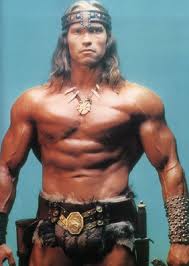
Arnold the Mighty, fearless defender of wealth and privilege.

Arnold Schwarzenegger’s term as Governor of California has ended. He leaves that state the same way he found it, mired in a budget crisis. Schwarzenegger could always have solved that crisis by raising the income tax rate on the richest one percent of Californians, but he steadfastly refused, on principle, to do such a thing. You may recall that several years ago there was a lot of talk of Arnold running for president. There was talk of amending the Constitution so that someone born outside the U.S. could become president. That’s all gone now. Arnold sacrificed his political career just so the richest people in California wouldn’t have to pay higher taxes.

What a guy.

You may recall that Arnold was elected as part of the recall of Governor Gray Davis. Peter Camejo ran as the Green Party candidate in that election. He ran on a solidly left-wing platform, and he actually received a fair amount of attention from the media, something virtually unheard of for a left-wing candidate in the U.S. A strong showing by Camejo would have sent a powerful message. However, some on the left started screaming that Schwarzenegger is a fascist – which he isn’t – and that was enough to stampede people back into the Democratic Party’s fold. So leftists wasted their votes trying to save the sorry ass of the corrupt and incompetent Davis. Once again, we see the self-defeating effect of the “lesser evil” argument.

Arnold’s successor is Jerry Brown, on whom Alexander Cockburn has a man-crush. In his inaugural address, Brown said, “The year ahead will require courage and sacrifice.” I assume he means courage and sacrifice on the part of the working class. Isn’t that always the way it is?

Now Arnold can go back to doing what he does best, which is appearing in action movies. Note that I said “appearing” and not “acting”. This is a guy who gets paid millions of dollars just to show up for film shoots. A lot of working class people voted for Arnold, yet it was too much to hope that someone with his background would have any sympathy or understanding for people who actually work for a living.

When Stan Tookie Williams was facing execution, Arnold could have done the courageous thing and commuted his sentence, but Mr. Action Hero is actually a coward. Another example of the gap between reality and dreams in Hollywood.

Inception

January 2, 2011

I finally got around to seeing Inception. I recently learned that there is a cinema near where I live where you can see a movie that’s been out for a while for a $1.25. So expect some belated movie reviews in the future.

Dominick Cobb (Leonardo DiCaprio) is an industrial spy who enters people’s dreams in order to get information from them. He is hired by a businessman, Saito (Ken Watanabe), to implant an idea into the head of a rival businessman by entering his dreams. Cobb employs a team of people to help him with his plan, but the success of his endeavor is threatened by Mal (Marion Cotillard), Cobb’s subconscious representation of his deceased wife, whom he is accused of having murdered. (Trust me, it will make sense when you see the movie.)

I found Inception entertaining, even though it runs into the same problem that the Matrix movies ran into, which is that it is hard to really care about what is happening when you know that it’s a dream. This especially becomes a problem towards the end, when the action starts to get confusing.

The basic idea in Inception is similar to that of a Japanes anime film, Paprika, which was directed by the late Satoshi Kon. There is a sense of wonder in Paprika that is lacking in Inception. This is because the latter is more concerned with being an action film than with exploring the possibilities of entering people’s dreams.

Inception is one of a number of Hollywood films that take it for granted that governments and trans-national corporations are corrupt. Although it’s nice to see these films acknowledge this, they present this idea in a casual manner that is likely to engender cynicism rather than anger. What’s more, in Inception we are expected to believe that a billionaire can, with just one phone call, immediately negate an arrest warrant for murder. This is in keeping with the conspiracist view of the world, which holds that George W. Bush could, with one phone call, get people to blow up the World Trade Center. Fortunately we have Wikileaks to remind us that the world isn’t that simple.

True Grit

December 28, 2010

True Grit is the Coen Brothers’ remake of the Henry Hathaway film that starred John Wayne. I haven’t seen the earlier film, but I have read the Charles Portis novel that it is based on. Although I liked the novel’s narrative voice, I ultimately found it disappointing. I thought Portis could have done a lot more with the characters and the situation than he did. It ends up being a very conventional Western novel.

Mattie Ross (Hailee Steinfeld) is a fourteen-year-old girl living in Arkansas during the 1870’s. When her father is shot to death by Tom Chaney (Josh Brolin), she swears to get revenge. With some difficulty, she persuades Rooster Cogburn (Jeff Bridges), a U.S. marshal with a sinister past, to pursue Chaney with her. They are joined by a Texas Ranger, LaBoeuf (Matt Damon), who is after Chaney for a separate murder. They follow Cheney into Choctaw Territory, where he has joined an outlaw band led by “Lucky” Ned Pepper (Barry Pepper).

The Coen Brothers have boasted that their film is faithful to Portis’s novel. In fact, they have taken enormous liberties with it. In the film, both Mattie and LaBoeuf speak a heavily stilted English. This is not how these characters talk in the book. I suppose the Coen Brothers thought this was funny; I just found it annoying. Also, we are expected to believe that contractions weren’t yet invented in the 1870’s. I lost count of how many times I heard someone begin a sentence with “Let us…”

Some of the changes are more troubling. In the novel, there is a Native American sheriff who helps Cogburn, LaBouef and Mattie at one point. This character has been completely written out of the movie. (The novel also has a Mexican character who is completely written out of the script.) In the film, Cogburn kicks two Native American boys who are tormenting a mule. If I remember correctly, in the novel the boys are white. Also, there is a scene in the novel of a public hanging. A Native American man is allowed to make a short speech before he is hanged. In the movie, he is dropped through the trap as he starts to speak. (There was some nervous laughter from the audience at this.) Considering that there are so few Westerns that present Native Americans in a positive light, one can only wonder why the Coens made these changes.

I found the movie moderately entertaining, in spite of the cutesy fake Shakespearean English and the problematic politics. Jeff Bridges is appropriately gruff as Cogburn, though at this point in his career he could probably play a gruff character in his sleep. Hailee Steinfeld and Matt Damon do the best they can with their awful lines. It could have been a much better film.

Rare Exports: A Christmas Tale

December 26, 2010

I’m not fond of Christmas movies, just as I am not fond of most Christmas music. I find It’s a Wonderful Life a bit too cute. And I’ve always wondered what the big deal is about Miracle on 34th Street. (This film pretends to be a parody of the commercialization of Christmas, while subtly endorsing it.) The only Christmas movie I can say that I really enjoyed was A Christmas Story, based on stories by Jean Shepherd, because of its realness and lack of sentimentality.

Leave it to the Finns to come up with a Christmas movie that will put a grin on every Grinch’s face. Rare Exports: A Christmas Tale, a film by Jalmari Helander, begins with a rich industrialist leading an expedition to drill in the Korvatunturi mountain on the Russo-Finnish border. The industrialist is convinced that the historical Santa Claus is buried here. (If there’s an historical Jesus, why not a historical Santa Claus?) He turns out to be right, but the historical Santa Claus turns out to be different from the one in modern myth. Instead of bringing gifts to good children, he would punish bad ones. The drilling awakens Santa and his army of elves, just as atom bombs awakened Godzilla. Santa’s helpers kill the drillers and proceed to terrorize a local village, until some of the villagers figure out a way to fight back.

Rare Exports starts out as a seemingly serious horror film, but gradually turns into a comedy. I was still laughing when I left the theatre. This film is a good cure for the Chirstmas blues.

Black Swan

December 24, 2010

Black Swan, a psychological thriller directed by Darren Aronofsky, tells the story of an aspiring ballerina, Nina Sayers (Natalie Portman), who lives with her obsessive, domineering mother, Erica (Barbara Hershey), in New York. Nina dances in a troupe directed by the demanding Thomas Leroy (Vincent Cassel). Thomas is planning a production of Swan Lake, and he needs someone to replace the troupe’s (unwillingly) retiring star dancer, Beth MacIntyre (Winona Ryder), in the starring dual roles of the white swan and the black swan. When Nina auditions for the roles, Cassel tells her that she is fine as the white swan, but that she lacks the passion to play the black swan (who is supposed to be evil). When Nina goes to Thomas’s office to plead for the roles, he makes a pass at her, and she bites him and runs away. After this, he changes his mind and gives the roles to Nina. However, she begins to feel threatened by a new and promising young dancer with the troupe, Lily (Mila Kunis). Nina begins to believe that Lily is actively plotting to steal her roles from her.

Black Swan starts out as an interesting study in the psychological stress that can be engendered in an art form as physically demanding and as intensely competitive as ballet. When Nina begins having hallucinations, these seem like the natural result of the stress she is under. However, the film becomes increasingly melodramatic, so much so that it starts to seem like a bad horror film, with bloody apparitions and people stabbing themselves in the face. At times I almost expected Freddy Krueger to emerge from the shadows. It was so overdone that there were moments when I laughed out loud. Other people in the audience reacted the same way.

I don’t know if I can recommend Black Swan. The film seemed silly to me, but I can’t say that I didn’t find it entertaining. I enjoyed it sort of the way that I enjoyed Starship Troopers, though I think Black Swan was actually meant to be serious.

I’m told that Black Swan has gotten mostly favorable reviews. I suppose if you’re the sort of person who thinks that I Am Love is a great film, you will probably think that Black Swan is a masterpiece.

William S. Burroughs: A Man Within

December 19, 2010

There seems to be a resurgence of interest in the Beats. This is the second time in a week that I’ve seen a film about a Beat writer.

William S. Burroughs: A Man Within is a documentary by Yony Leyser. It features interviews with many people who knew the writer. The film is well-made and provides many details, including film footage of the author himself, yet, when it was over, Burroughs was still something of a mystery to me. It’s still not clear to me what made the man tick. For example, the film discusses at length Burroughs’s obsession with firearms. We learn that he always carried a loaded gun and that he slept with a loaded pistol under his pillow. Yet the movie never succeeds in explaining this behavior. Did Burroughs have an experience that caused him to feel threatened? The film never indicates that he did.

Burrough’s fondness for weapons was bound up with a propensity for reckless behavior. He shot his wife, Joyce Vollmer, to death. (Not surprisingly, their son grew up to be a basketcase who drank himself to death at the age of thirty-three.) He nearly killed himself while doing target practice in his backyard. He shared needles with other addicts. He got himself bit while playing with a venomous snake. One of Burroughs’s friends expresses amazement that he lived as long as he did. The film discusses all these things dispassionately, though I think some moral judgement would have been appropriate here. Just because you’re a genius doesn’t give you the right to be an irresponsible asshole.

Critics have accused Burroughs of romanticizing drug use, but the film makes it clear that he hated being an addict. He quit several times, but he always eventually went back to his habit. As someone who has seen some of his friends develop addictions, I could relate to this part of the movie.

The film devotes a great deal of attention to Burroughs’s influence on the punk rock movement. There are interviews with several musicians, including Patti Smith. Since I’m not a huge fan of punk rock, I can’t say that I found this terribly impressive. I would have liked it if the movie had talked more about Burroughs’s influence on other writers, especially Beats such as Kerouac and Ginsberg.

The film does provide some human moments. We learn, for example, that Burroughs liked cats and that he shared recipes with his friends. Still, for the most part the film confirmed my previous impression of Burroughs as a cold and aloof person.

Howl

December 16, 2010

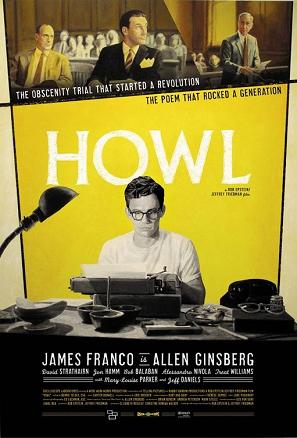
Howl, a film by Rob Epstein and Jeffrey Friedman, examines the circumstances surrounding the publication of Allen Ginsberg’s famous poem and the critical reaction to it. The film has been described by some as a cinematic form of literary criticism.

Much of the film is devoted to the obscenity trial of Lawrence Ferlinghetti (Andrew Rogers), who published Howl. Equal attention is given to an interview that Ginsberg (James Franco) gave at the time of the trial. There is a re-enactment of the famous reading of the poem that Ginsberg gave in 1955 in San Francisco, and there are also scenes from Ginsberg’s early life. There are animated sequences that accompany the reading of the poem.

I found Franco convincing as Ginsberg. Overall, I thought the film was intelligently done, but, except for the some of the animation, I did not find it emotionally engaging. I think that this was due to the device of telling the story of Ginsberg’s life mostly through his interview. People who had a strong influence on Ginsberg (Jack Kerouac, Neal Cassady, Carl Soloman) appear only in flashbacks, and we never hear them speak. (We never even hear Ferlinghetti speak during his trial). Ginsberg refers to his parents repeatedly (he feared his his father’s disapproval), but we don’t really learn much about them. Defenders of the film argue that it is meant as literary criticism, not as an attempt to fictionally portray Ginsberg’s life. Maybe so, but I prefer films that affect me on an emotional as well as an intellectual level.

One thing I can say for the film is that it did make me want to read more of Ginsberg’s writing.

Arcadia Lost

November 30, 2010

Phedon Papamichael’s film, Arcadia Lost begins with the story of Charlotte (Haley Bennett), who is unhappy that her widowed mother has remarried. What’s more, she doesn’t care for her new stepbrother, Sye (Carter Jenkins), who is obsessed with photographing things. During a trip to the Arcadia region of Greece, the family’s car goes off a cliff and into the ocean. Charlotte and Sye manage to escape from the car and swim to shore. There they meet Benerji (Nick Nolte), who spouts New Age gobbledegook and talks vaguely about finding a road. Benerji doesn’t seem very concerned when Charlotte and Sye tell him about what’s happened to their parents. For that matter, they don’t seem too terribly concerned themselves. For reasons that aren’t clear, they decide to follow Benerji around. During their wanderings, Charlotte meets an Australian hunk named Raffi (Lachlan Buchanan) and decides to go off with him. However, she soon realizes that he doesn’t really love her, so she goes back to Sye and Benerji. They then meet Gorgo (Dato Bakhtadze), a creepy guy who wears a monk’s outfit. At this point, Benerji, who doesn’t seem to care for Gorgo (who can blame him?) decides to take off by himself. Gorgo then tries to rape Charlotte, but Sye rescues her. After they escape from Gorgo, Sye announces to Charlotte that they must go to a place called Parnonas, but he doesn’t really explain why. He doesn’t know how to get to Parnonas, but he knows that they will find a way. They then wander around Greece for a while, until they finally arrive at Parnonas, where they immerse themselves in a lake. The film’s ending is ambiguous: it seems to suggest that it was all a dream, but then again, maybe it wasn’t.

This film is clearly symbolic. Benerji represents spirituality, while Gorgo represents materialism. Charlotte and Sye represent the innocence and restlessness of youth. The film is beautifully shot, with lots of gorgeous views of the Greek countryside. The characters undergo growth in the course of the film. Sye becomes less of a geek, and Charlotte becomes more thoughtful and serious. Still, I found it hard to care about them, since it was often unclear what their motives were. What’s more, they seemed strangely blasé about their parents’ deaths. And I found Benerji just annoying. Overall, this film doesn’t seem to accomplish its goal – whatever that is.

Crispin Glover

November 27, 2010

Crispin Glover performed at the Bijou Art Cinemas in Eugene last week. The first part of the show consisted of a slide show in which he read passages from old books that he had rearranged into stories. The stories were surreal, mysterious and funny. (One of the books Glover used is titled Studies in Rat Catching. I will have to add this to my reading list.)

In the second half he showed a film he had made entitled It is fine! EVERYTHING IS FINE. The film was written by, and starred, Stephen C. Schwartz, who was born with a severe case of cerebral palsy. It is basically about a man with cerebral palsy who fantasizes about having sex with women and then murdering them. That’s pretty much all there is to this film. (Oh, and he fantasizes about necrophilia as well.) The movie is a little over an hour long, but watching it seems like an eternity.

Glover did a question and answer session after the film was over. I would have stayed for this, but it was getting late and I had to get up early to go to work the next morning. Instead I read an interview with Glover in the Eugene Weekly. The interviewer asked him about another film he made, titled What Is It?, which employs actors who have Down’s Syndrome:

    Much has been made, and I’m sure critics have been divided, about the issue of using actors with Down syndrome in the films. How would you weigh in on this debate? Is it your intention to shock your audience or to make the viewer uncomfortable?

    Most of the actors in What is it? have Down syndrome, but the film is not about Down syndrome at all. The actors in the film are not necessarily playing characters that have Down syndrome. It was and is extremely important to me that all of the actors in the film were and are treated respectfully. What is it? is my psychological reaction to the corporate restraints that have happened in the last 20 to 30 years in filmmaking — specifically, anything that can possibly make an audience uncomfortable is necessarily excised or the film will not be corporately funded or distributed. This is damaging to the culture because it is the very moment when an audience member sits back in their chair, looks up at the screen and thinks to themselves, “Is this right what I am watching? Is this wrong what I am watching? Should I be here? Should the filmmaker have made this? What is it?” And that is the title of the film.

    What does it mean to the culture when it does not properly process taboo in its media? It is a bad thing when questions are not being asked because these kinds of questions are when people are having a truly educational experience. For the culture to not be able to ask questions leads towards a non-educational experience and that is what is happening in this culture. This stupefies this culture and that is of course a bad thing. So What is it? is a direct reaction to this culture’s film/media content.

    Steve [screenwriter Steven C. Stewart, who died within a month after filming on It is fine! EVERYTHING IS FINE. was completed] had been locked in a nursing home for about 10 years when his mother died. He had been born with a severe case of cerebral palsy, and he was very difficult to understand. People who were caring for him in the nursing home would derisively call him an “M.R.,” short for “mental retard.” This is not a nice thing to say to anyone, but Steve was of normal intelligence. When he did get out he wrote his screenplay. Although it is written in the genre of a murder detective thriller, truths of his own existence come through much more clearly than if he had written it as a standard autobiography.

Well, It is fine! EVERYTHING IS FINE did make people uncomfortable. There was nervous laughter throughout the film, and I could hear people squirming in their seats. Some people got up and left, though they eventually came back. The film is disturbing because it was clear that Schwartz was acting out his own resentment and anger towards women, and this anger and resentment were were intimately bound up with his having cerebral palsy.

This brings me to an important question: is it sufficient for a work of art to be merely disturbing? (I would argue that the best works of art are disturbing on some level.) The world offers us an abundance of disturbing images, disturbing events, disturbing arguments, etc. Art that is merely disturbing just adds to the noise.

Subtract the shock value from It is fine! EVERYTHING IS FINE and you’re left with nothing. The film doesn’t even succeed on a purely technical level: the acting and direction are amateurish, and the sets and costumes look embarrassingly cheap.

Glover should stick to doing slide shows.

Heartbreaker

November 26, 2010

I’m not keen on romantic comedies. I suppose this is because they always follow a familiar pattern, with a couple of “opposites” eventually falling for each other after numerous tribulations. Also in these films the man is usually made out to be a jerk, which makes it unbelievable when the woman eventually falls for him.

The French film, Heartbreaker is one of the better romantic comedies that I’ve seen, because it has a few genuinely funny moments in it. However, it stays true to the genre by eventually sinking into complete unbelievability. The film tells the story of Alex (Romain Duris, who, although he never seems to shave, never grows a full beard), who along with his sister, Mélanie (Julie Ferrier, who was in Micmacs), and her husband, runs a business that breaks up undesired marriages. This is done by having Alex seduce the woman in each relationship. Now, obviously, any man who could do this for a living would have to be a cold-hearted bastard, yet we are supposed to believe that deep down Alex is really a decent guy.

An industrialist, Van Der Becq, hires Alex to break up the pending marriage between his daughter, Juliette (Vanessa Paradis, who needs to have braces put on her teeth) and Jonathan (Andrew Lincoln). Alex pretends to be a bodyguard hired by Van Der Becq to watch Juliette, and he begins his usual process of seduction. However, this time, just as you expect, he actually falls in love with his intended victim. Of course the film ends with Juliette leaving Jonathan for Alex. The idea seems to be that Alex appeals to a wild streak in Juliette’s personality that the staid Jonathan can never satisfy. However, we are still left with the fact that Alex is basically a creepy sort of gigolo. (And let’s not forget his creepy beard that never seems to grow out.) Though this sort of thing apparently doesn’t bother people who like romantic comedies.