Archive for the ‘Cinema’ Category

Snake Oil

October 4, 2010

I can’t go to the movies nowadays without having to sit through the trailer for Waiting for Superman. This is a film that promotes the neoliberal quackery on education (privatization, charter schools, standardized tests). It doesn’t seem to bother the people advocating this stuff that there is no evidence that students do any better in charter schools than in public schools. Charter schools are being offered up as the all-purpose remedy for our nation’s education woes, and people are being urged to line up to get their share.

What really bugs me, though, is this emphasis on standardized testing. Call me old-fashioned, but I believe that an education consists of something more than just an ability to answer multiple-choice questions. (Having taken quite a few standardized tests in the course of my life, I know that there are ways to sometimes guess the correct answers on these things.) Standardized testing is a poor way of preparing students for college. Engineering students, for example, are expected to answer problem-solving questions. Standardized tests will not prepare them for this. College students are expected to be able to write clearly and to organize their thoughts. Standardized tests will not prepare them for this.

I suspect that this push for standardized testing has to do with the needs of U.S. capitalism right now. In the years following the Second World War, there was a big emphasis on getting students to learn science and engineering. This reflected the needs of many corporations at that time. Today, with much of manufacturing shipped overseas, corporations don’t have as much need for people with that kind of training. Standardized testing will create a generation of people who are good at clerical work, which seems to be what the capitalists need right now. The aim is to create a generation of bean counters.

The current push for education “reform” has, however, two main goals: to smash the teacher’s unions and, more importantly, to turn our schools into cash cows for private companies.

I’m Still Here

September 29, 2010

The mockumentary, I’m Still Here, is part of a hoax carried out by Joaquin Phoenix with the help of Casey Affleck. The idea was to convince people that Phoenix had quit acting in order to become a hip-hop artist. Since rumors immediately began to circulate that the whole thing was hoax, it can’t be said to have been very successful. Its main result is this film, ostensibly a documentary following Phoenix during the roughly yearlong period when he was supposedly pursuing a career in hip-hop. In it, Phoenix portrays himself as a sleazy and unpleasant character. We see him snorting cocaine, picking up prostitutes, and spewing verbal abuse at the people around him. There are moments that are clearly meant to be shocking: we see a man defecate on Phoenix’s face, and there’s an extended scene of Phoenix throwing up into a toilet. One of the jokes in the film is supposed to be that Phoenix is unaware that he’s terrible as a hip-hop artist. (The best thing in this film is the expression on Sean “Diddy” Combs’s face while he’s listening to some of Phoenix’s recordings.) There are a few funny moments, but overall I just found this movie annoying. The irony of all this is that Phoenix’s clumsy and heavy-handed parody of celebrity self-absorption and narcissism leaves one suspecting that perhaps he really is self-absorbed and narcissistic, just not in the way that’s shown in this film.

Animal Kingdom

September 25, 2010

Animal Kingdom is an Australian crime film that, I’m told, is loosely based on real events. It tells the story of ‘J’ (James Frecheville), a teenager, who, when his mother dies of a heroin overdose, is forced to move in with his criminally inclined relatives. These include coke-snorting Uncle Craig (Sullivan Stapleton), creepy Uncle Pope (Ben Mendelsohn), and the family matriarch, Mama Smurf (Jacki Weaver). J tries to keep himself aloof from their criminal activities. When, however, a family friend, Baz (Joel Edgerton), is killed by a cop, Pope demands that the family take revenge, and J finds himself drawn into the family’s violence. He eventually tells everything to the police, but his family persuade a crooked cop to try to kill him. The film ends with a twisted version of the return of the prodigal son.

Like Winter’s Bone, Animal Kingdom is about the difficult choices an individual must make to survive in a corrupt world. J finds that he can’t rely on the police any more than he can rely on his family. His only hope is to play the two sides off each other.

Although the acting is all very good, Jacki Weaver steals the film as Mama Smurf. One can sense the cold-bloodedness that underlies her relentless cheeriness. Very creepy.

Highly recommended

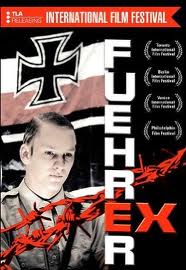
Führer Ex

September 19, 2010

I recently saw the 2002 German film, Führer Ex. I found it an odd and somewhat disappointing film. It is ostensibly about the neo-Nazi movement that flourished right after the re-unification of Germany. However, because most of the film takes places inside an East German prison, it’s really more about the brutality of prison life than about Nazism. (Judging from this film, the prisons in East Germany weren’t any worse than prisons anywhere else.) It is ostensibly based on a memoir by Ingo Hasselbach, though it bears no resemblance to the excerpt that I read in The New Yorker.

Tommy (Aaron Hildebrand) and Heiko (Christian Blümel) are two bored, disaffected teenagers living in East Berlin just before the fall of the Berlin Wall. They try to cross the border into the West but are caught. In prison, they gravitate towards an unrepentant Nazi, Friedhelm (Harry Baer), because he offers them protection from the other prisoners. When Heiko is put in solitary confinement, the Stasi use this to pressure Thomas into becoming an informer. After the fall of the Berlin Wall, they join an open neo-Nazi group in Berlin under Friedhelm’s leadership. One day Friedhelm tells Heiko that Tommy was a Stasi agent, so he must kill him. Heiko is unaware that Tommy became an informer to save his life. Meanwhile, Tommy has become disillusioned with the Nazis, after they kill a friend of his, a young girl. Heiko confronts Tommy, but he can’t bring himself to kill him. Tommy is subsequently killed by other Nazis. Heiko then quits the Nazis.

As I said before, most of the film takes place inside a prison. In these scenes, the prisoners are all concerned with power relationships between one another. These relations are enforced through the use of rape. When, for example, Heiko humiliates another prisoner, his cellmate demands that Heiko submit to him. The film seems to be saying that in the absence of the normal rules of society, these power relationships become an obsession for people. It may also be that these actions are a response to the boredom and dreariness of prison life.

One of the weaknesses of the film is that we’re not told much about Friedhelm, who only appears in a couple of scenes, even though he’s clearly an important character. We don’t get any sense of why people are attracted to him. Also, a large chunk of the film is devoted to a pointless subplot about Thomas’s efforts to escape from the prison. I don’t know why the fimmakers saw fit to include this, especially since we know that Heiko and Tommy are going to be released from prison anyway.

This film didn’t give me any insight into why some people are attracted to far right and racist ideologies. It seems to imply that the neo-Nazi movement in the wake of re-unification was a reaction against the East German state. (In one scene, one of the Nazis claims that they were all taught “lies” about Hitler in the Communist-run schools.) However, this doesn’t explain why there were (and are) neo-Nazi groups in western Germany as well as in the east.

All in all, this film is really more of a melodramatic adventure movie than a social analysis.

Micmacs, Get Low, The Eclipse

September 7, 2010

The French director, Jean-Pierre Jeunet, makes fantasies that are aimed at adults. In that sense, he’s sort of a cinematic E.T.A. Hoffmann. His latest film, Micmacs tells the story of Bazil (Dany Boon), an orphan whose father was killed by a land mine. When a shooting takes place outside the video store where Bazil works, he is struck in the head by a stray bullet. When he leaves the hospital with the bullet permanently lodged in his head, he finds that he has lost his job. He tries to support himself by working as a street performer, until he is befriended by a street vendor and former criminal, Pacard (Jean-Pierre Marielle). The latter takes him to a junkyard, where he introduces him to the Micmacs, a “family” of oddballs living in a sort of cave made out of junk. There they collect discarded items and turn them into useful objects or works of art. Bazil is welcomed into the group. One day, while out collecting scrap, he finds himself between two buildings. One is the headquarters of the company that made the mine that killed his father, the other is the company that made the bullet that is lodged in his head. Bazil then persuades the other Micmacs to help him get revenge on these two companies.

Micmacs is permeated with a uniquely French type of whimsicality, while it deals with a serious topic, the international arms market. The film’s aim is too broad to really make an effective statement. I nevertheless found it highly entertaining.

Get Low tells the story of Felix Bush (Robert Duvall), a hermit who has lived alone in the woods for forty years. He is the subject of many rumors among people in the nearby town. One day he tells the local undertaker, Frank Quinn (Bill Murray) and his assistant, Buddy Robinson (Lucas Black), that he wants to have his funeral while he’s still alive. This “funeral” will actually be a party, at which people will be invited to tell whatever stories they have heard about him. Soon, however, it becomes clear that Bush’s real intention to reveal a dark secret from his past.

I mostly liked Get Low, but I had a few problems with it. For example, some of the townspeople show an extreme hostility towards Bush that really isn’t explained. Also, it turns out that Bush’s only close confidant is a Black preacher (Bill Cobbs). I found this a bit of a stretch, since the film takes place in the South during the 1930’s. And in one scene an elderly preacher says that his mother used to call gossip “the devil’s radio”. Since radios didn’t become common until the 1920’s, I found this something of an anachronism. On the other hand, I liked that there wasn’t a flashback when Bush reveals his secret. Instead, Bush relates everything in a monologue, which was more powerful than a flashback would have been. Duvall turns in a good performance, and Murray displays his usual wry charm.

As a dialectical materialist, I must guiltily confess that I’m a sucker for ghost movies. (My two favorites are The Uninvited and Dead of Night.) That’s why I went to see the Irish film, The Eclipse, even though the trailer didn’t look promising.

Michael Farr (Ciarán Hinds) is a teacher living in Cobh, Ireland. He’s been seeing his father-in-law’s ghost, which is quite disturbing, especially since his father-in-law’s not dead. Farr is a volunteer for that city’s annual literary festival. His job to chauffeur Lena Morelle (Iben Hjejle), who writes books about ghosts, around town. (In one scene, Morelle tells him that her belief in ghosts led her to study particle physics. Uh, yeah.) Farr confides in her about his visions. Morelle is being pursued by her ex-lover, Nicholas Holden (Aidan Quinn), a novelist. A sort of romantic triangle soon develops between the three.

I found The Eclipse an unsatisfying film. At the end, it’s not clear whether Farr was actually seeing ghosts or whether he was just having nightmares. The film uses sudden loud noises and things like arms suddenly reaching up out of the ground to get its scary effects. This struck me as a little trite, though I have to admit that such clichés can still be viscerally effective at times.


The American

September 4, 2010

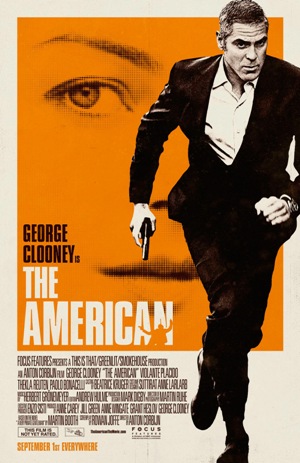
The American has only gotten a 61% approval rating at the Rotten Tomatoes website.(The Kids Are All Right, a contrived and dishonest film, has a 96% approval rating.) I can only assume that some people don’t like understated thrillers. The American is one of the more entertaining films I’ve seen this year.

Jack (George Clooney) is a professional killer who travels throughout Europe. After carrying out a bloody assignment in Sweden, he goes to Rome to meet his boss. The latter sends him to a small town in Italy, where he is to await his next assignment. Ignoring his boss’s orders to keep to himself, Jack becomes romantically involved with a prostitute, Clara (Violante Placido), and he becomes friends with a priest, Father Benedetto (Paolo Bonacelli). The latter begins to act as the conscience that Jack lacks. He tells Jack that Hell is “a world without love”, the implication being that this is the world that Jack inhabits.

Jack is an expert on firearms. He is ordered to construct a rifle for another professional killer, Mathilde (Thekla Reuten). As he does so, Jack begins to suspect that he is being betrayed, but he is not sure by whom or for what reason.

I said before that The American is an understated film. The dialogue is sparse, and the tension builds slowly. The director, Anton Corbijn, is highly adept at creating emotional effects with a minimum of resources. When, for example, Jack suddenly finds himself in an empty cafe, we feel his fear that he is being set up. The scenes of Jack methodically building Mathilde’s rifle serve to draw us into his world. It’s not often you see such skillfulness in a Hollywood film nowadays. Oh, and there are breathtaking shots of the Abruzzo region of Italy.

Highly recommended.

Coco Chanel & Igor Stravinsky

August 20, 2010

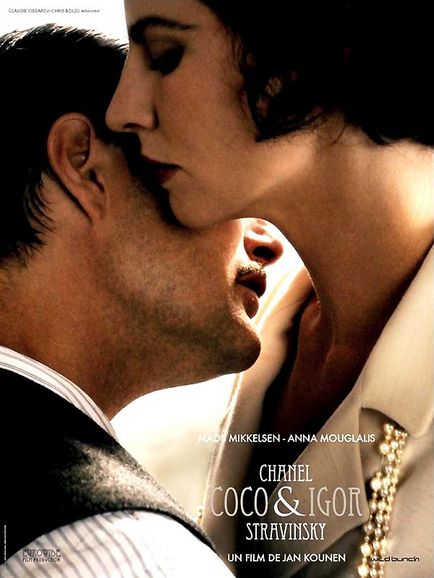
Whenever I’m watching a biopic, what’s usually uppermost in my mind is the question of how much of what I’m watching is bullshit. In the case of Princess Kaiulani, it was clear that it was almost entirely bullshit. Jan Kounen’s Coco Chanel & Igor Stravinsky, based on a novel by Chris Greenhalgh (who also wrote the screenplay), seems to have at least some bullshit in it, though how much I’m not sure.

The film starts out promisingly, with a depiction of the disastrous premiere of Stravinsky’s ballet, The Rite of Spring in 1913, at which the police had to be called in to prevent a full-scale riot. (The filmmakers recreate Nijinsky’s controversial choreography.) The film then jumps to the year 1920. Coco Chanel (Anna Mouglalis) is introduced to Stravinsky (Mads Mikkelsen) at a party. She invites him and his family to stay at her villa outside Paris. Stravinsky, who is living in straitened financial circumstances at the time, can’t afford to say no. Shortly after he and his family move in, he begins having an affair with Chanel. Eventually she demands that he leave his wife, Catherine (Elena Morozova). Stravinsky waffles. Finally Catherine, who has learned of the affair, decides the issue by leaving with her children. However, Chanel rejects Stravinsky at this point, apparently because she’s disenchanted with his indecisiveness. She nevertheless provides the funding for a new performance of The Rite of Spring.

The idea behind this movie apparently is that the love affair between Chanel and Stravinsky inspired them both to new levels of creativity. I didn’t really get this impression from the film, however, because Stravinsky mostly just revises The Rite of Spring. (Though Chanel does invent Chanel No. 5, which is something, at least.) I found it hard to become emotionally engaged with this film. Chanel comes across as cold and Stravinsky as self-absorbed. Perhaps they were like that in real life, but this doesn’t make for a compelling romantic film. I think I would have liked this picture better if it had shown more about the Parisian music scene of the time, instead of being so focused on the alleged romance between the title characters. Still the opening scene alone is almost worth the price of admission.

The Kids Are All Right

August 18, 2010

Hollywood doesn’t have a good track record when it comes to films about gays. The contrived and unconvincing Brokeback Mountain was considered a breakthrough. Now we have another contrived and unconvincing film, The Kids Are All Right, which has also been a subject of critical praise.

Jules (Julianne Moore) and Nic (Annette Bening) are a lesbian couple who have each had a child from an anonymous sperm donor. Their children, Joni (Mia Wasikowska) and Laser (Josh Hutcherson), are now teenagers. When Joni turns eighteen, Laser persuades her to get in contact with their biological father. He turns out to be Paul (Mark Ruffalo), a charming and somewhat raffish character. Joni and Laser take an immediate liking to him. Through them he eventually meets Jules and Nic. Jules has just started a landscaping business, and Paul hires her to work on his yard. They begin to have an affair. Obviously this is a situation fraught with all sorts of possiblities, but the film veers into melodrama when Nic finds out about their relationship. In the film’s climatic scene, Nic righteously tells Paul that he is an “interloper” in their family – a silly thing to say, since it was her family that first approached Paul.

So, this film ends up being a cautionary tale about the need to defend the lesbian nuclear family against home-wreaking sperm donors. In attempting to depict a lesbian family, the film reverts to a tired Hollywood formula.

Another thing that bothered me about this film is that in one scene Jules fires an employee whom she suspects of knowing about her affair with Paul. She later justifies this by claiming that he was a drug addict. The film treats this sleazy behavior as a minor character flaw. This only makes the film’s melodrama even more distasteful.

Winnebago Man

August 16, 2010

The Internet continues to change our culture in various ways. In recent years we have seen the phenomenon of the YouTube celebrity (one website uses the term, “viral video superstar”.) One such person is Jack Rebney. He did an industrial film for the Winnebago company in 1989. The out takes, in which Rebney repeatedly loses his temper, were circulated on videotape among collectors. When YouTube was created, the video was immediately uploaded, and it has been viewed by millions of people since.

The documentary filmmaker, Ben Steinbauer, was curious about Rebney and wanted to know what happened to him. With the help of a private detective, he tracked down Rebney and found him living in a cabin in the mountains of Northern California. At first, Rebney tells Steinbauer that he doesn’t mind his notoriety. However, Rebney finally admits that he finds the video humiliating. He hates the Internet and he despises the people who watch the video. (He refers to them as having “room temperature IQ’s”.) With great difficulty, Steinbauer manages to persuade Rebney to attend a found video show in San Francisco. Rebney is pleased by the reception he gets there, and he finds that the people in the audience are intelligent and very appeciative of what he’s done.

I greatly enjoyed Winnebago Man. However, as I watched it, I kept getting the feeling that Rebney is perhaps a more interesting person than the filmmakers were willing to document. When they first approach Rebney, he wants to talk about his political views. They try to get him to talk about his childhood and his marriage instead. He refuses to discuss these things. At one point they try to film Rebney standing in front of a Wal-Mart, but the store manager chases them away. We never learn what it is that Rebney wanted to say about Wal-Mart. We do hear Rebney make some snarcky comments about Dick Cheney, but that is almost all we get about his politics. (In the out takes shown with the end credits, we see Rebney making fun of Arnold Schwarzenegger.) My suspicion is that the filmmakers were intent on trying to make Rebney come across as likable. I think the film might have been more interesting if they had let the old man rant.

Winter’s Bone

August 9, 2010

Winter’s Bone, which was written and directed by Debra Granik, based on a novel by Daniel Woodrell, is set in the Ozark mountains in southern Missouri. It tells the story of a seventeen-year-old girl, Ree Dolly (Jennifer Lawrence), whose father is a crystal meth maker. Because her father is not around much of the time, she has to take of her mentally ill mother and her younger brother and sister. The sheriff tells her that her father has put up her family’s farm as bond for an upcoming court appearance. If he fails to show, they will lose their farm. Ree sets out to find her father to make sure that he goes to court. However, her questions about her father’s whereabouts are greeted with hostility from almost everyone she meets. She gradually come to the conclusion that her father has been murdered.

There are no good guys vs. bad guys in this film. Almost everyone Ree meets is either directly or indirectly involved in the meth business. The local law enforcement proves to be corrupt. Ree shows no interest in finding justice for her father; she only wants to save her family’s farm.

Winter’s Bone is about the difficult choices individuals have to make to survive in a society that has become thoroughly corrupt. Although a bleak film, it shows a deep sympathy for its characters. I was impressed by the acting, which I found thoroughly convincing.

Highly recommended.