Archive for the ‘Cinema’ Category

Winter’s Sleep

January 30, 2015

Winter_Sleep_(Poster)

Nuri Bilge Ceylan’s film, Winter’s Sleep, is set in a village in Cappadoccia. Aydin (Haluk Bilginer) is a hotel owner and also a landlord for many of the people in the town. He lives with his young wife, Nihul (Melisa Sözen), and with his sister, Necla (Demet Akbağ). During the course of the film, Aydin gradually becomes aware that many of the people in the town dislike him. He also learns that Nihul and Necla are both unhappy with him.

Winter’s Sleep is about how wealthy people are often unaware of how their actions look to other people or even how these actions affect other people. Aydin writes a newspaper column, in which he makes high-minded pronouncements about how people should behave. Yet when one of his tenants falls behind on his rent, Aydin sends men to take his TV as payment, and they beat up the man when he tries to resist them. Aydin thinks of himself as a generous person, but at times he reveals contempt and mistrust towards the townspeople. When, for example, Nihul forms a charitable group, Aydin worries that they might try to swindle her. Aydin’s wealth creates both a material and a psychological gulf between him and other people.

There are long scenes in this film of Aydin talking to Nihul or to Necla. These scenes may test some people’s patience. (They tested mine.) However, if you stick with this film, it is ultimately rewarding. Ceylan is similar to Chekhov in that he is interested in people who feel unfulfilled in their lives.

Chris Kyle, Michael Moore, and the Irrelevance of Heroism

January 22, 2015

04author_2-articleLarge
Chris Kyle

The enormous popularity of Chris Kyle’s memoir and the movie based on it shows that many Americans are still unwilling to face the truth of what happened in the Iraq War. This war was not about “fighting terrorists”, but about invading a country in order to control its resources. Unless and until people are willing to acknowledge this, they will not be able to make sense of this country’s recent history. Unfortunately, many people prefer a Hollywood fantasy about soldiers fighting “savages” to the truth.

The Iraq War was based on bluster and self-delusion. It is only fitting then, that its most famous hero was a liar and a braggart. The many stories Kyle made up suggest that he may have had difficulty distinguishing fantasy from reality, which would make him very typical of our times.

A few days ago Michael Moore tweeted:

    My uncle killed by sniper in WW2. We were taught snipers were cowards. Will shoot u in the back. Snipers aren’t heroes. And invaders r worse

Moore’s remark was clearly aimed at Kyle, but when he was pressed on the matter, he became coy, changing the subject by saying that he liked Clint Eastwood’s film about Kyle. (“Costumes, hair, makeup superb!” Well, now you know what Michael Moore looks for in a movie.)

Moore has always had a thing about cowardice. You may recall that he spent much of the 2000’s trying to prove that George W. Bush had gone AWOL from the Texas Air National Guard. This was a matter of grave concern to Moore as well as to many other liberals at the time. These people seemed to have suddenly forgotten that the Vietnam War was both immoral and unpopular. They thrilled to John Kerry’s Vietnam War stories of derring-do. If you ask me, Bush’s avoidance of serving in Vietnam actually speaks well of him. (It is the only thing that speaks well for him.)

Whether it’s John Kerry or Chris Kyle, heroism in the service of an immoral war is not something to be proud of.

Leviathan

January 21, 2015

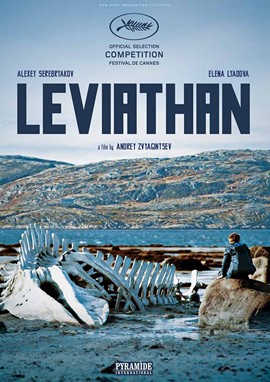
Leviathan_2014_poster

Leviathan, directed by Andrey Zvyagintsev, is a powerful film about corruption and decay in contemporary Russia.

Kolia (Alexei Serebriakov) lives in a run-down town on Russia’s Arctic coast with his wife, Lilya (Elena Lyadova), and his son, Roma (Sergey Pokhodaev). The property his house stands on is coveted by the town’s corrupt mayor, Vadim (Roman Madyanov), who connives to have it taken away from him. Kolia gets an old army fried of his, Dimitri (Vladimir Vdovichenkov), who is now a lawyer, to help him fight the mayor.

Zvyagintsev shows frequent shots of abandoned and decaying buildings. Leviathan was filmed in the town of Kirovsk, located near Murmansk. This town has been steadily losing population since the break-up of the Soviet Union. Indeed, one possible interpretation of the film’s title is that the characters are living in the decaying carcass of the Soviet Union. In one scene, some of the characters go target shooting. They use for their targets pictures of Soviet leaders.

It’s perhaps an indication of Maxim’s venality that instead of fixing up one of the abandoned buildings, he desires a property that is occupied. Maxim expresses open contempt for Kolia as well as for the other residents of the town. His closest confident is the local high priest. When at one point, Maxim considers giving in to Kolia, the priest tells him, “All power comes from God. As long as it suits Him, fear not.” This moment sets off the series of events that ultimately destroy Kolia.

In the final scene, we see the rich people of the town listening to the high priest give a sermon. Maxim leans over and whispers to his son, “God is watching you.” This is the intertwining of religion and corruption.

Leviathan is a great film.

Selma

January 18, 2015

Selma_poster

Selma, directed by Ava DuVernay based on a screenplay by Paul Webb and DuVernay, depicts the struggle for voting rights in Alabama, which resulted in the passage of the Voting Rights Act. Although the film is about historical events, it has a topicality due to the recent undermining of the Act and the efforts to disenfranchise black voters in some states.

The script is highly didactic. Almost every scene seems to drive home a particular point. Many of the scenes consist of two or three people talking, in which they present contrasting points of view. This can be effective at times, but it becomes a drawback in the scenes between Martin Luther King (David Oyelowo) and his wife, Coretta (Carmen Ejogo). The two of them sound so high-minded and professorial, that one wonders how they didn’t drive each other crazy.

Selma touches upon King’s complicated attitude towards violence. It makes clear that one of the aims of non-violent resistance was to provoke a violent response from authorities, in order to cause them to lose legitimacy in the eyes of the world. The film shows King struggling with the possible consequences of this tactic. In one scene, he calls off a march -much to the consternation of his supporters – because he fears that the police have set a trap.

One thing I liked about Selma is that it doesn’t try to prettify anything. J. Edgar Hoover and George Wallace are portrayed as being every bit as vile as they were. Some people have criticized the film’s portrayal of Lyndon Johnson (Tom Wilkinson), particularly its implication that Johnson got Hoover to try to blackmail King. However, we know that Johnson was not above playing dirty, and at the very least he was aware of Hoover’s hostility towards King, so one has to admit that this part of the film is at least plausible. (Fun fact: it was Robert Kennedy who ordered the FBI to spy on King and his associates.)

Selma is a timely film that everyone should see.

Kurmanjan Datka, Queen of the Mountains

December 1, 2014

Queen_of_the_Mountains

Kurmanjan Datka, also known as Queen of the Mountains is a Kyrgyz film by Sadyk Sher-Niyaz. It tells the story of the woman who was the leader of the Kyrgyz during the latter part of the nineteenth century.

The young Kurmanjan is forced to marry a man she doesn’t like. After she runs away, she eventually comes to the attention of the feudal lord, Alimbek, who marries her. When Alimbek is killed by a political rival, Kurmanjan becomes the leader of the Krygyz. When the Russian empire begins to intrude upon the Kyrgyz, Kurmanjan realizes that they simply aren’t powerful enough to defeat the Russians. She pursues a policy of accommodation, which is opposed by some of her countrymen, including members of her own family.

Kurmanjan is credited with enabling the Kyrgyz to maintain their identity and culture in the face of Russian imperialism. I imagine some will argue that this was due to her willingness to make concessions to the Russians. However, it seems to me that the Kyrgyz were lucky. The Russians apparently weren’t interested in colonizing their mountainous land. Others were not so lucky. For example, the Russians drove the Circassians off their land and sent them into exile. Last year’s Winter Olympics in Sochi were held on land that once belonged to the Circassians.

Kurmanjan Datka is hard to follow at times. I can only assume that Sher-Niyaz intended this film for Kyrgyz audiences who would already know about the events depicted. The early scenes, which show a young Kurmanjan struggling against the patriarchal strictures of Kyrgyz society, have feminist overtones to them. The battle scenes are well done, and there are beautiful shots of the magnificent Kyrgyz countryside. Aside from that, though, I can’t really recommend this film. Perhaps some day someone will make a film that does justice to this remarkable woman.

Whiplash

November 24, 2014

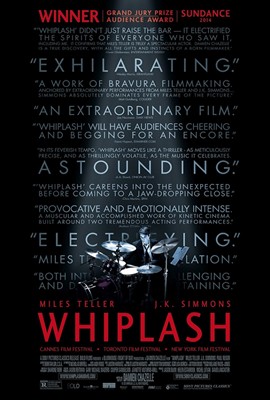
Whiplash_poster

Whiplash, written and directed by Damien Chazelle, tells the story of Andrew Neiman (Miles Teller), an aspiring young jazz drummer who is attending a highly prestigious music conservatory in New York. He is picked to be in the school’s premiere jazz band, which is led by Terence Fletcher (J.K. Simmons). When Neiman attends his first band practice, Fletcher shows up and immediately begins acting like a sadistic bully. He humiliates Neiman in front of the other band members, slaps him repeatedly, and throws a chair at his head (this is in a crowded room). Over time, Neiman becomes obsessed with trying to live up to Fletcher’s exacting standards. He practices until his hands bleed. He dumps his girlfriend, Nicole (Melissa Benoist), telling her that she’s a distraction from his becoming a great musician. He is rude and insulting to members of his own family. However, Fletcher’s abusive behavior leads to a violent confrontation, which results in Neiman being expelled from the conservatory and Fletcher being fired.

Later, Neiman runs into Fletcher in a jazz club. To Neiman’s surprise, Fletcher is friendly towards him. Fletcher explains (not convincingly) that the reason he was such an asshole was that he was trying to get Neiman to “break through” as a musician. He tells a story about how Joe Jones once threw a cymbal at Charlie Parker’s head when the latter wasn’t playing well. (That wasn’t really what happened, but I’ll let that go.) This motivated Parker to work harder and become a better musician. Fletcher then tells Neiman that he is going to be conducting a band at a jazz festival, and he needs a drummer. He assures Neiman that they will be playing pieces he is familiar with. When Neiman shows up for the performance, however, Fletcher has the band play a piece that Neiman doesn’t know. Neiman realizes that he has been lured into a trap, that Fletcher wants to humiliate him in front of an audience.

Now, I have a few problems with this. First, we are expected to believe that when Fletcher bumps into Neiman, he immediately concocts a scheme to get even with him. We are also expected to believe that Fletcher, an obsessive perfectionist, would deliberately sabotage his own band’s performance – and in front of an audience that has record company executives in it. (And the fact that Fletcher didn’t have him rehearse with the band should have tipped off Neiman that something wasn’t right.) In fact, I found the film’s whole premise – that a teacher would try to inspire his students by acting like a raving lunatic – impossible to believe.

I’m sure that a musician’s life can be stressful and difficult at times. (I imagine this is particularly true in a competitive field like jazz.) Instead of trying to depict this, however, Chazelle has given us an overheated melodrama.

The Hunger Games: Mockingjay

November 22, 2014

MockingjayPart1Poster3

The Hunger Games: Mockingjay, directed by Francis Lawrence, picks up where the last installment in the series left off. Katniss (Jennifer Lawrence) has been taken from the Hunger Game by the rebels. (These rebels have a set-up that would make Che Guevara’s head explode: a vast underground city and fighter planes. It is never explained where these rebels get their resources from, in what appears to be a tightly run police state.) The rebels want Katniss to become the “Mockingjay”, the symbol of their revolution. Katniss refuses unless the rebels promise to rescue her sometime boyfriend, Peeta (Josh Hutcherson), who has been taken prisoner by the government. (Some revolutionary. Imagine Robespierre saying, “If you don’t rescue my Fifi from the Austrians, you’ll have to find yourselves another Incorruptible!”)

When Katniss sees government planes destroy a hospital, she seems to finally embrace her role as the Mockingjay. Soon after, however, she goes back to moping and whining about how she wants her Peeta back, until, to make this prima donna happy, the rebels send a group into the capitol to rescue him.

What makes all this somewhat distasteful is that we see rebels sacrifice their lives to fight the government, yet our main concern is supposed to be that Katniss is worried about her sweetheart. The revolution will not be televised, but it will be made into a teenage romance.

Kill the Messenger

November 16, 2014

Kill_the_Messenger_poster

Kill the Messenger, directed by Michael Cuesta from a screenplay by Peter Landesman, tells the story of Gary Webb, the journalist who reported on contra drug-dealing in the US, and who was blacklisted by the news media for his efforts. The film follows Webb (Jeremy Renner) as he gradually uncovers the story and then writes about it for the San Jose Mercury News. The article causes a sensation, but then it immediately comes under attack from major news outlets, such as The New York Times, The Washington Post, and The Los Angeles Times. Webb then struggles to defend the article, as well as his reputation.

An interesting question here is: why was Webb’s article so controversial? I remember during the 1980’s hearing rumors that the contras were running drugs. A Senate committee eventually confirmed this as true. So why did Webb’s revelations upset so many people? I can only guess it was because Webb drew an explicit connection between the contras and the crack cocaine epidemic that swept South-Central Los Angeles in the 1980’s. I remember at the time, some journalists expressed fear of “black anger” as a result of Webb’s article.

This film suggests another possible motive: reporters at major newspapers were incensed that they had been scooped by a mid-size paper. Webb was, in that respect, a victim of the news media pecking order. What this movie also makes clear is the extraordinary vindictiveness of these people: even after the CIA admitted that Webb’s story was basically true, he was unable to get work at any newspaper.

Kill the Messenger is a tribute to a courageous reporter.

Interstellar

November 12, 2014

Interstellar_film_poster

Having sat through The Dark Knight Rises, I wasn’t sure I wanted to see Christopher Nolan’s latest film. However, having seen it, I am pleased to report that Interstellar is a better film than The Dark Knight Rises. It is, however, pretentious, melodramatic, overlong, and ultimately silly.

Interstellar is set in a dystopian future. A blight is killing food crops and threatens to starve the human race. Cooper (Matthew McConaughey) is a retired astronaut living on a farm with his family in a region that is plagues by dust storms. One day he notices the dust forming a pattern on the floor of his daughter’s room. It seems to him to be a binary code for a GPS location. When he goes to the location, he finds a secret NASA facility. There he finds his former teacher, Prof. Brand (Michael Caine), as well as Brand’s daughter, Amelia (Anne Hathaway). Brand tells Cooper that NASA has found a wormhole orbiting Saturn. Brand has devised a plan to transport the human race from the dying earth through this wormhole to another galaxy (shouldn’t this film be Intergalactic?) where they will settle on another planet, once he has solved the “problem of gravity”. (Wouldn’t it be easier just to find a way to kill the blight? One thing I’ve noticed about Nolan’s films is that no one ever does anything the easy way.) NASA has already sent astronauts through the wormhole to find habitable planets. Brand tells Cooper that he wants him to pilot a mission to go through the wormhole and find which astronaut has discovered a habitable planet.

I found most of the second half of this film entertaining, but the first half is a hard slog. There are scenes of people philosophizing about such things as man’s destiny and the true nature of love. There’s a subplot about Cooper’s relationship with his daughter, Murphy (Jessica Chastain). Michael Caine recites a Dylan Thomas poem. And there is a wisecracking robot, who, I take it, is meant to serve as comic relief. (Nolan has apparently forgotten that the comic relief is supposed to be funny.) It’s not until Cooper, Amelia, and the other astronauts travel through the wormhole that this film finally starts to pick up steam, and even then there’s a long lull after they visit the first planet. It seems to me that Nolan wants to be seen as a director with ideas. The problem is that his ideas aren’t very good. (The ideas in The Dark Knight Rises are terrible.) Interstellar could have been a nifty sci-fi adventure. Instead, it’s an ungainly hodgepodge of a a film.

St. Vincent

November 5, 2014

St_Vincent_poster

Last Saturday, I went to see Nightcrawler. When I got to the ticket booth, I was told that it had just sold out. I didn’t feel like going home. I saw that St. Vincent, which I had heard was receiving good reviews, was playing at the same time, so I decided to see that. After watching it, I felt that I might just as well have gone home.

Bill Murray plays Vincent MacKenna, a grouchy old coot who spends most of his time at bars and racetracks. Maggie (Melissa McCarthy), moves in next door to him with her son, Oliver (Jaeden Lieberher). Just as you expect, Vincent ends up befriending Oliver. After a series of misadventures and scenes of Vincent being an asshole, Oliver realizes that Vincent isn’t really a bad person, and everyone lives happily ever after.

The early scenes in this film gave me some hope that it would not be just another run-of-the-mill “feel good” movie. Alas, writer/director Theodore Melfi decides to play it safe, while appearing to be “edgy” by having Vincent make racist comments. Also, he leaves loose ends. In one scene, Vincent steals a large amount of money from Oliver. Neither Oliver nor any of the other characters refer to this later in the film.

As I have mentioned previously on this blog, I don’t care for this whole genre of “feel good” movies. Yes, life is worth living, and, yes, most people are not entirely bad. My question is this: why is it so hard for Hollywood filmmakers to make this point in a way that is not contrived and dishonest?