Archive for the ‘Cinema’ Category

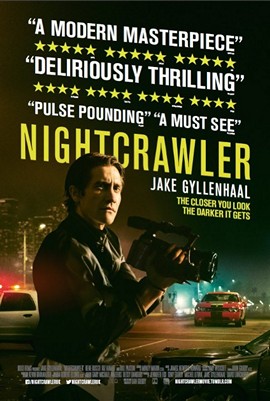
Nightcrawler

November 3, 2014

Nightcrawlerfilm

Filmmakers seem to have it in for the news media nowadays. First there was Gone Girl, and now there is Nightcrawler, written and directed by Dan Gilroy. (There is also Kill the Messenger, about the media’s trashing of Gary Webb, which I have yet to see.)

Louis Bloom (Jake Gyllenhaal) is a petty thief living in Los Angeles. One night he sees a freelance camera crew filming an accident. He gets the idea that he might be able to make a living this way. He steals an expensive bicycle, and he takes it to a pawn shop and trades it in for a camcorder and a police scanner. He struggles at first, but then he manages to get some graphic footage of a crime scene. He takes it to a local TV station. The station manager, Nina Romina (Rene Russo) buys the film, and she offers him advice on what things to look for. Louis then hires an assistant, Rick (Riz Ahmed). Louis sees an enormous opportunity for himself when he arrives at a home invasion before the police do.

Louis Bloom speaks in a mixture of self-help cliches and technocratic jargon. At times he sounds almost as though he were giving a TED talk. (I have had bosses who have said some of the same things to me that Bloom says to people.) He is an embodiment of our society’s penchant for hype and boosterism. Yet underneath his glib facade is a man with no empathy for other people, who is willing to commit murder just to get ahead. The film implies that it is these very qualities that make it possible for Louis to be so successful at what he does.

Nina tells Louis that her station promotes the idea that urban crime is spreading into suburban areas. She tells him that she prefers him to cover crimes in wealthy neighborhoods in which the victims are white. She is open and honest about the station’s fearmongering.

Nightcrawler is a powerful indictment of the news media.

Gone Girl

October 29, 2014

gone-girl-40653-poster-xlarge

Gone Girl is a film directed by David Fincher, with a screenplay by Gillian Flynn, based upon her own novel. The film is a thriller with elements of social criticism in it.

Nick Dunne (Ben Affleck) returns home one day to find that his house has apparently been broken into and that his wife, Amy (Amanda Pike) is missing. During the subsequent police investigation, Nick makes conflicting statements, and it is gradually revealed that he was emotionally estranged form Amy. Because Amy is the daughter of a writer of a popular series of children’s books, the case draws national attention. Suspicion begins to grow among both the police and the public that Nick murdered Amy. Nick’s sister, Margo (Carrie Coon), is suspected of being his accomplice.

What I found most interesting about this film is its devastating portrayal of the news media. Many of the events in this film are driven by a cable news reporter named Ellen Abbot (Missi Pyle), a character who is clearly modeled after Nancy Grace. Her sensationalist and biased reporting on the case help to create a lynch mob atmosphere in the small town in which Nick and Margo live. Gone Girl depicts the destructive effects of news reporters who try to identify “good guys” and “bad guys” in every situation, even though reality is rarely ever that simple. (I would argue that a similar criticism could be made of the Left, but I won’t go into that here.)

SPOILER ALERT. I AM ABOUT TO GIVE AWAY AN IMPORTANT PLOT TWIST

The early scenes create a strong feeling of suspense, as well as of foreboding. However, when, about halfway through the film, we learn what actually happened to Amy, it becomes basically a melodrama, and a somewhat cynical one at that. The film implies that the reason for Amy’s destructive behavior is that she is an emotionally needy sociopath. There is, however, a vague class consciousness here as well. Amy has a trust fund from her parents, and it appears that a sense of entitlement is part of her emotional make-up.

There is some psychological nuance, however. When Amy sees Nick apologize to her on TV for his behavior towards her, she decides to go back to him. Later, Nick tells Amy that he didn’t really mean it when he made that apology. She tells him she doesn’t care, that she would be happy to have him pretend to be the person he was at that moment. It’s clear at this point that Amy sees little distinction between fiction and reality. This may have something to do with the fact that Amy’s mother used her as the fictionalized subject of her children’s books.

And there is a deeper social criticism here as well. This film implies that many of us are like Amy: we are attracted to fake sentiment. After Amy returns, the media accept her implausible story of being kidnapped. People want to believe her story is true. Someone suggests that Nick and Amy should be in a “reality” TV show. Later, when Nick threatens to leave their loveless marriage, Amy tells him that the public will hate him for it. At this point, the public has become an almost tangible presence in their household. They are aware that they are constantly being watched by the media. Their fake marriage appeals to a society that watches obviously staged “reality” TV shows. At one point, Margo suggests to Nick that he too has come to like the spectacle of their fake marriage.

This movie goes on a bit long. Some things could have been cut out of it. Still, for all its flaws, Gone Girl is the most interesting and thought-provoking American film that I have seen in a long time.

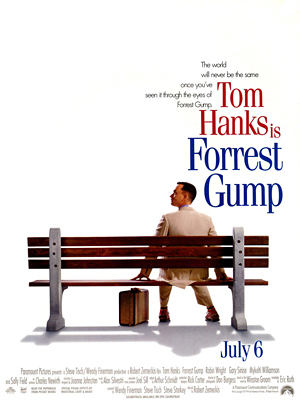
Forrest Gump and the Manufacturing of Innocence

September 7, 2014

Forrest_Gump_poster

It’s been 20 years since Forrest Gump was released. This anniversary is being celebrated with a week-long IMAX release. I guess this is a good enough excuse to write something that I’ve long been wanting to write.

When Forrest Gump first came out, it mostly received ecstatic reviews (with a few naysayers here and there). I went to see it fully expecting to enjoy it. The early scenes seemed promising. I liked Sally Fields as Forrest Gump’s mother. She quickly disappeared, however. After about half an hour, I started glancing at my watch, wondering how much longer this thing would go on. I was watching stick figure characters who were doing things that were neither believable nor interesting. When the film finally ended, I left the theater feeling numb, as if I had just sat through a really long and really dull lecture.

So, what gives? Why did this mediocre film win such rave reviews? And why was it so hugely popular? (Those Bubbagump Shrimp hats were far and away the most annoying fashion item of the 1990’s.) This is something that I have thought about from time to time. I think that one of the significant things about this film is the fact that Gump is depicted as morally pure. There isn’t a mean-spirited bone in his body. He even manages to make it through the Vietnam War without killing anyone. (Although he somehow wins the Medal of Honor.)

But what’s really striking about this film is its racial angle. Gump is depicted as being not the least bit racist, despite the fact that he grows up in the Deep South during the time of Jim Crow. (We are also explicitly told that he is named after Nathan Bedford-Forrest, the founder of the Klu Klux Klan.) He is nice to almost all the black people he meets. (Interestingly, the only black person Gump doesn’t like is a Black Panther.) When Gump is in the Army, he meets a black soldier named Bubba, who talks non-stop about the different ways to cook shrimp. We’re expected to believe that Gump somehow forms a deep emotional bond with this self-absorbed monomaniac. Bubba is killed in the war, and after Gump leaves the army, he buys a shrimp boat and calls his business “Bubbagump Shrimp”. The film then has one of its moments of “whimsy”. A hurricane destroys all the shrimp boats except for Gump’s. This gives Gump a monopoly on the shrimp business that makes him wealthy. (This film’s makers expect us to see it as a good thing that a whole bunch of people were impoverished so Gump could get rich.) Gump then gives a bunch of money to Bubba’s mother, who works as a maid. She retires and buys a nice house, where she is waited upon by a maid. The film implies that this is a form of justice. (Although not for the woman who has to wait on Bubba’s mother.)

The clear subtext of this film is that Gump absolves us of our sins. (The film critic, Gene Siskel, once called this movie “a healing balm”.) We’ve had 500 years of racism, but it’s OK, because Gump was nice to Bubba’s mom. Two million Vietnamese were killed in the war, but, hey, at least Gump didn’t kill any of them!

Forrest Gump promotes a notion of American “innocence” that helped to create the cultural climate in this country that made the invasion of Iraq possible.

Wadjda

April 1, 2014

Wadjda_(film)

A recent article by Patrick Cockburn in The Independent argues that the “War on Terror” has been a failure. He points out that jihadists have seized control of large areas of Iraq and Syria and that the Taliban have been making a resurgence in Afghanistan. He argues that the main reason for this is that the United States and Britain are allied with the two governments that do the most to spread jihadism: those of Saudi Arabia and Pakistan. You can’t win a struggle when you’re allied with your enemies. (Those on the left who advocate the “red-brown” strategy should think about this.)

Wadjda, Haifaa al-Mansour’s 2012 film set in Saudi Arabia, gives us a rare glimpse inside a country that is often misunderstood in the West. (9/11 Truthers will be surprised to learn that people in Saudi Arabia do not live in caves.)

This film tells the story of Wadjda (Waad Mohammed), a young girl who dreams of owning a bicycle. Girls riding bicycles is frowned upon in religiously conservative Saudi Arabia. Wadjda’ mother (Reem Abdullah) works as a teacher. Because women are not allowed to drive in Saudi Arabia, she has to be driven to work by a hired driver who treats her rudely. Wadjda’s father (Sultan Al Assaf) is loving and kind, but his parents pressure him into taking a second wife, because Wadjda’s mother can no longer bear children.

At Wadjda’s school, we see the headmistress (Ahd Kamel) scold some girls for laughing in the schoolyard – apparently because men can hear them. This film portrays the bleakness of religious fundamentalism. Wadjda subtly resists, yet she herself succumbs to it at times; for example, she betrays a couple of her fellow students to the headmistress at one point. This film ends on a heart-warmingly optimistic note, however.

Wadjda features strong performances and is beautifully filmed. This is an all the more remarkable achievement considering that this film was made under less than ideal conditions. (It is the first feature film made in Saudi Arabia, as well as the first film directed by a woman there.) Wadjda is about as close to a perfect film as I have ever seen.

The Life and Death of Colonel Blimp

March 20, 2014

Editors-Pick-The-Life-and-Death-of-Colonel-Blimp

The Criterion Collection has released a restored version of the 1943 British film, The Life and Death of Colonel Blimp, directed by Michael Powell and Emeric Pressberger. The title refers to a recurring character in the cartoons of David Low: an elderly Army officer who spouts reactionary nonsense. This film’s main character, Gen. Clive Wynne Candy (Roger Livesy), is clearly meant to be associated with Col. Blimp.

The Life and Death of Colonel Blimp tells, in flashback form, the life story of Gen. Clive Wynne Candy, from the Boer War to the beginning of the Second World War. In the film’s early scenes, Candy is on leave from the Boer War, where his courage has earned him a Victoria Cross. On his own initiative, Candy follows a German agent named Kaunitz to Berlin. Kaunitz has been spreading stories about British atrocities in the Boer War, inciting anti-British feeling among the Germans. Candy is determined to stop him. What makes this part of the film a bit icky is the fact that the British did commit atrocities in the Boer War. This is somewhat ameliorated by the fact that the film implies that Candy is a bit self-deluded, although this is never made explicitly clear.

However, in the next section of the film, detailing Candy’s experiences during World War I, we learn that his biggest fault is actually that he is too decent. He is reluctant to resort to the ruthless measures needed to defeat the Germans. This problem continues into the Second World War, when everyone around him becomes exasperated with Candy’s niceness. Even his Prussian friend, Theo (Anton Walbrook), lectures him about the need to get tough with the Germans.

At this point, I had to begin to question this film’s honesty. It seems to be saying that the main fault of the British is that they are too nice to their enemies. I suspect that many people in India and Africa and Ireland might beg to differ about this. (No doubt, Gandhi had the British in mind when he made his famous quip about Western Civilization being “a good idea.”) Early in the war, Noël Coward recorded a “satirical” song titled Don’t Let’s Be Beastly Towards the Germans, which also argues that the British are too nice to their foes. This idea of the British being “too nice” to their enemies strikes me as a back-handed form of self-flattery. (Sort of the way we’re often told that the U.S. is “generous” towards its enemies, even though it actually isn’t.)

What the film also seems to be saying is that Col. Blimp – and by extension all the “Blimps” in England – is not really a bad person after all. (The filmmakers apparently did this with David Low’s blessing.) This is in keeping with the “we’re all in this together” rhetoric of the British government during this period.

So, The Life and Death of Colonel Blimp is actually wartime propaganda, albeit of a subtle and sophisticated kind. What is odd is that this film was the subject of much right-wing criticism at the time of its release. (Churchill tried to prevent the film from being made.) One of their objections seemed to be that the film contains a sympathetic German character. In the U.S. at about this time, John Steinbeck’s The Moon is Down was harshly criticized for the same reason. War demands the dehumanization of the enemy.

This movie is gorgeously filmed. (The technicolor was lovingly restored for the DVD.) I was impressed by the high production values, considering that this was made during wartime rationing. The acting is superb. Livesy is impressive, convincingly aging over the course of the film. Deborah Kerr acts as the Eternal Feminine, playing three roles over the course of three generations. Her characters illustrate how women acquired greater personal freedom during this period.

One other thing that I found icky about this film is that the directors indicate the passage of time by filling up Candy’s house with the heads of animals that he killed while on hunting trips all over the world. At first, I thought this was meant to be satirical, but I gradually had the disturbing realization that this was something that the audience was supposed to find endearing about Candy. Ah, for the good old days when the British upper hunted species to the verge of extinction. Nostalgia can be a bitch sometimes.

Auto Focus

March 9, 2014

AutoFocus

I remember seeing the network premiere of Hogan’s Heroes when I was a kid. I liked the throbbing beat of the opening drum roll. I liked the sight of the POW’s rushing to get in line. I liked the haughty look of Werner Klemperer as he put a monocle to his eye under the opening credits. And then my mother turned the TV off. She was indifferent to my protests. I subsequently learned that my parents considered the show to be in bad taste – which it was. I was, however, too young to understand the concept of bad taste. Also, the fact that my parents forbade it made it attractive to me. I managed to find ways to watch it on the sly. I have to admit I found it pretty funny. Years later, though, I read in the newspaper that Bob Crane, the show’s star, had been found bludgeoned to death in his apartment in Scottsdale, Arizona. The article noted that the police had found dozens of videotapes of Crane having sex with various women. At that moment I had the weird feeling that perhaps my parents had comprehended something that had eluded me.

One of the things I found interesting about Paul Schrader’s 2002 film, Auto Focus, is that it seemed to me to suggest that my initial response to Crane’s death was correct. The film begins in the mid-1960’s, when Crane (Greg Kinnear) was the morning disc jockey at a radio station in Los Angeles. He has ambitions of working in movies; he sees himself as another Jack Lemmon. The best his manager, Mel Rosen (Ed Begly, Jr.) can do for him, however, is get him a role in a TV comedy set in a German P.O.W. camp during World War II. Crane initially expresses reservations about this, but eventually he decides to do it. On the set of the show one day, he meets John Carpenter (Willem Dafoe), who sells video equipment. Carpenter takes Crane to a strip club, and he and Crane begin double dating. They start taping themselves having sex with various women. Carpenter comes across as a sordid Mephistopheles, who introduces Crane to a world of casual sex and narcissistic voyeurism. Over time, though, they gradually switch roles, with Crane becoming the dominant partner, since his status as a TV star makes it easier for him to attract women. Carpenter becomes increasingly insecure as a result of his growing reliance on Crane.

Crane’s womanizing leads to the break-up of his twenty-year marriage to Anne (Rita Wilson). Crane subsequently marries Patricia (Maria Bello), his co-star on the show. Patricia is aware of Crane’s womanizing and accepts it. After she becomes pregnant, however, she gradually changes her mind and begins demanding that Crane spend more time with her.

After six years, Hogan’ Heroes comes to an end. As often happens to actors who are in a successful TV series, Crane has trouble finding work afterwards. He ends up doing dinner theatre. When Crane tires of this, he goes to Mel Rosen for advice. Mel tells Crane he needs to change his way of living if he wants to revive his acting career. Crane decides to sever his relationship with Carpenter and tells him so. Later that night, someone enters Crane’s apartment and bludgeons him to death. The film implies that Carpenter is the murderer, though it leaves some room for doubt about this. (In real life, Carpenter was tried for Crane’s murder and was acquitted.)

The final joke of the film is that Crane carries his lack of self-awareness into the after-life. As police officers gaze at Crane’s bloody corpse, we hear Crane’s voice, presumably coming from the grave, cheerily remarking, “Men gotta have fun.” One is reminded here of Taxi Driver, which Schrader co-wrote, in which Travis Bickle remains self-deluded to the very end. According to his Wickipedia biography, Schrader was raised in the Chrisian Reformed Church, which is described as Calvinist, meaning, I suppose, that they believe in predistination. Perhaps this explains why Schrader presents us with a world in which people are not redeemed.

Hannah Arendt

March 1, 2014

Hannah_Arendt_Film_Poster

Margarethe von Trotta’s 2012 film, Hannah Arendt, deals with the writing of Arendt’s Eichmann in Jerusalem and the ensuing controversy that it caused. The film is fictional, but it includes actual film footage of Eichmann’s trial. Arendt’s book was controversial because of its notion of the “banality of evil”, which many historians objected to (and still object to). This idea has remained in currency, however, perhaps because it doesn’t seem far-fetched to a generation that grew up under the cloud of a nuclear arms race. The book also angered people because of its criticism of Jewish Leaders in Eastern Europe during World War II.

This film is mostly sympathetic in its portrayal of Arendt (played by Barbara Sukowa), but it does not portray her as flawless. She ignored pleadings that her comments about the Jewish leaders were insensitive and should be left out. (She felt she had to discuss it, because the issue came up during Eichmann’s trial.) Some of the characters accuse her of being arrogant, and the film subtly implies that there was some truth in this.

There is also a sub-plot about Arendt’s relationship with the philosopher, Heidegger, who was once her lover. This part of the film was unsatisfying because Trotta doesn’t seem to know what to say about this aspect of Arendt’s life.

Hannah Arendt is that rare type of film that deals with the life of the mind. It is also interesting portrayal of the German-Jewish emigre community in the U.S. following World War II.

Philip Seymour Hoffman (1967-2014)

February 6, 2014

philip-seymour-hoffman

Like so many people, I was shocked and saddened when I learned of the death of Philip Seymour Hoffman. Of all the actors who have emerged in Hollywood over the past two decades, he was the one I liked the most. His performances were always powerful. In Capote, he mimicked the famous writer’s voice and mannerisms, without becoming a caricature. My favorite performance of his, however, was in The Master, in which he played a cult leader. Hoffman exuded an air of authority and all-knowingness that you understand why people would follow such a man despite the demands that he made on them. (I was not that impressed by his performance in Hunger Games: Catching Fire, but I think that is because the character was not well written.)

Hoffman reportedly died from a heroin overdose in his New York apartment. When I lived in New York, I knew several people who became heroin addicts. One of them died from an overdose. There is a very strong drug scene in New York, one in which many people get caught up. I don’t know whether this was a factor in why Hoffman became an addict, but I can’t help but note the possibility. One of my first memories of New York is of people whispering “steelworks” to me as they passed me on the street. They were offering to sell me heroin. New York can be a very stressful place to live, which may be why some people turn to drugs.

James Urbaniak tells an interesting story about Hoffman here.

American Hustle

January 21, 2014

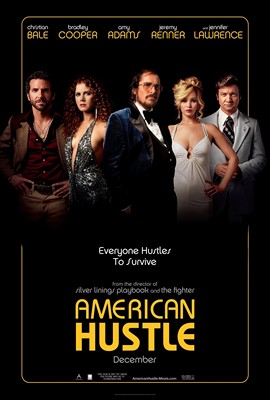
American_Hustle_2013_poster

American Hustle, directed by David O. Russell, is loosely based on the Abscam scandal of the 1970’s. This resulted from a sting operation in which the FBI developed the methods of entrapment it uses today against Muslims.

Irving Rosenfeld (Christian Bale) and Sydney Prosser (Amy Adams) are a couple of swindlers who are caught in an FBI sting operation led by Richard DiMaso (Bradley Cooper). DiMaso tells them that he will not press charges provided that they agree to help him catch white collar criminals, which they reluctantly consent to do. The three of them eventually set their sights on a powerful New Jersey politician, Carmine Polito (Jeremy Renner), who wants money to build casinos, which he believes will revive the state’s economy. They hook Polito up with a phoney sheikh (Michael Peña), who promises him money. The scheme begins to involve more people, including Victor Tellegio (Robert De Niro), one of the most powerful figures in organized crime. Meanwhile, Rosenfeld comes to believe that Polito, although somewhat corrupt, is basically a well-intentioned person, and he begins to regret the fact that he is setting him up. Rosenfeld’s woes are exacerbated by the erratic behavior of his wife, Rosalyn (Jennifer Lawrence), who nearly blows his cover.

American Hustle is an amusing comedy that benefits from strong perfromances (although Louis CK is not quite convincing as DiMaso’s boss). I have never been keen on Chirstian Bale in the past. His performances have struck me as either too operatic (The Fighter) or too understated (The Dark Knight Rises). In this movie, he strikes just the right balance, playing a character who is sleazy, but not totally devoid of empathy. And it’s fun to watch Jennifer Lawrence playing a character who is the human opposite of the one she plays in the Hunger Games films.

American Hustle questions whether the FBI’s sting operation actually accomplished anything. People have asked similar questions about the FBI’s sting operations against Muslim “terrorists”. (I have written about one of these cases here.)

Jordan Belfort: “The Wolf of Wall Street”

December 29, 2013

Jordan-Belfort

Martin Scorsese has a new film out titled The Wolf of Wall Street. It is based on the memoirs of Jordan Belfort, who in the 1990’s ran a brokerage firm called Stratton Oakmont that did illegal “pump and dump” schemes that got Belfort thrown into prison. I’m debating in my mind whether or not I should go see this movie. I found Scorsese’s last film, Hugo, dull and over-long. The Wolf of Wall Street clocks in at two hours and forty minutes. This doesn’t look promising.

One person who did see the movie was Christina McDowell, the daughter of Tom Prousalis, one of Belfort’s business partners at Stratton Oakmont. She has written an open letter to the makers of the film, in which she states:

    Belfort’s victims, my father’s victims, don’t have a chance at keeping up with the Joneses. They’re left destitute, having lost their life savings at the age of 80. They can’t pay their medical bills or help send their children off to college because of characters like the ones glorified in Terry Winters’ screenplay.

    Let me ask you guys something. What makes you think this man deserves to be the protagonist in this story? Do you think his victims are going to want to watch it? Did we forget about the damage that accompanied all those rollicking good times? Or are we sweeping it under the carpet for the sale of a movie ticket? And not just on any day, but on Christmas morning??

    I urge each and every human being in America NOT to support this film, because if you do, you’re simply continuing to feed the Wolves of Wall Street.

Another argument against seeing this movie. The L.A. Weekly has an interesting article about Belfort. In it, we learn that Belfort has only paid $11.6 million of the $110 million he owes his victims.

I’m told that Belfort now works as a motivational speaker. What kind of advice can someone with his background give to people? “Don’t start a company that fleeces people out of their life savings”? Out of curiosity, I looked at Belfort’s website. On the home page, it says:

    Right From The Smash Blockbuster Movie, “The Wolf of Wall Street”…
    THE STRAIGHT LINE PERSUASION SYSTEM
    REAL PROFITS FOR YOU… OR HOLLYWOOD MYTH?
    Can You Really Use The Wolf of Wall Street’s Sales Tactics To Ethically Persuade People And Make Money?

So, Belfort is using his criminal past to promote his motivational business. How ethical.

According to the above-mentioned L.A. Weekly article:

    Five years ago, the Weekly accompanied Belfort to one of his first speaking gigs, with the Young Entrepreneurs of Los Angeles. During the Q&A following his talk, Belfort had a stock answer whenever anyone questioned the morality of what he had done to his investors. “Hey, at least no one got killed,” he said several times.

At least no one got killed. That’s how low the bar is set in the business world.