Archive for the ‘Cinema’ Category

Amour

November 18, 2013

Amour-poster-french

Besides Amour, I have only seen two other films by Michael Haneke: The Seventh Continent and The White Ribbon. On the surface, Amour appears to be different from the others, but it actually deals with similar themes, in particular the question of how it is possible for ordinary people to do terrible things.

Georges (Jean-Louis Trintignant) and Anne (Emmanuelle Riva) are an elderly married couple living in Paris. One day, Anne suffers a stroke. Her doctors perform an operation on her carotid artery, but it is botched, leaving her paralyzed on her right side. For a time, she seems to be improving, but then her condition starts to rapidly deteriorate. Georges is forced to take care of her, which increasingly puts an emotional burden on him. His daughter, Eva (Isabelle Huppert), urges him to have Anne put in a hospital, but he refuses, because he promised Anne that he would never do that.

From the beginning, one can see the tragedy that this situation is moving towards. At times, Georges seems to sense this himself, but he seems incapable of acting any way other than he does. His devotion to Anne becomes a trap both for himself and for her.

This film has an emotional resonance for me. During the last ten years of his life, my father, who suffered from Type 2 diabetes, was almost continuously ill. This put a terrible strain on my mother and on other members of my family. At what point does letting go become the most humane thing to do?

Gravity

October 15, 2013

Gravity_Poster

Alfonso Cuarón’s Outer Space adventure film, Gravity, is thoroughly entertaining and the best Hollywood movie I’ve seen since Looper.

One of the reasons this movie succeeds so well is its simplicity. It’s basically about Sandra Bullock falling out of the sky. The problem with many Hollywood movies nowadays is that they end up getting lost in their own needlessly convoluted stories. One of the things I hated about The Dark Knight Rises (and there were many things I hated about this movie) was the fact that it was filled with all sorts of pointless subplots. There is, for example, a seemingly interminable sequence in which Joseph Gordon-Levitt tries to rescue an orphanage. I remember thinking, “Why the hell do I have to watch this when all I really want to see is Anne Hathaway in her Catwoman outfit?” The best of the Terminator films is the first one, which is basically just Arnold Schwarzenegger destroying things. In the later films we get Arnold doing dialogue. Not fun.

Gravity deals with the theme of an individual struggling to survive in a relentlessly hostile environment, a theme that has been dealt with by writers such as Coleridge, Poe, Melville, and London. It is a theme that touches the very core of our existence.

The Lives of Others

October 14, 2013

Leben_der_anderen

The East German Stasi were cavemen compared to the NSA. Their low-tech and labor-intensive bugging of individuals’ apartments seems crude and childish compared to the NSA’s wholesale monitoring of the Internet. Florian Henckel von Donnersmarck’s 2006 film, The Lives of Others is an un-nostalgic trip back to those more primitive days of government spying.

Captain Gerd Wiesler (Ulrich Mühe) is a Stasi agent who has been assigned to spy on Georg Dreyman (Sebastian Koch) a highly regarded East German playwright whom the Culture Minister, Minister Bruno Hempf (Thomas Thieme), suspects of having disloyal thoughts. The Stasi plant listening devices in the apartment that Dreyman shares with Christa-Maria Sieland (Martina Gedeck). Wiesler proceeds to listen in on their private conversations. At the beginning of the film, Hempf tells Wiesler that “people don’t change”. (This is about as un-Marxist a statement as one could possibly make.) Yet as Wiesler learns about the tender relationship between Georg and Christa-Maria and about Georg’s grief over the suicide of a friend who was blacklisted by the government, he begins to change. He ends up falsifying his records to conceal the fact that Georg is planning to smuggle a document out of the country.

The Lives of Others is an understated film that creates suspense through the emotional states of the characters. It is also a film that affirms the possibility of human redemption. I consider it one of the best films of the last decade.

The film critic, Carrie Rickey, has claimed that The Lives of Others influenced Edward Snowden, but I have not been able to find any statements by Snowden that confirm this. In a way, though, this film does bear a similarity to the Snowden case, in that it depicts a government spy who comes to realize the wrongness of what he is doing.

The Year of Living Dangerously

July 18, 2013

Year_of_living_dangerously

The 1965 Indonesian military coup was one of the most horrific events of the second half of the twentieth century. It killed over a million Indonesians, and it ushered in the Suharto dictatorship that ruled Indonesia for 31 years. It was an event that has not gotten as much attention in the West as it should.

Peter Weir’s 1982 film, The Year of Living Dangerously is set in Indonesia in the months before the coup. Guy Hamilton (Mel Gibson) is an ambitious young journalist from Australia, who has just been given his first foreign correspondent assignment in Indonesia. He meets a mysterious photographer named Billy Kwan (Helen Hunt). Billy arranges for Guy to interview the head of the PKI, the Indonesian communists, a major scoop that helps Guy’s career. Billy introduces Guy to Jill (Sigourney Weaver), who is an assistant to the military attaché at the British embassy. Guy and Jill have an affair, much to the disapproval of Jill’s boss. One day, Guy learns from that there is a shipment of arms coming from China for the PKI. Over Billy’s objections, Guy decides to write a story about this, even though everyone will know that he learned about this from Jill, which will hurt her standing at the embassy.

The Year of Living Dangerously is an oddly disappointing film, one that seems to promise far more than it actually delivers. There is a sense of foreboding during much of the film, because we know about the disaster that the characters can’t see coming. And some of the scenes seem to hint that more is going on than meets the eye. Yet the Indonesian coup ends up merely serving as the backdrop to a romance between Mel Gibson and Sigourney Weaver. There are depictions of poverty in Jakarta, and there is a scene of communists being executed by the military, but the the film is mainly about a group of wealthy Westerners. It would be interesting to see a film about the coup told from an Indonesian point-of-view.

Ace in the Hole

June 30, 2013

AiH

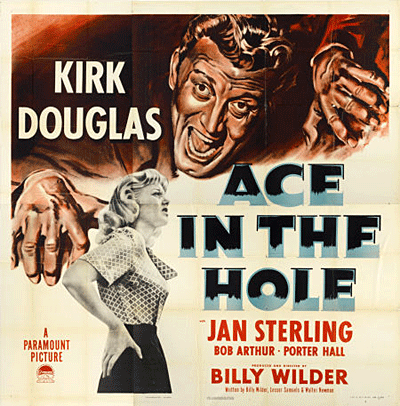
Chuck Tatum (Kirk Douglas) is an ethically challenged reporter who has been fired from several big city newspapers. He has wound up broke in Alberquerqe, New Mexico, where he persuades a local newspaper to hire him. Tatum is looking for that one big story that will get him hired by a major newspaper. While on an assignment, he stops to get gas at a diner/souvenir store, where he learns that the owner, Leo Minosa (Richard Benedict), has just been trapped in a rock fall while exploring the nearby ruins of an Indian cave dwelling. Sensing that this could be a big story, Tatum inserts himself into the situation, becoming the one who brings food and water to the unfortunate Leo. Tatum writes a melodramatic account of this incident for his paper. He then teams up with the corrupt local sheriff, Kretzer (Ray Teal), who believes he can use this to guarantee his re-election, as well as with Leo’s callous wife, Lorraine (Jan Sterling), who sees the publicity as a way to improve business. Tatum persuades Kretzer to pressure the rescuers into trying to reach Leo by drilling through the mountain, rather than going through the tunnel, which would take much less time. Tatum reasons that the longer the rescue takes, the more drama he can put into this news reports, thus making it into a bigger story. As the days go by, curiosity seekers begin showing up. Eventually a carnival arrives and sets up rides outside where Leo is trapped.

Billy Wilder’s Ace in the Hole was not well received by critics when it came out in 1951. They apparently thought that it was excessively cynical. The Hollywood Reporter, for example, called it “… nothing more than a brazen, uncalled-for slap in the face of two respected and frequently effective American institutions – democratic government and the free press.” In recent years, however, critics have taken a much kinder view of the film. I think one reason for that is that in the age of CNN and Fox News, it’s hard for people to take the noble view of the “free press” that the Hollywood Reporter‘s critic took.

Bosley Crowther, however, did make a valid point when he wrote: “There isn’t any denying that there are vicious newspaper men and that one might conceivably take advantage of a disaster for his own private gain. But to reckon that one could so tie up and maneuver a story of any size, while other reporters chew their fingers, is simply incredible.” It is highly improbable that a single reporter could completely control events the way Chuck Tatum does in this film. However, a group of reporters can control the way people perceive a story. Consider, for example, how some reporters have turned the recent revelations about the N.S.A. from a story about government spying to a story about Edward Snowden’s “narcissism”.

In Ace in the Hole, we see people enjoying carnival rides, while only a few hundred yards away, Leo is suffering, his legs trapped under rocks. This film is also about our society’s tendency to turn events into spectacles. The public’s reaction to the recent Boston Marathon bombings (“Boston Strong!”) was a good example of that, but the classic case in my opinion was the O.J. Simpson trial. Remember the “Ito Dancers”? Is Wilder’s film really much of an exaggeration of how people behave?

Ace in the Hole has Wilder’s usual biting dialogue, and the underrated Kirk Douglas gives a powerful performance as Tatum.

Downfall

June 25, 2013

215px-Der_Untergang_-_Poster

Downfall is a 2004 German film about the final days of the Third Reich. It was directed by Oliver Hirschbiegel from a screenplay by Bernd Eichinger (who also wrote the screenplay for The Baader-Meinhof Complex). The film mostly takes place in the bunker where Hitler(Bruno Ganz) and other members of this government are hiding out as the Soviet army surrounds Berlin.

Ganz’s performance in this film caused some controversy. Some people objected to the idea of portraying Hitler as human. This argument doesn’t make sense to me. Hitler was human. Does it make sense to portray him as a supernatural monster? Would that help us to understand what happened? Obviously not.

One thing that struck me as I watched this film was how out-of-touch with reality the German leaders seem. (Himmler (Ulrich Noethen) talks about negotiating a ceasefire with Eisenhower. He wonders whether he should give him the Nazi salute or shake his hand.) The generals talk about “loyalty to the Fuehrer”, even after he accuses them of betraying them. At the end of the film, reality finally asserts itself in the form of Russian soldiers swarming over the city.

More than any other film I’ve seen, Downfall brings home the sheer lunacy of Nazism. Children and old men are sent into battle. Civilians are shot or hanged as “traitors”. We see Magda Goebbels (Corinna Harfouch) methodically murder her own children, because, she says, “life is not worth living without National Socialism”. Some of the scenes in this film have a surreal quality to them. We see drunken officers laughing and playing cards outside Hitler’s private quarters, while their Fuehrer is planning his suicide. And we see a drunken orgy in a hotel lobby while the Russians are closing in on the city. The scene is almost like something out of Bosch.

Downfall is a great film, and arguably the best film about World War II. Watching this film, however, I kept thinking “How did people like this come to rule an entire country?” It would be interesting if someone were to make a film about how Hitler became the Fuehrer.

Spartacus

June 11, 2013

Spartacus_-_1960_-_poster

Spartacus is a 1960 film that stars Kirk Douglas as the leader of the ancient Roman slave rebellion. It was directed by Stanley Kubrick, from a screenplay by Dalton Trumbo, which was based on a novel by Howard Fast. Trumbo had been blacklisted during the early fifties. (Trumbo and Fast were both former members of the Communist Party.) At Douglas’s insistence, Trumbo was given an on-screen credit, in violation of the black-list. Spartacus is widely credited with helping to end the black-list in Hollywood.

Because Trumbo was black-listed, many people tend to interpret Spartacus as being about the Red Scare. (I have a deep reluctance to use the liberal term, “McCarthyism”. I will have to discuss that at some other time.) This does seem to apply to the famous “I am Spartacus” scene. There is, however, another way of looking at this film, that is more relevant to our current situation. A large part of the story details how the Roman general, Crassus (Laurence Olivier), uses the uprising to persuade the Roman Senate to give him dictatorial powers, in much the same way the Bush and Obama have used the threat of Al Qaida to persuade Congress to give them virtually dictatorial powers. Some things never change.

Spartacus has some powerful moments. The battle scenes are well done. The final battle between Spartacus’s army and Crassus’s is impressive to watch. And it’s fun to watch Charles Laughton and Peter Ustinov as a couple of scheming Roman politicians. I can’t, however, call Spartacus a great movie. It drags in some places and it is sentimental in others. A fight scene between Kirk Douglas and Tony Curtis towards the end of the film is contrived and unconvincing. And Alex North’s music score is repetitive and sentimental in places. Kubrick did not have complete artistic control over this film, which seems a shame to me. This could have been a truly great film.

American Beauty

May 11, 2013

The 1999 film, American Beauty, directed by Sam Mendes from a script by Alan Ball, is unusual for a Hollywood film, in that it deals with philosophical issues, in particular: the questions of what is freedom, is it possible for an individual to be truly free, and what is beauty.

Lester (Kevin Spacey), works for an advertising company in a job he hates. He is emotionally estranged from his wife, Carolyn (Annette Bening), and from his daugher, Jane (Thora Birch). Lester becomes infatuated with Jane’s friend, Angela (Mena Suvari), which repulses Jane. Meanwhile, she becomes involved with her next-door neighbor, Ricky (Wes Bentley), whose father, Frank Fitts (Chris Cooper) is a retired Marine colonel. One night, Lester meets Ricky at a party where the latter is working for a catering service. Ricky invites Lester outside to smoke a joint with him. When they are discovered by Ricky’s boss, Ricky tells him he is quitting. Ricky’s audacity impresses Lester, and it inspires him to change his life. He later gives a sarcastic memo to his boss, who fires him. This sets off a chain of events that result in Lester being killed.

The film makes clear the emptiness of Lester’s life. His efforts to reach out to his wife and daughter both fail. Yet his attempt to break out of his stifling life is deeply flawed from the very beginning. He despises the corruption and dishonesty of the company he works for, yet he blackmails his boss into giving him a generous severance package. He criticizes Carolyn for being materialistic, yet the first thing he does with his severance money is buy a Camaro. Indeed, Lester’s behavior merely becomes more cynical after he rejects his empty life. In a sense he moves from one type of imprisonment to another. However, when Lester tries to seduce Angela, he suddenly realizes that he can’t go through with it. It is at this point that Lester is finally finds peace with himself.

More problematic is the film’s treatment of the concept of beauty. In one scene, Ricky tells Jane how he once saw the body of a dead woman. He says: “When you see something like that, it’s like God is looking right at you, just for a second. And if you’re careful, you can look right back.” Jane asks: “And what do you see?” Ricky: “Beauty.” (The producers reportedly wanted to cut this scene, but Ball refused.) Later, after Lester is killed, Ricky gazes at his body in rapt fascination. This association of beauty with death is questionable in my opinion. I’m told that Ball had originally wanted to end the film with Ricky and Jane being wrongly accused of killing Lester, but the producers talked him out of it. This ending would have at least given some irony to Ricky’s talk about beauty. There is however a scene in which Ricky shows Jane a video he made of a plastic bag blowing around in the wind, which suggests that his idea of beauty is actually something that transcends life.

American Beauty is one of the most remarkable American films of the past twenty years.

Django Unchained

April 30, 2013

When Django Unchained came out, I heard many negative things about it, so I decided to wait until it came out on DVD. I now regret waiting so long to see it, for I found it thoroughly entertaining. What one has to understand about this movie is that it is not about slavery, it is about Spaghetti Westerns. Tarantino makes movies about movies. This may be incestuous, but nonetheless Tarantino is very good at it.

Django (Jamie Foxx) is rescued from slavers by a bounty hunter named King Schultz (Christoph Waltz). Schultz needs Django to help him identify some wanted men. Schultz eventually takes Django on as his partner. Django persuades Schultz to help him rescue his wife, Hildy (Kerry Washington) from a slave owner, Calvin Candie (Leonardo DaCaprio), whose plantation is called Candieland.

The first half of the film is mostly a typical Western, but when Django and Schultz approach Candie, the film begins to take on a surreal quality. It is as though Django Unchained wants us to see slavery as something unnatural. The film goes too far however, when we learn that Candie’s shuffling slave housekeeper, Stephen (Samuel L Jackson) is the real brains behind Candieland. A common plot device in genre films is to have the character the audience least suspects turn out to be the real villain, but this struck me as a bit much.

The reviews I read gave me the impression that every other line in this film contains the n-word. I was surprised to find that this is not the case. Yes, the n-word is used, but considering the time and place in which the story takes place, no more so than one would expect. What actually did bother me was the use of the n-word in Pulp Fiction, which struck me as gratuitous.

Some dim-witted liberals have criticized this film because of its violence, making the unproven argument that violent movies and TV programs cause people to be violent. Tarantino has rightly rejected these arguments. Japanese pop culture is filled with images of violence, yet Japan has one of the lowest rates of violent crime in the world. How do these liberals explain this? Violence is the result of material conditions in society.

Django Unchained clearly is not a realistic depiction of slavery, but has Hollywood ever tried to portray it realistically? (Gone with the Wind obviously doesn’t qualify.) There have been a number of films that tried to portray the Nazi concentration camps in a realistic manner. (Pontecorvo’s Kapò is one title that comes immediately to mind.) Yet slavery is apparently considered too painful a topic, perhaps because we are still in many ways living with the consequences of that awful institution.

Crash

April 10, 2013

Crash_ver2

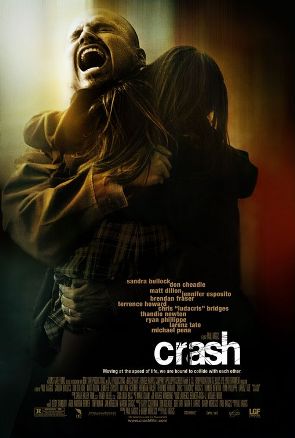
I recently learned through the Internet that some people are still seething over the fact that the 2006 Best Picture Oscar went to Crash instead of Brokeback Mountain. (Crash also won for Best Original Screenplay that year.) I missed Crash when it came out, but since I wasn’t all that impressed by Brokeback Mountain, I was curious to know why people though it was better than Crash, so I recently watched the latter film.

Crash is set in current day Los Angeles, and it tells the intertwined stories of a group of characters. These include: a black police detective, a Latina police detective, a racist white cop and his partner, a white district attorney and his wife, a black TV director and his wife, a Mexican locksmith and his daughter, an Iranian shopkeeper and his daughther, an Asian man involved in human trafficking, a black health care worker, and two black carjackers, one of whom spouts black nationalist rhetoric. The racial or ethnic identities of these characters are important, because this film is about the problem of racism.

This film is essentially a series of improbable coincidences that take place over a period of forty-eight hours. To take the most egregious example, the racist white cop and his partner pull over the black TV director and his wife as the latter are driving home. During the stop, the white racist cop sexually molests the wife. The next day, the racist white cop arrives at the scene of an accident. A woman is trapped in an overturned car. The racist white cop goes to rescue her, and – you guessed it – the woman turns out to be the same woman he molested the night before. What makes this scene offensive is that it seems to imply that being a racist and sexist pig doesn’t necessarily make you a bed person.

Coincidences do happen, but when a film presents us with one coincidence after another, it strains credulity. Furthermore, it’s lazy writing. Writers usually only resort to coincidences when they need to find some way to move the story along.

Another problem with this film is ham-handedness. Almost every conversation in it involves race in some way. When, for example, the Latina detective and the black detective have an argument after having had sex, she accuses him of having stereotyped ideas about Hispanics. In the world of Crash, people can’t even have a lovers’ quarrel without prejudice becoming the issue. Yes, racism is a problem in our society, but that doesn’t mean that people talk about it twenty-four hours a day.

There is also a problem of basic honesty. The black detective and the Latina detective are assigned to investigate an incident in which a white cop shot a black cop. The white cop claims that he acted in self-defense. Although it is unclear as to what exactly happened, the white district attorney pressures the black detective into filing a charge of murder against the white cop, because there is an election coming up and the district attorney wants to secure the black vote. Does anyone actually believe that this would happen in real life? District attorneys tend to be protective of the police, and (at least in L.A.) they don’t give a damn about the black vote. This part of the film is clearly inspired by an actual incident in which a white LAPD officer shot and killed a black LAPD officer. The white officer was acquitted of all wrong-doing.

Crash has a 75% “fresh” rating on Rotten Tomatoes, meaning that most critics liked it. It appears that people overpraised Crash because it deals with the issue of racism, just as people overpraised Brokeback Mountain because it deals with the issue of homophobia. There’s an old saying among artists that “good intentions are not enough”. Someone need to explain this to critics.