Archive for the ‘Cinema’ Category

Breaker Morant

April 8, 2013

Breaker_morant

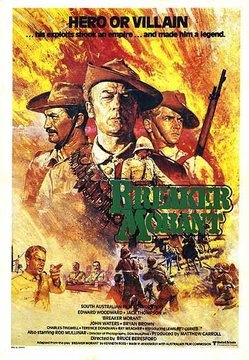
Breaker Morant is a 1980 Australian film that is a loosely fictionalized account of an actual incident that occurred during the Boer War. Lt. Harry “Breaker” Morant (Edward Woodward), Lt. Peter Handcock (Bryan Brown), and Lt. George Ramsdale Witton (Lewis Fitz-Gerald), who are officers in an elite British army unit called the Bushveldt Carbineers, have been accused of killing captured Boer guerillas, as well as a German missionary. Maj. J.F. Thomas (Jack Thompson), who has no previous legal experience, has been appointed to act as their attorney at the court martial. The film alternates between trail scenes and flashbacks of the events being discussed. Despite his lack of experience, Thomas makes a valiant attempt to defend the men, but it becomes clear that the court is determined to find the men guilty.

Bruce Beresford, the director of Break Morant, once said about it:

    The film never pretended for a moment that they weren’t guilty. It said they are guilty. But what was interesting about it was that it analysed why men in this situation would behave as they had never behaved before in their lives. It’s the pressures that are put to bear on people in war time… Look at all the things that happen in these countries committed by people who appear to be quite normal. That was what I was interested in examining. I always get amazed when people say to me that this is a film about poor Australians who were framed by the Brits.

This film does show that Morant and the others were corrupted by the war. However, Breaker Morant does go out of its way to give the impression that these men were used as scapegoats, and that the British singled them out because they were Australians. (The British officers repeatedly refer to them as “colonials”.) So, it’s perhaps not surprising that some people would interpret it as exonerating these men, even though that’s not what Beresford intended.

Breaker Morant is a good film that has some powerful moments. The scene in which Thomas gives his summing up speech is especially effective. However, as a depiction of the dehumanizing effect of war, it is not as strong as Apocalypse Now or Full Metal Jacket.

I should point out that Breaker Morant takes some liberties with the historical record. It changes some of the details of what happened, and it includes events that never occurred. In one scene, for example, the fort in which Morant and the others are being tried is attacked by the Boers. This never happened. In fact, the trial took place in Pretoria, far from the war zone. One can only assume that Beresford included this because he wanted to direct a battle scene. After he directed Breaker Morant, Beresford went to Hollywood. I suspect he wanted to show Hollywood producers that he could direct a “big picture”.

Roger Ebert (1942-2013)

April 5, 2013

ebert_obit_add_P5

The word “beloved” is almost never used to describe a critic, but, judging from the comments I’ve been reading about him, the late Roger Ebert seems to be the exception. I think this is because he managed to give the impression that he was basically a decent person, even when he was being waspish. He was willing to admit that he was not infallible (which is unusual for a critic), and he was courteous towards people who disagreed with him.

Pauline Kael and Andrew Sarris had far more influence among cineastes, but Ebert reached a much broader audience, because of his shrewd use of first television and then the Internet. When Ebert and Gene Siskel started their Sneak Previews TV show back in the 1970’s, there was much skepticism that people would want to watch a show that was basically two guys talking about movies. (Critics derided them as “the Fat Guy and the Bald Guy”.) Yet the show turned out to be hugely popular, and it was much imitated. Part of the attraction of the show was the sometimes tense relationship between Ebert and Siskel. (I have a suspicion that they may have deliberately played this up a bit. In that respect, it can be argued that Sneak Previews was the first “reality” TV show.) Their “thumbs up/thumbs down” gimmick irritated many of their fellow critics, but Ebert was in his own way an entertainer who knew how to get an audience’s interest.

Over the years, Ebert praised a lot of movies that I didn’t really think were that good, though in that respect he was no worse than most other critics. One thing I will say for Ebert is that he believed that it’s legitimate to criticize a film for moral reasons, which is something I completely agree with.

Paths of Glory

April 3, 2013

PathsOfGloryPoster

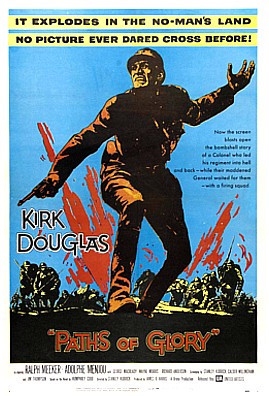
Stanley Kubrick’s 1957 film, Paths of Glory is one of the greatest war films ever made. Indeed, I would rank it as second only to Renoir’s Grand Illusion.

Colonel Dax (Kirk Douglas) is serving in the French Army during World War I. His commanding officer, the ambitious General Mireau (George Macready) orders him to lead his regiment in a suicidal attack on a heavily fortified hill. When Dax shows reluctance to do this, Mireau questions his patriotism. An incensed Dax tells Mireau that he will lead the attack. The next day, Dax leads his men into battle, but an intense artillery barrage forces them back into the trenches. Refusing to admit that the attack was a bad idea, Mireau claims that it failed because the soldiers were cowards. He orders that one soldier be picked from each battalion to be tried for cowardice. Dax, who was a lawyer in civilian life, announces that he will defend the men in court. The trial turns out to be rigged, however, and despite Dax’s best efforts, the men are condemned to death.

This film is filled with powerful images. There is, for example, a long tracking shot of Dax walking through the trenches just before the attack. The soldiers are lined up along the walls, and shells are exploding outside the trenches. We can see from the expression on his face that Dax has convinced himself that he can somehow make this insane plan work through sheer willpower. The scene is a striking depiction of the self-willed bravado that make war possible.

Paths of Glory is about bureaucratic corruption and incompetence. It makes the point that the military system actually rewards cynicism and ambition rather than courage and honor. (One can see this in the Army’s treatment of Bradley Manning.) In a scene between Dax and General Broulard (Adolphe Menjou), the latter assumes that Dax has opposed Mireau because he wants the latter’s position. When Dax tells him that he was actually trying to defend his men, Broulard reacts with a mixture of surprise and comtempt.

Paths of Glory is based on a novel by Humphrey Cobb that was inspired by an actual incident in the First World War. This film wasn’t shown in France for many, apparently because members of the French military objected to its portrayal of French army officers. (I guess these guys were a little touchy after their less than stellar performance during World War II.)

A great film.

Chinatown

March 23, 2013

Chinatownposter1

Chinatown, the 1974 film directed by Roman Polanski, from a screenplay by Robert Towne, tells the story of Jake Gttes (Jack Nicholson), a private investigator who mostly handles marital infidelity cases. One day, Evelyn Mulwray (Diane Ladd) shows up in his office and hires Gittes to find out whether her husband, Hollis Mulwray (Darrell Zwerling), who happens to be one of the most powerful men in the city of Los Angeles, has been cheating on her. Jake follows Mulwray and finds that he has been having an affair with another woman. When he tells Mrs. Mulwray, she gives the photos to the newspapers, causing a scandal. Then another woman shows up in his office and identifies herself as Evelyn Mulwray (Faye Dunaway). Shortly after this, Hollis Mulwray is found dead in a reservoir. Gittes becomes obsessed with trying to find out who used him and why.

Polanski and Towne were influenced by Raymond Chandler in their making of this film, although Gittes is a more cynical and less polished character than Chandler’s Philip Marlowe. And the film is actually bleaker than any of Chandler’s works. (Although, come to think of it, The Lady in the Lake is an extremely bleak novel.) The film benefits from Polanski’s intimate style of direction. He often has the camera follow people from room to room and from place to place. This has the effect of making one feel almost as if one were being physically drawn into the action. This contributes to the emotionally devastating effect of final scene.

The story of Chinatown was inspired by an actual series of events known as the California Water Wars. In the early decades of the twentieth century, the city of Los Angeles fought with local farmers for control of water in the Owens Valley. Los Angeles eventually managed to acquire the rights to all of the water in the valley, and Owens Lake was turned into a dust bowl. The character of Hollis Mulwray is loosely based on William Mulholland, a key player in the Water Wars. Mulholland, an Irishman, was a self-taught engineer. He was the superintendent of the Los Angeles Department of Water and Power. He deliberately underestimated the amount of water available to the city in order to whip up public support for the idea of building an aqueduct from the Owens Valley. Mulholland also falsely told the residents of Owens Valley the city would only take water for domestic use and not for commercial use. Mulholland conspired with Mayor Frederick Eaton to enrich themselves and their friends at the expense of the public.

Like many other American cities, Los Angeles was built through greed and corruption. Maybe this is a universal phenomenon. In Capitalism and Slavery, Eric Williams points out that many cities in Britain were built from the wealth generated by the slave trade. Much of the modern world has unsavory origins.

The Wind That Shakes the Barley

March 20, 2013

The_Wind_That_Shakes_the_Barley_poster

One of my Facebook friends suggested that instead of drinking green beer and getting violently drunk on St. Patrick’s Day, people should watch The Wind That Shakes the Barley. I decided to take this advice, and I’m glad I did. Ken Loach’s film about the Irish War of Independence is a remarkable work. Not only is it a stirring depiction of armed struggle against oppression, but it is also a disturbing examination of the moral dilemmas that such a struggle entails.

The year is 1920. Damien O’Donovan (Cillian Murphy) is a young doctor about to leave for London to work in a hospital there. When a friend of Damien’s is murdered by the Black and Tans, his friends urge him to join the Irish Republican Army, but he dismisses their cause as hopeless. At a train station, however, he sees British soldiers beat up some railway workers who refuse to let them on the train. He changes his mind and joins the IRA, where his brother, Teddy (Pádraic Delaney), is an officer. Together, they fight against the British. When the Anglo-Irish Treaty is signed, Teddy supports it. He argues they have no choice but to accept it, since the British threaten all-out war if it is rejected. (Considering that Churchill was not opposed to genocide, I don’t think this was an idle threat.) Damien, however, sees it as a betrayal of the Republican cause. They find themselves on opposite sides of the ensuing civil war.

It seems that in every revolution, there comes a moment when one group decides that it has gone as far as it can possibly go, while another group is equally convinced that the revolution must go further. The most famous example is the split between the Girondists and the Jacobins during the French Revolution. What is less appreciated is that such a split actually happened three times during the Russian Revolution: first between the Mensheviks and the Bolsheviks, then between Lenin and the Workers’ Opposition, and finally between Stalin and Trotsky. The Wind That Shakes the Barley illustrates how the Irish War of Independence followed this pattern, with tragic results for those involved. This film doesn’t present either side as being entirely right or entirely wrong. Like Brecht’s The Good Woman of Szechuan, it presents us with an open-ended question.

Hangmen Also Die

March 9, 2013

Hangmen_Also_Die_1943_poster

Hangmen Also Die is an entirely fictionalized account of the assassination of Reinhard Heydrich, one of the leaders of Nazi Germany. This 1943 film was directed by Fritz Lang, from a screenplay by John Wexley, based on a story by Bertolt Brecht and Lang. This was the only Hollywood film that Brecht worked on for which he received an on-screen credit. Lang had originally intended to have Brecht write the screenplay, but he apparently changed his mind due to aesthetic, political, and personal differences between himself and Brecht that made it increasingly difficult for them to work together.

The film is set in German-occupied Czechoslovakia during World War II. Svoboda (Brian Donlevy) has just assassinated Heydrich, and he is fleeing down a street. Mascha (Anna Lee) sees him. When the Gestapo ask her where he went, she points them in the opposite direction. Svoboda, who is hiding nearby, observes this. Desperate for a place to hide, he follows her to her home, where he manages to persuade her to take him in, even though he knows that by doing so, he is placing her and her family in danger of retaliation by the Gestapo.

Lang and Brecht did not get along well when they were working on the story for Hangmen Also Die. Brecht thought some of Lang’s story ideas were unbelievable. He complained, for example, of one scene in which Lang had the leader of the Czech resistance evade the Gestapo by hiding behind a curtain. (I found this hard to believe myself.) Yet Lang was right to reject Brecht’s idea that the mistakes of the underground “are corrected by the broad mass of the people”. Brecht’s, influence, however, can perhaps be seen in the fact that one of the film’s chief villains is a Czech collaborator who is also the wealthy owner of a beer brewery. And there is some dark Brechtian humor in the moment when, in the midst of interrogating someone, a Gestapo officer pauses to squeeze a pimple on his face. (That’s something you don”t often see in Hollywood movies.)

John Wexley and Hanns Eisler (who composed the music) were both later blacklisted. Eisler was eventually deported because of his left-wing political views. Brecht left the country after being questioned by the HUAC.

Despite its contrived and melodramatic moments, Hangmen Also Die does touch upon some complex moral and political questions, such as whether terror tactics, like assassinations, are ever a good idea. In the film, the Gestapo begin carrying out random executions in retaliation for the assassination. What happened in real life was even worse. The Nazis destroyed the Czech city of Lidice, killing most of its inhabitants or sending them to concentration camps.

Although it is not one of Lang’s best films, Hangmen Also Die is nonetheless one of the more interesting films to come out of World War II.

2013 Academy Awards

February 26, 2013

85th Annual Academy Awards - Show

The Academy Awards has become an annual ritual second only to the Super Bowl in its importance. Of equal significance is the wave of complaints that follow each telecast. There is always a great gnashing of teeth over the tacky dance numbers, the inept hosts, the comedy bits that fell flat, the overlong acceptance speeches, and the corny “tributes”. Yet every year the complainers watch. Perhaps it’s because the show speaks to our deeply ambivalent feelings towards the entertainment-industrial complex. (It must also be admitted that there is more than a bit of jealousy and envy in all this carping.)

This year’s show provided plenty of fuel for its critics, beginning with the Academy’s bizarre decision to make Seth MacFarlane the host. The director of Ted has been rightly criticized for his juvenile sense of humor, but I feel that I should point out that MacFarlane didn’t invent bad taste. I remember the 1987 Oscars – excuse me, I mean the 59th Academy Awards. They showed a clip from Platoon, in which American soldiers are shown clearing out a Vietnamese village. This immediately segued into a musical number with Bernadette Peters. This was perhaps the most tasteless ting I have ever seen on television.

This brings up a question: why even bother with musical numbers? Why not just hand out the awards? I guess because the awards are not so much about excellence as they are about hype. The movie industry must be to made to seem more important than it is, and the awards must be made to seem to have more meaning than they do. So the organizers of this year’s awards must have been so pleased with themselves when they persuaded Michelle Obama to announce the winner of the Best Picture award. A further step in the merger of Hollywood and the government, which began with the election of Ronald Reagan (Barack Obama’s hero) to the White House. And it was very fitting, too, considering that the picture that won it is an exercise in historical falsification that glorifies the C.I.A.

The Magnificent Ambersons

February 21, 2013

Magnificent_ambersons_movieposter

The Magnificent Ambersons was Orson Welles’s second film. It is based on the novel by Booth Tarkington. RKO Radio Pictures drastically edited it, and, over Welles’s protests, they tacked on an unconvincing “happy” ending. Even in its mangled form, however, this film is fascinating to watch.

The story begins in a Midwestern town in the late nineteenth century. The Ambersons are a wealthy family whose mansion dominates the town. Isabel Amberson (Dolores Costello) marries Wilbur Minafer (Donald Dillaway). Their son, George (Tim Holt), is the heir to the Amberson fortune. Isabel’s former suitor, Eugene Morgan (Joseph Cotten) shows up at a party one day. After Wilbur dies, Isabel and Eugene begin to strike up their former romance again. At the same time George becomes infatuated with Eugene’s daughter, Lucy (Anne Baxter). When George learns of his mother’s affair with Eugene, he is adamantly opposed to it. While the Ambersons lose their money through bad investments, Eugene’s automobile company prospers.

Welles’s film is an exercise in nostalgia. It presents a vision of an America that was more elegant and humane before the rise of the automobile. This is, of course, based on a highly selective view of the past. There were a lot more people working twelve-hour days in factories than there were living in stately mansions. Welles was no doubt aware of this. He apparently saw the belief in an idealized past as expressing a human desire for goodness. Also, he does not portray the Ambersons as perfect. George is essentially a spoiled brat. It’s not until when the Ambersons lose their fortune that he begins to show a sense of responsibility and consideration towards others.

The Magnificent Ambersons was a labor of love for Welles. He put considerable effort into making it. For example, he filmed the winter scenes in an ice house near downtown Los Angeles, so the actors’ breaths could be seen. He was reportedly deeply bitter at the studio’s drastic editing of the film. These cuts are perhaps the reason why the second half of the movie feels a bit rushed. The Ambersons seeem to lose their money all at once. Still, The Magnificent Ambersons is a remarkable achievement.

Chimes at Midnight

February 12, 2013

FalstaffPoster1

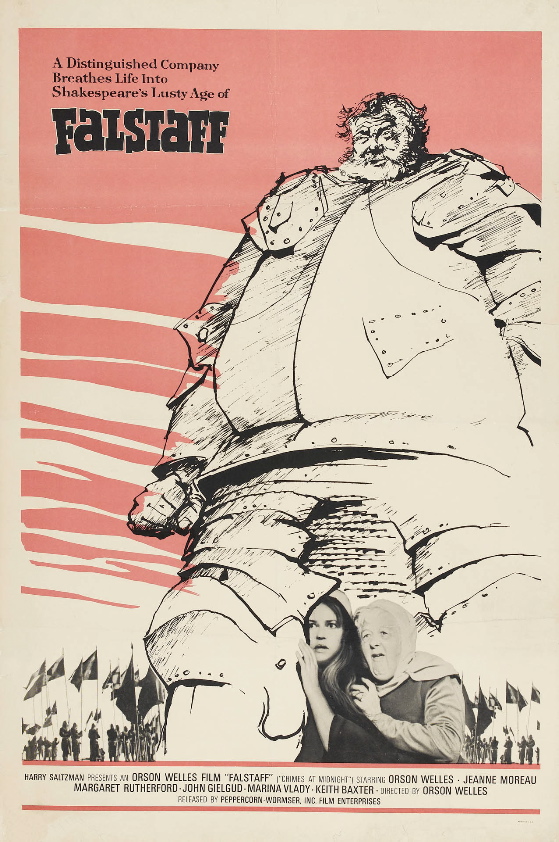
Orson Welles’s 1965 film, Chimes at Midnight, combines scenes and dialogue from five different Shakespeare plays to tell the story of Sir John Falstaff. This film was the result of a life-long fascination that Welles had with Shakespeare’s historical plays. Welles regarded Falstaff as a tragic figure, so it is not surprising that this film is more of a tragedy than a comedy.

Chimes at Midnight was a labor of love for Welles, so it is sad to note that he had difficulty getting funding for it. Welles had to work with a limited budget. One result of this is that the sound quality is poor. I often had difficulty making out what the actors were saying. (This is not a good film for someone who is unfamiliar with Shakespeare.) Despite such problems, though, this film is a remarkable achievement. The scene in which Harry (Keith Baxter), the newly crowned Henry V, coldly rejects his old friend, Falstaff, is disturbing to watch. It is, in a way, a comment on the corrupting effect of power, which can sever emotional ties between people. Overall, this film expresses a cynical view of political power. Henry IV (John Gielgud) comes across as a pompous hypocrite; he talks about honor and duty, when we know that he murdered his predecessor, Richard II. (He is so vain that he demands that his crown be placed on the pillow next to him on his deathbed.) Harry inherits his father’s hypocrisy along with his crown.

Chimes at Midnight is also notable for its depiction of the Battle of Shrewsbury. The scene begins with knights charging at each other on horseback, and it ends with soldiers grappling with one another in the mud. It is a visual metaphor for the dehumanizing effect of war.

Chimes at Midnight is one of Welle’s best films. Unfortunately, due to legal disputes over the film’s ownership, it has often been out of circulation. You can currently find it on YouTube. I recommend checking it out before it gets pulled.

Bullhead

February 10, 2013

Rundskop_bullhead_affiche_poster

I unfortunately missed Bullhead when it was first released in this country. This Belgian film was nominated for an Academy Award for best foreign language film. (It lost out to the Iranian film, A Separation, which is also very good.) First time director Michaël R. Roskam has crafted a powerful and disturbing movie.

Jacky Vanmarsenille (Matthias Schoenaerts) belongs to a cattle-raising family in Flanders. His family uses hormones to fatten their cattle, which is illegal in Belgium. Jacky uses steroids to bulk himself up, in a manner eerily similar to the way he bulks up cattle. Through a series of flashbacks we learn that Jacky’s behavior is the result of a traumatic childhood experience. Jacky’s family becomes increasingly involved in the trade in illegal hormones. When a leader of the “hormone mafia” has a government agent killed, Jacky begins to fear that his family may be in over their heads. At the same time Jacky obsesses over a girl from his childhood.

Bullhead derives much of its power from Schoenaerts’s performance. One can sense the frustration and rage boiling inside his character. Much of the suspense of the film comes from knowing that his anger can explode at any time.

This film depicts Belgium’s hormone mafia. This group presents a real problem in that country. In 1995, they murdered a government meat inspector (this incident was the inspiration for this film). It appears that farmers are willing to break the law just to give themselves a competitive advantage. The logic of capitalism fuels such behavior. Here in the U.S., where agribusiness practically controls the government, there are no prohibitions on hormone use. The U.S. has been pressuring European countries such as Belgium to lift their bans on hormone use. It seems that the U.S. has become a sort of hormone mafia.