Archive for the ‘Cinema’ Category

Shane

February 3, 2013

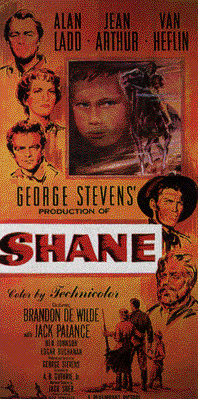
Shaneposter

I have to admit that I’ve never been terribly keen on Westerns. I find most of them impossible to believe; they’re simply not accurate depictions of the “Old West”. They get all sorts of details wrong, beginning with women wearing twentieth-century hairstyles. And they show cavalrymen shooting guns while riding their horses. In real-life, they had to dismount before firing, otherwise the horses would panic. And of course, there’s that whole business of the good guy and the bad guy facing each other in the middle of the street in a shoot-out. (Of course, the good guy always happens to have faster reflexes than the bad guy does.) In reality, gun battles were usually fought the same way they’re fought today: people hiding behind things and shooting at each other.

Dan-Blocker-Loren-Greene-Pernell-Roberts-Michael-Landon-Bonanza
The Cartwright family, moments before they were gunned down in the middle of the street.

George Stevens’s Shane is one of the better Westerns that I’ve seen. A retired gunslinger, Shane (Alan Ladd), who is fleeing his past, passes through the land of a homesteader, Starrett (Van Heflin). There he learns that a wealthy landowner named Ryker (Emile Meyer) is trying to force Starrett and other homesteaders off their land. Shane spends the night with Starrett and his wife, Marian (Jean Arthur), and his son, Joey (Brandon deWilde). He decides to work as a farmhand for Starrett. Meanwhile, Ryker hires a gunslinger named Walker (the wonderfully creepy Jack Palance) to help him intimidate the homesteaders. The rest of the film basically builds towards the inevitable confrontation between Shane and Walker.

Shane is entertaining to watch. The characters are complex, and the cinematography is beautiful. Still, while I was watching this movie, I couldn’t help feeling that it could have been better. It hints at a love triangle between Shane, Marian, and Starrett; but this idea is never developed. At the same time the film puts far too much emphasis on the business of Shane forging an emotional bond with Joey. At times this is almost embarrassing to watch. And I thought they could have done more with Palance’s character. (Palance’s mere presence in a film automatically makes it better.) Still, I can see why this film is considered a classic. If you want to see a good Western, you can’t do much better than Shane.

The Legend of Bhagat Singh

January 13, 2013

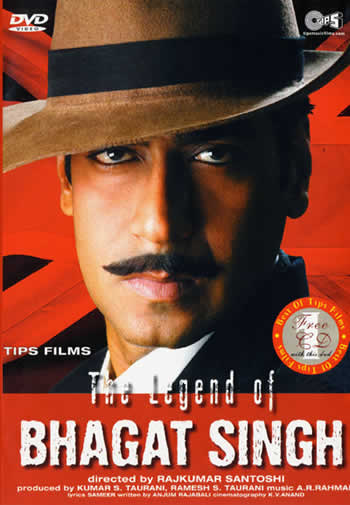
Bhagatsinghlegend

After reading my review of The Baader Meinhof Complex, a friend of mine recommended that I watch the 2002 Indian film, The Legend of Bhagat Singh, which also touches upon the question of what tactics should be used in the struggle against injustice. Although Bhagat Singh (1907-1931) is little known in the U.S., he is famous in India for his role in the Indian independence movement. He rejected Gandhi’s notion of non-violent resistance. He was a founding member of the Hindustan Socialist Republican Association, which sought to organize a mass uprising against the British. When the Indian writer, Lala Lajpat Rai, died after being beaten by the police, Singh and his comrades killed a British police officer in revenge. Later, they threw bombs in the Indian National Assembly, with the intent of getting themselves arrested. Singh hoped that his speeches at the trial would inspire the Indian people to rise up against their colonizers. His trial received considerable attention, and for a time he became as popular as Gandhi. However, this did not stop the British from executing him.

This film shows Gandhi in an unflattering light. It accuses him of dropping his demand that the Viceroy commute Singh’s death sentence so that he could get a political pact with the British granting limited rights to Indians. Given all the adulation given to Gandhi in both India and the West, it’s interesting to see a film that portrays him in a negative manner. In effect, it accuses him of being willing to sacrifice principle in order to get an agreement with the British.

The director, Rajkumar Santoshi, paints the story of Singh’s life in broad strokes. He doesn’t spend much time on character development. Singh (Ajay Devgan) appears fearless and wise almost from the time of his birth. And in true Bollywood fashion, there are musical numbers. Singh sings. He sings (twice) while he is on a hunger strike, and he sings while he is going to his execution. The Legend of Bhagat Singh emphasizes Singh’s advocacy of Hindu-Muslim reconciliation. (Singh came from a Sikh family, but he became an atheist at an early age.) Santoshi clearly wanted to remind his fellow Indians of Singh’s politics, which are more relevant than ever with the sectarian violence that has sometimes taken place in that country in recent years. No doubt Santoshi thought that following the conventions of Bollywood would give the film more appeal, although I’m told that it actually did not do well at the box office. In all honesty, I could have done without the singing, but I found this a compelling film nonetheless.

The Fog of War

January 6, 2013

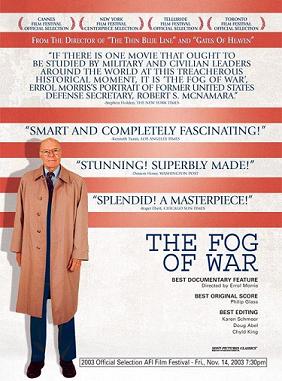
Fog_of_war

I just got around to watching Errol Morris’s 2003 documentary, The Fog of War. I didn’t see this film when it first came out, probably because 2003 was a busy year for me. I found it somewhat disappointing. Much of it consists of McNamara trying to justify his actions. I should have expected that, but the reviews I read led me to believe it would be much more than that. Still, the film does have some interesting moments, and it gives some insight into the way one member of the ruling class thinks. I don’t think this is a minor thing. I think that perhaps the reason so many people on the Left are suckers for crackpot conspiracy theories is that they don’t have much understanding of how the ruling class thinks.

The film begins with McNamara, who is shown in tight close-ups most of the time, discussing the Cuban Missile Crisis. McNamara repeatedly points out the U.S. and the Soviet Union came extremely close to a nuclear war. McNamara uses his account of the crisis to illustrate one of the “eleven lessons” he talks about in the course of The Fog of War; in this case, “empathize with your enemy”. McNamara tells how a diplomat named Tommy Thompson, who knew Krushchev well, persuaded a skeptical Kennedy that the Soviet premier would be willing to cut a deal over Cuba, which turned out to be the case. This raises the question of why there was a crisis at all, though, unfortunately, Morris doesn’t ask this question. McNamara also uses this incident to illustrate another one of his “lessons”: “rationality will not save us”. McNamara insists that the governments of the U.S., the Soviet Union, and Cuba all behaved in a “rational” manner, even though they brought their countries to the brink of nuclear annihilation. So, if this is rationality, then what is irrationality? And if rationality will not save us, then what will? Morris doesn’t ask, and McNamara doesn’t say.

The Fog of War then goes into a discussion of McNamara’s early years. During the Second World War, he served as an analyst for the Army Air Corps. Under the command of Gen. Curtis LeMay, McNamara helped plan the fire bombing of Tokyo, which killed 100,000 people. This leads to the film’s most startling moment: McNamara frankly states that he and Gen. LeMay were war criminals. Still, he expresses no regrets about what he did.

The largest section of the film is devoted to the Vietnam War. McNamara doesn’t say much about the strategic justification for the U.S.’s intervention in Vietnam; he seems to consider this to be self-evident. McNamara admits that there was some confusion over what actually happened in the Gulf of Tonkin Incident; nevertheless, he and President Johnson used it as justification to launch an intensive bombing campaign in North Vietnam. McNamara also gives a discussion in which he tries to distance himself from the use of Agent Orange in Vietnam. To illustrate his “lesson” of “empathize with your enemy”, McNamara talks about how years after the war he met the former foreign minister of North Vietnam. McNamara says he was surprised to learn from this man that his government viewed the U.S. as a foreign colonial power trying to take control of their country. Reall? It never occurred to McNamara that the Vietnamese might view the U.S. in this way? If McNamara was being honest here, then he was every bit as self-deluded as the people who led us into the Iraq War. (It so happens that this film was released the same year as the U.S. invasion of Iraq.)

McNamara casually discusses the deaths of millions of people, yet he gets choked up when he recounts how he helped pick out the grave-site for John F. Kennedy. One is reminded here of Stalin’s dictum: “One death is a tragedy, but a million deaths is a statistic.” I don’t think it is a stretch for me to say that McNamara had some of Stalin’s bureaucratic mind-set.

Another of McNamara’s “lessons” is “in order to do good, you may have to engage in evil”. One wonders if McNamara ever questioned whether what he was trying to do was actually good.

The Baader Meinhof Complex

December 31, 2012

Baader_meinhof_komplex

The 2008 German film, The Baader Meinhof Complex, directed by Uli Edel from a screenplay by Bernd Eichinger, tells the story of the Red Army Faction, better known as the Baader Meinhof Group, a terrorist group active in Germany from the 1970’s through the 1990’s. The group had broad support in its early years. It appealed to young people disillusioned with post-war German society. They were particularly opposed to the Vietnam War and the West German government’s passive support for it, which they viewed as being analogous to Germans who had allowed the Holocaust to happen. The death of Che Guevara had also inspired many of these people.

The film begins with a demonstration against the Shah of Iran during his visit to Berlin in 1967. The police attack a crowd of student demonstrators, resulting in the death of Benno Ohnesorg. Shortly afterwards, Andreas Baader (Moritz Bleibtreu) and Gudrun Ensslin (Johanna Wokalek) fire bomb a department store, protesting the political complacency of German society. Baader is eventually arrested by the police. A journalist, Ulrike Meinhof (Martina Gedeck), interviews him in prison. Meinhof is frustrated by what she sees as the inability of her journalism to bring about any change. Meinhof agrees to help Baader to escape from prison, which she does. She then joins Baader’s gang, which he has christened as the Red Army Faction (RAF).

The rest of the film starts out as farce and ends as tragedy. The RAF leaders flee Germany to a Fatah camp in Jordan, to be trained in guerilla warfare. The RAF consider themselves to be in support of “Third World” liberation struggles. Once in the camp, however, they begin behaving like a bunch of spoiled teenagers. (This is the best way I can describe it.) They quarrel with the Fatah leaders, and they violate Palestinian social norms by, among other things, doing nude sunbathing in the middle of the camp. They return to Germany, where they carry out a series of daring bank robberies and bombings. However, the police capture or kill members of the RAF one by one. They eventually capture Baader, Meinhof, and Ensslin. However, a “second generation” of RAF members springs up. They use terror methods to try get their leaders released, culminating in the highjacking of an airliner in 1977. When army troops succeed in freeing the hostages, Baader and the others despair of ever getting out of prison, so they kill themselves.

Edel and Eichinger try to compress a complex series of historical events into a two-and-a-half hour film with predictably uneven results. New RAF members suddenly appear out of nowhere, and at times it’s hard to tell who is doing what. The film touches upon some complex issues without addressing them in satisfying ways. For example, some people have raised reasonable doubts as to whether the RAF leaders actually killed themselves, suggesting that they might have been murdered. (According to Wikipedia: “… Baader was supposed to have shot himself in the base of the neck so that the bullet exited through his forehead; repeated tests indicated that it was virtually impossible for a person to hold and fire a gun in such a way. In addition, three bullet holes were found in his cell: one lodged in the wall, one in the mattress, and the fatal bullet itself lodged in the floor, suggesting that Baader had fired twice before killing himself. Finally, Baader had powder burns on his right hand, but he was left-handed.”) While the film mentions that there were doubts about the suicides, it doesn’t really discuss this matter. Also, the film ends with the RAF’s killing of the industrialist, Hans Martin Schleyer in 1978, although the RAF remained active well into the 1990’s.

This film is a grim reminder that terrorism doesn’t work. Germany is not a better place today because of the Baader Meinhof group. The 9/11 attacks resulted in the expansion of U.S. imperialism. Terrorism actually strengthens the state by providing it with an external enemy. (“War is the health of the state”, as Randolph Bourne once put it.) Only mass movements have ever brought about any progress.

Reds

December 24, 2012

Redsposter

Warren Beatty’s 1981 film, Reds, tells the story of John Reed and Louise Bryant, two American journalists who were witnesses to the Russian Revolution. Beatty wrote the screenplay with Trevor Griffiths. Watching this film, one is impressed by the personal courageousness of Reed and Bryant, as well as by their commitment to social justice. They were interesting and inspiring people, so I wish I could give this film an unqualified endorsement, but unfortunately it has a number of problems with it.

At nearly three hours, Reds is too long, mainly because the first half largely consists of scenes of Reed (Warren Beatty) and Bryant (Diane Keaton), who were married, bickering with each other, as well as scenes of Bryant having an affair with Eugene O’Neil (Jack Nicholson). The film doesn’t get interesting until about halfway through when Reed and Bryant go to Russia. Beatty and Griffiths seemed to have had trouble making convincing characters out of historical figures. O’Neil, for example, mostly just drinks a lot and glowers at people. It’s hard to see why Bryant is attracted to him.

Lenin and Trotsky appear only briefly. Zinoviev (Jery Kosinski) and Radek (Jan Triska) are the only Bolshevik leaders depicted in any detail. Reed’s feud with Zinoviev provides much of the drama in the second half of the film. Zinoviev comes across as a bit of a bully and somewhat dishonest, although personally brave. Reed, on the other hand, comes across as a bit ultra-left. He opposes the idea of communists trying to work within the American Federation of Labor, for example. Unfortunately for the film, their conflict is left unresolved because of Reed’s untimely death.

Reds does not romanticize the Russian Revolution. There are discussions about the collapse of the Russian economy and the high-handed methods of the Bolsheviks. Yet the film also points out that sixteen foreign armies (including the U.S. army) invaded Russia. This is a point that often gets conveniently ignored in discussions about the Russian Revolution.

Beatty does possess skill as a director. The scene in which Bryant’s home is raided by government agents, for example, is effectively done, as is the scene in which White Army soldiers attack a train on which Reed is traveling.

The film includes interviews with “witnesses”, people who knew Reed and Bryant. Most of their comments are unilluminating, and some are downright inane. (George Jessel is inexplicably allowed to sing.) They mostly serve as a distraction from the story. I think the film would actually have been better if these had been left out.

While we are on the topic of historical portrayals, I must say I always thought Patrick Stewart would make a good Lenin. So you can imagine my pleasant surprise when I learned that Stewart actually did play Lenin in a BBC TV-series in the early 1970’s entitled The Fall of Eagles. Here is a clip from the series that depicts Lenin’s return to Russia in 1917:

Full Metal Jacket

December 20, 2012

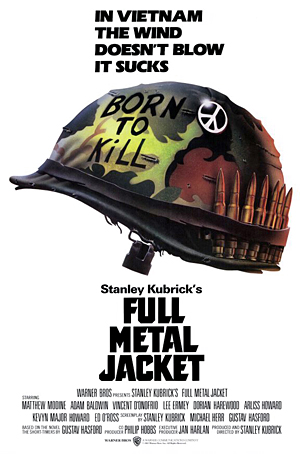
Full_Metal_Jacket_poster

Stanley Kubrick’s Full Metal Jacket is an examination of the meaninglessness and amorality of war. It is also a critique of the military and its values. This film is based on the writings of two Vietnam war veterans, Gustav Hasford and Michael Herr.

The film tells two stories that subtly mirror each other. The first half of the film depicts the basic training experience of James T. “Joker” Davis (Matthew Modine) at the Marine Corps base on Parris Island during the Vietnam War. He and a group of other recruits are under the command of a drill instructor, Sgt. Hartman (R. Lee Ermey, who was a Marine D.I. before he became an actor). Hartman aims most of his insults at Pvt. Lawrence (Vincent D’Onofrio), a hapless recruit who can never seem to do anything right. Hartman gives him the nickname “Gomer Pyle” and proceeds to make his life miserable. His taunting of Lawrence has tragic results for both of them.

There were several things that struck me about this half of the film. The first is that on several occasions Hartman either slaps or punches people. In one scene, he chokes Lawrence. I was always under the impression that officers and N.C.O.’s are not allowed to hit soldiers. (Didn’t Gen. Patton almost get fired for doing that?) I have since learned from various sources that D.I.’s sometimes get away with hitting recruits, even though technically they are not supposed to do it. Another thing that struck was religious indoctrination. Hartman sometimes talks about religion to the recruits. In one scene, Hartman asks Davis if he believes in the Virgin Mary. When Davis says no, Harman punches him in the stomach. Among other things, Hartman merely asking that question violates the First Amendment. People in the military take an oath swearing to defend the Constitution. The issue of religious indoctrination in the military is one that crops up in the news every now and then. There have been attempts at the United States Air Force Academy to convert people to fundamentalist Christianity. I guess a belief in Biblical literalism helps one to drop bombs on people.

This film also depicts how misogyny and homophobia are instilled in recruits during basic training.

The second half depicts Davis’s experiences during the Battle of Hue. Full Metal Jacket manages to avoid the clichés of war movies. It leads to a harrowing climax in which the members of Davis’s platoon are picked off one by one by a sniper. For all their savage training, the soldiers turn out to be just frightened men dealing with a terrifying situation. The lone sniper turns out to be a woman. When Davis kills her, we are reminded of Lawrence killing Sgt. Harman. Full Metal Jacket ends with a scene of Marines marching through the ruins of Hue while singing the theme song of The Mickey Mouse Club. There is perhaps no better metaphor for U.S. imperialism.

Marmoulak (Lizard)

December 14, 2012

Image

Marmalouk is a 2004 Iranian film directed by Kamal Tabrizi. The Iranian government banned it after a two-week run. Nevertheless, it is the successful Iranian film ever.

Reza (Parviz Parastui) is a thief who has the nickname, Marmoulak (Lizard), because of his uncanny ability to climb walls. He is caught, and he spends some time in prison, but he manages to escape by disguising himself as a mullah. He goes in search of a man who will help him escape across the border. On the way, he stops in a village where the people mistake him for the new mullah for their mosque. Reza pretends to be their mullah during the day, but at night he goes looking for the man who is supposed to help him cross the border. The villagers notice his night-time excursions, and they mistakenly believe that he is doing charitable works. Reza acquires a reputation as a saint, and people begin flocking to his sermons.

The film is implicitly critical of the Iranian clergy. It seems to suggest that they are out of touch of the people. The clergy apparently decided to prove this popular film’s point by banning it. Yet Marmoulak is not an attack on religion. Quite the contrary, it is actually very respectful towards Islam. It ends on a highly spiritual note. It is also quite funny. The characters are interesting, and it gives us a glimpse into Iranian society. It can be found on Youtube.

Lincoln

November 30, 2012

Last night I went to Spielberg’s and Kushner’s Lincoln, after having been apprised of the historical and political limitations of the film. I must say that I thoroughly enjoyed. The writing, acting, and direction were all splendidly done. Some moments were a bit schmaltzy, but not too much so. It was very restrained for a Steven Spielberg film. This film instilled in me a greater respect for Lincoln and for Thaddeus Stevens.

There has bee a lot of sniping at the film from some left-wing websites. It seems to me that what has provoked them is not so much the film itself, but the liberal politics of Kushner and Spielberg. In interviews, Kushner has compared Obama to Lincoln. Eve worse, he has taken a reactionary view of Reconstruction, claiming that

    The inability to forgive and to reconcile with the South in a really decent and humane way, without any question, was one of the causes of the kind of resentment and perpetuation of alienation and bitterness that led to the quote-unquote ‘noble cause,’ and the rise of the Klan and Southern self-protection societies.

What’s interesting to me is that Kushner’s own screenplay contradicts his arguments. In it, Lincoln is not a cautious compromiser like Obama. In fact, he never really compromises at all. Instead, he uses various methods, some of them quite ruthless, to pass the 13th Amendment, which abolishes slavery. The closest he ever comes to compromise is when he agrees to meet with a Confederate “peace” delegation, in order to get conservative Republicans to back the Amendment. Yet he delays meeting with the delegates, fearing that if the war ends, Congress won’t pass the Amendment. When he finally does meet with them, after the Amendment has been ratified, he finds that they are unrepentant slave-owners who want to preserve slavery. “Slavery is done,” he tells them, ending the negotiations.

I don’t know how Kushner came to his views on Reconstruction, but his idea that Obama is somehow like Lincoln is common among liberals. Obama has done nothing to earn this comparison, just as he did nothing to earn the Nobel Peace Prize. The only thing he has in common with Lincoln is that both men are hated by Southern racists. When I lived in Eugene, Oregon; there was a restaurant there that had on one of its wall a drawing of Obama with a stovepipe hat and a Lincolnesque beard. The image was so large that it was almost impossible to ignore it. There is something about this sort of thing that is almost akin to the worship of the Kim family in North Korea. All right, that may be going a little far, but you have to admit that there is the same desire for a hero in each.

One of the things I liked about this film is its sympathetic portrayal of Thaddeus Stevens (brilliantly played by Tommy Lee Jones). Perhaps this film will reawaken an interest in Stevens. In addition to his opposition to slavery, this was a man who championed the rights of women, of Native Americans, of Chinese immigrants, and of Jews. He was a seminal figure in the forgotten history of American radicalism.

Even Dwarfs Started Small

November 19, 2012

    I believe the common denominator of the universe is not harmony; but chaos, hostility and murder.
    – Werner Herzog

Werner Herzog’s 1970 film, Even Dwarfs Started Small (Auch Zwerge haben klein angefangen). This film was shot with a cast consisting entirely of dwarfs. According to Herzog, he did this to show that “the world is created in a way that is not theirs”. The objects around them are designed for full-sized people. In one scene, for example, Hombre (Helmut Döring) tries unsuccessfully to climb onto a bed. “The dwarves in the film are not freaks,” Herzog says; rather, “[they are] well proportioned, charming, and beautiful people.” It is the world around them that is freakish. The film is a critique of our consumer culture. The characters are surrounded by over-sized chairs, motorcycles, cars, and other objects that they can’t really use. When this film was released, it was banned in Germany for being “anarchistic and blasphemous”. Some claimed the film was meant to ridicule the student movement of that time. Herzog certainly was not sympathetic to the movement. He once said:

    Contrary to most of my peers, I had already been much further out into the world. I had traveled, I had made films, I had already taken on responsibilities that very few people my age had. For me, this very rudimentary analysis that Germany was a fascist and repressive prison state, which had to be overpowered by a socialist utopian revolution, seemed quite wrong. I knew the revolution would not succeed because it was rooted in such an inadequate analysis of what was really going on, so I did not participate.

The characters in this film certainly don’t have any analysis of their situation. They seem to act purely on impulse, which eventually becomes a form of nihilism.

The film is set in an institution whose purpose is never made clear. One day the inmates rise up and take over the place. The director (Paul Glauer) is holed up in his office. He has taken one of the inmates, Pepe (Gerd Gickel), hostage. The inmates amuse themselves by playing games, which are fairly innocent at first, but which gradually become destructive. They kill a pig, pull down a palm tree and set fire to flowers. They torment two blind inmates. In a scene that is clearly meant to be sacrilegious, they “crucify” a monkey by tying him to a cross, which they then parade around the yard. (No doubt it was this scene that got the film banned in Germany.) The director eventually goes mad and runs away. In the last scene, we see Hombre laughing stupidly while a camel kneels in front of him and defecates.

This film is disturbing to watch, yet there are moments that are actually funny in a dark sort of way. Herzog has alternately called this film “darkest of comedies you can imagine” and “a very profound…collective nightmare”. In Herzog’s comedy and horror are never far apart. There are even funny moments in Aguirre, the Wrath of God. Violence and megalomania are appalling and yet grotesquely humorous.

During the filming of Even Dwarfs Started Small, one of the actors suffered a mild injury. Herzog promised the cast that if they made it through the rest of the filming without any more injuries, he would jump into a large cactus plant. He later kept his promise. Incidents such as this have made Herzog an almost mythical figure in contemporary cinema. The 2004 mockumentary, Incident at Loch Ness seeks to exploit this. It is purportedly a documentary about Herzog making a documentary about the Loch Ness monster. Although it has amusing moments, it feels a bit familiar. It’s only been twenty-eight years since the making of This is Spinal Tap, yet already the mockumentary is becoming cliché. How about a mockumentary about the making of a mockumentary?

Dr. Mabuse

November 11, 2012

Fritz Lang made three films about the super villain, Dr. Mabuse. This character was clearly inspired by Conan Doyle’s Dr. Moriarty, as well as by Allain and Souvestre’s Fantômas. Like these two, Mabuse heads a criminal gang that carries out daring and elaborately planned crimes. (And, like Moriarty, Mabuse is a scientist.) Like Dr. Caligari, he is an expert hypnotist. Mabuse, however, has the added twist that he has the ability to perform telepathic hypnosis, making people do things against their will, sometimes simply by looking at them, even when they have their back turned on him. The character of Mabuse was created by the novelist, Nobert Jaques, but he is best remembered for the Fritz Lang films in which he appears.

The four-hour Dr. Mabuse the Gambler was released in 1922 in two parts. Mabuse (Rudolf Klein-Rogge) uses his hypnotic abilities to swindle wealthy men at card games. With the riches he makes, Mabuse plans to make himself the most powerful man in the world. His activities arouse the suspicions of the courageous, but not overly bright, State Prosecutor Wenk (Bernhard Goetzke). The wheels of justice grind slowly, but they eventually catch up with Mabuse. At the end of the film he goes mad, and the police take him away to an asylum.

In The Testament of Dr. Mabuse (1933), the good doctor has been treated at the asylum by Prof. Baum (Oscar Beregi, Sr.). Through a special form of hypnosis, Mabuse begins to control Baum’s mind. Baum then forms his own criminal gang. He identifies himself to his henchmen, who are not allowed to see him, as “Dr. Mabuse”. After Mabuse dies, he seems to completely takeover Baum. Whereas, in the first film, Mabuse’s aims were pecuniary, Baum/Mabuse shows no interest in making money. His crimes are committed merely for their own sake. This time he is opposed by Inspector Lohmann (Otto Wernicke), who is a little sharper than State Prosecutor Wenk. Lohmann foils Baum/Mabuse’s plan to release a cloud of poison gas over Berlin. At the end of the film, Baum/Mabuse voluntarily commits himself to his own asylum.

The 1000 Eyes of Dr. Mabuse (1960) was the last film that Lang made, before he retired due to failing eyesight. At the beginning, we are told that Mabuse died in 1932, yet a criminal named Mabuse is now operating in Berlin with a new gang. It seems that the spirit of Mabuse lives on and has occupied another body. (I won’t say the name of the actor who plays him, since part of the suspense of the film is that it is unclear which character is actually Mabuse, although the cover of the DVD that I have effectively gives it away.) Mabuse controls the Luxor Hotel in Berlin. There are cameras installed in every room, which he uses to acquire information he can use for crimes. He has set an elaborate trap for Henry Travers (Peter van Eyck), an American industrialist. His aim is to take over Travers’s company so he can build a stockpile of nuclear weapons with which to take over the world. (Yes, that’s right, the hero of this film, Travers, is a nuclear arms manufacturer. That was the Cold War for you.)

It has often been argued that Dr.Mabuse the Gambler anticipates Hitler. At times, Mabuse does express a megalomania that is strikingly similar to Hitler’s. It seems to me that a more plausible explanation is that Mabuse represents a type of cynicism that was common in Europe (and particularly in Germany) following the horrors of the First World War. Hitler’s Weltanschauung happened to be an extreme form of this cynicism.

Mabuse can also be viewed as a Nietzschean, particularly in his attitude towards women. At one point he cruelly tells his lover that there is no such thing as love, only desire. Lang’s biographer, Patrick McGilligan, claims that this was Lang’s own view, even though the screenplay was actually written by Lang’s wife, Thea von Harbou. This raises serious questions in my mind about the reliability of McGilligan’s biography.

In The Testament of Dr. Mabuse, Baum/Mabuse speaks of creating an “empire of crime”. This reportedly prompted Goebbels to ban the film, because he feared that people would see it as a criticism of the Nazis. (It didn’t have its German premiere until 1961.) This makes me wonder: did Hitler, Goebbels, and other Nazis see themselves as creating an “empire of crime”? If so, what does this tell us about the historical conditions that created the Nazis?

In hindsight, there is something eerie about the fact that Mabuse tries to use poison gas as a weapon of mass murder. This is no doubt a coincidence, but one can’t help noting it.

In The 1000 Eyes of Mabuse, made after the Second World War, Lang makes an explicit connection between Mabuse and the Nazis. We are told that the Luxor Hotel was used by the Gestapo, and Mabuse employs secret rooms and cameras that they used. No doubt this idea came to Lang in response to the enormity of what had happened. It makes this film an unsettling diminuendo to what is perhaps the greatest film trilogy ever made.