Archive for the ‘Crime’ Category

J. Edgar

November 14, 2011

Clint Eastwood has certainly come a long way from Dirty Harry. His new film about J. Edgar Hoover, from a screenplay by Dustin Lance Black, will upset many right-wingers. I wish I could give this movie an unqualified endorsement, but I have some reservations about it.

The film portrays Hoover (Leonardo DiCaprio) as a repressed homosexual, and it suggests that this repression was the source of his obsessive behavior. He and his number two man, Clyde Tolson (Armie Hammer), have a relationship similar to that between Burns and Smithers on The Simpsons. When Hoover tells Tolson that he intends to propose to Dorothy Lamour, the two of them have what amounts to a lovers’ quarrel. Their relationship, however, is never consummated. Hoover is portrayed as being obsessed with his domineering mother (Judi Dench), while being emotionally estranged from his father. Some will no doubt make the valid complaint that this reproduces an all too common “explanation” of homosexuality. You must admit, however, that this fits with what we know about Hoover.

Hoover is portrayed as petty and jealous. He deliberately wreaks the career of an F.B.I. agent named Melivin Purvis, because the latter has received more publicity than he has. He is also extremely prone to self-delusion. He says things like “love is the most powerful force in the world” without the least trace of irony. He tells people that he saved the U.S. from a “Bolshevik” revolution in 1919. In one scene, Hoover complains that newly elected president Richard Nixon wants him to do things that are illegal, oblivious to the fact that he has been doing illegal things all his life.

The film reminds us that Hoover began his career as a librarian. (Yes, it’s true.) He helped the Library of Congress develop a new system of organizing books. In one particularly eerie scene, the young Hoover tells his future secretary, Helen Gandy (Naomi Watts) that he wishes he could organize and identify people the same way he does books. “Information is power”, he tells her.

I found this movie fascinating to watch and even darkly funny at some moments. The acting is very good (DiCaprio is brilliant). However, it seemed a bit over-long. One weakness of the film is that it devotes far too much time to the Lindbergh kidnapping. Eastwood and Black apparently wanted to make the point that Hoover claimed to have solved the case when he actually hadn’t. (All the F.B.I. proved, really, was that Bruno Hauptmann was somehow connected to the crime.) This is a valid argument, but it skews the film towards a relatively minor episode of his career. For that matter, the film devotes too much time to the “Hoover was a closet queen” theory. This would have been a better film if it had spent more time on COINTELPRO and the way it destroyed people’s lives.

The posters for this movie call Hoover “the most powerful man in the world”. This is an enormous exaggeration. Hoover was actually an extremely ruthless and shrewd courtier, one who built his own fiefdom inside the U.S. government. This film attributes Hoover’s power to his knack for blackmailing people. There is a good deal of truth to this, but there was more to it than that. Many powerful people defended Hoover (or at least looked the other way), because they knew he was defending the interests of the ruling class. This could have been a more powerful film if it had made this point in some way.
How the Fire Fell

October 15, 2011

In 1902, a man named Edmund Creffield showed up in Corvallis, Oregon. He began to preach a militantly fundamentalist form of Christianity. He quickly attracted a small, but intensely devoted group of followers, most of them women. He named his sect the “Bride of Christ Church”. Rumors started to circulate that Creffield was having sex with his female followers. Creffield eventually announced that Esther Mitchell, who came from one of Corvallis’s most respected families, would become the “Second Mother of Christ”. To make a long story short, Esther’s brother, George, shot Creffield in the back of the head while the latter was walking down a street in Seattle. Although there was no doubt as to whether he did the killing, a jury found George Mitchell not guilty. (This was clearly a case of an “honor killing”.) Later, as George was boarding a train, Esther shot him in the back of the head, exactly as he had shot Creffield.

This story is true. You can read about it here. You can find a more colorful telling here.


Edmund Creffield, while he was serving a prison sentence for adultery.

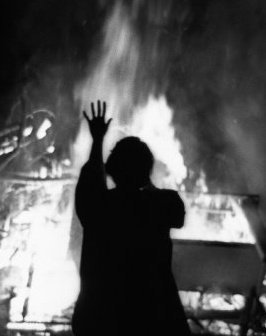
The Portland-based filmmaker, Edward P. Davee, has written and directed a film based on these events, How the Fire Fell. The film is in black & white, and much of it was shot in Corvallis. There is not much dialogue, although there are numerous scenes of Creffield (Joe Haege) preaching. The film is atmospheric, with lingering shots of forests, fields, and people lost in thought. Some of the imagery is clearly meant to be symbolic. In one scene, for example, while Creffield is preaching to his flock, there is a cutaway shot to flies caught in a spider’s web. Haege is quite good as Creffield. Davee was clearly limited by a very low budget in what he could do, but nevertheless there are some powerful scenes.

I found this film fascinating to watch, though I wish I could have learned more about the characters. Why were they so attracted to Creffield? At the screening I attended, there was a question-and-answer session with Davee and with the film’s director of photography, Scott Ballard. Davee said he wanted to “keep a sense of mystery alive” about the Creffield story. He also said he preferred to tell stories using images rather than dialogue. He expressed no strong feelings either for or against religion. (He said that some of the actors in the film are devout Christians.) Davee did say he found it disturbing that people could blindly follow a leader.

As I watched How the Fire Fell, I was reminded of the undertone of eroticism in many of the practices of evangelical Christian groups. (I remember H.L. Mencken commenting about this in one of his articles.) It may be that Creffield simply crossed a line that other evangelicals (apparently) do not cross.

How the Fire Fell has had a very limited release, mainly being shown at film festivals and at scattered venues in the Pacific Northwest. Let us hope that this film gets the wider audience it deserves.

You can find a trailer for the film here.

The Murder of Troy Davis and the Culture of Death

September 22, 2011

I was hoping I would not have to write another post about Troy Davis, but the Supreme Court has ensured that I would.

The State of Georgia has murdered Troy Davis. It was interesting to hear government officials deny that the fact that witnesses recanted their testimony was of no importance. They seemed to believe that saying that you committed perjury was an involuntary action, like the hiccups. Numerous studies have found that eyewitness testimony can be unreliable. Yet the criminal justice system seemed to determined to kill Davis rather than admit that witnesses are not infallible.

At a recent Republican debate, the audience burst into applause when it was pointed out that Rick Perry has presided over 234 executions since he became governor of Texas. The same people applauded when Dr. Ron Paul said that people who can’t afford health insurance should die. It seems we are developing a culture that holds human life in contempt.

Save Troy Davis

September 12, 2011

The state of Georgia is getting ready to execute Troy Davis, an innocent man. Davis was convicted of murdering an off-duty police officer, Mark MacPhail in 1989. There was no physical evidence against him. He was convicted based on the testimony of nine eyewitnesses, seven of whom later recanted. Others have testified to hearing another man confess to the murder. You can read about it here.

There will be an international day of solidarity for Davis on Friday, September 16. You can read about it here.

Update: To save Troy Davis, call Judge Penny Freesemann at 912-652-7252 to withdraw the death warrant. It’s his last chance.

Casey Anthony and the Price of Hysteria

July 14, 2011

In my earlier discussion of the Casey Anthony trial, I expressed my fear that the public hysteria over the trial’s verdict would lead to more unnecessary “tough-on-crime” legislation. Well, clearly my powers as a Nostradamus are vastly greater than those of Phil McGraw, for this has come to pass. In state legislatures across the country, “Caylee’s Law” legislation is being considered. These laws would make it a felony crime if a parent or guardian fails to report the death or disappearance of a child within a twenty-four period, regardless of the circumstances. So more people will be going to prison. All this just because people didn’t like one verdict in one trial.

The U.S. already incarcerates a larger percentage of its population than any other industrialized nation. California’s prison system is in crisis because it cannot adequately house and feed all its prisoners. Inmates at Pelican Bay State Prison have gone on a hunger strike to protest the inhuman conditions in which they live. This is how Wikipedia describes the place:

    Pelican Bay State Prison (PBSP) is a supermax California Department of Corrections and Rehabilitation state prison near Crescent City in unincorporated Del Norte County, California. The 275-acre (111 ha) facility is explicitly designed to keep California’s alleged “worst of the worst” prisoners in long-term solitary confinement, under conditions of extreme sensory deprivation.

Uh, isn’t sensory deprivation a form of torture? Wikepedia also tells us:

    Pelican Bay was built with little legislative or judicial oversight. The California legislature delegated building and design decisions to Department of Corrections administrators. These administrators toured high-security prisons across the United States. They identified Florence, Arizona’s Secure Management Unit (SMU), as a “model” prison and collaborated with prison architects to copy its floor plan and high tech design for PelicanBay’s SHU [Secure Housing Unit]. (Pelican Bay was one of 21 new prisons built in California in the 1980s and 1990s.)

    Correctional administrators purchased land in rural Del Norte County, California, on the northernmost border with Oregon. Its lengthy distance away from most prisoners’ families was considered a plus. It is in a remote forested area 13 miles from the California-Oregon state line and far from California’s major metropolitan areas, 370 miles north of San Francisco and more than 750 miles north of Los Angeles. One of the few legislative comments recorded about the institution concerns whether to call it Dungeness Dungeon or Slammer by the Sea. There was no legislative discussion of the novel punitive design of Pelican Bay nor that it would be the site of indefinite SHU commitments. The original planners did not contemplate that some prisoners would spend decades there.

    Federal district courts in California first heard about the prison after it opened in the early 1990s, when they started receiving letters and legal complaints from Pelican Bay prisoners detailing the draconian conditions at the institution, along with the egregious constitutional violations taking place there. Originally designed to house 2,550 prisoners, as of 2006, Pelican Bay houses 3,301 prisoners.

Of the Secure Housing Unit, we’re told:

    The 8 x 10 foot cells of the Pelican Bay SHU, or Secure Housing Unit, are made of smooth, poured concrete. They have no windows. Instead, there are fluorescent lights, which stay on 24 hours per day. For at least twenty-two hours every day, prisoners remain in their cells, looking out through a perforated steel door at a solid concrete wall. Food is delivered twice a day through a slot in the cell door.

We live in a society that believes that locking people up is the solution to every problem. This inevitably leads to abominations like Pelican Bay.

Casey Anthony

July 7, 2011

The media are all in a frenzy because of the verdict in the Casey Anthony trial. During all this blather, I fear no one will ask whether it is really a good idea to give so much attention to a single sensational murder trial. CNN, for example, had almost around the clock coverage during the days just prior to the verdict. (Anderson Cooper had the pop psychologist, Phil McGraw on his show. This Nostradamus told the credulous Cooper that Anthony’s unemotional demeanor during most of the trial would make a bad impression on the jury, likely resulting in a guilty verdict. An uncanny prediction, no?) And they have had almost around the clock coverage since the verdict. Is there nothing else for these people to talk about?

The Casey Anthony trial has given people a distorted view of our criminal justice system, just as the O.J. Simpson trial did. She had experienced trial lawyers who agreed to work pro bono. Your average criminal defendant has an overworked public defender. Over ninety percent of criminal trials end in guilty verdicts. Yet I fear that because of this one verdict, we are going to hear renewed calls for “tough on crime” legislation, such as mandatory minimum sentencing laws, sentence enhancement laws and so on, which will result in the further growth of that vast warehouse of human beings known as the U.S. prison system. Of course, all this will do nothing to prevent mentally ill people from killing their children.

I am curious to know why the media have been so concerned about the murder of Caylee Anthony, whereas they have largely ignored the murder of Brisenia Flores. Would it be cynical of me to suggest that this might have something to do with the fact that Caylee Anthony was white? Do you really think the case would have received any attention at all if Caylee had been African-American? I honestly can’t see it. In the eyes of the media, murders are only important when they happen to white people.

If A Tree Falls

June 27, 2011

Marshall Curry and Sam Cullman have made a film about the Earth Liberation Front. This group was very active in Eugene, Oregon, where I currently live; so I was naturally interested in seeing this film. Marshall Curry says he learned from his wife one day that the police had arrested an employee at her company for being an “eco-terrorist”. He immediately became interested, and he eventually decided he wanted to make a film about this person. The employee was Daniel McGowan, whose story serves as the central thread of this film. A round-faced, soft-spoken man, he seems an unlikely person to become a violent criminal. The son of a New York cop, he grew up on Rockaway Beach. In his youth he became interested in environmental issues. He eventually gravitated towards Eugene, a hotspot for environmental activism. The film does a short history of the environmental movement in the Pacific Northwest, recounting how non-violent protests have sometimes been met with police violence. Faced with such a response, it was inevitable that some activists would conclude that they should resort to violence themselves. A cell of the Earth Liberation Front was formed in Eugene, and McGowan, frustrated by the lack of progress by environmentalists, was eventually drawn into it.

McGowan’s first job was to serve as a lookout when ELF torched the offices of a lumber company. His second job was helping ELF destroy a tree farm that was allegedly growing genetically modified trees. Only it turned out afterwards that the trees were not GMO’s. At the same time ELF set fire to the office of a University of Washington professor who was involved in genetic engineering. The fire grew out of control and did a lot of damage that ELF didn’t intend. In the aftermath, the cell underwent a crisis and disbanded. McGowan became disillusioned with ELF’s methods, while still retaining his radical environmental views. He returned to New York, where he got a job with a group dealing with domestic violence issues.

The film then deals with police efforts to solve the crimes. For years they got nowhere. Then, by sheer dumb luck, they stumbled upon Jacob Ferguson. He just happened to be the weakest link in the ELF cell, since he was a heroin addict and therefore vulnerable to legal pressure. The police outfitted him with a wire and flew him to different parts of the country to have conversations with his former comrades. He showed up in New York to talk to a surprised McGowan. The latter thought there was something odd about this, especially since Ferguson seemed “talkative”, whereas McGowan remembered him as being quiet. McGowan spoke to him any way, which was a fatal mistake. McGowan was later arrested and found himself facing a possible sentence of life plus 350 years. He eventually made a plea deal in which he confessed to the arsons but did not name any accomplices. He was sentenced to eight years, but received a “terrorism enhancement”, meaning that he was put in a special high security prison built for “terrorists”. He can only receive one fifteen minute phone call a day and one visitor a month. The film documents the emotional anguish that this experience has inflicted upon McGowan and his family.

The filmmakers interview many people involved in these events, including the prosecutor and police detectives who pursued the ELF members. People with different viewpoints are allowed to state their positions. Although the filmmakers maintain a neutral tone, it’s clear that they feel that McGowan and other members of ELF were dealt with unfairly. Ferguson, who was involved in more arsons than anyone else, did not receive a prison sentence. He betrayed his friends solely to save himself, and the system rewarded him for that. Someone makes the point that capitalists who destroy the environment, such as the executives at BP, are never punished for what they do.

I highly recommend seeing this film.

Whitey Bulger

June 25, 2011

James “Whitey” Bulger, who is alleged to have murdered at least 19 people, has been arrested. This is a redemptive act for the FBI, just as the finding of Bin Laden was a redemptive act for the CIA. Bulger spent the 1980’s working as an informant for the FBI, at the same time he was building his criminal empire in Boston. It was an FBI agent who tipped Bulger off that the police were about to arrest him in 1994. Ever since then the feds have been trying to wipe that particular egg off their face.

Police have searched all over the world for Bulger, but it appears that he has spent the last 14 years living in a rent-controlled apartment in Santa Monica, along with his girlfriend, Catherine Greig. Judging from what I’ve seen of the building in the TV reports, it is one of those drab, ticky-tacky apartment buildings that are all too common in the Los Angeles area. Comfortable enough to live in, but it is not something you would find particularly enjoyable or satisfying. (The place is called the “Princess Eugenia”, which fits in with L.A.’s long tradition of giving silly, pretentious names to drab apartment buildings.) Bulger didn’t own a car. According to their neighbors, Bulger and Greig would go shopping at the local 99 Cents Only Store. (I’m not making this up.) Police found hundreds of thousands of dollars in cash in Bulger’s apartment. No doubt this is all because Bulger was afraid that if he spent all this money, he would draw attention to himself. It was too risky for him to even put his money in a bank account. Bulger’s frugal way of life is probably the reason why it took the police so long to find him. No doubt the feds were looking for a big spender.

It appears that Bulger’s only luxury was that he happened to live within walking distance of the beach. He killed nineteen people for that? Bulger was born in poverty, which is presumably why he turned to a life of crime. Yet in the end, for all his machinations, his life was like that of a typical retiree living on a fixed income.

Bulger illustrates what I call the paradox of the criminal life. For example, a guy robs a million dollars from a bank, but then he can’t spend it without making the police suspicious. Al Capone’s fellow mobsters chided him for his opulent way of life, and they were right, for it was the IRS that finally brought him down.

James M. Cain touches upon this paradox in his novel, Double Indemnity. The protagonist has an affair with another man’s wife. He persuades her that they should kill her husband and make it look like an accident, so they can collect his life insurance. After they kill the guy however, they find they can’t have any contact with each other without arousing suspicion. The novel ends with the main character losing his mind.

I’m curious to know about the state of Whitey’s mind.

Get Out of Jail Free!

May 24, 2011

Just when you were convinced that the Supreme Court is completely worthless, they surprise you. These mighty poo-bahs have ruled that because of inhumane overcrowding in California’s prisons, that state must release 33,000 prisoners. Well, that should be easy! They can start by releasing people who were sentenced under California’s unconstitutional (and insane) “Three Strikes” law. They can then begin releasing people convicted of non-violent drug offenses. Problem solved.

Of course, Gov. Jerry Brown (Alec Cockburn has a man-crush on him) won’t let that happen. He’s talking about transferring prisoners to county jails. Of course, we can’t let reason and logic (or the Constitution) get in the way of locking people up, now can we?

Angela Davis

January 24, 2011

The scholar and activist, Angela Davis, spoke at the University of Oregon, as part of its “Women of Color” conference. She began by talking about the civil rights movement. She said she thinks we should rather speak of a “freedom movement”. We “restrain our vision” by speaking of civil rights rather than freedom. She then spoke about the Montgomery Bus Boycott. She pointed out that it was Black women, most of whom worked as domestics in white people’s homes, who made the boycott succeed. She said we shouldn’t measure the progress of women by how many become CEO’s, but by the progress of poor women in our society. Feminism, she argued, involves a consciousness of how capitalism and imperialism affect our world. She criticized congress for failing to pass the DREAM act. She said we have to defend the rights of undocumented immigrants.

She talked about what she called the “21st Century Abolitionist Movement”. Its first aim is to abolish the death penalty, but its ultimate aim is to abolish prisons. Discussing violence against women – which is “pandemic in the world” – she pointed out that our government has passed stricter and harsher laws against domestic violence and rape, yet the rate of such violence remains unchanged. Simply locking up violent individuals doesn’t end violence. We think of violence as perpetrated by individuals, not by institutions. “Incarceration does not challenge the social attitudes that encourage rape.”

She also talked about a trip she recently took to Colombia, where the government has embarked on a program of building huge new prisons. She talked about how farmers there are being pushed off their land, so trans-national corporations can grow sugar cane for biofuels. (The people there refer to these cane fields as “green deserts”.) She said many of these people who have been driven off their land will end up in these new prisons the government is building. It was good to hear somebody say this in Eugene, where many people have embraced biofuels as the “solution” to our energy problems.

Davis’s argument that prisons are not the solution to violence is a direct challenge to the dominant mode of thinking in our society. It is an important argument that needs to be heard.