Archive for the ‘Fascism’ Category

Spartacus

June 11, 2013

Spartacus_-_1960_-_poster

Spartacus is a 1960 film that stars Kirk Douglas as the leader of the ancient Roman slave rebellion. It was directed by Stanley Kubrick, from a screenplay by Dalton Trumbo, which was based on a novel by Howard Fast. Trumbo had been blacklisted during the early fifties. (Trumbo and Fast were both former members of the Communist Party.) At Douglas’s insistence, Trumbo was given an on-screen credit, in violation of the black-list. Spartacus is widely credited with helping to end the black-list in Hollywood.

Because Trumbo was black-listed, many people tend to interpret Spartacus as being about the Red Scare. (I have a deep reluctance to use the liberal term, “McCarthyism”. I will have to discuss that at some other time.) This does seem to apply to the famous “I am Spartacus” scene. There is, however, another way of looking at this film, that is more relevant to our current situation. A large part of the story details how the Roman general, Crassus (Laurence Olivier), uses the uprising to persuade the Roman Senate to give him dictatorial powers, in much the same way the Bush and Obama have used the threat of Al Qaida to persuade Congress to give them virtually dictatorial powers. Some things never change.

Spartacus has some powerful moments. The battle scenes are well done. The final battle between Spartacus’s army and Crassus’s is impressive to watch. And it’s fun to watch Charles Laughton and Peter Ustinov as a couple of scheming Roman politicians. I can’t, however, call Spartacus a great movie. It drags in some places and it is sentimental in others. A fight scene between Kirk Douglas and Tony Curtis towards the end of the film is contrived and unconvincing. And Alex North’s music score is repetitive and sentimental in places. Kubrick did not have complete artistic control over this film, which seems a shame to me. This could have been a truly great film.

Rehabilitating the Kingfish

March 25, 2013

J+B-164_Huey-Long-the-Kingfisher
Huey P. Long, a.k.a. The Kingfish.

Mike Whitney has posted an article on CounterPunch titled Our Chavez: Huey Long. There seems to be an effort in recent years on the part of some people to to try to portray the sometime governor of Louisiana and U.S.Senator as a great champion of the people, no doubt because of his ant-capitalist rhetoric. Yet when one takes a closer look at his life, it becomes clear that things were not that simple.

During Long’s lifetime, most of the Left regarded him with deep wariness, if not outright hostility. There were good reasons for that. First of all, he governed Louisiana as a virtual dictator. He even organized a secret police force to keep watch on his opponents as well as on his followers.

Long was also a white supremacist. He maintained Louisisana’s Jim Crow laws. (Long would sometimes smear his opponents by spreading rumors that they had “coffee blood”. This gives a bitter irony to calling him “our Chavez”.) Long’s apologists point out that he didn’t talk about white supremacy in his speeches. This was perhaps because he didn’t need to. In 1935, Roy Wilkins interviewed Long for The Criis. They discussed an anti-lynching bill that Long opposed in the Senate:

    How about lynching. Senator? About the Costigan-Wagner bill in congress and that lynching down there yesterday in Franklinton…”

    He ducked the Costigan-Wagner bill, but of course, everyone knows he is aganst it. He cut me off on the Franklinton lynching and hastened in with his “pat” explanation:

    “You mean down in Washington parish (county)? Oh, that? That one slipped up on us. Too bad, but those slips will happen. You know while I was governor there were no lynchings and since this man (Governor Allen) has been in he hasn’t had any. (There have been 7 lynchings in Louisiana in the last two years.) This one slipped up. I can’t do nothing about it. No sir. Can’t do the dead nigra no good. Why, if I tried to go after those lynchers it might cause a hundred more niggers to be killed. You wouldn’t want that, would you?”

    “But you control Louisiana,” I persisted, “you could…”

    “Yeah, but it’s not that simple. I told you there are some things even Huey Long can’t get away with. We’ll just have to watch out for the next one. Anyway that nigger was guilty of coldblooded murder.”

    “But your own supreme court had just granted him a new trial.”

    “Sure we got a law which allows a reversal on technical points. This nigger got hold of a smart lawyer somewhere and proved a technicality. He was guilty as hell. But we’ll catch the next lynching.”

    My guess is that Huey is a hard, ambitious, practical politician. He is far shrewder than he is given credit for being. My further guess is that he wouldn’t hesitate to throw Negroes to the wolves if it became necessary; neither would he hesitate to carry them along if the good they did him was greater than the harm. He will walk a tight rope and go along as far as he can. He told New York newspapermen he welcomed Negroes in the share-the-wealth clubs in the North where they could vote, but down South? Down South they can’t vote: they are no good to him. So he lets them strictly alone. After all, Huey comes first.

In 1934, Long created the Share Our Wealth Society, which had clubs all over the country. He chose as its national organizer Gerald L.K. Smith, an outspoken anti-Semite and a former member of a fascist group called the Silver Shirts. Long also formed a political alliance with the ant-Semitic radio broadcaster, Father Coughlin, who expressed sympathy for Hitler and Mussolini and who claimed that the Russian Revolution was the work of Jewish bankers. Lance Hill has argued that the Share Our Wealth movement was an incipient form of fascism.

According to Wikipedia:

    Long .. planned to challenge Roosevelt for the Democratic nomination in 1936, knowing he would lose the nomination but gain valuable publicity in the process. Then he would break from the Democrats and form a third party using the Share Our Wealth plan as its basis … The new party would run someone else as its 1936 candidate, but Long would be the primary campaigner. This candidate would split the progressive vote with Roosevelt, causing the election of a Republican but proving the electoral appeal of Share Our Wealth. Long would then run for president as a Democrat in 1940. In the spring of 1935, Long undertook a national speaking tour and regular radio appearances, attracting large crowds and increasing his stature.

This scheme came to naught, as Long was assassinated in 1935. The Share Our Wealth movement quickly dwindled after that. The reasons for this may be that the economic recovery of 1934-36 strengthened support for Roosevelt, and that the revitalized labor movement probably drew in people who might otherwise have been attracted to Share Our Wealth.

It is often tempting to idealize figures from the past, yet if we hope to actually learn from them, we have to look at these people for what they actually were.

Hangmen Also Die

March 9, 2013

Hangmen_Also_Die_1943_poster

Hangmen Also Die is an entirely fictionalized account of the assassination of Reinhard Heydrich, one of the leaders of Nazi Germany. This 1943 film was directed by Fritz Lang, from a screenplay by John Wexley, based on a story by Bertolt Brecht and Lang. This was the only Hollywood film that Brecht worked on for which he received an on-screen credit. Lang had originally intended to have Brecht write the screenplay, but he apparently changed his mind due to aesthetic, political, and personal differences between himself and Brecht that made it increasingly difficult for them to work together.

The film is set in German-occupied Czechoslovakia during World War II. Svoboda (Brian Donlevy) has just assassinated Heydrich, and he is fleeing down a street. Mascha (Anna Lee) sees him. When the Gestapo ask her where he went, she points them in the opposite direction. Svoboda, who is hiding nearby, observes this. Desperate for a place to hide, he follows her to her home, where he manages to persuade her to take him in, even though he knows that by doing so, he is placing her and her family in danger of retaliation by the Gestapo.

Lang and Brecht did not get along well when they were working on the story for Hangmen Also Die. Brecht thought some of Lang’s story ideas were unbelievable. He complained, for example, of one scene in which Lang had the leader of the Czech resistance evade the Gestapo by hiding behind a curtain. (I found this hard to believe myself.) Yet Lang was right to reject Brecht’s idea that the mistakes of the underground “are corrected by the broad mass of the people”. Brecht’s, influence, however, can perhaps be seen in the fact that one of the film’s chief villains is a Czech collaborator who is also the wealthy owner of a beer brewery. And there is some dark Brechtian humor in the moment when, in the midst of interrogating someone, a Gestapo officer pauses to squeeze a pimple on his face. (That’s something you don”t often see in Hollywood movies.)

John Wexley and Hanns Eisler (who composed the music) were both later blacklisted. Eisler was eventually deported because of his left-wing political views. Brecht left the country after being questioned by the HUAC.

Despite its contrived and melodramatic moments, Hangmen Also Die does touch upon some complex moral and political questions, such as whether terror tactics, like assassinations, are ever a good idea. In the film, the Gestapo begin carrying out random executions in retaliation for the assassination. What happened in real life was even worse. The Nazis destroyed the Czech city of Lidice, killing most of its inhabitants or sending them to concentration camps.

Although it is not one of Lang’s best films, Hangmen Also Die is nonetheless one of the more interesting films to come out of World War II.

Dr. Mabuse

November 11, 2012

Fritz Lang made three films about the super villain, Dr. Mabuse. This character was clearly inspired by Conan Doyle’s Dr. Moriarty, as well as by Allain and Souvestre’s Fantômas. Like these two, Mabuse heads a criminal gang that carries out daring and elaborately planned crimes. (And, like Moriarty, Mabuse is a scientist.) Like Dr. Caligari, he is an expert hypnotist. Mabuse, however, has the added twist that he has the ability to perform telepathic hypnosis, making people do things against their will, sometimes simply by looking at them, even when they have their back turned on him. The character of Mabuse was created by the novelist, Nobert Jaques, but he is best remembered for the Fritz Lang films in which he appears.

The four-hour Dr. Mabuse the Gambler was released in 1922 in two parts. Mabuse (Rudolf Klein-Rogge) uses his hypnotic abilities to swindle wealthy men at card games. With the riches he makes, Mabuse plans to make himself the most powerful man in the world. His activities arouse the suspicions of the courageous, but not overly bright, State Prosecutor Wenk (Bernhard Goetzke). The wheels of justice grind slowly, but they eventually catch up with Mabuse. At the end of the film he goes mad, and the police take him away to an asylum.

In The Testament of Dr. Mabuse (1933), the good doctor has been treated at the asylum by Prof. Baum (Oscar Beregi, Sr.). Through a special form of hypnosis, Mabuse begins to control Baum’s mind. Baum then forms his own criminal gang. He identifies himself to his henchmen, who are not allowed to see him, as “Dr. Mabuse”. After Mabuse dies, he seems to completely takeover Baum. Whereas, in the first film, Mabuse’s aims were pecuniary, Baum/Mabuse shows no interest in making money. His crimes are committed merely for their own sake. This time he is opposed by Inspector Lohmann (Otto Wernicke), who is a little sharper than State Prosecutor Wenk. Lohmann foils Baum/Mabuse’s plan to release a cloud of poison gas over Berlin. At the end of the film, Baum/Mabuse voluntarily commits himself to his own asylum.

The 1000 Eyes of Dr. Mabuse (1960) was the last film that Lang made, before he retired due to failing eyesight. At the beginning, we are told that Mabuse died in 1932, yet a criminal named Mabuse is now operating in Berlin with a new gang. It seems that the spirit of Mabuse lives on and has occupied another body. (I won’t say the name of the actor who plays him, since part of the suspense of the film is that it is unclear which character is actually Mabuse, although the cover of the DVD that I have effectively gives it away.) Mabuse controls the Luxor Hotel in Berlin. There are cameras installed in every room, which he uses to acquire information he can use for crimes. He has set an elaborate trap for Henry Travers (Peter van Eyck), an American industrialist. His aim is to take over Travers’s company so he can build a stockpile of nuclear weapons with which to take over the world. (Yes, that’s right, the hero of this film, Travers, is a nuclear arms manufacturer. That was the Cold War for you.)

It has often been argued that Dr.Mabuse the Gambler anticipates Hitler. At times, Mabuse does express a megalomania that is strikingly similar to Hitler’s. It seems to me that a more plausible explanation is that Mabuse represents a type of cynicism that was common in Europe (and particularly in Germany) following the horrors of the First World War. Hitler’s Weltanschauung happened to be an extreme form of this cynicism.

Mabuse can also be viewed as a Nietzschean, particularly in his attitude towards women. At one point he cruelly tells his lover that there is no such thing as love, only desire. Lang’s biographer, Patrick McGilligan, claims that this was Lang’s own view, even though the screenplay was actually written by Lang’s wife, Thea von Harbou. This raises serious questions in my mind about the reliability of McGilligan’s biography.

In The Testament of Dr. Mabuse, Baum/Mabuse speaks of creating an “empire of crime”. This reportedly prompted Goebbels to ban the film, because he feared that people would see it as a criticism of the Nazis. (It didn’t have its German premiere until 1961.) This makes me wonder: did Hitler, Goebbels, and other Nazis see themselves as creating an “empire of crime”? If so, what does this tell us about the historical conditions that created the Nazis?

In hindsight, there is something eerie about the fact that Mabuse tries to use poison gas as a weapon of mass murder. This is no doubt a coincidence, but one can’t help noting it.

In The 1000 Eyes of Mabuse, made after the Second World War, Lang makes an explicit connection between Mabuse and the Nazis. We are told that the Luxor Hotel was used by the Gestapo, and Mabuse employs secret rooms and cameras that they used. No doubt this idea came to Lang in response to the enormity of what had happened. It makes this film an unsettling diminuendo to what is perhaps the greatest film trilogy ever made.

Barack Obama and the Persistence of the Old Regime

October 26, 2012

The Atlantic Monthly has dared to suggest what none have so far dared to say: that President Barack Obama should be impeached for the murder of Abdulrahman al-Awlaki. There is, of course, zero possibility of this actually happening, but the idea is worth raising if only to show what a sham our democracy is. The Republicans are not going to make an issue out of this, no doubt because they don’t see anything wrong with what the President did. For all their huffing and puffing, the Republicans are not really an opposition party. (It would be more accurate to call them an obstruction party.) Certainly Romney would have done the same thing Obama did.

The historical trend has always been to give more and more power to the executive branch. There was a brief push back against this during the Watergate scandal, but that is ancient history now. The idea that the president is not above the law is now regarded as one of those quaint fads of the 1970’s, along with leisure suits and bell-bottom pants.

Consider, for example, how often the president is referred to as the “commander-in-chief”. This is misleading. The president is the commander-in-chief of the armed forces. He is not the commander-in-chief of anything else. Reporters and pundits must surely be aware of this, but they use the term anyway, even though they must know that many people are not kwowledgeable about the Constitution. (And why aren’t they? That’s a question that will have to be addressed at another time.) One must seriously question their motives for doing this.

For the Left, there is nothing to recommend Obama. He has better positions on women’s reproductive rights than Romney does, but that is about it. Yet it can be argued that a defeat for Obama would be a triumph for the forces of reaction in this country. Every president gets criticized, but both the quality and the quantity of the criticism aimed at Obama are different from that aimed at previous presidents. Bill Clinton was the subject of paroxysms of paranoia on the right, but the attacks on him mostly had to do with real matters: Clinton’s marital infidelities, the accusations of sexual harassment (which were plausible), his involvement with the Whitewater scandal, and the slightly suspicious death of Vince Foster. Yet the accusations against Obama have nothing to do with reality. We’re told that Obama ia a Muslim, that he associates with terrorists, that he wants to create death panels and put people in re-education camps. There are accusations of a “missing” birth certificate that isn’t missing. This summer a movie was shown in theaters all across the country that argues that Obama is a “Kenyan nationalist” who wants to undermine the U.S. power in the world. (In fact, Obama has gone out of his way to try to shore up the U.S.’s empire.) It’s not hard to see that this is all tied to Obama’s race. Some people are incensed that a black man – the Other – now occupies the White House. Donald Trump, for angrily demands that Obama release his college transcripts. It is inconceivable to Trump that a black man could be more successful and better educated than he is. (I think it fair to say that most black people are better educated than Donald Trump.)

It has often been noted that the so-called blue state/red state divide bears a striking resemblance to the North/South divide of the Civil War. Race is at the center of both these divides, although people were more honest about this in 1861. The Republican Party has absorbed, and in turn been taken over by, the Old Democratic Party of Jim Crow. It is perhaps significant that in recent years, the idea of secession, once confined to a handful of crackpots, has crept its way into mainstream discourse. (The nitwits at CounterPunch bear some responsibility for this.) Romney is too smart to believe the Tea Party’s nonsense, but he pandered to them during the primaries, and a Romney victory will be seen as a win for them.

This raises a critical issue for the Left. Should the racism of Obama’s opponents be considered the most critical issue in this election? I haven’t made up my own mind about this, but I think it is a question that the Left should consider.

Israel Shamir and CounterPunch

August 25, 2012

Why does CounterPunch, which is ostensibly a left-wing website, continue to post articles by the neo-fascist nutjob, Israel Shamir? You only have to read Shamir’s website to see that the guy is crazy. Yet he is apparently not too crazy to be published by CounterPunch.

CounterPunch has just posted an article by Shamir entitled The Secret History of Pussy Riot. In it, he repeatedly refers to the members of the band by the misogynist term, “viragos”. This fact alone should have been sufficient reason to reject the article. Alas, it’s actually even worse than that. Shamir argues that the Putin government was right to send these women to prison for merely expressing their opinions. He writes:

    Two years’ sentence is quite in line with prevailing European practice. For much milder anti-Jewish hate talk, European countries customarily sentence offenders to two-to-five years of prison for the first offence. The Russians applied hate crime laws to offenders against Christian faith, and this is probably a Russian novelty. The Russians proved that they care for Christ as much as the French care for Auschwitz, and this shocked the Europeans who apparently thought ‘hate laws’ may be applied only to protect Jews and gays. The Western governments call for more freedom for the anti-Christian Russians, while denying it for holocaust revisionists in their midst.

Why does CounterPunch insult its readers by posting this garbage? The kindest thing one can assume here is that they didn’t bother to read this article.

Shamir has ties to the Lukaschenko dictatorship in Belarus. When David Irving was sentenced to prison for Holocaust deanial, Shamir wrote:

    Thus we should say: David Irving was sentenced for denial of Jewish superiority. His doom seals the reign of (albeit limited) freedom that began with the fall of Bastille. European history went full circle: from rejecting the rule of Church and embracing free thought, to the new Jewish mind-control on a world scale. Not only is Western Christian civilisation dead, but even its successor, secular European civilisation, has met its demise only a few days after its proud and last celebration by the Danish scribes. It was short-lived: about two hundred years from beginning to the end, the Europeans may once have had the illusion that they can live without an ideological supremacy. Now this illusion is over; and the Jews came in the stead of the old and tired See of St Peter to rule over the minds and souls of Europeans.

This is anti-Semitism, plain and simple. The Breivik shootings in Norway have shown that fascism is still a force to be reckoned with. Yet the editors of CounterPunch apparently think it is all a joke.

The Trial

July 10, 2012


Anthony Perkins in The Trial.

Orson Welles’s 1962 film, The Trial, fairly accurately captures the claustrophobic and nightmarish feel of Kafka’s classic novel. Joseph K. (Anthony Perkins) wakes up one morning to find out that he is under arrest. The police refuse to tell him what he has been arrested for or who has accused him. K. remains free, but he is told that he must show up for his trial at some unspecified date. K. eventually turns to the advocate, Hastler (Orson Welles), for help. In the process, he becomes romantically involved with Hastler’s flirtatious nurse, Leni (Romy Schneider). K. eventually learns that if he retains Hastler as his lawyer, he will wind up as the latter’s slave. K. balks at this prospect. Not long after this, K. learns that he has been condemned to death.

Welles saw Kafka’s novel as a prophecy of fascism. The Trial depicts a world of arbitrary violence, in which an individual can be crushed for no apparent reason. There are references to the concentration camps scattered throughout the film. In one scene, for example, K. makes his way through a crowd of people who have signs around their necks with numbers on them – a clear reference to the practice of tattooing i.d. numbers on people in the camps.

Welles does depart from the novel in making K. a more aggressive character than the oddly passive person depicted in the book. He does, however, follow Kafka in having K. killed in the end. I must admit that I found this disappointing. I really wanted to see K. triumph over his oppressors. One change Welles did make was that instead of having K. stabbed to death, he is blown up by dynamite. The cloud forms the shape of a mushroom, an obvious reference to the Cold War.

The Trial has all of Welles’s visual earmarks: unusual camera angles and inventive uses of light and shadow. This film is a feast for the eyes. The bank that K. works in is an enormous hall filled with row upon row of people furiously and monotonously banging away on typewriters – a striking metaphor for the dehumanizing effects of capitalism.

I read that Welles originally offered the role of Hastler to Jackie Gleason, but the latter turned it down. And Gleason later chose to appear in the Smokey and the Bandit movies. Amazing.

Welles sometimes said that The Trial was his best work. Citizen Kane is still my favorite, but The Trial is nonetheless a great film.

Triumph of the Will

June 6, 2012

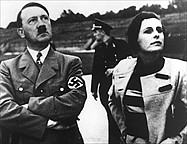
I recently saw Triumph of the Will. I felt obligated to watch it because it is considered the penultimate example of a political propaganda film. Such is its notoriety, that when Michael Moore’s Fahrenheit 911 first came out, right-wing pundits immediately tried to smear it by comparing it to Triumph of the Will. Of course, they only revealed their intellectual poverty by doing so, since Moore’s approach to film making is nothing at all like Leni Riefenstahl’s.

The early scenes depict Hitler’s arrival in Nuremberg for a party rally. The creepy thing about these scenes is how normal they seem. Take away the gaudy uniforms and raised arms and Hitler could be just your ordinary politician, shaking hands with people, smiling for the camera, and engaging in small talk with the plebeians. It’s not until Hitler addresses the Reichsarbeitsdienst, a sort of paramilitary construction group, that we begin to sense that something profoundly weird is going on here. From a visual standpoint, this is the best part of the film, because there is something slightly surreal about the sight of hundreds of uniformed men marching around with shovels as if they were rifles. This cuts to a spooky scene of storm troopers gamboling in the woods at night. (At least I think that’s what they’re doing. It’s hard to tell.) Unfortunately, it’s all downhill from there: seemingly endless scenes of people marching around, with an inexplicably large number of them carrying Nazi flags, occasionally interspersed with speeches by Hitler.

The most striking thing about this film, however, is how physically unimpressive the Nazi leaders are. Many of them are fat: Goering, Wagner, Ley, Streicher. Wagner, Rosenberg, and Ley sweat profusely. Schirach has sweaty armpits. Hess, however, looks underfed, and he has a strangely high-pitched voice. (I must say, though, he did know how to give a crisp salute.) Lutze also has an annoyingly high-pitched voice. (Did Hitler have a thing for male sopranos?) Goebbels looks like a weasel. As for Himmler, why didn’t they just put at bag over this guy’s head? Seriously, he could have had a lucrative career as a character actor in Hollywood, playing ignorant rubes who get taken in by the likes of W.C. Fields. (“Here’s all my life’s savings, mister. Give me all the bottles you can of that there miracle elixir!”) Even the storm troopers and SS men are unimpressive. They look a bit scrawny, and their uniforms often don’t seem to fit quit right. Hitler, however, looks well-fed. Yet the plumpness of his face makes you uncomfortably aware of how silly his tiny moustache looks. And he has too much Brylcream in his hair. (Or whatever was the German equivalent of Brylcream in the 1930’s.) And his uniform makes his ass look huge. (This is true of some of the other people in this film. I wonder, did Hitler think that having a big ass was a sign of racial superiority?)

The reason I bring all this up is that it has often been said that Triumph of the Will was a highly effective advertisement for Nazism. I find this hard to believe. This film is mostly boring. A lot of it is just people marching around to bad music. Riefenstahl knew that rapid cutting and moving the camera around can make things appear more interesting than they actually are, but these tricks can only do so much, and sometimes they can even be counter-productive. When, for example, we see the stage at a rally from a camera that’s being lifted upwards, the effect is merely showy. Indeed, it actually seems a bit naive. True, this was the 1930’s, but they were already using more sophisticated techniques than this in Hollywood – or in Germany’s own cinema, for that matter.

Early in the film, there are evocative shots of the amazingly beautiful city of Nuremberg. Alas, these are marred by the ubiquitous presence of Nazi and German imperialist flags.

Even the speeches are not all that interesting. There are repeated calls for “national unity”, as well as a lot of talk about how the Nazi Reich will last thousands of years (heh, heh). I must say, though, that Hitler did occasionally inflect his voice in interesting ways. There are, however, some ominous references to the notion of “racial purity” in the speeches of Hitler and of Streicher.

In her later years, Riefenstahl collected many awards from film festivals. (Her fellow propagandist, Streicher, was hanged.) Since Triumph of the Will was, far and away, her most famous movie, one must wonder about the people who decided to give her all these honors. Riefenstahl claimed that she was a neutral observer, but this assertion is contradicted by her own film. At the beginning, it says it is Das Dokument der Reichsparteitag 1934 – hergestellt im Auftrage des Fuehrers. (The Documentary of the Reich party conference of 1934 – produced according to the Fuehrer’s instructions.) Well, you can’t get any more explicit than that, can you? Also, it’s clear just from watching this film that Riefenstahl could not have made it without plenty of help from the Nazis. Also, there are some scenes that were clearly staged specifically for the camera.

There’s one scene in the film in which we see Hitler and his cronies watching soldiers riding around on horseback. While I was watching this, I was reminded of the fact that during World War II, 90% of the German army’s supply transport was horse-drawn. The truth was that Germany was actually under-prepared for the war. My father rarely talked about his wartime experiences, but one story he did tell more than once was about when his unit captured a German army base. In the mess hall there was a gigantic soup tureen, which was apparently what everyone ate from. It always amazed my father that a government that could only afford to feed its soldiers gruel actually believed it could conquer the world.

Thought Control Comes to the U.S.A.

May 13, 2010

Arizona seems determined to become the worst state in the Union. Not satisfied with making Latinos into second-class citizens, the state government just passed a law targeting ethnic studies programs in schools. Among other things, “the measure prohibits classes that advocate ethnic solidarity, that are designed primarily for students of a particular race or that promote resentment toward a certain ethnic group.” This is clearly meant to bring an end to ethnic studies programs, which inevitably touch upon the issue of racism in our society.

It seems to me that if fascism ever comes to this country, it will come not from the federal government, but from state governments. There are several state governments getting ready to pass anti-immigrant bills modeled after the one just passed in Arizona. And recently some governors have been expressing nostalgia for the days of the Confederacy. This would fit in with a historical pattern. The notion of “state’s rights” was used to first defend slavery and then racism. It’s often in state governments that the most reactionary ideas are found.

Vincere

May 11, 2010

Vincere (Win) is an Italian film that tells the story of Ida Dalser (Giovanna Mezzogiorno), who was the first wife of Mussolini (Filippo Timi) and who bore him a son. During the First World War, she became estranged from Mussolini, and he married another woman. After he rose to power, Mussolini had to hide the embarrassing fact that he was married to two women. He sought to discredit Dalser and to destroy any evidence of their marriage. He had their son taken away from her, and he had her placed in an asylum. She died in 1937.

The film largely depicts Dalser’s life in mental hospitals and asylums, and the brutality and indifference she experiences in these places. Throughout she struggles valiantly, but futilely, to have herself recognized as Mussolini’s wife, and to have her son recognized as Mussolini’s son. I have to admit, I found the film hard to follow at times. It doesn’t always make clear what is happening, and it jumps back and forth in time. Also, I found it a bit hard to sympathize with someone who was essentially a fascist. However, I was impressed by the acting. Both Mezzogiorno and Timi turn in very strong performances.

Strange to say, the film leaves out two historical details that are very interesting. At one point, Dalser accused Mussolini of being a traitor, claiming that he had taken money from the French government to agitate for Italy’s entry into the First World War. (In the film, Dalser is portrayed as remaining loyal to Mussolini in spite of everything.) And although the film mentions that Dalser’s son, Benito, who claimed Mussolini as his father, died in an asylum at the age of 26, it doesn’t show that his doctors had given him coma-inducing drugs.

Still, at a time when fascism has undergone a revival in Italy, it’s good to see an Italian film that portrays Mussolini as a scumbag.