Archive for the ‘France’ Category

House of Pleasures

January 9, 2012

Bertrand Bonello’s film, L’Apollonide: Souvenirs de la maison close, has been showing at my local art house movie theatre under the title, House of Pleasures. (It has also been released under the title, House of Tolerance). It depicts the lives of women living and working in a brothel in Paris at the beginning of the twentieth century. Their lives are hard. One woman, Madeleine (Alice Barnole), has her face slashed by a client and is permanently disfigured. Another, Julie (Jasmine Trinca) contracts syphilis and eventually dies. Clotilde (Céline Sallette) becomes an opium addict. The fate of the other women is uncertain, since the madame (Noemie Lvovsky) cannot afford to pay the increased rent demanded by the landlord.

Despite its grimness, this film is not strictly realistic, for there are fantasy sequences. In some scenes, for example, there is late twentieth century pop music, such as the Moody Blues’ Nights in White Satin, playing on the soundtrack. In one scene, we see semen coming out of Madeleine’s eyes. This struck me as completely gratuitous.

House of Pleasures is two hours long, but it seems much longer than that. What’s really frustrating about this movie, though, is that one senses that buried somewhere in this sprawling, confused, and sometimes repulsive mess is what could have been a good film. When they’re not dancing to anachronistic pop music, the characters sometimes come across as complex and interesting. House of Pleasures does show a sense of class consciousness in that the women all come from factory worker or peasant backgrounds, whereas their clients all come from wealthy families. Unfortunately, Bonello’s self-conscious artiness and heavy-handed efforts to shock the audience ultimately rid this work of any emotional power. It simply leaves you feeling numb.

Hugo

December 8, 2011

Hugo is a film by Martin Scorcese, based on the novel, The Invention of Hugo Cabret by Brian Selznick. Set in Paris during the 1920’s, it tells the story of Hugo (Asa Butterfield), who inhabits the Montparnasse train station in a manner similar to the way the Phantom inhabits the Paris Opera House. He keeps the clocks in the station running, a job that his missing uncle is supposed to be doing. He supports himself by stealing food and other goods from stores and cafes in the station. His life is made precarious by the presence of a Dickensian villain, Inspector Gustave (Sacha Baron Cohen), who want to put him in an orphanage. (Personal disclosure: as a film goer, I have a low tolerance level for Dickensian villains.) Hugo is caught stealing by Georges (Ben Kingsley), a toymaker who has a shop in the station. Georges makes Hugo work for him to make up for what he has stolen. Hugo meets Georges’s goddaughter, Isabella (Chloë Grace Moretz), and the two of them become friends. Through an elaborate series of events, Hugo and Isabella learn that Georges is actually Georges Méliès, the pioneering filmmaker whose works are now largely forgotten. Hugo and Isabella become determined to restore Georges’s reputation as an artist.

This film is a fond tribute to Méliès, one of the first film directors, who began making movies in the 1890’s. Towards the end, there is a montage of scenes from Méliès’s films. Even in this jaded age of CGI effects, they are fascinating to watch. Méliès had a visual imagination that makes most modern directors seem anemic. He was also a great technical innovator. (Among other things, Méliès made the first color films. Each frame was tinted by hand.) He made 500 films, most of which have, alas, been lost. I hope that this film will encourage a new generation to discover his work.

The film’s central conceit, that Méliès doesn’t want to be reminded of his past, is a bit thin and hard to believe. The main problem with this movie, however, is that at 126 minutes, it is too long. During the first half, the story unfolds with agonizing slowness, although the tempo does pick up during the second half. Also, the film is padded out with chase scenes that don’t advance the story, as well as numerous unfunny “funny” scenes featuring Inspector Gustave. (I know I’m not the only person who felt this way. The audience was mostly quiet during these scenes.) This character is played charmlessly by Baron Cohen, who at times seems to be doing an unsuccessful imitation of Peter Sellers as Inspector Clouseau.

I would have liked this film better if there had been more scenes from Méliès’s films, and fewer scenes of Baron Cohen trying to be funny.

Here is Melies’s A Trip to the Moon. (Unfortunately, the tinting is washed out in this version.)

The Hedgehog

December 1, 2011

The Hedgehog is a film by Mona Achache, based upon the novel, The Elegance of the Hedgehog, by Muriel Barbery. Paloma (Garance Le Guillermic) is a precocious 11-year-old girl who lives with her wealthy parents in an apartment building in Paris. She believes that the people around her are shallow and stupid, so she decides to kill herself on her twelfth birthday, which is coming up in a month. A new neighbor, Mr. Ozu (Togo Igawa), a rich, retired Japanese businessman, moves in. Paloma meets him on the elevator. He is impressed to learn that she knows some Japanese. He begins inviting her to his apartment, and they become friends. (Paloma’s parents don’t seem concerned about a stranger showing such an intense interest in their daughter.) When the concierge, Mrs. Michel (Josiane Balasko), quotes Tolstoy to him, Ozu is immediately taken with her. He begins inviting her out to dinner and buying clothes for her. Paloma also gets to know Michel. She discovers that Michel has a room full of books, and she spends much of her time reading. She keeps her literary interests hidden from other people. (Michel is the “hedgehog” of the film’s title.) Paloma decides not to kill herself. When Michel is struck and killed by a van, Paloma and Ozu console each other.

The main problem with this film is that Paloma never really develops as a character. The only thing that has really changed at the end of the film is that she now knows an adult, Ozu, who is capable of amusing her. In all honesty, she struck me as cold and selfish. True, she does care about Michel, but the film makes it clear that she admires the latter for being withdrawn and secretive. As for Michel, she does begin to open up and become less misanthropic when she starts seeing Ozu, but since she is suddenly killed, this doesn’t lead to anything. Ozu is too perfect to be believable. He is clearly a Westerner’s idealized notion of a wise, old Oriental man. We are never told how Ozu made his fortune, no doubt because the filmmakers didn’t want to soil him with any mundane or unsavory details. (We are apparently not supposed to see anything incongruous about an admirer of Tolstoy having a musical toilet installed in his apartment.) The film does show some class awareness, in that the building’s rich residents largely ignore Michel. (The owner of the building fails to recognize Michel after the latter has had her hair done.) However, this is undermined by the presence of the inexplicable Ozu.

The Hedgehog is a “feel good” movie that doesn’t really make you feel good.

Potiche

June 16, 2011

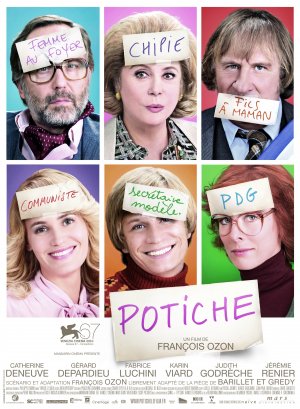
The wikipedia article on François Ozon, says he is “a French film director and screenwriter and [sic] whose films are usually characterized by sharp satirical wit and a freewheeling view on human sexuality.” In Potiche (Trophy Wife), Ozon’s latest film, there is some of the latter and only a little bit of the former.

The time is the 1970’s. Suzanne (Catherine Deneuve) is the stay-at-home wife of Robert (Fabrice Luchini), who runs the umbrella factory that belonged to Suzanne’s father. Robert has affairs with other women, including with his secretary, Nadège (Karin Viard). When the workers at the factory go on strike, Robert assaults one of them. The workers retaliate by taking Robert hostage. Suzanne appeals to Maurice (Gérard Depardieu), a Communist member of Parliament who also happens to be Suzanne’s onetime lover, to intervene. He persuades the workers to release Robert, promising them there will negotiations to address their grievances. After his release, Robert suffers a heart attack. Suzanne, who has never worked before in her life, takes his place. She negotiates a new contract with the workers. She hires her children, Joëlle (Judith Godrèche) and Laurent (Jérémie Renier), to help her run the business. The company begins to prosper. Suzanne finds that she likes being a businesswoman. She begins seeing Maurice. When Robert returns from the hospital, he demands that Suzanne turn the business back over to him. Suzanne refuses, and she tells Robert that he should stay at home from now on. Meanwhile, Maurice becomes indignant when he learns that he was only one of several lovers that Suzanne had when she was young. He helps Robert in a scheme to take control of the business away from Suzanne. She retaliates by running for Maurice’s parliamentary seat.

Suzanne’s transition from trophy wife to businesswoman and then politician is apparently supposed to be seen as personal liberation. Yet her political campaign is inane. Her slogan is “Liberty Lights our Way”, which doesn’t really mean anything. We are never told what her positions are, or even if she has any. We see her visit a dairy farm, where she talks about how wonderful cheese is. In the final scene, she addresses her supporters after she has just won the election. She tells them they are her “children”. She then sings C’est beau la vie. The film ends with an overhead camera shot, with Suzanne looking upwards, surrounded by her supporters gazing adoringly at her. So, is this Ozon’s idea of feminism? The politician as Super Mom? For Ozon’s sake, I would like to believe that he is trying to be ironic here, but the cynical part of me tells me that he isn’t. After all, many liberals admire the vapid, self-promoting Arianna Huffington. What’s more the film gives the idea that there would be no problems with capitalism if we just had “good people” (most likely women) running things. If only the world were that simple.