Archive for the ‘Imperialism’ Category

The Fog of War

January 6, 2013

Fog_of_war

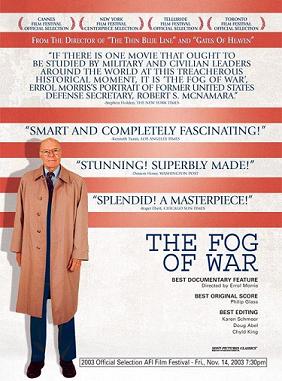
I just got around to watching Errol Morris’s 2003 documentary, The Fog of War. I didn’t see this film when it first came out, probably because 2003 was a busy year for me. I found it somewhat disappointing. Much of it consists of McNamara trying to justify his actions. I should have expected that, but the reviews I read led me to believe it would be much more than that. Still, the film does have some interesting moments, and it gives some insight into the way one member of the ruling class thinks. I don’t think this is a minor thing. I think that perhaps the reason so many people on the Left are suckers for crackpot conspiracy theories is that they don’t have much understanding of how the ruling class thinks.

The film begins with McNamara, who is shown in tight close-ups most of the time, discussing the Cuban Missile Crisis. McNamara repeatedly points out the U.S. and the Soviet Union came extremely close to a nuclear war. McNamara uses his account of the crisis to illustrate one of the “eleven lessons” he talks about in the course of The Fog of War; in this case, “empathize with your enemy”. McNamara tells how a diplomat named Tommy Thompson, who knew Krushchev well, persuaded a skeptical Kennedy that the Soviet premier would be willing to cut a deal over Cuba, which turned out to be the case. This raises the question of why there was a crisis at all, though, unfortunately, Morris doesn’t ask this question. McNamara also uses this incident to illustrate another one of his “lessons”: “rationality will not save us”. McNamara insists that the governments of the U.S., the Soviet Union, and Cuba all behaved in a “rational” manner, even though they brought their countries to the brink of nuclear annihilation. So, if this is rationality, then what is irrationality? And if rationality will not save us, then what will? Morris doesn’t ask, and McNamara doesn’t say.

The Fog of War then goes into a discussion of McNamara’s early years. During the Second World War, he served as an analyst for the Army Air Corps. Under the command of Gen. Curtis LeMay, McNamara helped plan the fire bombing of Tokyo, which killed 100,000 people. This leads to the film’s most startling moment: McNamara frankly states that he and Gen. LeMay were war criminals. Still, he expresses no regrets about what he did.

The largest section of the film is devoted to the Vietnam War. McNamara doesn’t say much about the strategic justification for the U.S.’s intervention in Vietnam; he seems to consider this to be self-evident. McNamara admits that there was some confusion over what actually happened in the Gulf of Tonkin Incident; nevertheless, he and President Johnson used it as justification to launch an intensive bombing campaign in North Vietnam. McNamara also gives a discussion in which he tries to distance himself from the use of Agent Orange in Vietnam. To illustrate his “lesson” of “empathize with your enemy”, McNamara talks about how years after the war he met the former foreign minister of North Vietnam. McNamara says he was surprised to learn from this man that his government viewed the U.S. as a foreign colonial power trying to take control of their country. Reall? It never occurred to McNamara that the Vietnamese might view the U.S. in this way? If McNamara was being honest here, then he was every bit as self-deluded as the people who led us into the Iraq War. (It so happens that this film was released the same year as the U.S. invasion of Iraq.)

McNamara casually discusses the deaths of millions of people, yet he gets choked up when he recounts how he helped pick out the grave-site for John F. Kennedy. One is reminded here of Stalin’s dictum: “One death is a tragedy, but a million deaths is a statistic.” I don’t think it is a stretch for me to say that McNamara had some of Stalin’s bureaucratic mind-set.

Another of McNamara’s “lessons” is “in order to do good, you may have to engage in evil”. One wonders if McNamara ever questioned whether what he was trying to do was actually good.
Full Metal Jacket

December 20, 2012

Full_Metal_Jacket_poster

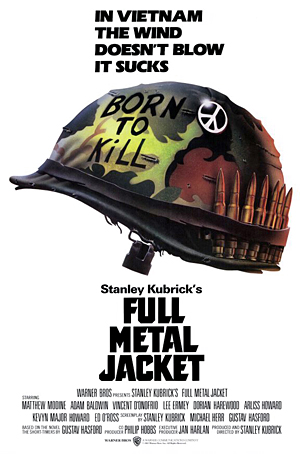
Stanley Kubrick’s Full Metal Jacket is an examination of the meaninglessness and amorality of war. It is also a critique of the military and its values. This film is based on the writings of two Vietnam war veterans, Gustav Hasford and Michael Herr.

The film tells two stories that subtly mirror each other. The first half of the film depicts the basic training experience of James T. “Joker” Davis (Matthew Modine) at the Marine Corps base on Parris Island during the Vietnam War. He and a group of other recruits are under the command of a drill instructor, Sgt. Hartman (R. Lee Ermey, who was a Marine D.I. before he became an actor). Hartman aims most of his insults at Pvt. Lawrence (Vincent D’Onofrio), a hapless recruit who can never seem to do anything right. Hartman gives him the nickname “Gomer Pyle” and proceeds to make his life miserable. His taunting of Lawrence has tragic results for both of them.

There were several things that struck me about this half of the film. The first is that on several occasions Hartman either slaps or punches people. In one scene, he chokes Lawrence. I was always under the impression that officers and N.C.O.’s are not allowed to hit soldiers. (Didn’t Gen. Patton almost get fired for doing that?) I have since learned from various sources that D.I.’s sometimes get away with hitting recruits, even though technically they are not supposed to do it. Another thing that struck was religious indoctrination. Hartman sometimes talks about religion to the recruits. In one scene, Hartman asks Davis if he believes in the Virgin Mary. When Davis says no, Harman punches him in the stomach. Among other things, Hartman merely asking that question violates the First Amendment. People in the military take an oath swearing to defend the Constitution. The issue of religious indoctrination in the military is one that crops up in the news every now and then. There have been attempts at the United States Air Force Academy to convert people to fundamentalist Christianity. I guess a belief in Biblical literalism helps one to drop bombs on people.

This film also depicts how misogyny and homophobia are instilled in recruits during basic training.

The second half depicts Davis’s experiences during the Battle of Hue. Full Metal Jacket manages to avoid the clichés of war movies. It leads to a harrowing climax in which the members of Davis’s platoon are picked off one by one by a sniper. For all their savage training, the soldiers turn out to be just frightened men dealing with a terrifying situation. The lone sniper turns out to be a woman. When Davis kills her, we are reminded of Lawrence killing Sgt. Harman. Full Metal Jacket ends with a scene of Marines marching through the ruins of Hue while singing the theme song of The Mickey Mouse Club. There is perhaps no better metaphor for U.S. imperialism.

The Fall of General Petraeus

November 13, 2012


Gen. David Petraeus and Paula Broadwell

It’s been a long time since we’ve had a really good sex scandal in Washington, so the one involving Gen. Petraeus comes as a welcome relief after a truly dreary presidential election. Petraeus is accused of having had an affair with his “biographer”, Paula Broadwell. She is the reputed author of an admiring book about Petraeus with the perhaps unfortunate title of All In. (It has also come out that this book was at least partly ghost-written.)

There is more than a little moral hypocrisy in all this. Congresswoman Debbie Wasserman Schultz, who is chair of the Democratic National Committee, has said: “Disturbing is the word that has come to my mind since all of this has come to light. Really, I think it goes without saying if you’re the director of the CIA, if you are a four-star general in the United States army, that you have to hold yourself to a higher standard. And you can’t put yourself in a compromising position.” Yes, a man who authorizes torture and drone strikes can’t sully himself with extra-marital sex. Schultz, by the way, helped organize last summer’s Democratic convention, at which one of the featured speakers was former president Bill Clinton, who coaxed a White House intern into giving him blow jobs.

It all started when Jill Kelley, a friend of Petraeus’s family, told an FBI agent, with whom she was apparently involved in some way, that she had been receiving harassing e-mails from Broadwell. Even though the FBI normally doesn’t investigate this sort of thing, those intrepid G-Men went to work, eventually examining 20,000 pages of e-mails. (I’m not making this up.) Not only did they discover Broadwell’s affair with Petraeus, but they also discovered that Kelly was having an affair with Gen. David Allen, Petraeus’s successor in the Afghanistan command.

Kelley is an interesting person in her own right. According to the Los Angles Times: “…she has angered some senior officers for what were described as persistent efforts by her to forge close personal ties to successive Central Command four-star officers by deluging them with emails, a former Central Command aide said.” Could there be such a thing as a military groupie? There must be something about a man who bombs villages in Afghanistan.

Some will cite this affair as evidence that the American empire is in decline. This is nonsense. There is, for example, good reason to believe that Eisenhower had an affair with his female chauffeur during World War II. And at one point in his career, MacArthur was demoted when it was discovered that he had a mistress.

The FBI agent who started the investigation – who has so far only been identified as Agent Shirtless – is said to have a “worldview” that is “hostile” to Obama. I think we can guess what that probably means.

Those who live by the media, die by it. When the Iraq war wasn’t going well, the government and the media decided that they needed a hero to distract people. Petraeus, who wears more medals than a Soviet-era bureaucrat, seemed a logical choice. He was given credit for a non-existent victory in Iraq, to hide the fact that Bush had actually cut a deal with Sunni militia groups. Now Petraeus has been undone by one of those who worked hardest create his myth. Shakespeare would have relished this.

Barack Obama and the Persistence of the Old Regime

October 26, 2012

The Atlantic Monthly has dared to suggest what none have so far dared to say: that President Barack Obama should be impeached for the murder of Abdulrahman al-Awlaki. There is, of course, zero possibility of this actually happening, but the idea is worth raising if only to show what a sham our democracy is. The Republicans are not going to make an issue out of this, no doubt because they don’t see anything wrong with what the President did. For all their huffing and puffing, the Republicans are not really an opposition party. (It would be more accurate to call them an obstruction party.) Certainly Romney would have done the same thing Obama did.

The historical trend has always been to give more and more power to the executive branch. There was a brief push back against this during the Watergate scandal, but that is ancient history now. The idea that the president is not above the law is now regarded as one of those quaint fads of the 1970’s, along with leisure suits and bell-bottom pants.

Consider, for example, how often the president is referred to as the “commander-in-chief”. This is misleading. The president is the commander-in-chief of the armed forces. He is not the commander-in-chief of anything else. Reporters and pundits must surely be aware of this, but they use the term anyway, even though they must know that many people are not kwowledgeable about the Constitution. (And why aren’t they? That’s a question that will have to be addressed at another time.) One must seriously question their motives for doing this.

For the Left, there is nothing to recommend Obama. He has better positions on women’s reproductive rights than Romney does, but that is about it. Yet it can be argued that a defeat for Obama would be a triumph for the forces of reaction in this country. Every president gets criticized, but both the quality and the quantity of the criticism aimed at Obama are different from that aimed at previous presidents. Bill Clinton was the subject of paroxysms of paranoia on the right, but the attacks on him mostly had to do with real matters: Clinton’s marital infidelities, the accusations of sexual harassment (which were plausible), his involvement with the Whitewater scandal, and the slightly suspicious death of Vince Foster. Yet the accusations against Obama have nothing to do with reality. We’re told that Obama ia a Muslim, that he associates with terrorists, that he wants to create death panels and put people in re-education camps. There are accusations of a “missing” birth certificate that isn’t missing. This summer a movie was shown in theaters all across the country that argues that Obama is a “Kenyan nationalist” who wants to undermine the U.S. power in the world. (In fact, Obama has gone out of his way to try to shore up the U.S.’s empire.) It’s not hard to see that this is all tied to Obama’s race. Some people are incensed that a black man – the Other – now occupies the White House. Donald Trump, for angrily demands that Obama release his college transcripts. It is inconceivable to Trump that a black man could be more successful and better educated than he is. (I think it fair to say that most black people are better educated than Donald Trump.)

It has often been noted that the so-called blue state/red state divide bears a striking resemblance to the North/South divide of the Civil War. Race is at the center of both these divides, although people were more honest about this in 1861. The Republican Party has absorbed, and in turn been taken over by, the Old Democratic Party of Jim Crow. It is perhaps significant that in recent years, the idea of secession, once confined to a handful of crackpots, has crept its way into mainstream discourse. (The nitwits at CounterPunch bear some responsibility for this.) Romney is too smart to believe the Tea Party’s nonsense, but he pandered to them during the primaries, and a Romney victory will be seen as a win for them.

This raises a critical issue for the Left. Should the racism of Obama’s opponents be considered the most critical issue in this election? I haven’t made up my own mind about this, but I think it is a question that the Left should consider.

The Tiger of Eschnapur and The Indian Tomb

October 24, 2012


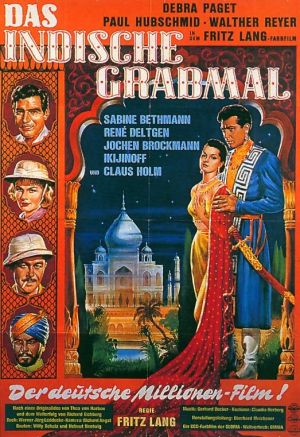
These can perhaps be regarded as typical of German movie poster art of the 1950’s.


It was left to the Italians to show them how to do it right.

By the late 1950’s, Fritz Lang’s Hollywood movie career had come to end. There were no more studio executives left for him to piss off. It was at this time that the German film producer, Artur Brauner, approached Lang and suggested he do a remake of his silent film The Indian Tomb, (which had been completed without Lang’s supervision). Lang agreed, and the resulting work was released as two films: The Tiger of Eschnapu and The Indian Tomb. They were two of the last three films that Lang made before he retired due to failing eyesight.

Lang regarded film as a visual art form rather than as a form of literature, so he had no reservations about using “genre” subject matter: science fiction, detective stories or, in the case of these two films, Orientalist fantasy. In this respect, he is similar to such contemporary directors as George Lucas, Steven Spielberg, and James Cameron. Unlike them, however, Lang’s films are never coy or campy. He always treats his subject matter seriously and with respect. For that reason, I consider Lang’s work to be artistically superior to that of these other directors.

From the moment one begins watching The Tiger of Eschnapur, one can see right away that this is an example of what the late Edward Said called “Orientalism”. More than once some character mentions that Europeans can never really understand India. (It doesn’t help that most of the Indian roles are played by Europeans in brown face.) This “Mysterious Orient” nonsense was, of course, used to justify Western imperialism. (The “clash of civilizations” is a more sophisticated, contemporary version of this argument.) This film is based on a 1918 novel written by Lang’s former wife, Thea von Harbou, who wrote the silly story for Metropolis and who later joined the Nazi party (although, interestingly, she secretly married an Indian man). One can, however, enjoy these films on their own terms without worrying about the politics of it. It is simply a remnant from a defunct way of looking at the world.

Harold Barger (Paul Hubschmid) is a German architect who has been hired by Chandra (Walter Reyer), the maharajah of Eschnapur, to design public buildings for his kingdom. On his way to Chandra’s palace, Harold meets Seetha (Debra Paget), a temple dancer with whom the maharajah has fallen in love. The carry out a secret affair, which Chandra eventually discovers. Chandra throws Harold into a pit with a man-eating tiger, but Harold manages to kill it. (The tiger is obviously fake. Don’t worry, no animals were harmed in the making of this film.) Chandra then tells Harold that he has until sunrise to leave Eschnapur. Harold, however, has an assignation with Seetha in a temple, and the two of them flee into the desert. There, they are overcome by the heat and dust. Harold deliriously shoots at the sun just before he collapses. A message then flashes across the screen promising that we can see the miraculous rescue of the lovers in the sequel, which will be “more grandiose” than the first film.

The Indian Tomb is, indeed, more grandiose. Seetha and Harold are rescued by a caravan. Shortly afterwards, however, they are captured by Chandra’s soldiers. True love eventually wins out, though not without a lot of people getting killed in the process.

These are not among Lang’s best films, but they are nonetheless entertaining movies to watch. Lang directed them in a beautiful manner, although he clearly had to deal with a limited budget. Some of the sets and costumes are not quite convincing. And some of the special effects are embarrassing, such as the fakest looking cobra you will ever see. On the other hand, Debra Paget gives not one, but two, erotic dances. Paget, an American, was, like Lang, a refugee from Hollywood. She had refused to abide by the rules of the studio system, so she was blacklisted. She had to go to Europe to find work. I’m told that in her later years Paget became a born-again Christian, and she had her own religiously themed TV show. I wonder if she ever discussed temple dancing on her show.

Jean Bricmont and Gilad Atzmon

October 3, 2012


Gilad Atzmon

Jean Bricmont has written an article defending Gilad Atzmon from his numerous critics on the Left, who accuse him of, among other things, being an anti-Semite. (Personal disclosure: I am one of them.) You can read the complete article here. (This links to Atzmon’s website. If you are unfamiliar with his work, you will be amazed at some of the things you will find there.) The first thing one notices about this piece is that it is extremely long-winded. You could cut out at least half the verbiage in it, and it would say the same exact thing. I consider that to be bad writing (although I realize some may not agree with me about this). I find this disheartening. I have always liked to think that theoretical physicists must also be good writers. Einstein wrote well. Carl Sagan could express himself clearly and succinctly. Yet another one of my illusions in life has been shattered.

After nine mostly long paragraphs, Bricmont finally gets to his main argument:

    This movement often gives the impression that its “solidarity” with Palestine takes place above all over there and requires more and more missions, trips, dialogues, reports, and even sometimes “peace processes.” But the plain facts of the matter are that the Israelis do not want to make the concessions that would be needed to live in peace and that a main reason for that attitude is that they think they can enjoy Western support ad vitam aeternam. Therefore, it is precisely this support that the solidarity movement should attack as its priority. Another frequent error is to think that this support is due to economic or strategic considerations. But, at least today, Israel is of no use to Western interests. [This is plainly false.] It turns the Muslim world against us [this is only partly true], doesn’t bring in a single drop of oil [man does not live by oil alone, Prof. Bricmont], and pushes the United States into a war with Iran that the Americans clearly don’t want [some, such as Norman Finkelstein, have argued that Israel is bluffing about this]. The reasons for this support are obvious enough: constant pressure from Zionist organizations on intellectuals, journalists and politicians by endlessly manipulating the accusation of anti-Semitism and the climate of guilt and repentance (for the Holocaust) kept on artificial life support, in large part by those same organizations. As a result, the main task of the Palestine solidarity movement should be to allow free speech about Palestine, but also to denounce the pressure and intimidation by various lobbies. Which is what Atzmon does. Far from rejecting him, the solidarity movement should make it a priority to defend the possibility of reading and listening to him, even if one is not in total agreement with what he says.

Look, so far as I and other leftists are concerned, Atzmon can write whatever bullshit that happens to float his boat. All we’re asking is that we at least acknowledge that what Atzmon writes is bullshit. Bricmont’s unwillingness to admit this raises serious questions about his intellectual honesty. Moreover, Bricmont makes so many dubious assertions here, that one must wonder whether he actually has any idea what he’s talking about. I think I should also point out that the “Israel is useless to the West” argument is often made by right-wing critics of Israel, at least some of whom are almost certainly anti-Semites. That fact should give Bricmont pause.

    By his all-out attack on Jewish “tribalism,” Atzmon’s essential contribution to solidarity with Palestine is to help non-Jews realize that they are not always in the wrong when conflicts with Jewish organizations arise. The day when non-Jews free themselves from the mixture of fear and internalization of guilt that currently paralyses them, unconditional support for Israel will collapse.

If I may speak for my fellow non-Jews, I don’t feel one shred of guilt about what happened during the years 1933-45. Again, one has to wonder whether Bricmont has any idea what he is talking about. What’s more, the second sentence is obviously nonsense. Bricmont apparently considers it a matter of principle to ignore the political and economic forces that drive the West’s support for Israel.

In all fairness to Bricmont, I should point out that he seems to be partly motivated by concerns about laws recently passed in France that prohibit certain types of speech. Although I don’t pretend to be an expert on French politics, it seems to me that the problem there is that France has no equivalent of the First Amendment to the United States Constitution, which guarantees freedom of speech. (This is a problem in many other countries as well.) I realize that this argument may be too idealist, but I think there is at least some truth to it.

With all due respect, perhaps Bricmont should stick to particle physics. There is no shame in that.

Jean Bricmont

September 5, 2012

The August 31 edition of CounterPunch contains an interview with the Belgian writer and physicist, Jean Bricmont, conducted by Kurosh Ziabari. I agree with most of what he says, but he makes a couple of highly problematic arguments. In response to a question about U.S. policy in the Middle East, Bricmont says:

    Well, I think one has to make a difference between support for Israel and the desire to “devour” oil. The two policies are not the same and are, in fact, contradictory. As, I think, Mearsheimer and Walt have shown, the pro-Israel policies of the U.S. are to a large extent driven by the pro-Israel lobby and do not correspond to or help their economic or geo-strategic interests. For example, as far as I know, there would be no problem for our oil companies to drill in Iran, if it weren’t for the sanctions imposed on that country; but the latter are linked to the hostility to Iran from Israel, not from any desire to control oil.

I can’t quite agree with this. Does Bricmont really think that the U.S. derives no advantage from having a heavily armed ally in the Middle East? The Arab Spring exposed the fragility of the U.S.’s client states in the Arab world. Israel, on the other hand, is rock solid. Now, more than ever, the U.S. needs to have a “policeman” in the Middle East. As for drilling for oil in Iran, even if there were no sanctions it would be impossible, because Iran has a nationalized oil industry.

From this, Bricmont immediately segues into another argument:

    The second remark is that the anti-war people are not necessarily on the left. True, there is a big part of the Right that has become neo-conservative, but there is also a big part of the Left that is influenced by the ideology of humanitarian intervention. However, there is also a libertarian Right, Ron Paul for example, that is staunchly anti-war, and there are some remnants of a pacifist or anti-imperialist Left. Note that this has always been the case: the pro and anti-imperialist position, even back in the days of colonialism, do not coincide with the Left-Right divide, if the latter is understood in socio-economic terms or in “moral” terms (about gay marriage for example).

    What we do not have is a consistent anti-war movement; to build the latter one would have to focus on war itself and unite both sides of the opposition (Right and Left). But if movements can be built around other “single issues,” like abortion or gay marriage, that put aside all socio-economic problems and class issues, why not?

This is the same as the “left-right” alliance argument that the late Alexander Cockburn used to make. This idea has always been a non-starter, for reasons that should be obvious. These “anti-war” conservatives all have terrible politics. Pat Buchanon is a racist. Ron Paul has ties to white supremacist groups. Israel Shamir is an anti-Semite. These things are not accidents. The supposed “anti-imperialism” of such people is really just the outward expression of an essentially nativist world-view. It is simply absurd to think that leftists can march side-by-side with racists and neo-fascists. Bricmont might as well talk about why the sea is boiling hot and why pigs have wings.

Israel Shamir and CounterPunch

August 25, 2012

Why does CounterPunch, which is ostensibly a left-wing website, continue to post articles by the neo-fascist nutjob, Israel Shamir? You only have to read Shamir’s website to see that the guy is crazy. Yet he is apparently not too crazy to be published by CounterPunch.

CounterPunch has just posted an article by Shamir entitled The Secret History of Pussy Riot. In it, he repeatedly refers to the members of the band by the misogynist term, “viragos”. This fact alone should have been sufficient reason to reject the article. Alas, it’s actually even worse than that. Shamir argues that the Putin government was right to send these women to prison for merely expressing their opinions. He writes:

    Two years’ sentence is quite in line with prevailing European practice. For much milder anti-Jewish hate talk, European countries customarily sentence offenders to two-to-five years of prison for the first offence. The Russians applied hate crime laws to offenders against Christian faith, and this is probably a Russian novelty. The Russians proved that they care for Christ as much as the French care for Auschwitz, and this shocked the Europeans who apparently thought ‘hate laws’ may be applied only to protect Jews and gays. The Western governments call for more freedom for the anti-Christian Russians, while denying it for holocaust revisionists in their midst.

Why does CounterPunch insult its readers by posting this garbage? The kindest thing one can assume here is that they didn’t bother to read this article.

Shamir has ties to the Lukaschenko dictatorship in Belarus. When David Irving was sentenced to prison for Holocaust deanial, Shamir wrote:

    Thus we should say: David Irving was sentenced for denial of Jewish superiority. His doom seals the reign of (albeit limited) freedom that began with the fall of Bastille. European history went full circle: from rejecting the rule of Church and embracing free thought, to the new Jewish mind-control on a world scale. Not only is Western Christian civilisation dead, but even its successor, secular European civilisation, has met its demise only a few days after its proud and last celebration by the Danish scribes. It was short-lived: about two hundred years from beginning to the end, the Europeans may once have had the illusion that they can live without an ideological supremacy. Now this illusion is over; and the Jews came in the stead of the old and tired See of St Peter to rule over the minds and souls of Europeans.

This is anti-Semitism, plain and simple. The Breivik shootings in Norway have shown that fascism is still a force to be reckoned with. Yet the editors of CounterPunch apparently think it is all a joke.

Gore Vidal (1925-2012)

August 2, 2012

Gore Vidal has died. I enjoyed reading his essays in the New York Review of Books, but I was never keen on his novels. (Although I did enjoy Julian.) Vidal’s acerbic criticisms of U.S. foreign policy and of this country’s plutocracy earned him an enthusiastic following among the left. However, Doug Henwood, who is generally an admirer of Vidal’s, reminds us that he had a “creepy nativist streak”. He recalls hearing Vidal express sympathy for the racist Dutch politician, Pim Fortuyn. In the 1980’s, Vidal published an article titled The Empire Lovers Strike Back, in which he wrote:

    My conclusion: for America to survive economically in the coming Sino-Japanese world, an alliance with the Soviet Union is a necessity. After all, the white race is the minority race with many well-deserved enemies, and if the two great powers of the Northern Hemisphere don’t band together, we are going to end up as farmers—or, worse, mere entertainment—for more than one billion grimly efficient Asiatics.

The kindest thing one can say about this is that it shows that Vidal was completely ignorant about Asia. Vidal surely must have been aware of the “Yellow Peril” rhetoric that was common in the early twentieth century. And bear in mind that he was making this argument in a country with a history of discrimination against Asians, including the internment of 110,000 Japanese-Americans during World War II.

In the same article, Vidal says that Norman Podhoretz is not an “assimilated American”. This comment provoked accusations of anti-Semitism. Vidal once said of Hilton Kramer that his name “sounds like a hotel in Tel-Aviv”.

Also problematic for the left are the disturbing implications of Vidal’s ham-fisted writings on population control. He once said:

    If the human race is to survive, population will have to be reduced drastically, if not by atomic war then by law, an unhappy prospect for civil liberties but better than starving… it may already be too late to save this ark of fools.

Vidal would perhaps have been pleased to know that the birth-rate in Japan has been falling.

Despite all his faults, I am saddened by Vidal’s passing. He was a public intellectual, a type of person that is becoming increasingly rare in the United States. Unfortunately, the media often saw him as a figure of entertainment rather than enlightenment. They could never get enough of his silly fight with Norman Mailer or his tiresome feud with Truman Capote. It seems the media must trivialize everything, including writers.

They Call It Myanmar

June 30, 2012

Writer and filmmaker, Robert H. Lieberman, spent two years putting together this documentary about Myanmar (known in the West as Burma). Much of the filming had to be done secretly, because Myanmar has a military government that is highly secretive and suspicious of outsiders. Except for Aung San Suu Kyi, a leading dissident who was awarded the Nobel Peace Prize, none of the people interviewed in this film are identified, for fear of government reprisals.

Myanmar used to be one of the wealthiest countries in Asia. It is now one of the poorest. Lieberman shows us crumbling buildings in Rangoon, the nation’s capitol. The military seized control of the country in 1962. They have mismanaged the economy ever since. The generals are ultra-nationalists who are deeply suspicious of the outside world. The situation is strikingly similar to that of North Korea, except that there is no cult of personality. Instead, the generals rule as a faceless bureaucracy, remote from the people.

The British invaded Myanmar in the early 19th century, and, after a series of wars, took control of the country in 1885. They ruthlessly exploited the people and their country. When the Japanese invaded during World War II, many Myanmarese welcomed them as liberators. Yet the Japanese occupation turned out to be even more brutal than that of the British, and the Myanmarese turned against them. (The parallels to the history of the US in Iraq and in Afghanistan is striking here.) The country was finally granted independence in 1948. Given the country’s history, the xenophobic views of the military actually make some sense.

The World Health Organization has ranked Myanmar as 190th in the quality of its health care. Most people cannot afford to see a real doctor. Many resort to seeing quacks who have little or no medical training. Education is also out of reach for most people. Many of the people interviewed in this film have had only one or two years of schooling. There are free schools run by Buddhist monks, but their quality of education is uneven. Many of them teach only basic reading and math and Buddhist religious ideas. Those who manage to get a college education often choose to emigrate to other countries, with the result that the country doesn’t benefit from their knowledge.

Child labor is common. We see, for example, a young girl who can’t be more than eight or nine years old carrying a basket full of gravel on her head. It’s not unusual for families to sell their children to work as servants for rich people.

Myanmar is a country with a rich culture and history. The countryside is dotted with beautiful Buddhist temples, some of them more than a thousand years old. The film emphasizes the importance of Buddhism in the nation’s culture. However, it says nothing about the country’s Christian, Muslim, and Hindu minorities. I would have liked to learn something about these groups.

There have been uprisings against the government, most notably the failed “Saffrom Revolution” of 2007. Each time these revolts have been brutally supressed. Lieberman tries to end the film on an optimistic note by saying that the young people in the country seem to feel less bound by the government’s sanctioned conventions. It is also proving increasingly difficult to keep out foreign influences. We see, for example, scenes of Burmese punk rock bands performing. Yet it’s not clear whether this will have any political consequences.

Lieberman repeatedly says that going to Myanmar is like going back in time. Is this really so? Here is a country in which a small number of people control most of the wealth, while most people can’t afford an education or decent health care, and in which the military enjoys unlimited power. Is this not the direction in which our own country is heading? Doesn’t Myanmar perhaps give us a glimpse into our own future?