Archive for the ‘Imperialism’ Category

Triumph of the Will

June 6, 2012

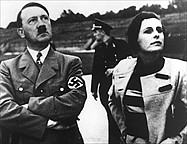
I recently saw Triumph of the Will. I felt obligated to watch it because it is considered the penultimate example of a political propaganda film. Such is its notoriety, that when Michael Moore’s Fahrenheit 911 first came out, right-wing pundits immediately tried to smear it by comparing it to Triumph of the Will. Of course, they only revealed their intellectual poverty by doing so, since Moore’s approach to film making is nothing at all like Leni Riefenstahl’s.

The early scenes depict Hitler’s arrival in Nuremberg for a party rally. The creepy thing about these scenes is how normal they seem. Take away the gaudy uniforms and raised arms and Hitler could be just your ordinary politician, shaking hands with people, smiling for the camera, and engaging in small talk with the plebeians. It’s not until Hitler addresses the Reichsarbeitsdienst, a sort of paramilitary construction group, that we begin to sense that something profoundly weird is going on here. From a visual standpoint, this is the best part of the film, because there is something slightly surreal about the sight of hundreds of uniformed men marching around with shovels as if they were rifles. This cuts to a spooky scene of storm troopers gamboling in the woods at night. (At least I think that’s what they’re doing. It’s hard to tell.) Unfortunately, it’s all downhill from there: seemingly endless scenes of people marching around, with an inexplicably large number of them carrying Nazi flags, occasionally interspersed with speeches by Hitler.

The most striking thing about this film, however, is how physically unimpressive the Nazi leaders are. Many of them are fat: Goering, Wagner, Ley, Streicher. Wagner, Rosenberg, and Ley sweat profusely. Schirach has sweaty armpits. Hess, however, looks underfed, and he has a strangely high-pitched voice. (I must say, though, he did know how to give a crisp salute.) Lutze also has an annoyingly high-pitched voice. (Did Hitler have a thing for male sopranos?) Goebbels looks like a weasel. As for Himmler, why didn’t they just put at bag over this guy’s head? Seriously, he could have had a lucrative career as a character actor in Hollywood, playing ignorant rubes who get taken in by the likes of W.C. Fields. (“Here’s all my life’s savings, mister. Give me all the bottles you can of that there miracle elixir!”) Even the storm troopers and SS men are unimpressive. They look a bit scrawny, and their uniforms often don’t seem to fit quit right. Hitler, however, looks well-fed. Yet the plumpness of his face makes you uncomfortably aware of how silly his tiny moustache looks. And he has too much Brylcream in his hair. (Or whatever was the German equivalent of Brylcream in the 1930’s.) And his uniform makes his ass look huge. (This is true of some of the other people in this film. I wonder, did Hitler think that having a big ass was a sign of racial superiority?)

The reason I bring all this up is that it has often been said that Triumph of the Will was a highly effective advertisement for Nazism. I find this hard to believe. This film is mostly boring. A lot of it is just people marching around to bad music. Riefenstahl knew that rapid cutting and moving the camera around can make things appear more interesting than they actually are, but these tricks can only do so much, and sometimes they can even be counter-productive. When, for example, we see the stage at a rally from a camera that’s being lifted upwards, the effect is merely showy. Indeed, it actually seems a bit naive. True, this was the 1930’s, but they were already using more sophisticated techniques than this in Hollywood – or in Germany’s own cinema, for that matter.

Early in the film, there are evocative shots of the amazingly beautiful city of Nuremberg. Alas, these are marred by the ubiquitous presence of Nazi and German imperialist flags.

Even the speeches are not all that interesting. There are repeated calls for “national unity”, as well as a lot of talk about how the Nazi Reich will last thousands of years (heh, heh). I must say, though, that Hitler did occasionally inflect his voice in interesting ways. There are, however, some ominous references to the notion of “racial purity” in the speeches of Hitler and of Streicher.

In her later years, Riefenstahl collected many awards from film festivals. (Her fellow propagandist, Streicher, was hanged.) Since Triumph of the Will was, far and away, her most famous movie, one must wonder about the people who decided to give her all these honors. Riefenstahl claimed that she was a neutral observer, but this assertion is contradicted by her own film. At the beginning, it says it is Das Dokument der Reichsparteitag 1934 – hergestellt im Auftrage des Fuehrers. (The Documentary of the Reich party conference of 1934 – produced according to the Fuehrer’s instructions.) Well, you can’t get any more explicit than that, can you? Also, it’s clear just from watching this film that Riefenstahl could not have made it without plenty of help from the Nazis. Also, there are some scenes that were clearly staged specifically for the camera.

There’s one scene in the film in which we see Hitler and his cronies watching soldiers riding around on horseback. While I was watching this, I was reminded of the fact that during World War II, 90% of the German army’s supply transport was horse-drawn. The truth was that Germany was actually under-prepared for the war. My father rarely talked about his wartime experiences, but one story he did tell more than once was about when his unit captured a German army base. In the mess hall there was a gigantic soup tureen, which was apparently what everyone ate from. It always amazed my father that a government that could only afford to feed its soldiers gruel actually believed it could conquer the world.

2011: A Glimmer of Hope

December 31, 2011

2011 was the best year of my life. True, this year had more than its share of tragedies, most notably the terrible tsunamis in Japan and the meltdown of the Fukushima reactors (we will be living with the consequences of the latter for generations). What I’m referring to here is that this year we saw mass demonstrations against the ravages of capitalism, beginning in Tunisia and spreading to various parts of the globe, most recently in China and in Russia. I have never seen anything like this before. The “anti-capitalist” upsurge of 1999 to 2001 was paltry compared to this.

Not everything has gone smoothly, of course. The demonstrations in Bahrain have been defeated (so far). The struggle is still uncertain in Syria. There has been an Islamist backlash in Tunisia and in Egypt. The National Transitional Council in Libya is dominated by former Khadafyites. Yet the problems that led to the initial uprisings in these countries are not going away.

The 99% movement has changed the political landscape here in the U.S. The Tea Party hoax is dead. The mainstream media have been forced to talk about issues such as economic inequality. Six months ago, all they were talking about was the need to cut government spending. What was perhaps most striking about the movement was the way it continued to grow in the face of savage police repression. The sight of cops beating and pepper-spraying people only seemed to make people want to join the resistance. The tactic of occupying public spaces seems to have run its course. However, new methods of stuggle are starting to emerge, such as occupying foreclosed homes.

This December, U.S. troops were pulled out of Iraq. This was, as I made clear in an earlier post, partly the result of the revelations provided by WikiLeaks, which also helped to fuel the uprisings in other parts of the world. We should support Private Bradley Manning as the government tries to railroad him. We owe a lot to this brave young man.

2012 should prove to be an interesting year.

Thank You, WikiLeaks

October 25, 2011

 
Julian Assange                                       Bradley Manning

The admirable Glenn Greenwald has written an aritcle about why the Obama Administration’s efforts to extend the occupation of Iraq failed. It seems that the release by WikiLeaks of a cable that revealed a war crime by the U.S. military turned the Iraqi parliament against the idea of giving legal immunity to U.S. troops. Greenwald explains:

    That cable was released by WikiLeaks in May, 2011, and, as McClatchy put it at the time, “provides evidence that U.S. troops executed at least 10 Iraqi civilians, including a woman in her 70s and a 5-month-old infant, then called in an airstrike to destroy the evidence, during a controversial 2006 incident in the central Iraqi town of Ishaqi.” The U.S. then lied and claimed the civilians were killed by the airstrike. Although this incident had been previously documented by the U.N. special rapporteur on extrajudicial, summary or arbitrary executions, the high-profile release of the cable by WikiLeaks generated substantial attention (and disgust) in Iraq, which made it politically unpalatable for the Iraqi government to grant the legal immunity the Obama adminstration was seeking. Indeed, it was widely reported at the time the cable was released that it made it much more difficult for Iraq to allow U.S. troops to remain beyond the deadline under any conditions.

This is why, as I explained in an earlier post, leftists are opposed to government secrecy. When people know what governments are actually trying to do, they will tend to oppose those actions.

Game over in Iraq. Unfortunately, the imperialist beast is still far from dead.

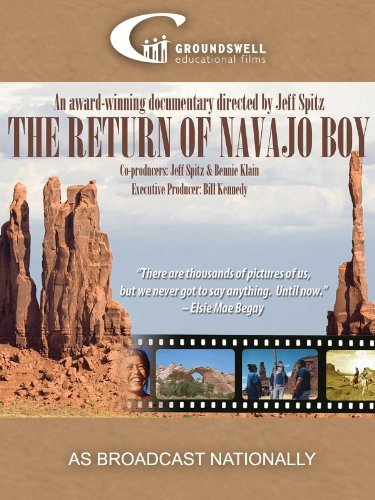
The Return of Navajo Boy

October 11, 2011

The Multicultural Center at the University of Oregon recently held a screening of the documentary, The Return of Navajo Boy. The director, Jeff Spitz, spoke beforehand. He told about how in the late 1990’s a man named Bill Kennedy approached him with a film that his recently deceased father had made in the 1950’s. It was a half-hour documentary about the Navajos (Diné) called Navajo Boy. Kennedy asked Spitz to help him preserve his father’s work. Spitz could make no sense out of the film, which had no sound. He took the film to a library in Chicago that had an extensive collection of literature and films related to Native Americans. The people at the library told him that the film showed a ceremony that, according to Navajo religious belief, should never be filmed. They advised him to destroy the movie. Spitz couldn’t bring himself to do this. Instead, he and Kennedy decided to locate the people in the film and ask them what should be done with it.

The documentary begins with Kennedy talking with Lorenzo Begay, a descendent of the family in the film. (We’re not told how Kennedy managed to locate him.) He lives with his family on a reservation in the austerely beautiful Monument Valley in Utah. He takes Kennedy to meet his uncle and his mother, Elsie Mae Cly Begay, both of whom appear as children in the film.


Elsie Mae Cly Begay in the 1950’s.

He shows the movie to the Begay family. They seem pleased to see themselves in it. We are then told about the family’s history. During the 1950’s, they supported themselves by raising sheep, which they still do today. They were also paid by a local merchant to pose for photographs that would be used for postcards. (They also appeared as extras in John Ford’s The Searchers). Elsie Mae’s mother, Happy Cly, was believed to be the most photographed woman in America at that time.


Happy Cly

Some members of the family also worked in the uranium mines. The Navajo workers were not warned about the health hazards of radiation exposure. One of Elsie Mae’s brothers worked in the mines, and he later developed cancer. The film discusses his efforts to get compensation from the government. Also, radioactive tailings from these minds contaminated the ground water. Elsie Mae’s hogan was built using rocks from the mines. Later it was found to contain 80 times the acceptable level of radiation, so it was destroyed. Two of Elsie Mae’s sons died of cancer, and a third has recently developed it. Happy Cly died from cancer. It turns out that the ceremony shown in the documentary by Bill Kennedy’s father is that of a medicine man trying to cure her.

Elsie Mae had a baby brother, John Wayne Cly, who also appears in Kennedy’s movie. When Happy Cly died, the family was unable to take care of him, so they gave him to white missionaries who promised to bring him back when he was older. They never did. When Kennedy’s documentary is shown at a Navajo museum, John Cly, who was then living in New Mexico, reads about it in a newspaper. The film ends with an emotional reunion between him and his family. There is also a postscript that relates how Elsie Mae now travels the country and to other countries to tell people about what uranium mining did to the Navajo nation.

This is an interesting and important film. Incredibly, the government wants to reopen some of these mines to provide fuel for a new generation of nuclear reactors. This is more evidence that nuclear energy is a bad idea.

You can learn more about this film at NavajoBoy.com.

The Libyan Revolution

August 26, 2011

Some on the left (Glen Ford, for example) have taken the view that the Libyan revolution is nothing more than a NATO-driven coup d’etat. I cannot share this view. Clearly, the rebels could not have succeeded without support from a substantial portion of the Libyan population. One thing we learned from the Afghanistan war is that dropping a lot of bombs and sending in special operations forces do not guarantee a victory. Civilian support – which the U.S. clearly lacks in Afghanistan – is an important factor.

No doubt the Western governments will try to profit as much as they can from the current situation in Libya. Some members of the ruling class are openly calling for a U.S. occupation of Libya. Richard Haas has written in the Financial Times:

    Nato’s airplanes helped bring about the rebel victory. The “humanitarian” intervention introduced to save lives believed to be threatened was in fact a political intervention introduced to bring about regime change. Now Nato has to deal with its own success. Some sort of international assistance, and most likely an international force, is likely to be needed for some time to restore and maintain order. Looting must be prevented. Die-hard regime supporters will have to be defeated. Tribal war must be averted. Justice and not revenge need to be the order of the day if Libya is not to come to resemble the civil war of post-Saddam Iraq in the first instance, or the chaos (and terrorism) of Somalia and Yemen down the road.

Haas, a diplomat, apparently did not notice that the U.S. military completely failed to stop the sectarian civil war in Iraq. I suspect Haas’s real concern is guaranteeing for the U.S. easy access to Libyan oil. Despite his knowing use of quotation marks, it is clear that Haas is actually making a more sophisticated version of the “humanitarian intervention” argument. I doubt, however, that Obama will take Haas’s advice. Among other things, the current political mood in the country is not favorable for such a move.

Is the revolution an unqualified victory for the U.S.? Bear in mind that the U.S. did not get everything it wanted in Iraq, and it certainly did not get what it wanted in Afghanistan. The U.S. may find Libya also hard to control.

More Thoughts about Obama’s Budget Deal

August 7, 2011

The raucous debates that preceded the budget deal have led some to the conclusion that the U.S. ruling class is in a state of crisis. The wars in Iraq, Afghanistan and Libya have not gone they way they hoped. The recovery from the last recession has been extremely weak. They are desperately trying to find a way to increase profits while maintaining the empire, but they are divided on how to do it. Some, like the Koch Brothers (the driving force behind the Tea Party), want to simply destroy whatever is left of workers’ living standards, effectively making the U.S. into a “Third World” country. Others favor less drastic measures. The people at Standard & Poor’s are trying to impose their own ideas on the government by downgrading their credit rating. None of these people seem to see unemployment as a problem, even though the more intelligent members of the ruling class must realize that chronic unemployment will eventually lead to social unrest. (The Wisconsin uprising may be a foreshadowing of this.) Yet they are unwilling to accept any New Deal-type reforms that might assuage public anger.

Again, what we need is a movement of unemployed people.

Glenn Beck and Israel

July 13, 2011

Glenn Beck has dabbled in anti-Semitic conspiracy theories. He has expressed admiration for the anti-Semitic writers Elizabeth Dilling and Eustace Mullins. Yet he was recently invited to speak before a committee of the Israeli Knesset, where he was well received and lauded as one of “Israel’s great friends”.

We live in a society in which anyone who criticizes Israel is labeled as an “anti-Semite”. Yet the Israelis have made it clear that they regard a genuine anti-Semite as one of “Israel’s great friends”.

What does this tell us about Israel?

Dennis Banks

May 14, 2011

Dennis Banks, who was one of the founders of the American Indian Movement, came to speak at the University of Oregon. His appearance was part of a day long series of events dealing with the problem of diabetes in our society. Banks has for years been working to draw attention to the epidemic of diabetes in Native American communities. However, he also used the occasion to talk about his political experiences.

Banks began by talking about his childhood. An Anishinaabe, he was born in the Leech Lake Indian Reservation in northern Minnesota in 1937. When he was four years old, he and his sister were taken away from their parents, and sent to a boarding school with other Indian children. They were not allowed to speak their languages and practice their customs. The children were only taught to do manual labor. This was part of a U.S. government program to “kill the Indian, save the man”. The aim was to destroy the cultures and identities of Native Americans. This was a form of genocide. Interestingly, the U.S. was doing this at the same time it was fighting the Nazis in Europe.

According to Banks, beatings were common at the boarding schools he was sent to. He ran away repeatedly. He escaped for the last time when he was fifteen. He felt bitter that his mother did not seem to write to him while he was in the schools. Three years ago, some people were doing a documentary about him. They went to an office in Kansas City where there are records of these schools. There, they found packets of letters that his mother had written him.

Banks founded one of the first AIM chapters in Minneapolis in 1968. He had observed the civil rights and anti-war movements, and he came to believe that a similar movement was needed to advocate for the rights of Native Americans. In 1973, AIM occupied Wounded Knee, South Dakota for seventy-one days to protest rampant corruption on the PIne Ridge Indian Reservation. (Banks prefers to say that they “secured” the town.) Afterwards Banks and Russell Means were charged with 16 felony counts and faced two hundred years in prison. Their trial lasted nine months. At one point an FBI agent testified, “My job was to bring down Dennis Banks.” As he was leaving, he said to Banks, “I’m sorry, Mr. Banks. It was my job.” The government prosecutors repeatedly introduced fabricated evidence. Eventually, the judge threw out all the charges.

The second half of Banks’s talk was devoted to the problem of diabetes. He blamed it on the diet of most Americans. He pointed to the example of the Pimas, whose lands are bisected by the U.S.-Mexican border. The rate of diabetes among Pimas north of the border was far higher than among those in Mexico, even though the two groups are genetically identical. Banks believes that this is because the Pimas in the U.S. have adopted the U.S. diet of the twentieth century, meaning more fat and less starch and fiber. Oddly, Banks made it sound as though he has been fighting the medical establishment on this issue, even though the recommendations he made (eat more vegetables, get more exercise) are often made by doctors.

Banks’s talk went a bit long. In his discussion of diabetes, he made many of the same points over and over again. I have to admit, I became a bit fidgety towards the end. Nevertheless, Banks is a powerful and affecting speaker who has interesting and important things to say.

Bin Laden

May 4, 2011

It seems these government officials just can’t resist the urge to lie about military operations. Initially, we were told that Bin Laden took part in a firefight with the Navy Seals and that he used his wife as a “human shield”. The government now admits that never happened. Moreover, we are now told that Bin Laden was unarmed. If it is true that the Seals were to try take Bin Laden alive, then their killing him has to be considered a blunder.

Bin Laden was an evil man, and he caused nothing but suffering in the world. Some have pointed out that the U.S. military have killed more people than Bin Laden did. This is true, but it was Bin Laden who provided them with a convenient excuse to carry out their wars. Without the September 11th attacks, it would have been a lot harder for the U.S. government to persuade people to support the invasion of Iraq. Of course, that is what Bin Laden wanted: the U.S. sending its troops into Muslim countries. No doubt he derived satisfaction from this, though the only people who have benefited have been corporate CEO’s.

Will this change anything? The Arab revolutions have made Al Qaida largely irrelevant. With Bin Laden’s death, however, the emotional justification for the U.S.’s interventions in the Muslim world is gone. I have heard a number of people say that the U.S. should leave Afghanistan now. The Stratfor website has speculated that Obama may start pulling troops out of Afghanistan soon. I hope that they are right, though I fear that the government will find some other excuse to continue the occupation.

Libya

April 22, 2011

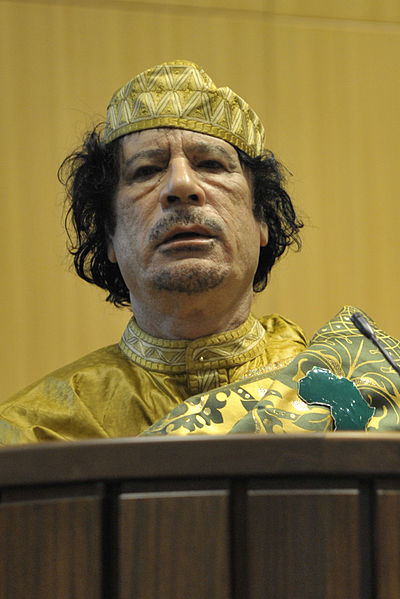
The U.S., Britain and France have been carrying out bombing raids in Libya. Originally, the stated purpose of these raids was to create a “no-fly” zone, to keep Libyan rebels from being wiped out by Moammar Gaddaffi’s forces. Now, we are told that the aim is to remove Gadaffi from power, and that special forces troops may have to be sent in to do this. This is a classic example of what in the military they call “mission creep”. The involvement of Western troops means that whatever government replaces Gadaffi, it will be one that designed to protect the interests of the Western powers, not the Libyan people. In effect, the West has intervened in the revolutionary upsurge sweeping the Arab world in order to protect its interests. At the same time that the U.S. has purportedly intervened to save the rebels in Libya, it has given the green light to Saudi Arabia to crush the uprising in Bahrain. And it has supported the government in Yemen, which is trying to crush protests in its country, which it denounces as “un-Islamic” because they include women as well as men. Clearly, the U.S. is not concerned with spreading democracy in the Arab world, but with defending its own interests.

There are some on the Left, such as Gilbert Achcar and Juan Cole, who have defended the intervention in Libya. They argue that a no-fly was necessary to defend the rebels. But as Lance Selfa has pointed out in Socialist Worker:

    Reportedly, the Libyan National Transition Council appealed to European governments with a list of demands, including the handing over of sequestered Qaddafi funds to the rebel government. The European governments chose to ignore most of the demands, but to accept the proposal for a no-fly zone.

    In other words, the notion that “there was no other choice” but a no-fly zone already accepts a compromise of the Libyan movement’s independence. In the coming weeks, we may learn if the West extracted other concessions from the Libyan opposition in exchange for support for its action–for example, honoring the Qaddafi government’s debts or giving preferential oil contracts to particular Western interests.

    As SocialistWorker.org has argued, Western intervention has many other motivations besides the “humanitarian” claims in support of Resolution 1973: preserving the flow of Libyan oil; preventing mass migrations of Libyans to Europe; getting rid of a “failed state” in Libya; and stopping the Arab revolution from overthrowing another dictator through its own efforts.

As Mike Marqusee has pointed out:

    The current intervention ensures that if Gaddafi falls, his replacement will be chosen by the West. The new regime will be born dependent on the Western powers, which will direct its economic and foreign policies accordingly. The liberal interventionists will say that’s not what they want, but their policy makes it inevitable.

At the opposite end of the spectrum from Achcar and Cole are people who have defended Gaddaffi, claiming that he is an anti-imperialist. In fact, since 2003, and possibly earlier, Gadaffi has been cooperating with the West. Some have even claimed that the rebels are motivated by racism against the country’s black African immigrants. In fact, it is the Libyan government that has been promoting racism. In the 1990’s, the Libyan government allowed black Africans to enter the country because it needed a source of cheap labor. Since then it has promoted tensions between these immigrants and the Libyan population. In 2000, there were attacks against blacks that killed at least 135 people. What’s more, Gadaffi has presented himself a gatekeeper against black immigration to Europe. During a trip to Rome in 2010, he declared:

    We don’t know what will happen, what will be the reaction of the white and Christian Europeans faced with this influx of starving and ignorant Africans…We don’t know if Europe will remain an advanced and united continent, or if it will be destroyed, as happened with the barbarian invasions.

Researchers Gregor Noll and Mariagiulia Giuffré have written:

    In the last two years, hundreds of migrants and asylum-seekers intercepted at sea have been driven back to Libya without any chance of setting foot on European soil to claim asylum. But in Libya, migrants and refugee are victims of discriminatory treatment of all kinds. They live in constant fear of being arrested, in which case they will be indefinitely confined in overcrowded detention centers, where they are exploited, beaten, raped and abused. Refugees who have no possibility of applying for asylum or accessing any other effective remedy, thereby run the risk of being forcibly returned to countries of origin, where they may face persecution or torture.

An interesting question presents itself here: if Gadaffi has been doing the bidding of the West, why are they now trying to get rid of him? My guess is that they decided that it was worth sacrificing Gaddaffi to regain control over the situation in the Arab world. They have used the fighting in Libya to make it appear that the West is on the side of democracy, while the West’s allies in Bahrain and in Yemen crush the revolts in those countries. There may also be domestic considerations behind this decision. In Britain, the government of David Cameron is deeply unpopular because of its drastic cuts. The Sarkozy government in France is also unpopular. This war is one way to distract people’s attention from the problems in those countries.

Back in February, Defense Secretary Robert Gates told an audience at West Point that the U.S. cannot afford any more wars like the ones in Iraq and in Afghanistan. I doubt that Gates would have said that if he didn’t believe it. The U.S. has been limiting its involvement in the fighting, no doubt in the expectation that Britain and France will carry most of the burden. However, if those countries are unsuccessful, there will be pressure on the U.S. to intervene more aggressively, perhaps even send in troops. Having declared the removal of Gadaffi as its goal, the U.S. cannot afford to allow him to survive. The U.S. may find itself draw into the Libyan conflict against its will.

The people of the Arab World must be allowed to decide their own future. That is why we should oppose the West’s intervention.