Archive for the ‘Iraq’ Category

Syria and the Art of Moral Imperialism

August 28, 2013

425.obama.barack.lc.111408

The conflict in Syria has been going on for over two years now, and President Obama has been doing everything he can to stay out of it, but now there is talk in the media of an attack, possibly this week. Confronted by growing evidence that the Assad government has used poison gas against civilians, President Obama now has to make good on all his talk about red lines. (Barry Crimmins recently said, “If we’re prepared to use force on people who commit chemical warfare, when do we attack Monsanto?”) He is reportedly studying different options that have been presented to him by the military. However, a White House spokesman, Jay Carney, has said, “The options that we are considering are not about regime change.” So what are Obama’s aims then? My guess is that he is going to carry out a one-off attack, similar to Clinton’s missile strike in Khartoum or Reagan’s bombing of Libya. Obama can then say that the U.S. has shown zero tolerance towards the use of chemical weapons, to the applause of his supporters. The attack will increase tensions with Russia and with Iran, but it will be a small price to pay so that the U.S. can maintain its facade of moral high-mindedness.

We have come a long way since the giddy days following the invasion of Iraq, when there was delirious talk about the prospect of U.S. troops marching through the streets of Damascus and Teheran. I argued in an earlier post that the U.S. empire is not in decline, and I still hold that view. What has happened is that the Iraq War and its aftermath has taught the U.S. ruling class to take a more realistic view of what it can and cannot do, as well as to take a more realistic view of the internal politics of other countries. (Contrast Gen. Dempsey’s sober assessment of the Syrian opposition with the neoconservatives’ love affair with the convicted embezzler, Ahmad Chalabi.) In that respect, it can be argued that the U.S. empire is actually in better shape today than it was under George W. Bush.
The Fog of War

January 6, 2013

Fog_of_war

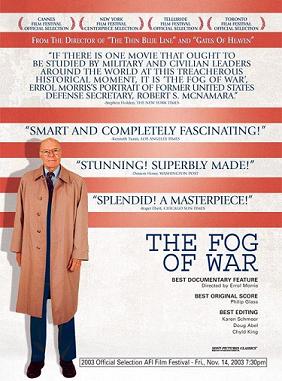
I just got around to watching Errol Morris’s 2003 documentary, The Fog of War. I didn’t see this film when it first came out, probably because 2003 was a busy year for me. I found it somewhat disappointing. Much of it consists of McNamara trying to justify his actions. I should have expected that, but the reviews I read led me to believe it would be much more than that. Still, the film does have some interesting moments, and it gives some insight into the way one member of the ruling class thinks. I don’t think this is a minor thing. I think that perhaps the reason so many people on the Left are suckers for crackpot conspiracy theories is that they don’t have much understanding of how the ruling class thinks.

The film begins with McNamara, who is shown in tight close-ups most of the time, discussing the Cuban Missile Crisis. McNamara repeatedly points out the U.S. and the Soviet Union came extremely close to a nuclear war. McNamara uses his account of the crisis to illustrate one of the “eleven lessons” he talks about in the course of The Fog of War; in this case, “empathize with your enemy”. McNamara tells how a diplomat named Tommy Thompson, who knew Krushchev well, persuaded a skeptical Kennedy that the Soviet premier would be willing to cut a deal over Cuba, which turned out to be the case. This raises the question of why there was a crisis at all, though, unfortunately, Morris doesn’t ask this question. McNamara also uses this incident to illustrate another one of his “lessons”: “rationality will not save us”. McNamara insists that the governments of the U.S., the Soviet Union, and Cuba all behaved in a “rational” manner, even though they brought their countries to the brink of nuclear annihilation. So, if this is rationality, then what is irrationality? And if rationality will not save us, then what will? Morris doesn’t ask, and McNamara doesn’t say.

The Fog of War then goes into a discussion of McNamara’s early years. During the Second World War, he served as an analyst for the Army Air Corps. Under the command of Gen. Curtis LeMay, McNamara helped plan the fire bombing of Tokyo, which killed 100,000 people. This leads to the film’s most startling moment: McNamara frankly states that he and Gen. LeMay were war criminals. Still, he expresses no regrets about what he did.

The largest section of the film is devoted to the Vietnam War. McNamara doesn’t say much about the strategic justification for the U.S.’s intervention in Vietnam; he seems to consider this to be self-evident. McNamara admits that there was some confusion over what actually happened in the Gulf of Tonkin Incident; nevertheless, he and President Johnson used it as justification to launch an intensive bombing campaign in North Vietnam. McNamara also gives a discussion in which he tries to distance himself from the use of Agent Orange in Vietnam. To illustrate his “lesson” of “empathize with your enemy”, McNamara talks about how years after the war he met the former foreign minister of North Vietnam. McNamara says he was surprised to learn from this man that his government viewed the U.S. as a foreign colonial power trying to take control of their country. Reall? It never occurred to McNamara that the Vietnamese might view the U.S. in this way? If McNamara was being honest here, then he was every bit as self-deluded as the people who led us into the Iraq War. (It so happens that this film was released the same year as the U.S. invasion of Iraq.)

McNamara casually discusses the deaths of millions of people, yet he gets choked up when he recounts how he helped pick out the grave-site for John F. Kennedy. One is reminded here of Stalin’s dictum: “One death is a tragedy, but a million deaths is a statistic.” I don’t think it is a stretch for me to say that McNamara had some of Stalin’s bureaucratic mind-set.

Another of McNamara’s “lessons” is “in order to do good, you may have to engage in evil”. One wonders if McNamara ever questioned whether what he was trying to do was actually good.

The Fall of General Petraeus

November 13, 2012


Gen. David Petraeus and Paula Broadwell

It’s been a long time since we’ve had a really good sex scandal in Washington, so the one involving Gen. Petraeus comes as a welcome relief after a truly dreary presidential election. Petraeus is accused of having had an affair with his “biographer”, Paula Broadwell. She is the reputed author of an admiring book about Petraeus with the perhaps unfortunate title of All In. (It has also come out that this book was at least partly ghost-written.)

There is more than a little moral hypocrisy in all this. Congresswoman Debbie Wasserman Schultz, who is chair of the Democratic National Committee, has said: “Disturbing is the word that has come to my mind since all of this has come to light. Really, I think it goes without saying if you’re the director of the CIA, if you are a four-star general in the United States army, that you have to hold yourself to a higher standard. And you can’t put yourself in a compromising position.” Yes, a man who authorizes torture and drone strikes can’t sully himself with extra-marital sex. Schultz, by the way, helped organize last summer’s Democratic convention, at which one of the featured speakers was former president Bill Clinton, who coaxed a White House intern into giving him blow jobs.

It all started when Jill Kelley, a friend of Petraeus’s family, told an FBI agent, with whom she was apparently involved in some way, that she had been receiving harassing e-mails from Broadwell. Even though the FBI normally doesn’t investigate this sort of thing, those intrepid G-Men went to work, eventually examining 20,000 pages of e-mails. (I’m not making this up.) Not only did they discover Broadwell’s affair with Petraeus, but they also discovered that Kelly was having an affair with Gen. David Allen, Petraeus’s successor in the Afghanistan command.

Kelley is an interesting person in her own right. According to the Los Angles Times: “…she has angered some senior officers for what were described as persistent efforts by her to forge close personal ties to successive Central Command four-star officers by deluging them with emails, a former Central Command aide said.” Could there be such a thing as a military groupie? There must be something about a man who bombs villages in Afghanistan.

Some will cite this affair as evidence that the American empire is in decline. This is nonsense. There is, for example, good reason to believe that Eisenhower had an affair with his female chauffeur during World War II. And at one point in his career, MacArthur was demoted when it was discovered that he had a mistress.

The FBI agent who started the investigation – who has so far only been identified as Agent Shirtless – is said to have a “worldview” that is “hostile” to Obama. I think we can guess what that probably means.

Those who live by the media, die by it. When the Iraq war wasn’t going well, the government and the media decided that they needed a hero to distract people. Petraeus, who wears more medals than a Soviet-era bureaucrat, seemed a logical choice. He was given credit for a non-existent victory in Iraq, to hide the fact that Bush had actually cut a deal with Sunni militia groups. Now Petraeus has been undone by one of those who worked hardest create his myth. Shakespeare would have relished this.

The Hunger Games

March 30, 2012

The Hunger Games is set in a dystopian future in which a group of teenagers are forced to fight to the death on live television. One of the interesting things about this film is its implied criticism of so-called “reality” TV shows. Suzanne Collins, who wrote the novel on which this film is based, has said that she got the idea for it when she switched from a reality TV show to coverage of the U.S. invasion of Iraq. She said the two “began to blur in this very unsettling way”. Indeed, the Iraq invasion was covered somewhat like a reality show. The military and the media colluded, for example, in concocting a fake “dramatic” story about a female army private being held prisoner by the Iraqis. This took place in a context in which innocent civilians were killed. The Hunger Games presents a future in which state-sanctioned murder has become a form of entertainment.

This is a well-made film that is superior to your usual Hollywood blockbuster. It features complex characters and strong performances. I must say, though, that I found some of the fight scenes hard to follow. Also, I would have liked to learn more about the politics of this future world. How does the regime justify itself ideologically? There are extremes of wealth and poverty. Clearly there is exploitation here, but how is it carried out? Perhaps we will learn more about this is the promised sequels.

Early on in The Hunger Games, we see a government propaganda film that starts out by decrying the horrors of war, which then leads into a justification of the blood-letting in the games. This is an interesting portrayal of how, in politics, idealistic language is often used to justify monstrous behavior.

Thank You, WikiLeaks

October 25, 2011

 
Julian Assange                                       Bradley Manning

The admirable Glenn Greenwald has written an aritcle about why the Obama Administration’s efforts to extend the occupation of Iraq failed. It seems that the release by WikiLeaks of a cable that revealed a war crime by the U.S. military turned the Iraqi parliament against the idea of giving legal immunity to U.S. troops. Greenwald explains:

    That cable was released by WikiLeaks in May, 2011, and, as McClatchy put it at the time, “provides evidence that U.S. troops executed at least 10 Iraqi civilians, including a woman in her 70s and a 5-month-old infant, then called in an airstrike to destroy the evidence, during a controversial 2006 incident in the central Iraqi town of Ishaqi.” The U.S. then lied and claimed the civilians were killed by the airstrike. Although this incident had been previously documented by the U.N. special rapporteur on extrajudicial, summary or arbitrary executions, the high-profile release of the cable by WikiLeaks generated substantial attention (and disgust) in Iraq, which made it politically unpalatable for the Iraqi government to grant the legal immunity the Obama adminstration was seeking. Indeed, it was widely reported at the time the cable was released that it made it much more difficult for Iraq to allow U.S. troops to remain beyond the deadline under any conditions.

This is why, as I explained in an earlier post, leftists are opposed to government secrecy. When people know what governments are actually trying to do, they will tend to oppose those actions.

Game over in Iraq. Unfortunately, the imperialist beast is still far from dead.