Archive for the ‘Popular Culture’ Category

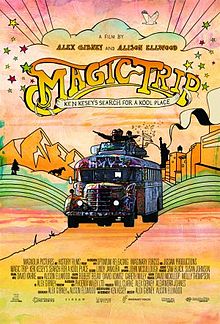
Magic Trip

October 4, 2011

In the early 1960’s, Ken Kesey and the Merry Pranksters decided they would make a film about a cross-country trip they would undertake. After the journey, when they tried to edit the film, they found they couldn’t synchronize the sound and the images. Perhaps this had something to do with the fact that they were tripping on LSD most of the time they were filming. Recently, Alison Ellwood and Alex Gibney used the surviving footage as the basis for a documentary about Kesey and about the 1960’s.

In 1964, Kesey and a group of his friends, inspired by Jack Kerouac’s On The Road, decide to travel across the country from California to New York. They renovate an old school bus and paint it bright colors. They name it “Further”, and they call themselves “The Merry Pranksters”. They manage to get Neal Cassady – the “Dean Moriarty” from On The Road – to be their bus driver. Cassady is on speed much of the time, so he talks incessantly and is constantly gesturing with his arms. The trip is largely a success, but it is not without problems. A woman has a mental breakdown and has to be sent home. Another woman, who is pregnant, eventually decides that she is not enjoying herself and eventually drops out. When the pranksters reach New York, they seek out their hero, Jack Kerouac, only to get a decidedly chilly reception from him. They go to the World’s Fair, thinking it will be a good place to trip, only to find it a bit dull. They then travel to upstate New York, where Timothy Leary has a mansion, where he and others carry out experiments with LSD. When the Pranksters arrive, however, most of the people there, including Leary, hide from them. (One of the Pranksters comments that these people seem “upper class”.) The only one who talks to them is Richard Alpert (“Ram Dass”), who creeps them out.

When the Pranksters return to California, they begin holding parties called “acid tests”. These start to attract large numbers of people. The Pranksters become disenchanted with Cassady, who seems to be all talk and nothing else. One day he is found dead lying alongside a railroad track in Mexico. Kesey eventually seems to sour on the drug culture he helped create, although he never expresses any regrets about what he did. He moves to Oregon, where he settles down on a farm with his wife and children.

It’s funny how society tries to appropriate artists after they die. A statue of Kesey now stands in downtown Eugene, where environmental activists have sometimes been brutalized by the police. At least one of these incidents took place across the street from the statue.

Magic Trip is part road movie, part cultural history, and part morality tale. I highly recommend seeing it.
X-Men: First Class

August 13, 2011

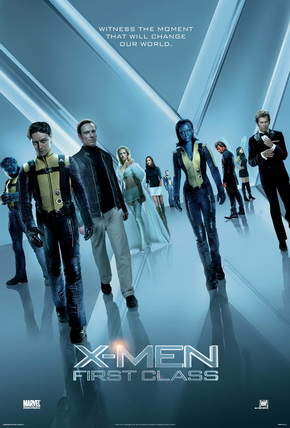
After watching such highbrow fare as The Tree of Life and Hobo with a Shotgun, I felt the need for something light, so I went to see X-Men: First Class. I have to admit that I was never really into the whole X-Men thing. I belong to a generation for whom Spiderman and the Fantastic Four were the really cool superheroes. So I probably didn’t get all the in-jokes, although I noticed some moments that clearly had that in-joke feel to them. Personally, I don’t like it when they put in-jokes in movies, but they seem to be a requirement with these genre films.

X-Men: First Class gets off to a slow start. The problem is that it spends too much time establishing the origins of the main characters. About twenty minutes in, however, it starts to take off, and soon it’s like a roller coaster ride. I won’t go into too much detail about the story. Basically it takes place in the early 1960’s, and it’s about a group of evil mutants who try to start a nuclear war between the United States and Russia. They want to destroy non-mutants so that they and other mutants can rule the world. They are opposed by a group of good mutants, who at the end become the “X-Men”. As you may have guessed by now, the words “mutants” and “mutations” get tossed around a lot in this film. I guess this is supposed to sound scientific, although I’m not aware that it’s possible for a mutation to allow one to violate the laws of physics, as the characters in this film frequently do.

One of the things I liked about this film is that some of the characters are remarkably complex for an action movie. Indeed, the characters in this film have more depth than the characters in some supposedly “adult” movies such as Horrible Bosses. Even though they have super powers, they can't help feeling like misfits who aren't wanted. I suspect this is the secret to the comic books' success: they appeal to adolescents who feel they aren't appreciated for their talents.

This film mixes historical events with fictional ones in a manner that I did not find objectionable. Indeed, I was struck by the fact that the movie makes it clear that it was the U.S.'s decision to place Jupiter missiles in Turkey that led to the Cuban missile crisis. When I was young, if you had pointed that out to someone, he might very well have called you a "traitor". It's funny how things have changed since the end of the Cold War.

Hobo with a Shotgun

August 5, 2011

Years ago, I had a group of friends who liked to watch bad movies. No, I don’t mean “so bad it’s good” movies like Plan 9 from Outer Space or Robot Monster. I mean movies that are just bad. I’m talking about low budget exploitation films that make you feel unclean while you’re watching them. The idea seems to have been that these guys would get together and share a common feeling of smug superiority towards the people who made these films, sneering at the bad acting and the inept camera work. Try as hard as I could, I was never able to buy into this aesthetic. I would sit squirming in my chair, wanting to say, “ Wouldn’t it be more fun to watch a good movie?”

Hobo with a Shotgun seems to belong to a similar aesthetic, although the attitude here seems to be one of morbid fascination rather than smug superiority. The main reason I went to see this film is because I thought the trailer was funny. Considering that even the trailers for Hollywood “comedies” aren’t funny, I thought this had to be a promising sign. I have since learned that it originally was one of a series of joke trailers that were made for the Robert Rodriguez-Quentin Tarantino concoction, Grindhouse, which I haven’t seen. I have, however, seen Rodriguez’s Machete, which also started out as one of these joke trailers. Although I liked that this film takes the side of immigrants, I must admit that I didn’t think it was very good. The characters were too cartoonish to be interesting, and the action sequences weren’t well done. (Well-done action sequences, in my opinion, are the bare minimum requirement for a good action film.) I suppose some would argue that this film’s badness is the whole joke, although, in my opinion, it is a joke that wears thin pretty quickly.

Hobo with a Shotgun, directed by Jason Eisener and written by John Davies, is the second of these Grindhouse spin-offs. The film has a 1970’s look and feel to it. (I take it the seventies were a sort of Golden Age of exploitation films.) The basic plot is an example of a peculiarly American genre. It’s that type of story in which a stranger arrives in a corrupt city or town and, using ruthless methods, proceeds to clean the place up. (The best example of this type of story is Dashiell Hammett’s Red Harvest.) One morning, a hobo (Rutger Hauer) arrives in Hope Town, which is known by its residents as either “Scum Town” or “Fuck Town”. (In keeping with the rules of the genre, we are never told the hobo’s name, just as we are never told the name of Hammett’s Continental Op.) The hobo finds that there is rampant crime in the city. The place is run by The Drake (Brian Downey), who is a combination gangster, preacher and carnival barker. The Drake holds public executions of people who displease him, including his own brother. The police are completely under The Drake’s control. The hobo befriends a prostitute, Abby (Molly Dunsworth), who is far and away the most sympathetic character in the film. When he sees a robber threatening to kill a baby, the hobo snaps. He gets a shotgun, and soon the bodies start to pile up.

Hobo with a Shotgun is the most violent film I have ever seen. Eisener and Davies cram as much gratuitous violence as they can into each scene. There are depictions of torture, disembowelment, mutilation and people being burned alive. Yet the film has a Grand Guignol feel to it that makes it hard to take seriously. Everything is so ridiculously overdone that I couldn’t help laughing at times. Other people in the audience reacted the same way. However, several people got up and left.

I have deeply mixed feelings about this film. I can’t say that I didn’t find it entertaining, yet I can’t really recommend it. It has no redeeming value, even though Eisener and Davies try to inject some social consciousness into it. In one scene, for example, Abby makes a speech defending homeless people. The problem is that when you present an argument like that in the cynical context of an exploitation film, it rings hollow.

I have a suggestion for Rodriguez, Eisener and Davies: wouldn’t it be more fun to make good movies?

Saint Misbehavin’: The Wavy Gravy Story

July 17, 2011

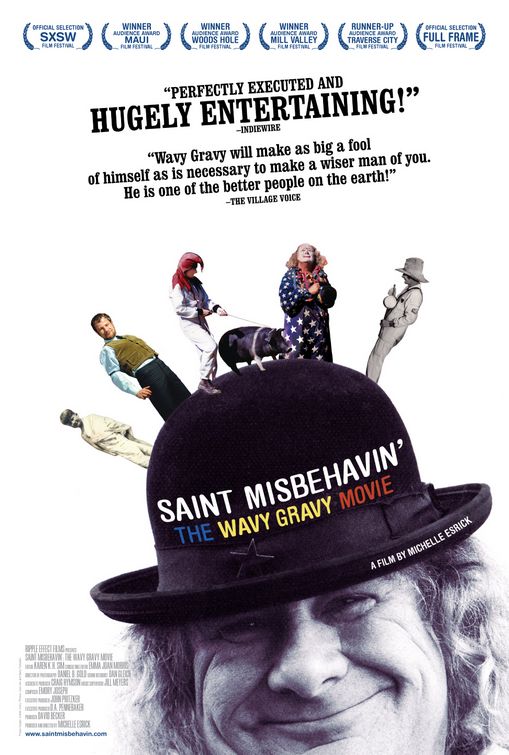
Michelle Esrick has directed a documentary about Hugh Romney, better known as Wavy Gravy, the peace activist, clown and archetypal hippy. Romney’s early career is in many ways highly representative of how hipsterism evolved from the 1950’s to the 1970’s. In the fifties, he was reciting poetry at the Gaslight Cafe in Greenwich Village. Inspired by Lenny Bruce, he began doing stand-up comedy, and he released a comedy album. In the early sixties, he moved to California. There he met Ken Kesey. He joined the Merry Pranksters and experimented with LSD. (He gives good advice on how to deal with someone who’s having a bad trip: keep telling the person that what he’s seeing isn’t real and that it will soon end.) He then founded a commune outside of Los Angeles called the Hog Farm. While touring with fellow members of the Hog Farm, he was asked to help organize the Woodstock music festival, and he became the MC. It was shortly after this that B.B. KIng gave him the name “Wavy Gravy”. He took part in numerous anti-war demonstrations. On at least one occasion he was severely beaten by the police, with the result that he suffers back problems to this day. W.G. found that if he dressed as a clown, the police would not hurt him. So that is the public persona he has adopted to this day.

Wavy Gravy comes across as a likable person in this film, but for all his supposed zaniness and irreverence, he seems strangely bland and – dare I say it? – even a bit dull at times. The problem is that, aside from the Vietnam War (which he rightly calls genocide), he never expresses any really strong opinions about anything. There is, strange to say, no discussion in this film of any of the U.S.’s military interventions since Vietnam. An extraterrestrial watching this film might well get the impression that human history came to an end during the 1960’s. (I’ve met some elderly hippies who seemed to believe this.)

A lot of this has to do with Wavy Gravy’s concept of spirituality. The film begins with W.G. entering a room that is filled all sorts of religious icons – Christian, Buddhist, Hindu, with toys mixed in. (There is a multi-armed Donald Duck figurine. No doubt this represents the multiple aspects of Donald’s powers.) W.G. then recites a prayer in which he names all sorts of famous religious figures (including Lenny Bruce). It’s a spirituality in which various religious traditions are mixed together in a sort of feel good froth. W.G. emphasizes the importance of providing food and shelter to the poor and unfortunate. He argues that if we are kind and decent to people, it will create a ripple effect that will eventually spread through the whole world.

Wavy Gravy does some good things. He helped found a charity that provides eye care to poor people. He runs a children’s summer camp called Camp Winnarainbow that, judging from this film, looks as though it’s a hell of a lot more fun than the fascistic summer camp I went to as a kid. Still, we live in a world that’s being destroyed by capitalism, in which imperialist wars are being fought. Just being nice to people is not enough.

American: The Bill Hicks Story

May 31, 2011

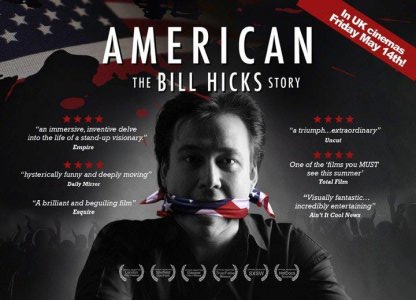
Matt Harlock and Paul Thomas have produced this documentary about Bill Hicks, who died of pancreatic cancer at the age of 32. We learn about Hick’s childhood, growing up in a Southern Baptist family that moved around the South before settling in Texas. Hicks began doing stand-up as a teenager in Houston. His act developed with remarkable speed, and within a few years he was performing at the Comedy Store in Los Angeles. At around this time, he began experimenting with drugs and drinking heavily. He became notorious for getting drunk before going on stage, an absolute no-no in stand-up comedy. When clubs started banning him, he sobered up and quit drinking.

In his act, Hicks began to deal increasingly with controversial issues such as religion, patriotism and militarism. He was an outspoken critic of the first Gulf War. Posing as a journalist, he witnessed the Waco massacre. He saw a Bradley tank open fire on the Branch Davidian compound. He criticized the media for not reporting this.

Hicks’s death was a great tragedy. He could use someone like him today.

You can find samples of Hicks’s comedy here.

Elizabeth Taylor (1932-2011)

March 29, 2011

I feel obligated to note the recent death of Elizabeth Taylor. Although I was never a huge fan of Miss Taylor’s, she appeared in a number of important films, some of which have become classics. I seem to recall Taylor as a ubiquitous presence in the mid-twentieth century American culture that I grew up in, yet when I recently looked at her filmography, I was dismayed to realize that I’ve actually only seen a few of her films. It perhaps says something about Taylor that she seemed such a presence to me despite the fact that I rarely actually saw her in anything.

When I was in high school, I had a 300-pound English teacher who had a twisted sense of humor. One day he had the class watch Suddenly, Last Summer, which was the closest that Tennessee Williams ever came to writing a Grade B horror movie. I don’t remember much about Taylor’s performance, although I vividly recall the scene in which she flounders around in the surf wearing a skin-tight bathing suit. As you can imagine, this made quite an impression on the hormonal teenager I was in those days. (I must say though, what made a greater impression on me was Katherine Hepburn’s profoundly creepy performance as Violet Venable. The moment in which she suddenly turns to Montgomery Clift and exultantly semi-shouts “We saw the face of God!” almost made me fall out of my chair.)

Taylor was never a favorite with critics, though she managed to win two Academy Awards. One of them was for Who’s Afraid of Virginia Woof? I saw this film several years ago, and I must say that I was not that impressed by it. Ernest Lehman’s screenplay pads out Edward Albee’s play, merely making obvious what Albee wisely only hinted at. Again, I don’t remember much about Taylor’s performance, except that she wore a not quite convincing wig, and she yelled a lot. I did, however, like the performance of Richard Burton, who inexplicably failed to win an Oscar. His portrayal of a cynical, jaded college professor was cruelly accurate. (I can say that having known many cynical, jaded college professors in the course of my life.)

Interestingly, Taylor unintentionally had a profound impact on Los Angeles, one of the great cities of the world. (Snicker all you want, you New York snobs.) Taylor starred in the 1963 film, Cleopatra, which, although a huge box office success, cost so much money that 20th Century Fox could only fend off bankruptcy by selling off part of its backlot. (Taylor was paid $7 million – which went a lot farther in those days compared to now – and had 65 costume changes.) Century City was then built in its place. I once had a job working in an office building there. I remember the area as a striking example of bad urban design. It mainly consists of non-descript buildings surrounded by vast, empty lawns. The latter are criss-crossed by cement sidewalks that lead to bleak, charmless concrete plazas. Even in the middle of the day, when there are hundreds of office workers going to lunch, the place seems empty and impersonal. What’s more, there’s no place to park your car, except for a few expensive parking garages. (The company I worked for refused to reimburse me for parking.) I’m told that this place was deliberately meant to be a “city within a city”. The result is that it has no connection to the surrounding urban landscape. You’re in the second largest city in the U.S., yet you might as well be in an office park in Lower Bumfuck, New Jersey.

But I digress.

As too often happens with hugely successful celebrities, Taylor became something of a joke in her later years. Her messy personal life increasingly overshadowed her career. The fact that she put on weight in middle age (something that most people tend to do) was, for some reason, considered hilarious. I remember a Saturday Night Live sketch about an ‘interview” with Taylor (actually John Belushi in a wig and a dress). The “joke” was that Belushi/Taylor was ravenously stuffing his/her face the whole time. The “satire” in this sketch struck me as hypocritical, considering that Belushi was no stranger to carbohydrates himself. Our society seems take a perverse pleasure in seeing the inevitable decline of its once popular idols.

Steve Landesberg (1945-2010)

December 21, 2010

Steve Landesberg has died. He was best known for playing Arthur Dietrich on Barney Miller, which was a funny TV show, even though it did whitewash the New York City police department. (Isn’t that always the way? You’re never going to see a TV series about a corrupt cop or a racist cop, but I digress.) I remember before that he was in a short-lived series called The Paul Sand Show. Landesberg was the only reason for watching that program. He had a dry, understated delivery that could make material seem better than it was.

As is often the case with an actor who appears in a successful TV series, his subsequent career was disappointing. Mainly he just did bit parts here and there. When I lived in Hollywood, on more than one occasion I heard someone ask, “Whatever happened to Steve Landesberg?” It’s a shame the entertainment industry didn’t use him more.

Sasquatch

November 12, 2010

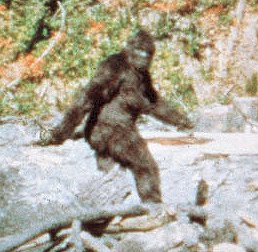
When I first started this blog, one of my intentions was to write about some of the lore and history of Oregon. Clearly I’ve moved in a very different direction, but I’ve decided to try to make a return to my original aim. And what better place to start than with sasquatch (vulgarly known as “bigfoot”)? These are creatures who reportedly walk upright, are nine feet tall and covered with hair.

The name of the creature is derived from sésquac, a Salish Indian word meaning “wild man”. There are many Native American stories about tall, hairy humanoid creatures. Sasquatch is an interesting example of a Native American belief being adopted by whites.

There have been 76 reported sasquatch sightings in Lane County where I live, more than in any other county. (I’m not sure whether I should feel proud of this.) In recent years there have been sasquatch sightings in places such as Florida. At the risk of sounding provincial, I must say that I resent this. Sasquatch is a creature of the Pacific Norhtwest. It seems to me that people from other parts of the country are trying to horn in on our fun.

I must admit to being a sasquatch skeptic. Since these creatures are bipedal, they would likely be closely related to human beings. Yet there is no fossil record of nine-foot tall hominids. What’s more, I often walk through the hills of South Eugene at night, and I have yet to encounter any nine-foot tall hairy hominids Still, there are fervent sasquatch-believers. Last June a sasquatch symposium was held here in Eugene. Scholars and academics (well, they call themselves scholars and academics) from all over the world gathered together to discuss all things sasquatch. I would have liked to have gone to this event, but I couldn’t afford it, since I was broke at the time. However, I read about it in the Eugene Weekly. The big celebrity speaker at the event was Autumn Williams, author and Oregon native. According to the Weekly:

    Williams spent a good deal of time talking about a pseudonymous witness she called Mike, a “redneck” bulldozer driver from Florida, who claims to have developed close ties to a sasquatch he calls Enoch. Williams’ relationship with Mike appears to have had a profound, almost life-altering impact on her. “I felt like somebody had handed me the Holy Grail of sasquatch research,” she said of hearing Mike’s story.

    Williams attested that Mike was an “incredibly credible” witness whose stories were “detailed” and “intense” and never once changed despite several retellings. If it’s that the devil is in the details, and so is the believability of any good yarn. And, as related by Williams, Mike shared some lovely, offbeat and wonderfully colloquial observations about “skunk apes,” which is what he calls sasquatch.

This is starting to sound like a bad children’s TV show. (“Redneck Mike and His Forest Friend, Enoch”.) I was hoping for something more in the lurid manner of The X-Files. The Weekly goes on:

    Williams’ bigfoot presentation, over time, took on a distinct utopian vibe, one of rosy romantic primitivism. The underlying message of her story was that the bigfoot — community oriented, nonmaterialistic, free of artifice and, overall, purely pure as nature itself — lives a simpler, less encumbered and more peaceful way of life than human beings. In fact, it is actually us, with our alienating cities and glitzy consumer goods and fear of boredom and, as Williams put it, our constructed selves that “change on a daily basis with fads,” who must learn from the skunk apes. “We’re so far removed from what we were,” Williams said.

Yuck. This is New Age mush. This just ruins it. When I was growing up, sasquatch were terrifying creatures. I would read newspaper stories about people who claimed that sasquatch threw rocks at them and tried to abduct them. I remember when I was about twelve years old, I saw a doucmentary about sasquatch in a movie theatre. It scared the bejesus out of me. (I suspect that if I saw it now, I would just laugh at it. One can never recapture the innocence of childhood.) Now, they’re just overgrown, hirsute hippies. Boring. I think this is another example of the Disneyfication of American culture. Everything has to be made to seem as cute as a litter of puppies. Well, I won’t have it. I want my scary sasquatch back!

Cropsey

October 27, 2010

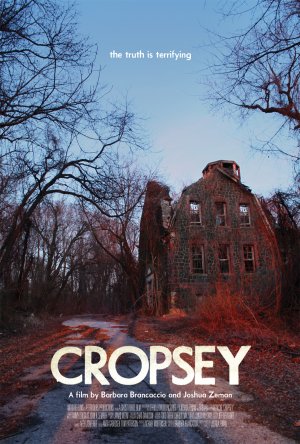
Cropsey, which is dubiously advertised as a “horror-documentary”, is a film by Joshua Zeman and Barbara Brancaccio. It examines a series of disappearances of children on Staten Island in the 1970’s and 1980’s. The film begins with a discussion of urban legends, common throughout the Hudson River Valley, about a character named Cropsey, who murders children. Zeman recounts being told stories about Cropsey by counselors at a Boy Scout camp on Staten Island. In these stories, Cropsey lived in the abandoned buildings of the Willowbrook State School. This was an institution for the mentally retarded that was closed down in the 1980’s, after Geraldo Rivera did an exposé on the inhuman conditions there. (Yes, Rivera was once a serious journalist, believe it or not.)

From urban legends the film proceeds to reality. In 1987, a little girl with Down’s Syndrome disappeared on Staten Island. After an intensive search, her body was found in a shallow grave. The police eventually arrested Andre Rand, a homeless man who camped near the grounds of Willowbrook, where he once worked. Rand was eventually found guilty of kidnapping, but the jury could not agree on a verdict for murder. Since then, some people have questioned whether Rand was guilty. No physical evidence was found to connect him to the murder. The case against him relied entirely on eyewitness testimony. (The filmmakers correctly point out that eyewitness testimony can be unreliable, a point that is often ignored in our criminal justice system.) The filmmakers interview police officers and others who were involved with the case, as well as Rand’s defense attorneys.

From there the film proceeds to a discussion of the community’s reaction to Rand’s arrest and conviction. Shortly after Rand’s arrest, stories began to go around that Rand was the leader of a Satanic cult that would have meetings in the abandoned Willowbrook buildings. To this day, rumors abound that Satanists meet at night in the buildings. In a questionable act of bravado, Zeman and Brancaccio go to Willowbrook at night to see if there is any truth to these stories. There, not surprisingly, they fumble around and manage to spook themselves. They begin to seem like an inept version of Scully and Mulder from The X-Files. They don’t find any Satanists, but they do come across a group of teenagers, doing the silly things that teenagers do in a place like that. These kids solemnly tell the filmmakers that the stories about Satanists are true, even though they’ve never seen any themselves.

During the filming of this documentary, Zeman and Brancaccio corresponded with Rand and spoke with people who knew him. From these letters and interviews, a portrait of Rand gradually emerges, and it turns out to be more disturbing than any urban legend. It prompts the filmmakers to suggest the disappearances of the children were in a way connected with the inhumanity of what went on at Willowbrook.

Cropsey is a rich, multi-layered documentary that touches upon issues such as what urban legends say about us, the reliability of our criminal justice system, the sensationalism of the media, the way our society treats the mentally handicapped, and the question of whether we can really know the truth about past events.

Highly recommended.

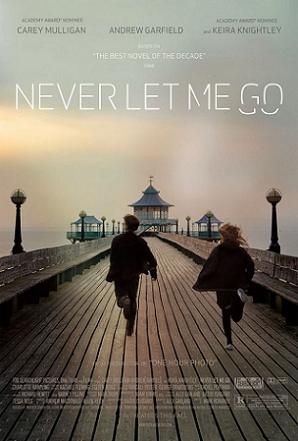
Not Really a Review of Never Let Me Go

October 18, 2010

I am debating in my mind whether or not to see the new British film, Never Let Me Go, which is directed by Mark Romanek and based on a novel by Kazuo Ishiguro. I looked up Ishiguro’s novel on Wikipedia, and when I read the synopsis, I was startled to learn that it has the same basic idea as The Clonus Horror, a Grade B science fiction movie that was made in 1979, and which starred Peter Graves, Dick Sargent and Keenan Wynn. (You may recall that it was shown on Mystery Science Theatre 3000.) It tells the story of a group of people who discover that they’re really clones, and they’re going to eventually be killed so their organs can be harvested. Since Ishiguro wrote the novel in 2005, I think it likely that he got the idea from The Clonus Horror. (He may have watched it on MST3K.) The novel was shortlisted for the 2005 Booker Prize. It did pretty well for a book inspired by a bad movie.

At first it struck me as cheesy that Ishiguro would take an idea from a movie that appeared on MST3K. On further reflection, however, I can’t really fault him for this. Having done some writing myself, I know that coming up with ideas is hard. Shakespeare had to get his stories from wherever he could find them. My problem is that I don’t know if I’ll be able to take this film seriously, knowing its origins. What’s more, the trailer makes it look like one of those self-consciously arty, but decidedly middlebrow, British films. I’ve had bad experiences with those things in the past. On the other hand, it does have Carey Mulligan, whom I liked very much in An Education. Then again, the wikipedia article says that the novel ends with the main character resigned to being killed and her organs being harvested. Yuck. The hero of The Clonus Horror at least fights back. That’s the kind of story I like to see.