Archive for the ‘Racism’ Category

George Washington’s Dentures and the Reliability of Sources

May 5, 2014

Gilbert_Stuart_Williamstown_Portrait_of_George_Washington

Like millions of Americans, I was taught as a child that George Washington had wooden teeth. Like so much of American folklore, this story conceals a sadder truth.

Over the past several days, several of my Facebook friends have linked to an article titled “George Washington Had Teeth That Actually Were Yanked From The Heads Of His Slaves And Fitted Into His Dentures” on a website called Reunion Black Family. The article starts out in a plausible vein, but then I came to this sentence:

    Consider, for example, his December 19, 1786 vow to never again purchase another slave from Zionist corporations that invaded Africa villages with guns and kidnapped people.

Zionist corporations? This has the stench of crankery about it. I decided to find out more about this website. From what I have been able to gather, it is owned by a man named Kola Afolabi, who apparently lives in Nigeria. He is a pan-African nationalist. He likes Gadaffi and Mugabe. He dislikes Christianity and Islam. Last year he got into a dispute with Gallery Ezakwantu, a website devoted to African art. They accused him of using copyrighted images from their website without their permission. One of the articles on Afolabi’s site is titled “On 9/11 about 4000 Jews who work in WTC were on leave. So where were they all gone just on that Day? Think about it” Yeah, think about it. I will spare you any quotes from this article. The title says it all.

So, Reunion Black Family is not a reliable source. This leaves the question: did Washington use teeth from his slaves in his dentures? I consulted several sources on this topic. They all said that Washington’s dentures were made from human teeth, animal teeth, and teeth carved from ivory. (The ivory teeth tended to turn brown over time. This may be the origin of the story about Washington having wooden teeth.) They did not say where the human teeth came from. Then I came across an article titled “The Private Life of George Washington’s Slaves” on PBS’s website. In it I found this:

    The following year, in May of 1784, Washington paid several unnamed “Negroes,” presumably Mount Vernon slaves, 122 shillings for nine teeth, slightly less than one-third the going rate advertised in the papers, “on acct. of the French Dentis [sic} Doctr. Lemay [sic],” almost certainly Le Moyer. Over the next four years, the dentist was a frequent and apparently favorite guest on the plantation. Whether the Mount Vernon slaves sold their teeth to the dentist for any patient who needed them or specifically for George Washington is unknown, although Washington’s payment suggests that they were for his own use. Washington probably underwent the transplant procedure–“I confess I have been staggered in my belief in the efficacy of transplantion,” he told Richard Varick, his friend and wartime clerk, in 1784–and thus it may well be that some of the human teeth implanted to improve his appearance, or used to manufacture his dentures, came from his own slaves.

“The going rate advertised in the papers” refers to the fact that in those days dentists sometimes advertised in the newspapers for people willing to sell their teeth, which were then used to make dentures. (It appears that the idea of professional ethics in dentistry was still in its infancy.) One can only speculate as to whether Washington’s slaves who sold their teeth did so “voluntarily”. It should also be borne in mind that this was before the invention of anaesthesia.

So, George Washington did use teeth from his slaves in his dentures. I just wish people wouldn’t use a crank website to make this point.

Gilad Atzmon and Veterans Today Declare War on the Weimar Republic

April 5, 2014

gilad-atzmon

I was looking at CounterPunch the other day, and I noticed an article by Eugene Schulman entitled “What Heidegger Hysteria Tells Us About the Press”. This piqued my curiosity, so I read it. The article turned out to be only tangentially about Heidegger. It’s main argument is that the New York Times is pro-Israel. (The late Alexander Cockburn made this point about ten million times. I guess Schulman must be new to CounterPunch.) I did find one passage interesting:

    In a recent article published at the Veterans Today website controversial author of “The Wandering Who?”, Gilad Atzmon, takes to task The Guardian newspaper for an article criticizing the publication of Martin Heidegger’s ‘black notebooks’. Heidegger was one of the 20th Century’s most famous philosophers, almost best known for having joined the Nazi party during the war years [Heidegger joined the Nazi Party in 1933] and, thus, gaining the reputation for being anti-Semitic.

I guess that’s what happens when you join the Nazi Party. Anyway, the article provides a link to Veterans Today (which I had never heard of before). I must guiltily confess that I gave in to my morbid sense of curiosity and clicked on it. VT calls itself a “Military & Foreign Affairs Journal”, and it tells us that it has been serving “Military & Veterans for 40+ Years”. Among other things, it provides job listings for veterans and information for how veterans can get loans. Atzmon’s article is titled “The Banality Of The Guardian Of Judea”. In it, he defends Heidegger from the accusation of anti-Semitism. I found this passage particularly interesting:

    Heidegger was a German patriot. As such he knew very well that it was Zionist leadership and German Jewish bankers in America that facilitated the entry of the USA into the first world war (in return in part for the 1917’s Belfour Declaration that promised a national home for Jews in Palestine). In that regard, Heidegger, like his contemporaries, had good reason to believe that Germany was betrayed by its Jewish elite.

There you have it: the “stabbed in the back” lie, dusted off and presented to American military veterans.

My morbid sense of curiosity was now in overdrive. I searched around the VT website. I found out that VT is big on 9/11 conspiracy theories. (One recent article is titled “Malaysian plane disappearance linked to 9/11”). They like Vladimir Putin a lot. I also found an article by someone named Jonas E. Alexis titled “Hitler and Germany’s Sexual Question (Part II)”. It’s a rambling, somewhat confusing article, but it makes clear that Alexis doesn’t care much for Weimar Germany:

    Theater in Germany began to produce films such as The Cabinet of Dr. Caligari (1920), directed and written by Jewish producers Robert Wiene and Hans Janowitz. This particular film was teleological in nature: it was supposed to hypnotize audiences in an expressionist and psychoanalytic form.

    Other films of the same genre included Carl Mayer’s The Last Laugh (1924), Fritz Lang’s Metropolis (1927), Madchen in Uniform (1931), and Kuhle Wampe (1932).[14] Madchen in Uniform was an explicitly pro-lesbian film, something that was completely contrary to the Prussian education system at the time, and many of the cast in the movie were Jewish.

Yes, we’ve got to point out those Jews, don’t we? Alexis adds:

    Madchen in Uniform became a symbol for feminist movements in the 1970s, one of the weapons used against the existing culture. Moreover, Jewish film directors and producers, like many current Jewish directors in Hollywood (Eli Roth and David Cronenberg come to mind), knew that they were indirectly changing the social and cultural mode of Germany.

Huh? Do Roth and Cronenberg have a time machine? Later on, Alexis writes:

    This anger [Hitler’s] began to escalate after World War I when he [Hitler] saw what was happening in the press and theatre in Germany, when art in general was being used to denigrate the German culture.

    What perhaps moved Hitler’s anger to a new height was that the Jews were less than three percent of the population, yet they largely controlled the theatre and were promoting what he would call “filth” and “pornography.”

    For Hitler, these acts “must have been definitely intentional.” Moreover, he got first-hand knowledge after World War I that pornography was almost exclusively a Jewish phenomenon.

It’s interesting to note that Alexis is black. I wonder if Alexis has ever done any research on Hitler’s views on blacks. (Another black contributor to VT is H. K. Edgerton. VT tells us that he does “Confederate street preaching for the South”.)

I looked at the page listing the editorial board for VT. They list as a board member, Lt. General Hamid Gul, who, they claim, is “Director General ISI (Former Chief of Intelligence Services, Pakistan)”. About another board member, we are told:

    Gordon Duff is an accredited diplomat and is generally accepted as one of the top global intelligence specialists. He manages the world’s largest private intelligence organization and regularly consults with governments challenged by security issues.

I bet. I noticed that one of VT’s Iran bureau chiefs just happens to be none other than our old friend, Ismail Salami. (Small world, isn’t it?) One frequent contributor to VT is Franklin Lamb, who is also a frequent contributor to CounterPunch.

According to Quantcast.com, Veterans Today receives a little more than 377,000 views a month in the U.S. That is close to the number of views that CounterPunch receives each month (386,400). It is substantially more than the number of views that Dissident Voice, which also posts articles by Atzmon and Salami, receives (35,600).

I’m not sure what exactly to make of these numbers, but one thing clear to me is that Gilad Atzmon has found a warm, welcoming, safe space.

Chirs Hedges and Cynthia McKinney

December 9, 2013

Lauraflanders-GRITtvRoundtableCynthiaMcKinneyChrisHedgesMJRosenberg282

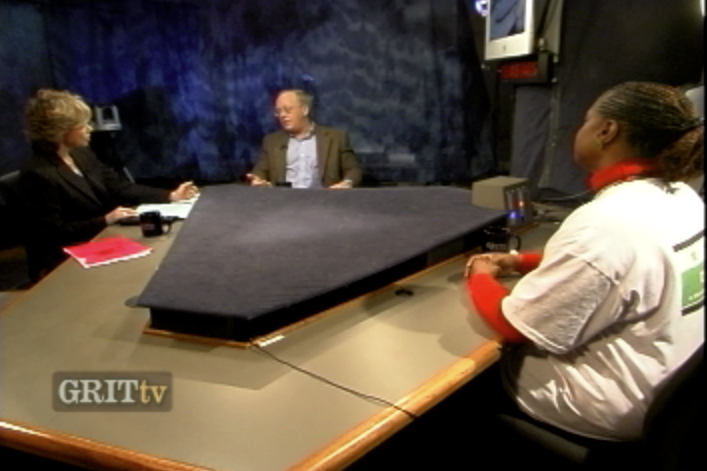
Chris Hedges has an article at Truthdig entitled Is America ‘Yearning for Fascism’? In it, he makes an argument that he’s been making on and off since 2008, which is that the United States is going to go down the same road that Yugoslavia did in the 1990’s. Hedges seems unfazed by the fact that this country is no closer to a civil war today than it was five years ago. The two biggest acts of violence of the last year, the Boston Marathon bombings and the Sandy Hook massacre, were both carried out by isolated misfits not associated with any political group.

One is, in fact, struck by the stability of U.S. society, especially considering the extreme inequality of wealth that exists in this country. The Occupy movement came and went without making even a dent in the status quo. It would perhaps be more useful for Hedges to try to analyze the reasons for this, rather than make dubious apocalyptic predictions.

What is strange about this article, though, is that Hedges suddenly and inexplicably quotes Cynthia McKinney – yes, that Cynthia McKinney, the one who earlier this year claimed that the Boston Marathan bombings were a false flag operation. Why would Hedges, or anyone else for that matter, care what this woman has to say (except perhaps as an example of a particular type of political lunacy)? Hedges writes:

    It is time for us to stop talking about right and left,” McKinney told me. “The old political paradigm that serves the interests of the people who put us in this predicament will not be the paradigm that gets us out of this.

Somebody as historically literate as Hedges must surely know that the claim of going beyond right and left is a common theme in fascist rhetoric. (Yes, I am implying that McKinney is leaning towards fascism. This is someone who repeats Alex Jones nuttery, after all.)

McKinney also says:

    I am a child of the South. Janet Napolitano tells me I need to be afraid of people who are labeled white supremacists but I was raised around white supremacists. I am not afraid of white supremacists. I am concerned about my own government. The Patriot Act did not come from the white supremacists, it came from the White House and Congress. Citizens United did not come from white supremacists, it came from the Supreme Court.

What did come from white supremacists were lynchings, sundown towns, racist police departments, and a black underclass. And McKinney wants to make common cause with these people.

I have always had deeply mixed feelings about Hedges. He sometimes makes good arguments, but there are times when he seems to have drifted off into the ether. (Here is an article in which I write about a talk that Hedges gave in Oakland a few years ago.)

The System is Broken

July 15, 2013

trayvon_martin

We should ask ourselves, as individuals and as a society, how we can prevent future tragedies like this.
– Barack Obama

One way to prevent future tragedies like this is by putting vigilante nutjobs such as George Zimmerman in prison. However, it should be clear by now that the state of Florida was never really serious about doing that. They only brought charges against Zimmerman because of public pressure, then they blew the case against Zimmermann. The state of Florida is perfectly happy to have deranged people with guns killing innocent teenagers, provided that latter have a certain skin color.

It’s worth noting that the prosecutors in the Zimmerman case are also responsible for this travesty:

    Last Friday, Jacksonville mother Marissa Alexander was sentenced by a Florida judge to 20 years in prison for firing what she says was a “warning shot” into the wall after a physical altercation with her husband, Rico Gray.

    The case has set off yet another controversy involving the state’s “stand your ground” law, which is under intense scrutiny after the shooting death of Trayvon Martin in February. Critics, including Congresswoman Corrine Brown (D-Fla.), are crying foul.

    How, they ask, could a 31-year-old woman in a relationship with a man who had a history of domestic violence, and whose actions did not result in any physical injury, be sentenced to two decades in prison while George Zimmerman, the man who shot and killed Martin, is out on bail?

A good question.

The system is broken. It is broken beyond repair.

Edward Abbey

June 3, 2013

abbey

The latest issue of CounterPunch contains an article by Jeffrey St. Clair, in which he expresses his deep indignation that some people have actually dared to criticize something that appeared on his poorly edited and politically confused website. The article is mostly not very interesting, but my curiosity was piqued by the following passage in which St. Clair recounts a conversation he allegedly had with Joshua Frank:

    “Right, right. Are we Trots?”
    “Not that I know of.”
    “Doug Henwood just wrote that we were Edward Abbeyists.”
    “Sounds good to me.”
    “He didn’t mean it as a compliment.”
    “What does he know? He hasn’t left his apartment in the last 12 years.”

I have never met Doug Henwood, but I feel reasonably certain that he does leave his apartment sometimes, if only to buy groceries at the very least. That’s not what concerns me here, however. What interests me is that St. Clair and Frank apparently see themselves as “Edward Abbeyists”. (The correct term is “Abbeyists”. I know, I’m nitpicking.)

Edward Abbey was an American writer and environmentalist. I remember that his writings were very popular during the 1980’s. They influenced the radical environmentalist movement of that period, as well as some anarchists. However, I don’t hear his name mentioned often nowadays. When I lived in Oregon, the anarchists I met there mostly talked about Kropotkin and Bakunin. There may be any number of reasons for this, but I suspect that one of them may be that Abbey sometimes wrote things like this:

    This being so, it occurs to some of us that perhaps evercontinuing [sic] industrial and population growth is not the true road to human happiness, that simple gross quantitative increase of this kind creates only more pain, dislocation, confusion, and misery. In which case it might be wise for us as American citizens to consider calling a halt to the mass influx of even more millions of hungry, ignorant, unskilled, and culturally-morally-genetically impoverished people. At least until we have brought our own affairs into order. Especially when these uninvited millions bring with them an alien mode of life which – let us be honest about this – is not appealing to the majority of Americans. Why not? Because we prefer democratic government, for one thing; because we still hope for an open, spacious, uncrowded, and beautiful–yes, beautiful!–society, for another. The alternative, in [sic] the squalor, cruelty, and corruption of Latin America, is plain for all to see. [Emphasis added.]

This is from an article that Abbey wrote for The New York Times. The Times, which has never been a huge defender of immigrants, refused to publish it.

How did Abbey propose to keep out these “culturally-morally-genetically impoverished” people? He tells us:

    Therefore-let us close our national borders to any further mass immigration, legal or illegal, from any source, as does every other nation on earth. The means are available, it’s a simple technical-military problem. Even our Pentagon should be able to handle it. We’ve got an army somewhere on this planet, let’s bring our soldiers home and station them where they can be of some actual and immediate benefit to the taxpayers who support them.

So, Abbey wanted to militarize the U.S.-Mexican border. Some environmentalist. Few things are more environmentally destructive than an army.

Elsewhere, Abbey wrote:

    Am I a racist? I guess I am. I certainly do not wish to live in a society dominated by blacks, or Mexicans, or Orientals. Look at Africa, at Mexico, at Asia.

One sympathetic article in The New York Times described him as as a “a melancholic naturalist who loved the land but did not care much for Indians, Hispanics or blacks.”

This melancholic naturalist is the man with whom the editors of CounterPunch politically identify.

Interesting.

Mapping Hate

May 17, 2013

1682955-slide-slide-7-hate-map-twitter

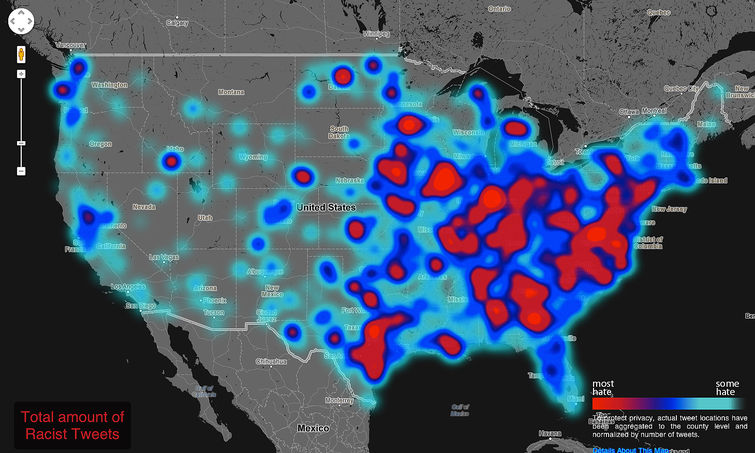
Students at Humboldt State University have put together a map of racist and homophobic tweets that were made between June 2012 and April 2013. They looked at 150,000 tweets in all. You can find the map here. The map indicates tweets that expresses prejudice against blacks, East Asians, and Latinos, as well as prejudice against gays and disabled people.

Some of the results are not surprising. Most of the hateful tweets come from rural areas, and, yeah, more of them come from the southeastern U.S. than the rest of the country. Yet there are also some things that seem odd. For example, there appears to be hotspots of homophobia in southeastern New Mexico, on the Oregon-Washington border, at the southern end of Lake Tahoe, and in a couple of places in eastern Wasington. On the other hand, there are few homophobic tweets from Mormon Utah, except for a place just outside of Salt Lake City. There are hotspots of anti-black racism just north of Sacramento, California and in Twin Falls, Idaho. And there are hotspots of anti-Chinese sentiment in central Virginia and in a couple of places in Minnesota. It’s possible that these anomalies may be due to a few people obsessively tweeting over and over again. I would like to know more about the methodology that was used in making this map.

One thing we learn is that “queer” appears to be a more popular epithet than “fag”. And “wetback” is popular in a couple of parts of Texas, but almost nowhere else. The map also gives the impression that anti-black racism is much more of a problem than anti-Latino racism.

However, the most striking thing about this map is how there are far more hate tweets from the eastern U.S. than from the western U.S. (with the exception of the anomalies I just mentioned). The rate of hate tweeting drops off sharply from central Kansas westwards. I know for a fact that there are a lot of racists and homophobes here in the West, so why this huge difference? Without knowing more about how this map was made, I can only put forward the following theory. There is a common stereotype that people from the East Coast are ruder and more verbally aggressive than people from the West Coast. I know from personal experience that there is some truth to this stereotype. (I have lived in Boston and in New York, two cities where rudeness is almost a way of life. People in L.A. can be rude sometimes, but it’s nothing at all like New York.) Could the corollary of this be that people in western states are less likely to vent their racism on Twitter than people in eastern states? I wonder.

I have some criticisms of the way this map was made. The students sought to measure prejudice against people with disabilities by counting the number of times people used the work “cripple”. This word is tactless and insensitive, but it is not hate speech. And it might have illuminating if these students had looked for derogatory words about Native Americans, Arabs, Jews, South Asians, and Muslims. As it is, this map only gives a partial portrait of the current state of racism in the U.S.

Django Unchained

April 30, 2013

When Django Unchained came out, I heard many negative things about it, so I decided to wait until it came out on DVD. I now regret waiting so long to see it, for I found it thoroughly entertaining. What one has to understand about this movie is that it is not about slavery, it is about Spaghetti Westerns. Tarantino makes movies about movies. This may be incestuous, but nonetheless Tarantino is very good at it.

Django (Jamie Foxx) is rescued from slavers by a bounty hunter named King Schultz (Christoph Waltz). Schultz needs Django to help him identify some wanted men. Schultz eventually takes Django on as his partner. Django persuades Schultz to help him rescue his wife, Hildy (Kerry Washington) from a slave owner, Calvin Candie (Leonardo DaCaprio), whose plantation is called Candieland.

The first half of the film is mostly a typical Western, but when Django and Schultz approach Candie, the film begins to take on a surreal quality. It is as though Django Unchained wants us to see slavery as something unnatural. The film goes too far however, when we learn that Candie’s shuffling slave housekeeper, Stephen (Samuel L Jackson) is the real brains behind Candieland. A common plot device in genre films is to have the character the audience least suspects turn out to be the real villain, but this struck me as a bit much.

The reviews I read gave me the impression that every other line in this film contains the n-word. I was surprised to find that this is not the case. Yes, the n-word is used, but considering the time and place in which the story takes place, no more so than one would expect. What actually did bother me was the use of the n-word in Pulp Fiction, which struck me as gratuitous.

Some dim-witted liberals have criticized this film because of its violence, making the unproven argument that violent movies and TV programs cause people to be violent. Tarantino has rightly rejected these arguments. Japanese pop culture is filled with images of violence, yet Japan has one of the lowest rates of violent crime in the world. How do these liberals explain this? Violence is the result of material conditions in society.

Django Unchained clearly is not a realistic depiction of slavery, but has Hollywood ever tried to portray it realistically? (Gone with the Wind obviously doesn’t qualify.) There have been a number of films that tried to portray the Nazi concentration camps in a realistic manner. (Pontecorvo’s Kapò is one title that comes immediately to mind.) Yet slavery is apparently considered too painful a topic, perhaps because we are still in many ways living with the consequences of that awful institution.

Rehabilitating the Kingfish

March 25, 2013

J+B-164_Huey-Long-the-Kingfisher
Huey P. Long, a.k.a. The Kingfish.

Mike Whitney has posted an article on CounterPunch titled Our Chavez: Huey Long. There seems to be an effort in recent years on the part of some people to to try to portray the sometime governor of Louisiana and U.S.Senator as a great champion of the people, no doubt because of his ant-capitalist rhetoric. Yet when one takes a closer look at his life, it becomes clear that things were not that simple.

During Long’s lifetime, most of the Left regarded him with deep wariness, if not outright hostility. There were good reasons for that. First of all, he governed Louisiana as a virtual dictator. He even organized a secret police force to keep watch on his opponents as well as on his followers.

Long was also a white supremacist. He maintained Louisisana’s Jim Crow laws. (Long would sometimes smear his opponents by spreading rumors that they had “coffee blood”. This gives a bitter irony to calling him “our Chavez”.) Long’s apologists point out that he didn’t talk about white supremacy in his speeches. This was perhaps because he didn’t need to. In 1935, Roy Wilkins interviewed Long for The Criis. They discussed an anti-lynching bill that Long opposed in the Senate:

    How about lynching. Senator? About the Costigan-Wagner bill in congress and that lynching down there yesterday in Franklinton…”

    He ducked the Costigan-Wagner bill, but of course, everyone knows he is aganst it. He cut me off on the Franklinton lynching and hastened in with his “pat” explanation:

    “You mean down in Washington parish (county)? Oh, that? That one slipped up on us. Too bad, but those slips will happen. You know while I was governor there were no lynchings and since this man (Governor Allen) has been in he hasn’t had any. (There have been 7 lynchings in Louisiana in the last two years.) This one slipped up. I can’t do nothing about it. No sir. Can’t do the dead nigra no good. Why, if I tried to go after those lynchers it might cause a hundred more niggers to be killed. You wouldn’t want that, would you?”

    “But you control Louisiana,” I persisted, “you could…”

    “Yeah, but it’s not that simple. I told you there are some things even Huey Long can’t get away with. We’ll just have to watch out for the next one. Anyway that nigger was guilty of coldblooded murder.”

    “But your own supreme court had just granted him a new trial.”

    “Sure we got a law which allows a reversal on technical points. This nigger got hold of a smart lawyer somewhere and proved a technicality. He was guilty as hell. But we’ll catch the next lynching.”

    My guess is that Huey is a hard, ambitious, practical politician. He is far shrewder than he is given credit for being. My further guess is that he wouldn’t hesitate to throw Negroes to the wolves if it became necessary; neither would he hesitate to carry them along if the good they did him was greater than the harm. He will walk a tight rope and go along as far as he can. He told New York newspapermen he welcomed Negroes in the share-the-wealth clubs in the North where they could vote, but down South? Down South they can’t vote: they are no good to him. So he lets them strictly alone. After all, Huey comes first.

In 1934, Long created the Share Our Wealth Society, which had clubs all over the country. He chose as its national organizer Gerald L.K. Smith, an outspoken anti-Semite and a former member of a fascist group called the Silver Shirts. Long also formed a political alliance with the ant-Semitic radio broadcaster, Father Coughlin, who expressed sympathy for Hitler and Mussolini and who claimed that the Russian Revolution was the work of Jewish bankers. Lance Hill has argued that the Share Our Wealth movement was an incipient form of fascism.

According to Wikipedia:

    Long .. planned to challenge Roosevelt for the Democratic nomination in 1936, knowing he would lose the nomination but gain valuable publicity in the process. Then he would break from the Democrats and form a third party using the Share Our Wealth plan as its basis … The new party would run someone else as its 1936 candidate, but Long would be the primary campaigner. This candidate would split the progressive vote with Roosevelt, causing the election of a Republican but proving the electoral appeal of Share Our Wealth. Long would then run for president as a Democrat in 1940. In the spring of 1935, Long undertook a national speaking tour and regular radio appearances, attracting large crowds and increasing his stature.

This scheme came to naught, as Long was assassinated in 1935. The Share Our Wealth movement quickly dwindled after that. The reasons for this may be that the economic recovery of 1934-36 strengthened support for Roosevelt, and that the revitalized labor movement probably drew in people who might otherwise have been attracted to Share Our Wealth.

It is often tempting to idealize figures from the past, yet if we hope to actually learn from them, we have to look at these people for what they actually were.

Gilad Atzmon Knocks Down Straw Men, CounterPunch is Impressed

March 12, 2013

gilad-atzmon

It had been a while since I’d seen anything by Gilad Atzmon in CounterPunch, so I thought maybe they had lost interest in him. Unfortunately, I was wrong about that. On March 8, they posted an article by him entitled Is Palestinian Solidarity an Occupied Zone? It begins:

    Once involved with Palestinian Solidarity you have to accept that Jews are special and so is their suffering; Jews are like no other people, their Holocaust is like no other genocide and anti Semitism, is the most vile form of racism the world has ever known and so on and so forth.

Atzmon doesn’t name anyone who says this. I don’t know of anyone in the Palestinian solidarity movement who says such things. Atzmon continues:

    But when it comes to the Palestinians, the exact opposite is the case. For some reason we are expected to believe that the Palestinians are not special at all – they are just like everyone else. Palestinians have not been subject to a unique, racist, nationalist and expansionist Jewish nationalist movement, instead, we must all agree that, just like the Indians and the Africans, the Palestinian ordeal results from run-of-the-mill 19th century colonialism – just more of the same old boring Apartheid.

Again, Atzmon doesn’t identify who is saying these things. No doubt, this is because he can’t. I think I should point out that here in the U.S., simply using the word “apartheid” in connection with Israel can get one in a lot of hot water. Doing such a thing requires a certain amount of courage.

From this, Atzmon segues into an aesthetic criticism of the Palestinian Solidarity movement:

    Can you think of any other liberation or solidarity movement that prides itself in being boring, ordinary and dull?

I have met a number of people in the Palestinian solidarity movement, and they are among the least boring people I have ever met. One must admit here that Atzmon is not boring himself. Unfortunately, that is the only thing one can say for him.

    Palestinian Solidarity is an occupied zone and, like all such occupied zones must dedicate itself to the fight against ‘anti Semitism’.

Ah, now we see what’s really bugging Atzmon. It seems that his tender feelings have been hurt by all those people who have called him an anti-Semite. Of course, that does tend to happen when you say things that are anti-Semitic. Life can be funny sometimes.

Atzmon then delivers his knock-out punch:

    Dutifully united against racism, fully engaged with LGBT issues in Palestine and in the movement itself, but for one reason or another, the movement is almost indifferent towards the fate of millions of Palestinians living in refugee camps and their Right of Return to their homeland.

That’s right! All those people who have dedicated their lives to the Palestinian struggle – sometimes at great personal cost – have done so because they basically don’t give a shit about the Palestinians!

What a brilliant insight!

Why the hell do the editors of CounterPunch insult the intelligence of their readers by posting such gobbledegook? I am at a a complete loss to try to explain this.

As for Atzmon, I can’t see why he’s being so petulant. Things are actually looking up for him. At a special conference held by the Socialist Workers Party of Britain this past weekend, the leadership defeated motions put forward by the opposition, causing many of the latter to resign. This means that Atzmon’s good buddy, Martin Smith will soon be back on the SWP’s Central Committee, and they will soon be again sponsoring concerts featuring Atzmon playing the saxophone in front of empty seats. Good times!

The Legend of Bhagat Singh

January 13, 2013

Bhagatsinghlegend

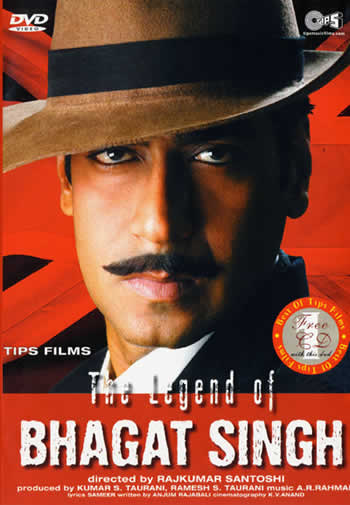
After reading my review of The Baader Meinhof Complex, a friend of mine recommended that I watch the 2002 Indian film, The Legend of Bhagat Singh, which also touches upon the question of what tactics should be used in the struggle against injustice. Although Bhagat Singh (1907-1931) is little known in the U.S., he is famous in India for his role in the Indian independence movement. He rejected Gandhi’s notion of non-violent resistance. He was a founding member of the Hindustan Socialist Republican Association, which sought to organize a mass uprising against the British. When the Indian writer, Lala Lajpat Rai, died after being beaten by the police, Singh and his comrades killed a British police officer in revenge. Later, they threw bombs in the Indian National Assembly, with the intent of getting themselves arrested. Singh hoped that his speeches at the trial would inspire the Indian people to rise up against their colonizers. His trial received considerable attention, and for a time he became as popular as Gandhi. However, this did not stop the British from executing him.

This film shows Gandhi in an unflattering light. It accuses him of dropping his demand that the Viceroy commute Singh’s death sentence so that he could get a political pact with the British granting limited rights to Indians. Given all the adulation given to Gandhi in both India and the West, it’s interesting to see a film that portrays him in a negative manner. In effect, it accuses him of being willing to sacrifice principle in order to get an agreement with the British.

The director, Rajkumar Santoshi, paints the story of Singh’s life in broad strokes. He doesn’t spend much time on character development. Singh (Ajay Devgan) appears fearless and wise almost from the time of his birth. And in true Bollywood fashion, there are musical numbers. Singh sings. He sings (twice) while he is on a hunger strike, and he sings while he is going to his execution. The Legend of Bhagat Singh emphasizes Singh’s advocacy of Hindu-Muslim reconciliation. (Singh came from a Sikh family, but he became an atheist at an early age.) Santoshi clearly wanted to remind his fellow Indians of Singh’s politics, which are more relevant than ever with the sectarian violence that has sometimes taken place in that country in recent years. No doubt Santoshi thought that following the conventions of Bollywood would give the film more appeal, although I’m told that it actually did not do well at the box office. In all honesty, I could have done without the singing, but I found this a compelling film nonetheless.