Archive for the ‘Religion’ Category

Jean Bricmont and Gilad Atzmon

October 3, 2012


Gilad Atzmon

Jean Bricmont has written an article defending Gilad Atzmon from his numerous critics on the Left, who accuse him of, among other things, being an anti-Semite. (Personal disclosure: I am one of them.) You can read the complete article here. (This links to Atzmon’s website. If you are unfamiliar with his work, you will be amazed at some of the things you will find there.) The first thing one notices about this piece is that it is extremely long-winded. You could cut out at least half the verbiage in it, and it would say the same exact thing. I consider that to be bad writing (although I realize some may not agree with me about this). I find this disheartening. I have always liked to think that theoretical physicists must also be good writers. Einstein wrote well. Carl Sagan could express himself clearly and succinctly. Yet another one of my illusions in life has been shattered.

After nine mostly long paragraphs, Bricmont finally gets to his main argument:

    This movement often gives the impression that its “solidarity” with Palestine takes place above all over there and requires more and more missions, trips, dialogues, reports, and even sometimes “peace processes.” But the plain facts of the matter are that the Israelis do not want to make the concessions that would be needed to live in peace and that a main reason for that attitude is that they think they can enjoy Western support ad vitam aeternam. Therefore, it is precisely this support that the solidarity movement should attack as its priority. Another frequent error is to think that this support is due to economic or strategic considerations. But, at least today, Israel is of no use to Western interests. [This is plainly false.] It turns the Muslim world against us [this is only partly true], doesn’t bring in a single drop of oil [man does not live by oil alone, Prof. Bricmont], and pushes the United States into a war with Iran that the Americans clearly don’t want [some, such as Norman Finkelstein, have argued that Israel is bluffing about this]. The reasons for this support are obvious enough: constant pressure from Zionist organizations on intellectuals, journalists and politicians by endlessly manipulating the accusation of anti-Semitism and the climate of guilt and repentance (for the Holocaust) kept on artificial life support, in large part by those same organizations. As a result, the main task of the Palestine solidarity movement should be to allow free speech about Palestine, but also to denounce the pressure and intimidation by various lobbies. Which is what Atzmon does. Far from rejecting him, the solidarity movement should make it a priority to defend the possibility of reading and listening to him, even if one is not in total agreement with what he says.

Look, so far as I and other leftists are concerned, Atzmon can write whatever bullshit that happens to float his boat. All we’re asking is that we at least acknowledge that what Atzmon writes is bullshit. Bricmont’s unwillingness to admit this raises serious questions about his intellectual honesty. Moreover, Bricmont makes so many dubious assertions here, that one must wonder whether he actually has any idea what he’s talking about. I think I should also point out that the “Israel is useless to the West” argument is often made by right-wing critics of Israel, at least some of whom are almost certainly anti-Semites. That fact should give Bricmont pause.

    By his all-out attack on Jewish “tribalism,” Atzmon’s essential contribution to solidarity with Palestine is to help non-Jews realize that they are not always in the wrong when conflicts with Jewish organizations arise. The day when non-Jews free themselves from the mixture of fear and internalization of guilt that currently paralyses them, unconditional support for Israel will collapse.

If I may speak for my fellow non-Jews, I don’t feel one shred of guilt about what happened during the years 1933-45. Again, one has to wonder whether Bricmont has any idea what he is talking about. What’s more, the second sentence is obviously nonsense. Bricmont apparently considers it a matter of principle to ignore the political and economic forces that drive the West’s support for Israel.

In all fairness to Bricmont, I should point out that he seems to be partly motivated by concerns about laws recently passed in France that prohibit certain types of speech. Although I don’t pretend to be an expert on French politics, it seems to me that the problem there is that France has no equivalent of the First Amendment to the United States Constitution, which guarantees freedom of speech. (This is a problem in many other countries as well.) I realize that this argument may be too idealist, but I think there is at least some truth to it.

With all due respect, perhaps Bricmont should stick to particle physics. There is no shame in that.


The Master

October 1, 2012

Scientology was a logical product of post-World War II America. In a society flush with an extraordinary military victory and enjoying an unprecedented economic prosperity, it seemed inconceivable to anyone that there could be any excuse for not being prosperous and happy. It was not unreasonable then for people to look for the solutions to their problems inside themselves. Psychoanalysis enjoyed its greatest popularity in the U.S. during this period. Scientology, with its roots in pulp fiction (Hubbard was sometimes called the “King of the Pulps”), was a sort of pop culture Freudianism, albeit with religious overtones that were understandable to Americans who had been exposed to evangelical Christianity.

Paul Thomas Anderson’s new film has a character who is obviously modeled after L. Ron Hubbard, although Anderson insists that the film is not actually about Scientology. Fred Qwell (Joaquin Phoezix) is a World War II veteran who suffers from Post-Traumatic Stress Disorder. (In those days, it was called “combat fatigue”.) He is severely alcoholic, and he is unable to hold down a job. One night, hungry and desperate, he stows away aboard a yacht on which a party is taking place. When people on the yacht discover him, they treat him kindly. They take him to the yacht’s “commander”, Lancaster Dodd (Philip Seymour Hoffman). Dodd takes a liking to Qwell, and he begins to treat Qwell as though he were another one of his guests. We learn that Dodd is the leader of a movement known as The Cause. He has developed a form of analysis that he believes can make people achieve happiness and ultimately solve all of mankind’s problems It becomes clear to the viewer that Dodd is suffering from megalomania, but Qwell finds him charming, likable, and impressive. Dodd uses Qwell as a test-subject for his theories. Qwell develops a strong emotional attachment to Dodd, so much so that he sometimes physically assaults people who criticize “The Master”. The film subtly suggests that Dodd, for his part, develops a psychic dependence on the fiercely loyal Qwell.

When I went to see The Master, I was under the impression that it was going to be mainly about Dodd. The advertising seems to indicate that. In fact, it turns out to be essentially about Qwell and his efforts to make sense out of the world. I’m afraid some people may find it disappointing for that reason. However, I found it fascinating to watch and emotionally compelling. Hoffman’s performance is amazing. This is the best American film I have seen so far this year.

Dr. Ismail Salami and the “Clash of Cultures”

September 26, 2012


Ismail Salami, Shakespearean scholar, author of children’s books, spouter of gibberish.

Dissident Voice has recently posted this cracking good article by Ismail Salami, entitled West Braces for Clash of Cultures. (No one I know is bracing for a clash of cultures, but then maybe I just don’t move through the right social circles.) The article begins:

    With the publication of the profane pictures of the holy Prophet of Islam in Charlie Hebdo magazine, the West seems to be consciously moving in a direction where chaos will dominate the international arena and a clash of cultures will inevitably run deeper for an indefinite period of time.

A literary agent once said to me, “You’ve got to grab the reader by the throat and lift him out of his chair.” Dr. Salami (I’m trying hard not to go for the obvious joke here) has clearly accomplished this with this extraordinary paragraph/run-on sentence. But what exactly does it mean? In the first half, he seems to suggest that Charlie Hebdo is published by somebody named “the West”. In the second half, he seems to be saying that a “clash of cultures” will “run deeper” (like a submarine?).

Clearly, Salami is a master of the Nietzschean aphoristic syle. However, he can be shockingly blunt when he puts his mind to it:

    There are abortive attempts by western analysts to interpret the two baneful incidents in the light of freedom of expression and thereby explain away the emotional hurt of the Muslim world.

That’s right, 1.6 billion Muslims will not be able to sleep tonight because of some cartoons in an obscure left-wing newspaper in France. If you believe that, I’ve got some property in Florida I’d like to sell you.

    However, to an intellectually trained mind, this seems more than just an insult to Islam and the Muslims.

Of course, those of us without intellectually trained minds just have no idea what the fuck is going on, do we? (By the way, someone needs to explain to Dr. Salami that “intellectually trained mind” is redundant.)

    The calculated move of the French magazine [sic] in publishing the insulting cartoons immediately after the blasphemous film indicates a united front forming against Islam in the West.

Damn right. As soon as the right-wing Christian producers of Innocence of Muslims had finished filming, they immediately called up their left-wing atheist comrades in France and said, “It’s your turn, bros!” Tag team style.

    On the one hand, the move can be seen as an attempt to help escalate the crisis in the Middle East region and on the other hand to plunge the world into a vortex where a clash of civilizations is imminent.

“… plunge the world into a vortex where a clash of civilizations is imminent.” This may not be worthy of Shakespeare, but it’s almost worthy of H.P. Lovecraft.

    Should we naively believe that the anti-Islam film which has caused much uproar and intellectual chagrin in the Muslim world is the work of a Coptic Christian Egyptian fraudster, a small-time porn director and a bunch of extremists who harbor deep hatred against Islam?

Uh… yes? Is this some sort of trick question?

    This is a good question and it deserves an answer.

As my Aunt Bea used to say, “Every good question deserves an answer.”

    Still, the answer seems to be found in the incident which followed the film i.e. the publication of the blasphemous cartoons.

Uh… what?

    Seen from an analytical point of view, the entire scenario apparently tilts the scale in favor of the Zionists who capitalize on a large-scale fracas between the Muslim countries and the rest of the world. In fact, they are the ones who will catch the bigger fish in these trouble waters.

Bigger than whose fish?

    Amidst this craftily authored plan [yeah it’s fucking brilliant, isn’t it?], Israel has commenced a series of war games in Golan Heights, the biggest the Israeli Defense Force (IDF) has conducted in the six years since the second Lebanon war on Hezbollah in 2006. Military sources say the war game looks like a real war with tens of thousands of soldiers and senior officers, including the artillery and the air force taking part. Israeli officials have announced that the situation in Syria is precariously volatile and that the country is in possession of a huge arsenal of chemical weapons which they fear might fall into the hands of wrong people stockpile if President Bashar Assad is ousted. This is the excuse which they use to justify their military show-off. In point of fact, Israel is readying itself to wage a military encounter in the region by using the anti-Islam scenario.

Perhaps I’m nitpicking, but the last two sentences seem to contradict each other. If Israel can use an alleged chemical weapons stockpile as an excuse to intervene in Syria, why would they need to use “the anti-Islam scenario” (whatever that is)? (By the way, the Israelis have never needed an excuse to do anything.)

One can clearly see why the editors of Dissident Voice thought this article was worth posting. What better way to understand what is currently happening in the Muslim world than by reading gibberish?

I feel inspired to write my own article for Dissident Voice. It will be a learned dissertation on why the sea is boiling hot and why pigs have wings.

Watch for it.

Random Thoughts on the Current Troubles

September 15, 2012

The growing inter-connectedness of the world does not always redound to our advantage. Case in point: a cheesy movie made in a strip mall in Monrovia, California, causes riots and the deaths of four people on the other side of the world. We are living in the Global Village, and just as Marshall McLuhan warned, it is filled with “panic terrors, exactly befitting a small world of tribal drums, total interdependence, and superimposed co-existence.” Fear increasingly becomes people’s normal state of existence, because they are increasingly bombarded with ideas and facts that they don’t understand or only partially understand.

Reading the comments on threads on other sites, I am struck by how many people have no desire to try to understand what is happening. We have an amazing informational tool in the form of the Internet, yet some people would prefer to use it for spewing hate and parading their ignorance. Sad.

Nakoula Basseley Nakoula, alias “Sam Bacile” is the auteur responsible for that blood and sand epic, Desert Warrior Innocence of Muslims. Nakoula is a Coptic Christian from Egypt, yet he told the Wall Street Journal that he is an Israeli and that the film was funded by Jewish donors. The kindest thing one cam assume here is that Nakoula wanted to prevent any blame for the film being placed on Egypt’s Coptic community, yet there is something sinister about the fact that Nakoula invented a story about non-existent Jewish donors. One has to question what game Nakoula is really trying to play.

The cast and crew of the film say they were duped, and I believe them. The 14-minuste clip on Youtube is heavily (and badly) dubbed. These people will be haunted by this for the rest of their lives. They were used by Nakoula, Steve Klein, Terry Jones and other right-wing Christians to advance their twisted political agenda.

Sun Myung Moon (1920-2012)

September 3, 2012

Sun Myung Moon was one of the greatest entrepreneurial geniuses of the twentieth century. Like L. Ron Hubbard, he grasped the essential truth that religion is a business. You promise salvation to people, and they pay you money for it. (Salvation is a special kind of commodity. Although it has no form or substance, it is nonetheless fungible.) His Unification Church is quite the corporate conglomerate. According to the Associated Press:

    The church’s holdings included the Washington Times newspaper; Connecticut’s Bridgeport University; the New Yorker Hotel, a midtown Manhattan art deco landmark, and a seafood distribution firm that supplies sushi to Japanese restaurants across the U.S. It acquired a ski resort, a professional football team and other businesses in South Korea. It also operates a foreign-owned luxury hotel in North Korea and jointly operates a fledgling North Korean automaker.

All in all, Moon didn’t do badly for a man who was sent to complete Christ’s work on Earth.

In 1991, Moon traveled to North Korea to meet with Kim Il Sung, who was himself a messiah of sorts. The two of them got along famously, no doubt because they had so much in common. Imagine Jesus and Mohammed meeting at a barbecue and talking shop. It must have been something like that.

When I was young, I attended a college in Boston. The place was lousy with Moonies. They had an office across the street from the campus. They were always trying to recruit people. One day, while I was sitting in the cafeteria eating lunch, a young East Asian man came up to me and started giving me the Moonie spiel. He talked about how corrupt our society is and how we need to do something about it. I finally got irritated, and I said to him, “If that’s the way you feel, why don’t you go back to your own country.” That was not a good thing to say, I admit. The guy had a humorless, monomaniacal air about him. Later on in my life, I would meet members of sectarian left groups who had that same quality about them.

Still, I would argue that Moon didn’t do nearly as much harm as Mitt Romney and his Bain Capital did. The worst that Moon did was make people take part in mass weddings that everyone else thought were creepy. I know a guy whose parents were married in one of these ceremonies, and he seems pretty normal. (Well, to me, any way.) Whereas Bain put people out of work and destroyed whole communities.

Mad Russians and the American Left

August 31, 2012


Soon to be a contributor to CounterPunch and Dissident Voice.

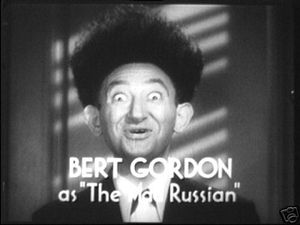
Back in the 1930’s, there was a radio comedian named Bert Gordon, who was billed as the Mad Russian. His tagline was “How do you dooo!”, which you can hear in some Warner Brothers cartoons from that period. Gordon was enormously popular in his time, but, alas, he is largely forgotten today. Yet, the spirit of the Mad Russian lives on at some left-wing websites. At CounterPunch, Israel Shamir has become their resident authority on Russia, the Dreyfus Affair, and conspiracy theories.

Not to be outdone, CP’s rival, Dissident Voice, have their own mad Russian, Andre Fomine. His latest article is entitled Pussy Riot, the CIA, and Cultural Terrorism. In this article, we learn the shocking truth about Pussy Riot:

    No doubt it was not a single spontaneous act by a group of dissolute individuals but an episode of a much wider global campaign to shake and eventually ruin traditional societies and institutions. It is being carried out by the same powerful circles which inspired — e.g. offensive caricatures of Prophet Muhammad in a Danish newspaper in 2005.

Oh, my. From Pussy Riot to Danish cartoons. Who could possibly be behind this fiendish global conspiracy? Need you ask?

    It is an open secret that avant-gardism became popular in the West in 1950-1960s thanks to unprecedented support from the CIA and was used by the United States as a powerful ideological weapon.

The CIA. Why, of course! Aren’t they behind everything?

Fomine ends his article with a dire warning: “The puppeteers of Modern Art and Cultural Terrorism keep carrying out their mission.” [Emphasis in the original.]

Modern Art! Run! Flee! Hide!

In another article, entitled The Last Victory of Muammar Gaddafi, Fomine exposes the sordid truth behind the “Arab Spring”:

    First, there was nothing spontaneous in the wave of 2011 North Africa and Middle East revolutions. The popular unrests in Tunisia, Egypt, Libya, Bahrain, etc were carefully prepared, organized, financed and supported through international media. Quite surprisingly, Al-Jazeera played a critically important role in fueling the conflicts within Arabic societies spreading disinformation and blocking truthful and sober voices.

The media did it! And, as we all know, media = CIA. Fomine, however, ends his article on a cheerful note:

    Thus we are entering very interesting, perhaps decisive times. Muammar Gaddafi has won his last battle despite eluding vigor and insolent pressure from everywhere. Will there be any new Gaddafis born by Muslim mothers to resist the new world order? We hope and pray for that.

More Gaddafis! That’s exactly what we need! The comments on the thread for this article were adulatory. (“Excellent article. I am glad that the author had the courage to write it.” I’m not sure that “courage” is the right word.) When one commenter was churlish enough to point out that Fomine offers no evidence to support his claim about the Arab revolutions, he was promptly smacked down by another commenter who wrote:

    How do you expect the writer can supply you with what you call proof?!
    Do you expect him to hack computers or bulglarise certain offices and displays the documents here for you to see??!! Is that make sense?!
    There is something called commonsense combined with knowledge of history, precedents and good analytical ability!

Yeah, who needs evidence?

As you can imagine, I wanted to learn more about this truly original thinker, Andre Fomine. I found out that he edits a web journal called Oriental Review. There, you can find excerpts from a book by Nikolay Starikov entitled Who Made Hitler Attack Stalin. The latest installment is titled Leon Trotsky, Father of German Nazism. Lest you think that this title is meant as a joke, here is how the article begins:

    Who organized the February and October revolutions in Russia and the November revolution in Germany? The Russian and German revolutions were organized by British intelligence, with the possible support of the United States and France.

That’s right, British intelligence must have engineered the Russian Revolution, since it was a strategic defeat for the British empire. This is common sense. Displaying his extraordinary narrative skill, Starikov tells us:

    Dropped into Russia by British intelligence, thanks to a secret agreement with German secret services aboard the “closed wagon,” the Bolsheviks refused to leave the political scene.

That’s right, the Bolsheviks (all of them) were parachuted into Russia inside a sealed train car. (It must have been awfully uncomfortable, but they were willing to endure anything for the revolution.) Later, we learn:

    The main funding supplied to the Russian Revolution from American bankers was transferred through accounts in neutral Sweden and briefcases of inconspicuous figures stealthily entering the country.

Because there’s nothing bankers love more than a government that’s dedicated to abolishing capitalism.

Just by clinking on certain links on the Dissident Voice website, you can find this treasure trove of occult knowledge.

How do you dooo!

Israel Shamir and CounterPunch

August 25, 2012

Why does CounterPunch, which is ostensibly a left-wing website, continue to post articles by the neo-fascist nutjob, Israel Shamir? You only have to read Shamir’s website to see that the guy is crazy. Yet he is apparently not too crazy to be published by CounterPunch.

CounterPunch has just posted an article by Shamir entitled The Secret History of Pussy Riot. In it, he repeatedly refers to the members of the band by the misogynist term, “viragos”. This fact alone should have been sufficient reason to reject the article. Alas, it’s actually even worse than that. Shamir argues that the Putin government was right to send these women to prison for merely expressing their opinions. He writes:

    Two years’ sentence is quite in line with prevailing European practice. For much milder anti-Jewish hate talk, European countries customarily sentence offenders to two-to-five years of prison for the first offence. The Russians applied hate crime laws to offenders against Christian faith, and this is probably a Russian novelty. The Russians proved that they care for Christ as much as the French care for Auschwitz, and this shocked the Europeans who apparently thought ‘hate laws’ may be applied only to protect Jews and gays. The Western governments call for more freedom for the anti-Christian Russians, while denying it for holocaust revisionists in their midst.

Why does CounterPunch insult its readers by posting this garbage? The kindest thing one can assume here is that they didn’t bother to read this article.

Shamir has ties to the Lukaschenko dictatorship in Belarus. When David Irving was sentenced to prison for Holocaust deanial, Shamir wrote:

    Thus we should say: David Irving was sentenced for denial of Jewish superiority. His doom seals the reign of (albeit limited) freedom that began with the fall of Bastille. European history went full circle: from rejecting the rule of Church and embracing free thought, to the new Jewish mind-control on a world scale. Not only is Western Christian civilisation dead, but even its successor, secular European civilisation, has met its demise only a few days after its proud and last celebration by the Danish scribes. It was short-lived: about two hundred years from beginning to the end, the Europeans may once have had the illusion that they can live without an ideological supremacy. Now this illusion is over; and the Jews came in the stead of the old and tired See of St Peter to rule over the minds and souls of Europeans.

This is anti-Semitism, plain and simple. The Breivik shootings in Norway have shown that fascism is still a force to be reckoned with. Yet the editors of CounterPunch apparently think it is all a joke.

The Campaign

August 21, 2012

In a post earlier this year, I deplored the dearth of good movie comedies in recent years. It seems I spoke too soon, for I’ve seen four good comedies this year: Damsels in Distress, Moonrise Kingdom, Bernie, and now The Campaign. Although broad in its humor, this film is nevertheless a shrewd satire of the corruption and moral hypocrisy that pervade our political system.

Cam Brady (Will Ferrell), a priapic Democratic congressman from North Carolina, is running unopposed for re-election, until he comes into the cross-hairs of the billionaire Motch brothers (Dan Ackroyd and John Lithgow), whose factories in China employ child labor. They want to open up similar factories in Brady’s congressional district. To this end, they persuade Marty Huggins (Zach Galifianakis), the well-intentioned, but not terribly bright, scion of a wealthy family, to run against Brady as a Republican. When Brady humiliates Huggins in their first debate, the Motches decide to bring in Tim Wattley (Dylan McDermott), an unprincipled political operator, to run Huggins’s campaign. Under Wattley’s tutelage, Huggins becomes an increasingly ruthless campaigner. Soon he and Brady are in a tight race.

The Campaign accurately parodies the shallow rhetoric of election campaigns in this country, including pandering to religious prejudice, spouting about “family values”, and making cheap appeals to patriotism. This movie’s cynicism, however, goes overboard sometimes. When, for example, Brady releases a video of himself having sex with Huggins’s wife, Mitzi (Sarah Baker), it causes Brady to pull ahead of Huggins in the polls. Would this happen in real life? Obviously not.

This film has a happy ending that seems tacked on and unconvincing. It seems that that the screenwriters, Chris Henchy and Shawn Harwell, and the director, Jay Roach, wanted to reassure us that “the system works”, despite having just demonstrated that the system does not work. Still, this movie will provide a welcome relief to those who are weary of this interminable and depressing presidential election.

We Have a Pope

June 27, 2012

Although I am not a Catholic, I have always felt a peculiar connection to the Catholic Church. My father came from a family of devout Catholics. My great-father reportedly came to this country to escape the kulturkampf, Bismarck’s campaign to suppress the power of the Catholic Church in Germany. (Since my great-grandfather was a coal miner, it’s not clear to me why this would have affected him. I will have to do more research on this.) My father was sent to a Catholic school, an experience that had the happy effect of making him into an atheist. What’s more, most of my friends were raised as Catholics, and the ones who aren’t traumatized still go to mass occasionally. Oh, and I once played a priest in a school play.

So, I was naturally interested in seeing Nanni Moretti’s latest film, We Have a Pope. I didn’t know whether this film would be a satire of the Church or simply a “feel good” comedy in priestly drag. Strange to say, it turns out to be neither.

The College of Cardinals has gathered to choose a new Pope. After several inconclusive ballots, they elect the unassuming Cardinal Melville (Michel Piccoli) as the new pontiff. Just before he is to be presented to the crowd in St. Peter’s square, however, he suffers a panic attack that turns into a nervous breakdown. He tells the Cardinals that the burden of the papacy would be too much for him. (Could it really be that much of a burden? Basically all the Pope has to do is make speeches denouncing contraception.) Out of desperation, the cardinals bring in a psychoanalyst, Brezzi, (Nanni Moretti) to examine Melville. Their sessions get nowhere. Brezzi mentions that his wife, (Margherita Buy), is also a therapist. Melville persuades the Vatican press agent (Jerzy Stuhr) to take him in disguise to see this woman. On their way back, Melville manages to run away. Melville wanders around Rome. He eventually falls in with a troupe of actors who are putting on a production of Chekhov’s The Seagull. Meanwhile, the cardinals are stuck at the Vatican, because, according to tradition, they cannot leave the conclave until the new Pope has been announced. To pass the time, Brezzi organizes a volleyball tournament.

The main problem with We Have a Pope is that it’s never made clear why Melville is so afraid of becoming Pope. He merely mumbles vague statements about how he is not worthy of the position. The closest we get to an explanation is when he tells Brezzi’s wife that he once wanted to be an actor. But wouldn’t that make the papacy attractive to him? After all, church ceremonies are basically a form of theater.

There are a few funny moments, but not enough for this film to qualify as a comedy. The ending is inexplicably melodramatic. From a balcony, Melville tells a huge crowd in St. Peter’s square that he cannot be Pope. He then goes inside and the screen goes black. It’s not clear what exactly Moretti is trying to say about the Catholic Church. Moretti has said about this film: “I wanted to depict a fragile man, Cardinal Melville, who feels inadequate in the face of power and the role he’s called to fill … I think this feeling of inadequacy happens to all cardinals elected Pope, or at least that’s what they say.” Unfortunately, Moretti is unable to show why we should care about this.

The Way

December 5, 2011

The Way is a film starring Martin Sheen, written and directed by his son, Emilio Estevez. Thomas Avery (Sheen) learns that his son, Daniel (Estevez), has died in France. He goes to retrieve his son’s remains. There, he learns that Daniel died in a freak storm while trying to cross the Pyrenees as part of the Camino de Santiago, a centuries-old pilgrimage route through northern Spain. It ends at the Cathedral of Santiago de Compostela, which purportedly contains the remains of St. James. While examining his son’s backpack, Thomas is suddenly seized with the idea of walking the route himself while carrying his son’s ashes. He embarks on the journey. Right away he meets a group of eccentric characters: a Dutch gourmand, Joost (Yorick van Wageningen), an angry Canadian who smokes a lot named Sarah (Deborah Kara Unger), and an annoying Irish writer named Jack (James Nesbitt). The film alternates between scenes of the characters engaging in not quite convincing dialogue and scenes of them walking through the Basque and Spanish countryside with obtrusive pop music blaring away on the soundtrack. (I thought the purpose of going on a pilgrimage was to get away from this sort of thing. I guess not.)

Just as you expect, the characters evolve over time. Thomas becomes less of a dick, Joost becomes less of a hedonist, Sarah becomes less angry and Jack becomes less annoying. Yes, this film will uncomfortably remind you of The Wizard of Oz (which is intentional, by the way), except that in this case the man behind the curtain is never revealed. When the group arrive at the Cathedral of Santiago de Compostela, Thomas kneels in front of a silver casket that may or may not contain the remains of St. James. He and the others then look on in awe as a large, porous metal container full of incense is swung back and forth. The significance of this is never explained. Indeed, the significance of the Camino de Santiago is never really explained, except that it is good exercise for people who can afford expensive backpacks, as well as a plane ticket to France.

This film does touch upon issues such as Basque nationalism and prejudice against the Roma. And it does contain breathtaking shots of the Basque and Spanish countryside. All in all, though, I found this movie less interesting than one of those travel documentaries on PBS.