Archive for the ‘Religion’ Category

How the Fire Fell

October 15, 2011

In 1902, a man named Edmund Creffield showed up in Corvallis, Oregon. He began to preach a militantly fundamentalist form of Christianity. He quickly attracted a small, but intensely devoted group of followers, most of them women. He named his sect the “Bride of Christ Church”. Rumors started to circulate that Creffield was having sex with his female followers. Creffield eventually announced that Esther Mitchell, who came from one of Corvallis’s most respected families, would become the “Second Mother of Christ”. To make a long story short, Esther’s brother, George, shot Creffield in the back of the head while the latter was walking down a street in Seattle. Although there was no doubt as to whether he did the killing, a jury found George Mitchell not guilty. (This was clearly a case of an “honor killing”.) Later, as George was boarding a train, Esther shot him in the back of the head, exactly as he had shot Creffield.

This story is true. You can read about it here. You can find a more colorful telling here.


Edmund Creffield, while he was serving a prison sentence for adultery.

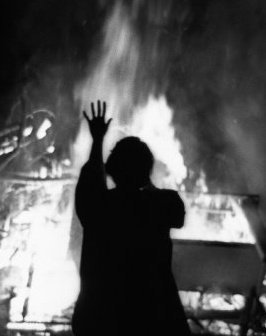
The Portland-based filmmaker, Edward P. Davee, has written and directed a film based on these events, How the Fire Fell. The film is in black & white, and much of it was shot in Corvallis. There is not much dialogue, although there are numerous scenes of Creffield (Joe Haege) preaching. The film is atmospheric, with lingering shots of forests, fields, and people lost in thought. Some of the imagery is clearly meant to be symbolic. In one scene, for example, while Creffield is preaching to his flock, there is a cutaway shot to flies caught in a spider’s web. Haege is quite good as Creffield. Davee was clearly limited by a very low budget in what he could do, but nevertheless there are some powerful scenes.

I found this film fascinating to watch, though I wish I could have learned more about the characters. Why were they so attracted to Creffield? At the screening I attended, there was a question-and-answer session with Davee and with the film’s director of photography, Scott Ballard. Davee said he wanted to “keep a sense of mystery alive” about the Creffield story. He also said he preferred to tell stories using images rather than dialogue. He expressed no strong feelings either for or against religion. (He said that some of the actors in the film are devout Christians.) Davee did say he found it disturbing that people could blindly follow a leader.

As I watched How the Fire Fell, I was reminded of the undertone of eroticism in many of the practices of evangelical Christian groups. (I remember H.L. Mencken commenting about this in one of his articles.) It may be that Creffield simply crossed a line that other evangelicals (apparently) do not cross.

How the Fire Fell has had a very limited release, mainly being shown at film festivals and at scattered venues in the Pacific Northwest. Let us hope that this film gets the wider audience it deserves.

You can find a trailer for the film here.
Of Gods and Men

April 10, 2011

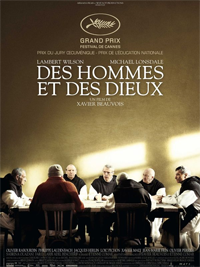
Of Gods and Men, a French film directed by Xavier Beauvois, is based on a real incident. It tells the story of a group of Trappist monks living in a monastery in the Atlas mountains during the Algerian Civil War of the 1990’s. The leader of the monks is Christian (Lambert Wilson). One of the monks, Luc (Michael Lonsdale), is trained as a doctor. He provides treatment for people from the nearby impoverished village. They learn that Islamist rebels have been targeting foreigners. An official urges the monks to return to France, because the government cannot guarantee their safety, but the monks refuse. Luc treats the wounds of one of the rebels. After that, the government suspects the monks of providing aid to the rebels. (In one scene, we see the look of disgust on an officer’s face when he sees Christian praying over the dead body of a rebel.) The monks try to maintain the routines of their existence, despite the pressures on them.

The film mostly depicts the daily lives of the monks. We see their rituals, their prayers, their chores, their dealings with the villagers. The slow pacing of this film may test some people’s patience, but Beauvois wants us to get a sense of how these monks experience time. They grapple with the question of whether they should stay or leave. Although they are afraid, they feel obligated to remain. They have completely committed themselves to their way of life.

In the film’s last scene, we see seven of the monks being led away by the rebels. In the end, faith, duty and honor are not enough to protect us in this world.

Enter the Void

January 13, 2011

Enter the Void is a film by the French director, Gaspar Noé. It tells the story of Oscar (Nathaniel Brown), an American drug dealer who lives in Tokyo with his sister, Linda (Paz de la Huerta), who works as a stripper. At the urging of his friend, Alex (Cyril Roy), Oscar has been reading The Tibetan Book of the Dead. During a police raid, Oscar is shot to death. (It appears that Japanese cops are every bit as trigger-happy as American cops.) We then see things from the perspective of Oscar’s soul floating above the city. He observes Linda and Alex and other people he knows. He also relives experiences from his past, observing himself from behind his shoulder. Noé has said that the film should be viewed as a dream rather than a depiction of life after death: “the whole movie is a dream of someone who read The Tibetan Book of the Dead, and heard about it before being [shot by a gun]. It’s not the story of someone who dies, flies and is reincarnated, it’s the story of someone who is stoned when he gets shot and who has an intonation of his own dream.”

I’m not sure what Noé means by “an intonation of his own dream.” However, it is clear to me that being familiar with The Tibetan Book of the Dead helps to understand this movie. (Noé says he is non-religious.) For example, towards the end of the film there is a series of scenes of people having sex. I could see no reason for this as I watched the movie. I have since learned, however, that according to The Tibetan Book of the Dead, just before the soul is reborn it has a series of hallucinations, typically of men and women passionately entwined. I suspect that if I were to read The Tibetan Book of the Dead, other things in the film would make more sense to me. However, I’m not keen on reading religious texts, so I’m not inclined to read one just to understand a movie.

Noé has said that the visual style of the film was influenced by his use of hallucinogens in the past. There are, indeed, scenes that look very much like things one would see under the influence of hallucinogens. At times this film comes remarkably close to reproducing the sensation of tripping.

What struck me most about the film, however, is its unrelentingly grim view of life. We’re never shown any scenes of people of laughing or enjoying themselves, except for a few brief scenes of Oscar’s early childhood. What’s more, Noé tends to dwell on scenes of human suffering. The impression this film gives is that the only times when people aren’t miserable is when they’re getting high or having sex. (It turns out that the title actually refers to the experience of being born.) Noé has said that the subject of the film is “the sentimentality of mammals and the shimmering vacuity of the human experience.” Clearly, this is not meant to be a “feel good” movie.

The relationship between Oscar and Linda is strange. For example, Oscar is supposedly deeply attached to his sister, yet he shows no concern when she gets a job as a stripper. The film hints at an incestuous relationship between the two. In one scene, Linda nibbles on Oscar’s ear in a sexually suggestive manner. In another scene, they quarrel like lovers.

Some humor would have helped this film. (After all, I’ve been told that even Buddha had a sense of humor.) Perhaps Noé was afraid this wouldn’t convey “the shimmering vacuity of the human experience.”

I found Enter the Void visually fascinating, but I didn’t care for its ponderously bleak view of life.

A Defeat for Bigotry

August 6, 2010

A proposal to build a Muslim Community Center in Lower Manhattan appears to be going forward. (See here.) At a time when the right is seeking to whip up hate and fear in any way it can, it’s refreshing to see it suffer a defeat. The right’s attempt to build up hysteria over this failed to get much support, even after the loathsome Sarah Palin jumped on the bandwagon. (So much for Palin’s supposed ability to reach out to people.) The misnamed Anti-Defamation League (which is actually devoted to defaming people) also hopped on board with little effect. New York’s Republican mayor, Michael Bloomberg refused to oppose the building. (I guess he’s too busy whipping up hatred of Mexicans.)

I could be wrong about this, but It seems to me that anti-Muslim sentiment is stronger in Europe than it is in the U.S. We don’t have the government passing laws against minarets and veils here. A recent attempt to whip up opposition to a mosque in Temecula, California fell flat. Perhaps U.S. society is too heterogeneous and too secular for this sort of thing. If that’s so, it’s one thing we have going for us.

Papal Culpability

April 17, 2010

Richard Dawkins and Christopher Hitchens have announced that they are going to try to have the Pope arrested for “crimes against humanity” when he visits Britain in September. I agree that Ratzinger’s behavior has been criminal, but “crimes against humanity” seems to me to be a little over the top. (Hitchens should stay away from terms like “crimes against humanity”, since he supported the Iraq War. Such things could come back to bite him.) They also claim that the Pope has no immunity, because the Vatican is not a sovereign state, since it is not a member of the United Nations. This argument seems specious to me. Many nations (including the U.S.) have diplomatic relations with the Vatican. In any case, it seems to me that militant atheists like Dawkins and Hitchens shouldn’t need to fret about having Benny arrested. The very fact that these allegations about child abuse have been made public shows that the power of the Catholic Church has declined greatly in recent years. In previous generations people were afraid to make such accusations in public. (Don’t think that bad behavior started with Ratzinger. During the Paris Commune, for example, the Communards found in the Picpus nunnery nuns who had been imprisoned in cells for years, as well as instruments of torture.)

People’s whole view of Christianity is changing. A few years ago, the world’s bestselling novel claimed that Jesus and Mary Magdalene had sex. In previous centuries, this would have been considered the worst sort of blasphemy. The Church would have had the author tortured and then burned at the stake. Now, church leaders could only wring their hands in impotent rage.

The liberation theology movement, which Ratzinger helped to kill, offered the Church’s last, best hope for reasserting itself in the modern world. Now, the Church is losing ground to evangelical Protestant churches in Latin America, and it is losing ground to shopping malls and to computer games in the U.S. All the Church can do now is circle its wagons and defend itself from accusations about pedophile priests and abusive nuns. I guess this just shows that even when you’re Christ’s representative on Earth, shit catches up with you sooner or later.

Update: I have since learned that people in Germany sometimes refer to the Pope (not affectionately) as der Ratzepapst. I swear, I’m not making this up.

As the above photo suggests, I believe that Ratzinger missed his true calling in life. He should have been an actor in grade B horror movies.

Is the Church of England Breeding Anarchists?

December 24, 2009

I found this the other day at the HuffPost:

Tim Jones, English Priest, Says Shoplifting Okay At Times

I guess this is another indication of how bad the economy has become. When priests start sounding like anarchists, you know the situation is serious.

Oral Roberts (1918-2009)

December 16, 2009

Oral Roberts has died. He was a famous television evangelist and the founder of Oral Roberts University. He was an advocate of “prosperity theology”, which claims that if you’re faithful, God will reward you with material wealth. Roberts also claimed to be able to heal people through prayer. Strange to say, none of the obituaries that I’ve read mention what, to me, is the most interesting thing about him: he saw a 900-foot tall Jesus (or at least that’s what he said.) And he saw Him more than once. The second time, Roberts was having trouble raising money for a medical center he wanted to build. (If he could cure people by praying, what did he need a medical center for?) According to the Tulsa World, when Roberts talked about his problems, the 900-foot Jesus said, “I told you that I would speak to your partners and, through them, I would build it!” (The wording here suggests to me that Jesus felt that Oral was starting to nag him.) I don’t know about you, but if a 900-foot tall Jesus showed up at my door and told me to give money to Oral Roberts, I don’t think I would be in a position to say “No”.

To me, there is something quintessentially American about all this. I doubt that it ever occurred to Bernadette Soubirous that her accounts of meeting Mary would have sounded more impressive if she said that the Holy Virgin was 900 feet tall. A predilection for gigantism seems characteristic of Roberts. In the 1980’s he built the City of Faith Medical Center, which included a 60-story building, in Tulsa, Oklahoma; even though the local medical community said it wasn’t needed. It went out of business in 1989. (When he was raising funds for the place in 1987, Roberts told people God would kill him if he didn’t raise the necessary money. It seems that God doesn’t mess around.)

Out of curiosity, I went to the website of Oral Roberts University. What do they teach at a Pentecostal Christian university? I found that they have colleges of Art and Cultural Studies, Business, Nursing, and Theology. I’m pleased to find that they also have a college of Science, though it is unclear whether they teach evolution – or geology, for that matter. Discussing the accomplishments of the school’s graduates, the website notes: “One of our recent French language students was hired by the CIA.” That’s not something I would brag about.

In 2007, ORU was the scene of a scandal involving Roberts’s son, Richard Roberts, who was then president of the university, as well as Richard’s wife, Lindsay. According to the Associated Press:

    Richard Roberts is accused of illegal involvement in a local political campaign and lavish spending at donors’ expense, including numerous home remodeling projects, use of the university jet for his daughter’s senior trip to the Bahamas, and a red Mercedes convertible and a Lexus SUV for his wife, Lindsay.

    Lindsay Roberts is accused of dropping tens of thousands of dollars on clothes, awarding nonacademic scholarships to friends of her children and sending scores of text messages on university-issued cell phones to people described in the lawsuit as “underage males.”

Maybe they thought that God was rewarding them for being faithful. Just a suggestion.