The conflict in Syria has been going on for over two years now, and President Obama has been doing everything he can to stay out of it, but now there is talk in the media of an attack, possibly this week. Confronted by growing evidence that the Assad government has used poison gas against civilians, President Obama now has to make good on all his talk about red lines. (Barry Crimmins recently said, “If we’re prepared to use force on people who commit chemical warfare, when do we attack Monsanto?”) He is reportedly studying different options that have been presented to him by the military. However, a White House spokesman, Jay Carney, has said, “The options that we are considering are not about regime change.” So what are Obama’s aims then? My guess is that he is going to carry out a one-off attack, similar to Clinton’s missile strike in Khartoum or Reagan’s bombing of Libya. Obama can then say that the U.S. has shown zero tolerance towards the use of chemical weapons, to the applause of his supporters. The attack will increase tensions with Russia and with Iran, but it will be a small price to pay so that the U.S. can maintain its facade of moral high-mindedness.
We have come a long way since the giddy days following the invasion of Iraq, when there was delirious talk about the prospect of U.S. troops marching through the streets of Damascus and Teheran. I argued in an earlier post that the U.S. empire is not in decline, and I still hold that view. What has happened is that the Iraq War and its aftermath has taught the U.S. ruling class to take a more realistic view of what it can and cannot do, as well as to take a more realistic view of the internal politics of other countries. (Contrast Gen. Dempsey’s sober assessment of the Syrian opposition with the neoconservatives’ love affair with the convicted embezzler, Ahmad Chalabi.) In that respect, it can be argued that the U.S. empire is actually in better shape today than it was under George W. Bush.
Warren Beatty’s 1981 film, Reds, tells the story of John Reed and Louise Bryant, two American journalists who were witnesses to the Russian Revolution. Beatty wrote the screenplay with Trevor Griffiths. Watching this film, one is impressed by the personal courageousness of Reed and Bryant, as well as by their commitment to social justice. They were interesting and inspiring people, so I wish I could give this film an unqualified endorsement, but unfortunately it has a number of problems with it.
At nearly three hours, Reds is too long, mainly because the first half largely consists of scenes of Reed (Warren Beatty) and Bryant (Diane Keaton), who were married, bickering with each other, as well as scenes of Bryant having an affair with Eugene O’Neil (Jack Nicholson). The film doesn’t get interesting until about halfway through when Reed and Bryant go to Russia. Beatty and Griffiths seemed to have had trouble making convincing characters out of historical figures. O’Neil, for example, mostly just drinks a lot and glowers at people. It’s hard to see why Bryant is attracted to him.
Lenin and Trotsky appear only briefly. Zinoviev (Jery Kosinski) and Radek (Jan Triska) are the only Bolshevik leaders depicted in any detail. Reed’s feud with Zinoviev provides much of the drama in the second half of the film. Zinoviev comes across as a bit of a bully and somewhat dishonest, although personally brave. Reed, on the other hand, comes across as a bit ultra-left. He opposes the idea of communists trying to work within the American Federation of Labor, for example. Unfortunately for the film, their conflict is left unresolved because of Reed’s untimely death.
Reds does not romanticize the Russian Revolution. There are discussions about the collapse of the Russian economy and the high-handed methods of the Bolsheviks. Yet the film also points out that sixteen foreign armies (including the U.S. army) invaded Russia. This is a point that often gets conveniently ignored in discussions about the Russian Revolution.
Beatty does possess skill as a director. The scene in which Bryant’s home is raided by government agents, for example, is effectively done, as is the scene in which White Army soldiers attack a train on which Reed is traveling.
The film includes interviews with “witnesses”, people who knew Reed and Bryant. Most of their comments are unilluminating, and some are downright inane. (George Jessel is inexplicably allowed to sing.) They mostly serve as a distraction from the story. I think the film would actually have been better if these had been left out.
While we are on the topic of historical portrayals, I must say I always thought Patrick Stewart would make a good Lenin. So you can imagine my pleasant surprise when I learned that Stewart actually did play Lenin in a BBC TV-series in the early 1970’s entitled The Fall of Eagles. Here is a clip from the series that depicts Lenin’s return to Russia in 1917:
Soon to be a contributor to CounterPunch and Dissident Voice.
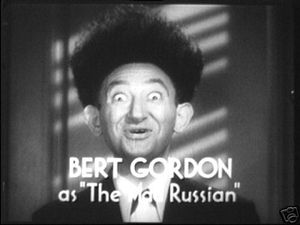
Back in the 1930’s, there was a radio comedian named Bert Gordon, who was billed as the Mad Russian. His tagline was “How do you dooo!”, which you can hear in some Warner Brothers cartoons from that period. Gordon was enormously popular in his time, but, alas, he is largely forgotten today. Yet, the spirit of the Mad Russian lives on at some left-wing websites. At CounterPunch, Israel Shamir has become their resident authority on Russia, the Dreyfus Affair, and conspiracy theories.
Not to be outdone, CP’s rival, Dissident Voice, have their own mad Russian, Andre Fomine. His latest article is entitled Pussy Riot, the CIA, and Cultural Terrorism. In this article, we learn the shocking truth about Pussy Riot:
No doubt it was not a single spontaneous act by a group of dissolute individuals but an episode of a much wider global campaign to shake and eventually ruin traditional societies and institutions. It is being carried out by the same powerful circles which inspired — e.g. offensive caricatures of Prophet Muhammad in a Danish newspaper in 2005.
Oh, my. From Pussy Riot to Danish cartoons. Who could possibly be behind this fiendish global conspiracy? Need you ask?
It is an open secret that avant-gardism became popular in the West in 1950-1960s thanks to unprecedented support from the CIA and was used by the United States as a powerful ideological weapon.
The CIA. Why, of course! Aren’t they behind everything?
Fomine ends his article with a dire warning: “The puppeteers of Modern Art and Cultural Terrorism keep carrying out their mission.” [Emphasis in the original.]
First, there was nothing spontaneous in the wave of 2011 North Africa and Middle East revolutions. The popular unrests in Tunisia, Egypt, Libya, Bahrain, etc were carefully prepared, organized, financed and supported through international media. Quite surprisingly, Al-Jazeera played a critically important role in fueling the conflicts within Arabic societies spreading disinformation and blocking truthful and sober voices.
The media did it! And, as we all know, media = CIA. Fomine, however, ends his article on a cheerful note:
Thus we are entering very interesting, perhaps decisive times. Muammar Gaddafi has won his last battle despite eluding vigor and insolent pressure from everywhere. Will there be any new Gaddafis born by Muslim mothers to resist the new world order? We hope and pray for that.
More Gaddafis! That’s exactly what we need! The comments on the thread for this article were adulatory. (“Excellent article. I am glad that the author had the courage to write it.” I’m not sure that “courage” is the right word.) When one commenter was churlish enough to point out that Fomine offers no evidence to support his claim about the Arab revolutions, he was promptly smacked down by another commenter who wrote:
How do you expect the writer can supply you with what you call proof?!
Do you expect him to hack computers or bulglarise certain offices and displays the documents here for you to see??!! Is that make sense?!
There is something called commonsense combined with knowledge of history, precedents and good analytical ability!
Yeah, who needs evidence?
As you can imagine, I wanted to learn more about this truly original thinker, Andre Fomine. I found out that he edits a web journal called Oriental Review. There, you can find excerpts from a book by Nikolay Starikov entitled Who Made Hitler Attack Stalin. The latest installment is titled Leon Trotsky, Father of German Nazism. Lest you think that this title is meant as a joke, here is how the article begins:
Who organized the February and October revolutions in Russia and the November revolution in Germany? The Russian and German revolutions were organized by British intelligence, with the possible support of the United States and France.
That’s right, British intelligence must have engineered the Russian Revolution, since it was a strategic defeat for the British empire. This is common sense. Displaying his extraordinary narrative skill, Starikov tells us:
Dropped into Russia by British intelligence, thanks to a secret agreement with German secret services aboard the “closed wagon,” the Bolsheviks refused to leave the political scene.
That’s right, the Bolsheviks (all of them) were parachuted into Russia inside a sealed train car. (It must have been awfully uncomfortable, but they were willing to endure anything for the revolution.) Later, we learn:
The main funding supplied to the Russian Revolution from American bankers was transferred through accounts in neutral Sweden and briefcases of inconspicuous figures stealthily entering the country.
Because there’s nothing bankers love more than a government that’s dedicated to abolishing capitalism.
Just by clinking on certain links on the Dissident Voice website, you can find this treasure trove of occult knowledge.
Why does CounterPunch, which is ostensibly a left-wing website, continue to post articles by the neo-fascist nutjob, Israel Shamir? You only have to read Shamir’s website to see that the guy is crazy. Yet he is apparently not too crazy to be published by CounterPunch.
CounterPunch has just posted an article by Shamir entitled The Secret History of Pussy Riot. In it, he repeatedly refers to the members of the band by the misogynist term, “viragos”. This fact alone should have been sufficient reason to reject the article. Alas, it’s actually even worse than that. Shamir argues that the Putin government was right to send these women to prison for merely expressing their opinions. He writes:
Two years’ sentence is quite in line with prevailing European practice. For much milder anti-Jewish hate talk, European countries customarily sentence offenders to two-to-five years of prison for the first offence. The Russians applied hate crime laws to offenders against Christian faith, and this is probably a Russian novelty. The Russians proved that they care for Christ as much as the French care for Auschwitz, and this shocked the Europeans who apparently thought ‘hate laws’ may be applied only to protect Jews and gays. The Western governments call for more freedom for the anti-Christian Russians, while denying it for holocaust revisionists in their midst.
Why does CounterPunch insult its readers by posting this garbage? The kindest thing one can assume here is that they didn’t bother to read this article.
Thus we should say: David Irving was sentenced for denial of Jewish superiority. His doom seals the reign of (albeit limited) freedom that began with the fall of Bastille. European history went full circle: from rejecting the rule of Church and embracing free thought, to the new Jewish mind-control on a world scale. Not only is Western Christian civilisation dead, but even its successor, secular European civilisation, has met its demise only a few days after its proud and last celebration by the Danish scribes. It was short-lived: about two hundred years from beginning to the end, the Europeans may once have had the illusion that they can live without an ideological supremacy. Now this illusion is over; and the Jews came in the stead of the old and tired See of St Peter to rule over the minds and souls of Europeans.
This is anti-Semitism, plain and simple. The Breivik shootings in Norway have shown that fascism is still a force to be reckoned with. Yet the editors of CounterPunch apparently think it is all a joke.
Sergei Eisenstein’s 1925 film, Battleship Potemkin, is loosely based on an actual incident in Russia’s 1905 revolution. The crew members of the Potemkin, which took part in the recent Russo-Japanese war, are given rotten meat to eat by their officers. When the captain finds out about this, he threatens the crew with severe punishments. He has a group of sailors rounded up, and he announces that they will executed as an example. A squadron of marines raise their rifles, but the sailors persuade them not to shoot. The sailors overpower the officers and throw them overboard, but one officer manages to shoot and kill Vakulinchuk (Aleksandr Antonov), the leader of the mutiny. The sailors take his body to the nearby port of Odessa, where it is put on public display with a sign reading “Killed for a bowl of soup.” The townspeople support the sailors, with the exception of a small group of men who shout, “Kill the Jews!”, but they are shouted down. Soldiers show up and open fire on the townspeople, killing many of them. The sailors of the Potemkin retaliate by opening fire on the soldiers.
The sailors learn that a naval squadron is coming to help the soldiers. They get together to decide what they should do. There are strong disagreements. (Some things never change.) They eventually decide to sail to meet the squadron. They will try to persuade the other sailors to join them. If that fails, they will almost certainly die, since they are outnumbered. They go to meet the squadron. They signal to the other ships, but they get no response. They load their guns and get ready to fire, but just then they receive a signal that the other ships will join them. The sailors rejoice.
Eisenstein clearly meant Battleship Potemkin to be propaganda. During the scene when the sailors are about to be shot, for example, we see numerous close-up shots of officers grinning ear to ear in eager anticipation of what is about to happen. And yet this film somehow manages to be something more than that. The massacre seen on the Odessa steps is extremely powerful to watch. It is impossible not to be moved by it. Eisenstein used this scene to test his theories about the use of montage in film. (The massacre did not happen in real life. Nor was it in the script. Eisenstein and the cast and crew improvised it on the spot.) Battleship Potemkin manages to be not just propaganda, but art as well.
Eisenstein’s 1928 film, October, is a commemoration of the tenth anniversary of the Russian Revolution of 1917. (It is also known as Ten Days That Shook the World, although it is not actually based on John Reed’s book.) The film is shot in a documentary style. (I remember seeing it on TV as a child. I thought I was watching actual film footage of the Russian Revolution.) Many of the people we see actually took part in the revolution, and the scenes were shot in places where the fighting took place. Despite these efforts at authenticity, this film is basically propaganda. During the Kornilov coup, for example, we see Kerensky hiding underneath pillows. We also see Bolshevik soldiers smashing bottles in the Tsar’s wine cellar. According to Victor Serge, the soldiers drank the wine and got stinking drunk.
The storming of the Winter Palace is fun to watch, but it doesn’t have the same emotional power as the massacre scene in Battleship Potemkin. Also, Eisenstein used this film to test out a type of montage he called “intellectual montage”, in which a series of unrelated images are shown to illustrate an idea. We are shown a Russian Orthodox priest, and then a series of images of Buddhist, Hindu, Chinese, and Aztec sculptures. This is meant to be an attack on religion, but it doesn’t succeed, unless you think there is something inherently objectionable about sculpture.
Before this film was released, Eisenstein was forced to cut out a number of scenes that had Trotsky in them. Trotsky had just been expelled from the Communist Party. The irony here is that in commemorating the revolution, October marks the beginning of the counterrevolution.



 The Spanish Prisoner