Once More into the Big Muddy

September 25, 2014

OBAMA_UN_001-x-large

Earlier this month, Andy Borowitz wrote an article with the title “Growing Pressure on Obama to Do Something Stupid”. This title is (partly) meant in jest, but it has proven to be prescient. Obama has finally done something that he has long resisted doing: he has bombed Syria. Why? Salim Lone, in The Guardian, writes: “Obama’s resistance to launching a war has for months made him the target of a sustained barrage of criticism, of a vehemence suffered by no other US president in the last 40 years.” Lone is probably referring to Jimmy Carter here. He was harshly criticized for not going to war with Iran over the hostage “crisis”. I would go back further, to Harry Truman, whom Republicans and much of the news media accused of “losing” China. These accusations may have contributed to Truman’s later reckless behavior during the Korean War, when he allowed Gen. MacArthur to exceed the UN mandate and invade North Korea – which led to a horrific war with China.

Over the past year or more, Obama has been under intense criticism from the media. They accuse him of being “soft” on Putin. (Do these people really want the president to start World War III?) As Lone points out:

    To get a sense of the pro-war shift in the US political landscape, recall how Bush’s infinitely more contentious 2003 war was preceded by a national debate. [Not much of a debate, actually.] Merely a media-amplified campaign for stepped-up military intervention has preceded Obama’s war. Even within his party, there has been little support, with senior figures like Hillary Clinton pouring scorn on his reticence.

Such discredited figures as Dick Cheney, John McCain, and Lindsey Graham – all of whom helped to create the current crisis in Iraq and Syria – are being exhibited on news shows as “experts” on what we should do now. We shouldn’t consider this surprising, considering that most of the people in the news media supported the invasion of Iraq.

Once again into the Big Muddy.

One Point about Iraq

September 17, 2014

iraqisolders

I would like to make a point here about Iraq, that, so far as I know, no one else has made. Years ago, Iraq had a capable, battle-seasoned army that could have easily dispatched a group like ISIS. After the invasion of Iraq in 2003, the US disbanded this army. The US then trained and equipped a new Iraqi army. It was this army that abandoned Mosul in the face of an ISIS offensive, leaving behind US-supplied weapons. So, yes, in that respect the US does bear responsibility for the current crisis in Iraq.

Tunnel Vision on ISIS

September 13, 2014

Isis fighters, pictured on a militant website verified by AP.

There is a certain type of argument that I’ve been hearing on the Left lately, a good example of which can be found in an article by John V. Walsh at Dissident Voice, entitled Syria Next on Hit List (ISIS is a side issue at best). In it, he writes about President Obama’s recent speech:

    The rationales that Obama is peddling make no sense. If the barbarity of beheading were the actual trigger of this latest onslaught on the Middle East, then the U.S. would not be sending our “moderate” trainees to Saudi Arabia where beheading is a well respected national past time – far more popular than allowing women to drive automobiles.

But the beheadings aren’t the only trigger. ISIS has carried out mass killings of Yazidis, Christians and Shi’a Muslims. These have received extensive coverage in the US media. Walsh must surely know this, yet he never mentions this. The point about beheadings in Saudi Arabia is basically true, but it’s not really pertinent to the situation in Syria. Walsh goes on:

    And ISIS remains a mysterious entity, springing up out of nowhere and carrying arms that are supplied by American and Saudi agencies. In Iran as was reported in the NYT yesterday on the front page, the great majority of “the street” believes it is an American/Israeli/Saudi creation.

Since Walsh apparently reads the New York Times, he must surely know that ISIS captured US weapons when the US-trained Iraqi army fled Mosul. Another important detail that he neglects to mention. And in what possible sense can “the street” in Iran be considered a reliable source on the relationship between the US and ISIS?

    Syria, of course, was on the list of targets that General Wesley Clarke [sic] revealed to us that there was a hit list in the Middle East and North Africa of seven countries, “starting with Iraq, and then Syria, Lebanon, Libya, Somalia, Sudan and, finishing off, Iran.” And miraculously the schedule has been modified only slightly perhaps because Assad has put up such fierce resistance.

Walsh has no idea what he is talking about here. The “hit list” he refers to was drawn up by neoconservatives in the Bush Administration before the invasion of Iraq. They expected to accomplish all of their goals within five years. (You can see how well that worked out.) It’s doubtful whether this list still has any influence over US foreign policy. Obama has had five years in which to attack Syria. Last year’s Sarin gas attack gave him a perfect excuse to do so, yet instead he eagerly accepted an offer by Russia to negotiate a deal with Assad.

Walsh ends with this rhetorical flourish:

    The dream of the U.S. Empire to dominate the Eurasian land mass is being implemented: Damascus, Tehran, Moscow and finally Beijing unless nuclear war breaks out first. Obama and the rest of the imperial elite are flirting with Armageddon.

Uh, yeah. Look, I have strong reservations about what the president is proposing to do in Syria and Iraq. We need to have a serious national discussion about this. Unfortunately, we have too many people like Walsh, who just want to idly spin conspiracy theories.

Forrest Gump and the Manufacturing of Innocence

September 7, 2014

Forrest_Gump_poster

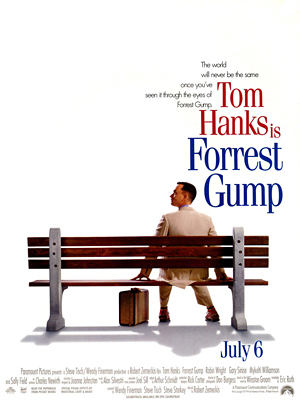
It’s been 20 years since Forrest Gump was released. This anniversary is being celebrated with a week-long IMAX release. I guess this is a good enough excuse to write something that I’ve long been wanting to write.

When Forrest Gump first came out, it mostly received ecstatic reviews (with a few naysayers here and there). I went to see it fully expecting to enjoy it. The early scenes seemed promising. I liked Sally Fields as Forrest Gump’s mother. She quickly disappeared, however. After about half an hour, I started glancing at my watch, wondering how much longer this thing would go on. I was watching stick figure characters who were doing things that were neither believable nor interesting. When the film finally ended, I left the theater feeling numb, as if I had just sat through a really long and really dull lecture.

So, what gives? Why did this mediocre film win such rave reviews? And why was it so hugely popular? (Those Bubbagump Shrimp hats were far and away the most annoying fashion item of the 1990’s.) This is something that I have thought about from time to time. I think that one of the significant things about this film is the fact that Gump is depicted as morally pure. There isn’t a mean-spirited bone in his body. He even manages to make it through the Vietnam War without killing anyone. (Although he somehow wins the Medal of Honor.)

But what’s really striking about this film is its racial angle. Gump is depicted as being not the least bit racist, despite the fact that he grows up in the Deep South during the time of Jim Crow. (We are also explicitly told that he is named after Nathan Bedford-Forrest, the founder of the Klu Klux Klan.) He is nice to almost all the black people he meets. (Interestingly, the only black person Gump doesn’t like is a Black Panther.) When Gump is in the Army, he meets a black soldier named Bubba, who talks non-stop about the different ways to cook shrimp. We’re expected to believe that Gump somehow forms a deep emotional bond with this self-absorbed monomaniac. Bubba is killed in the war, and after Gump leaves the army, he buys a shrimp boat and calls his business “Bubbagump Shrimp”. The film then has one of its moments of “whimsy”. A hurricane destroys all the shrimp boats except for Gump’s. This gives Gump a monopoly on the shrimp business that makes him wealthy. (This film’s makers expect us to see it as a good thing that a whole bunch of people were impoverished so Gump could get rich.) Gump then gives a bunch of money to Bubba’s mother, who works as a maid. She retires and buys a nice house, where she is waited upon by a maid. The film implies that this is a form of justice. (Although not for the woman who has to wait on Bubba’s mother.)

The clear subtext of this film is that Gump absolves us of our sins. (The film critic, Gene Siskel, once called this movie “a healing balm”.) We’ve had 500 years of racism, but it’s OK, because Gump was nice to Bubba’s mom. Two million Vietnamese were killed in the war, but, hey, at least Gump didn’t kill any of them!

Forrest Gump promotes a notion of American “innocence” that helped to create the cultural climate in this country that made the invasion of Iraq possible.

Human Smoke

August 24, 2014

poster_victory-through-air-power

Lately I have been reading Human Smoke, Nicholson Baker’s pacifist history of the beginning of World War II. Although I don’t find Baker’s main argument – that Britain might have provoked Germany into war – convincing, I find the book interesting nonetheless. Among other things it’s always good to be reminded that Roosevelt and Churchill were not the saints that are often portrayed in popular culture.

One thing that Baker makes clear is that going back to the First World War, and possibly even earlier, military planners regarded the aerial bombardment of civilian populations to be a legitimate tool of warfare. Indeed, some of them seemed to eagerly look forward to this prospect. (Churchill once expressed disappointment that World War I ended before Britain could try out its new bombers.) The idea was that bombings will break a people’s will to fight. Yet if there is one thing that we should have learned from the twentieth century, it is that bombings do not break a people’s will to fight. Britain’s bombing of Germany did not break the Germans’ will to fight, nor did Germany’s bombing of Britain break the will of the British to fight. The US’s bombing of Japan did not break the will of the Japanese to fight. The US’s bombing of North Vietnam did not break the will of the Vietnamese to fight.

And so Israel’s bombing of Gaza has not broken the will of the Gazans to fight. We seem to learn nothing from history.

Iraq and the Law of Unintended Consequences

August 17, 2014

131030_nouri_al_maliki_barack_obama_ap_605
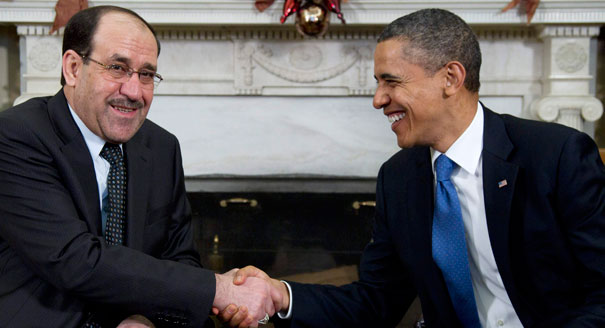
Nouri al-Maliki and Barack Obama

The other day I went to my local library to read Hillary Clinton’s memoir, Hard Choices. I found it dull, and it didn’t tell me anything I didn’t already know. I was, however, struck by the following sentence on page 389: “Benghazi is a port city on the Mediterranean Sea with a population of more than 1 million people, mostly Sunni Muslims, and large African and Egyptian minorities.” So, our former Secretary of State doesn’t know that Libyans and Egyptians are Africans. Interesting.

I got so bored, that out of desperation I picked up a copy of Robert Gates’s memoir, Duty. I must say that I found Gates to be a more interesting writer than Clinton, if only because his writing doesn’t sound like sound-bites from a presidential debate. I also learned something from him: Bush had frequent video conferences with Hamid Karzai, the president of Afghanistan, and with Nouri al-Maliki, the prime minister of Iraq. Gates says that Bush acted as a “useful mentor” to these men (page 337). The idea that Bush could serve as a mentor to anyone, let alone the leaders of two nations, is mind-boggling to me. Later, Gates says that Maliki’s party came in second in Iraq’s 2010 (page 472) elections, but Maliki was nonetheless eventually able to resume his position as prime minister. What Maliki apparently learned from Bush was how to take office after losing an election.

Gates shares with us the following heart-warming anecdote:

    … Maliki, frustrated and angered by Iranian-backed Shia extremist actions in Basra, ordered units of the Iraqi army into the city to reestalish control. The U.S. commanders were horrified that Maliki had taken such a risk without proper preparation. They scrambled to provide the logistics, planning, and military advice to support Maliki’s effort; without such help, he almost certainly would have failed. But he didn’t and therefore won significant recognition all across Iraq for acting like a “national” leader by suppressing his Shia brethren. The president told the chiefs, “We ought to say hurray to Maliki for going down to Basra and taking on the extremists.” He charactized is a “milestone event.” “Maliki used to ba a paralyzed neophyte – now he is taking charge.” Bush was right. (Page 233.)

This same “national”, Maliki, is now widely blamed for the disintegration of the Iraqi state; his relentless sectarianism is alleged to a have antagonized the country’s Sunni Muslim minority. At this point, one must question whether Bush and Gates really understood what was going on in Iraq.

Ah, but according to conspiracy theory, leaders always have complete control over what is happening. Consider this article by Mike Whitney, Why Obama Wants Maliki Removed in the most recent isssue of CounterPunch. Whitney writes:

    The Obama administration is pushing for regime change in Iraq on the basis that current prime minister Nouri al Maliki is too sectarian. The fact is, however, that Maliki’s abusive treatment of Sunnis never factored into Washington’s decision to have him removed. Whether he has been “too sectarian” or not is completely irrelevant. The real reason he’s under attack is because he wouldn’t sign the Status of Forces Agreement in 2011. He refused to grant immunity to the tens of thousands of troops the administration wanted to leave in Iraq following the formal withdrawal. That’s what angered Washington. That’s why the administration wants Maliki replaced.

That’s right! Obama was so angry at Maliki, that he waited three years to demand his removal from office.

The life of a conspiracy theorist is difficult and unpleasant. He must be continually searching for whatever paltry (or perhaps non-existent) evidence that may buttress his pre-conceived ideas. He simply cannot concede the possibility that the people in charge may not always understand what exactly is going on.

Harry Truman’s Shirts

August 14, 2014

Truman

Lately, I have been reading David McCullough’s biography of Harry Truman. I’m interested in the Truman administration, because it was a pivotal period in our nation’s history. One thing I like about McCullough’s book is that it does a lot to dispel the myth of “Give ‘Em Hell Harry”. McCullough shows that Truman was often indecisive, and that he was reluctant to make decisions that he knew would be unpopular. Among other things, McCullough makes it clear that Truman should have fired MacArthur months before he did. (Truman did have a temper though. He once threatened to throw Joseph Kennedy out of a hotel window. You can’t really blame him for wanting to do that.) Although McCullough is highly sympathetic to Truman, he is nevertheless critical of him at times. He argues, for example, that Truman’s Loyalty Program helped set the stage for McCarthyism.

McCullough is a skillful writer who is good at historical narrative, but his amassing of details began to annoy me after a while. He writes about such things as what clothes Truman wore and what he had for lunch on certain days. This is more than I really wanted to know about Truman. What makes this baffling is that he devotes one paragraph to the creation of NATO. And he says hardly anything about Truman’s policies towards post-war Germany. (Which was one of the issues I was interested in when I picked up this book.) Call me a philistine, but I think these topics would have been more interesting than Truman’s shirts.

PETA Dines on the Corpse of Detroit

July 27, 2014

detroit

Detroit, one of the world’s great cities, is slowly dying. The city government is cutting off water to thousands of residents, and there is serious talk of selling off the artworks in the city’s art museum. The rest of America stands by and watches while this happens.

Ah, but the People for the Ethical Treatment of Animals (PETA) is doing something about it. On their website, they have announced:

    Thanks to this donor, PETA will be able to pay off the water bills for 10 families who commit to going vegan for one month. We’ll also help them get started by giving each family a basket of healthy vegan foods and recipes.

    The last thing that people who are struggling need is increased health-care costs. By accepting our offer to go vegan, not only will families be getting an immediate financial boost and helping animals, if they stick with it, they’ll also lower their risk of obesity, heart disease, cancer, diabetes, and strokes.

Yes, a lucky few – 10 families exactly – will get to have running water in exchange for agreeing to eat vegan for one month. (And if they break their promises, will they have to pay the money back?) Not quite the same as finding a ticket to Willy Wonka’s chocolate factory, but pretty close to it.

No doubt this is meant to provide publicity for PETA and to make people aware of the many advantages of veganism.

The website provides an address that people can write to if they want to be considered for this. I hope the people of Detroit write to them to tell them what they think of this offer.

The people of PETA are not vegans, they are vultures.

Here is some more about PETA.

The Slaughter in Gaza

July 25, 2014

1405388940-stop-the-slaughter-in-gaza-demonstration-in-belfast_5266232

I know a woman who used to live in Gaza. Today, she told me that three children she knew when she was living there have been killed by Israeli bombs. As the slaughter in Gaza continues, it’s effects are beginning to be felt even here in the US.

Barack Obama has displayed his usual moral cowardice, giving pious speeches about Israel’s “right to defend itself”, as if the people of Gaza have no right to defend themselves. Obama talked about this at an Iftar dinner attended Muslim Americans. Obama deliberately insulted these people by inviting the Israeli ambassador to the US to this dinner.

There is growing opposition to Israel’s attack on the people of Gaza throughout the world including within Israel itself.

We must stand with the people of Gaza.

Carving Up the Golden State

July 17, 2014

drapermap-thumb-600x680-68007

Every few years, somebody comes up with a proposal to break up California into smaller states. (Usually, by some conservative who thinks the state government is “too liberal”). These proposals have always never gone anywhere, no doubt because most Californians are pretty much satisfied with the state the way it is. Now, however, a Silicon Valley billionaire named Tim Draper says he has collected more than enough signatures to put on the ballot a plan to divide up California into six states.

Draper has given these proposed states such imaginative names as “Central California”, “South California”, “West California”, and “North California”. Another state will be called “Silicon Valley”. (That’s right, it will be named after a branding gimmick.) And another state will be named “Jefferson” (after a slave owner who never set foot in California). According to SF Gate: “…Draper spent $1.3 million and hired the signature-gathering firm Arno Political Consultants, which paid collectors as much as $3 per signature.” Draper claims that California as currently exists is “ungovernable”. (If California were truly ungovernable, it would resemble Somalia.) In fact, if this plan were put into effect, it would be a bureaucratic nightmare. Among other things, responsibility for the state’s enormous water system would have to be divided up between six different governments. (Just think of the potential for lawsuits here.)

I once had a job verifying signatures for a company that did ballot petitions. I was struck by the huge number of redundant signatures I would find. Certain people would sign the same petitions over and over again. This suggested to me that these people weren’t really paying that close attention to what they were signing. This confirmed to me a suspicion I had always had: you can put almost anything on the ballot if you’re willing to spend enough money and hire enough collectors. “Direct democracy”, the rationale behind having ballot initiatives, is a highly problematic concept in a society in which there is an enormous disparity in wealth.

Even if this initiative passes, the plan would have to be approved by Congress, which is not likely to happen. However, this provides us with an illuminating example of how a billionaire can wast people’s time.