The Life and Death of Colonel Blimp

March 20, 2014

Editors-Pick-The-Life-and-Death-of-Colonel-Blimp

The Criterion Collection has released a restored version of the 1943 British film, The Life and Death of Colonel Blimp, directed by Michael Powell and Emeric Pressberger. The title refers to a recurring character in the cartoons of David Low: an elderly Army officer who spouts reactionary nonsense. This film’s main character, Gen. Clive Wynne Candy (Roger Livesy), is clearly meant to be associated with Col. Blimp.

The Life and Death of Colonel Blimp tells, in flashback form, the life story of Gen. Clive Wynne Candy, from the Boer War to the beginning of the Second World War. In the film’s early scenes, Candy is on leave from the Boer War, where his courage has earned him a Victoria Cross. On his own initiative, Candy follows a German agent named Kaunitz to Berlin. Kaunitz has been spreading stories about British atrocities in the Boer War, inciting anti-British feeling among the Germans. Candy is determined to stop him. What makes this part of the film a bit icky is the fact that the British did commit atrocities in the Boer War. This is somewhat ameliorated by the fact that the film implies that Candy is a bit self-deluded, although this is never made explicitly clear.

However, in the next section of the film, detailing Candy’s experiences during World War I, we learn that his biggest fault is actually that he is too decent. He is reluctant to resort to the ruthless measures needed to defeat the Germans. This problem continues into the Second World War, when everyone around him becomes exasperated with Candy’s niceness. Even his Prussian friend, Theo (Anton Walbrook), lectures him about the need to get tough with the Germans.

At this point, I had to begin to question this film’s honesty. It seems to be saying that the main fault of the British is that they are too nice to their enemies. I suspect that many people in India and Africa and Ireland might beg to differ about this. (No doubt, Gandhi had the British in mind when he made his famous quip about Western Civilization being “a good idea.”) Early in the war, Noël Coward recorded a “satirical” song titled Don’t Let’s Be Beastly Towards the Germans, which also argues that the British are too nice to their foes. This idea of the British being “too nice” to their enemies strikes me as a back-handed form of self-flattery. (Sort of the way we’re often told that the U.S. is “generous” towards its enemies, even though it actually isn’t.)

What the film also seems to be saying is that Col. Blimp – and by extension all the “Blimps” in England – is not really a bad person after all. (The filmmakers apparently did this with David Low’s blessing.) This is in keeping with the “we’re all in this together” rhetoric of the British government during this period.

So, The Life and Death of Colonel Blimp is actually wartime propaganda, albeit of a subtle and sophisticated kind. What is odd is that this film was the subject of much right-wing criticism at the time of its release. (Churchill tried to prevent the film from being made.) One of their objections seemed to be that the film contains a sympathetic German character. In the U.S. at about this time, John Steinbeck’s The Moon is Down was harshly criticized for the same reason. War demands the dehumanization of the enemy.

This movie is gorgeously filmed. (The technicolor was lovingly restored for the DVD.) I was impressed by the high production values, considering that this was made during wartime rationing. The acting is superb. Livesy is impressive, convincingly aging over the course of the film. Deborah Kerr acts as the Eternal Feminine, playing three roles over the course of three generations. Her characters illustrate how women acquired greater personal freedom during this period.

One other thing that I found icky about this film is that the directors indicate the passage of time by filling up Candy’s house with the heads of animals that he killed while on hunting trips all over the world. At first, I thought this was meant to be satirical, but I gradually had the disturbing realization that this was something that the audience was supposed to find endearing about Candy. Ah, for the good old days when the British upper hunted species to the verge of extinction. Nostalgia can be a bitch sometimes.


Auto Focus

March 9, 2014

AutoFocus

I remember seeing the network premiere of Hogan’s Heroes when I was a kid. I liked the throbbing beat of the opening drum roll. I liked the sight of the POW’s rushing to get in line. I liked the haughty look of Werner Klemperer as he put a monocle to his eye under the opening credits. And then my mother turned the TV off. She was indifferent to my protests. I subsequently learned that my parents considered the show to be in bad taste – which it was. I was, however, too young to understand the concept of bad taste. Also, the fact that my parents forbade it made it attractive to me. I managed to find ways to watch it on the sly. I have to admit I found it pretty funny. Years later, though, I read in the newspaper that Bob Crane, the show’s star, had been found bludgeoned to death in his apartment in Scottsdale, Arizona. The article noted that the police had found dozens of videotapes of Crane having sex with various women. At that moment I had the weird feeling that perhaps my parents had comprehended something that had eluded me.

One of the things I found interesting about Paul Schrader’s 2002 film, Auto Focus, is that it seemed to me to suggest that my initial response to Crane’s death was correct. The film begins in the mid-1960’s, when Crane (Greg Kinnear) was the morning disc jockey at a radio station in Los Angeles. He has ambitions of working in movies; he sees himself as another Jack Lemmon. The best his manager, Mel Rosen (Ed Begly, Jr.) can do for him, however, is get him a role in a TV comedy set in a German P.O.W. camp during World War II. Crane initially expresses reservations about this, but eventually he decides to do it. On the set of the show one day, he meets John Carpenter (Willem Dafoe), who sells video equipment. Carpenter takes Crane to a strip club, and he and Crane begin double dating. They start taping themselves having sex with various women. Carpenter comes across as a sordid Mephistopheles, who introduces Crane to a world of casual sex and narcissistic voyeurism. Over time, though, they gradually switch roles, with Crane becoming the dominant partner, since his status as a TV star makes it easier for him to attract women. Carpenter becomes increasingly insecure as a result of his growing reliance on Crane.

Crane’s womanizing leads to the break-up of his twenty-year marriage to Anne (Rita Wilson). Crane subsequently marries Patricia (Maria Bello), his co-star on the show. Patricia is aware of Crane’s womanizing and accepts it. After she becomes pregnant, however, she gradually changes her mind and begins demanding that Crane spend more time with her.

After six years, Hogan’ Heroes comes to an end. As often happens to actors who are in a successful TV series, Crane has trouble finding work afterwards. He ends up doing dinner theatre. When Crane tires of this, he goes to Mel Rosen for advice. Mel tells Crane he needs to change his way of living if he wants to revive his acting career. Crane decides to sever his relationship with Carpenter and tells him so. Later that night, someone enters Crane’s apartment and bludgeons him to death. The film implies that Carpenter is the murderer, though it leaves some room for doubt about this. (In real life, Carpenter was tried for Crane’s murder and was acquitted.)

The final joke of the film is that Crane carries his lack of self-awareness into the after-life. As police officers gaze at Crane’s bloody corpse, we hear Crane’s voice, presumably coming from the grave, cheerily remarking, “Men gotta have fun.” One is reminded here of Taxi Driver, which Schrader co-wrote, in which Travis Bickle remains self-deluded to the very end. According to his Wickipedia biography, Schrader was raised in the Chrisian Reformed Church, which is described as Calvinist, meaning, I suppose, that they believe in predistination. Perhaps this explains why Schrader presents us with a world in which people are not redeemed.

Sense and Nonsense about Crimea

March 2, 2014

map_of_crimea

The ongoing crisis in Ukraine has predictably created confusion in the West. The New York Times reports:

    Senator Bob Corker of Tennessee, the ranking Republican on the Foreign Relations Committee, said he consulted on Saturday with Secretary of State John Kerry and Senator Robert Menendez, the New Jersey Democrat who heads the committee, about targeted sanctions against individuals in the Putin government and possibly Russian institutions. The proposal could be taken up as early as this week.

    Mr. Corker was one of the few Republicans in September to support a Senate resolution authorizing airstrikes in Syria, and he said the failure of Washington to follow through on those strikes had emboldened Mr. Putin.

    “Ever since the administration threw themselves in his arms in Syria to keep from carrying out what they said they would carry out, I think he’s seen weakness,” Mr. Corker said Saturday. “These are the consequences.”

This is a stupid argument. Putin knows perfectly well that the U.S. is not going to attack Russia, for the obvious reason that Russia has nuclear weapons. The idea that Putin would be shitting in his pants if the U.S. had dropped some bombs on Damascus is simply childish. Putin decided to seize an opportunity that the chaos in Ukraine created for him. It’s that simple.

The Guardian isn’t much more helpful. An editorial states:

    What is hard to see, having been so effectively outmanoeuvred over the last two days, is how the US and EU should respond beyond futile expressions of concern and outrage. Equally, it is clear that when western political institutions have attempted to penetrate Russia’s neighbours – the suggestion of Nato expansion in Georgia, and closer EU integration for Ukraine – Moscow has pushed back hard on both occasions.

So, what should we do? They tell us:

    One thing is certain: the current crisis presents the biggest threat to security in Europe since the Balkan wars, and western leaders, including Obama and David Cameron (who has spoken to Putin on the phone), have hardly been impressive in their response, demonstrating a weak grasp on the events unfolding. For now, Putin is ahead of the game. It is time for the international community to catch up.

Well, that’s clear, isn’t it? The international community needs to catch up with Russia – whatever the hell that means.

A few things are clear. Crimea is of no strategic importance to the U.S. Although there are concerns about Crimea’s Tatars, there are no signs of a humanitarian crisis at this point. President Obama can only object to Russia’s seizure of Crimea on the narrow grounds that it violates international law. The problem is that the U.S. regularly violates international law with its drone attacks. And the invasion of Iraq was a violation on a far greater scale than what is currently happening in Crimea. International law is a useful tool that we have thoughtlessly thrown away.

Hannah Arendt

March 1, 2014

Hannah_Arendt_Film_Poster

Margarethe von Trotta’s 2012 film, Hannah Arendt, deals with the writing of Arendt’s Eichmann in Jerusalem and the ensuing controversy that it caused. The film is fictional, but it includes actual film footage of Eichmann’s trial. Arendt’s book was controversial because of its notion of the “banality of evil”, which many historians objected to (and still object to). This idea has remained in currency, however, perhaps because it doesn’t seem far-fetched to a generation that grew up under the cloud of a nuclear arms race. The book also angered people because of its criticism of Jewish Leaders in Eastern Europe during World War II.

This film is mostly sympathetic in its portrayal of Arendt (played by Barbara Sukowa), but it does not portray her as flawless. She ignored pleadings that her comments about the Jewish leaders were insensitive and should be left out. (She felt she had to discuss it, because the issue came up during Eichmann’s trial.) Some of the characters accuse her of being arrogant, and the film subtly implies that there was some truth in this.

There is also a sub-plot about Arendt’s relationship with the philosopher, Heidegger, who was once her lover. This part of the film was unsatisfying because Trotta doesn’t seem to know what to say about this aspect of Arendt’s life.

Hannah Arendt is that rare type of film that deals with the life of the mind. It is also interesting portrayal of the German-Jewish emigre community in the U.S. following World War II.

Secrecy, the ISO, and the Left, Part 2

February 26, 2014

1884

By now, most people on the Left have heard about the sexual assault allegation against a member of the International Socialist Organization (ISO). It is discussed in the ISO’s Internal Bulletin #19, which can be found on the Internet. What’s interesting about this is that this document was originally meant to be read by ISO members only. It appears that a disgruntled ISO member gave a bunch of the ISO’s internal documents to Ross Wolfe, who posted them on his blog, The Charnel House. This greatly angered many ISO members, even though there is nothing in these documents that is embarrassing or damaging to the ISO. Some of them said very insulting things about Wolfe. I find this inexplicable.

By now, most people on the Left have heard about the sexual assault allegation against a member of the International Socialist Organization (ISO). It is discussed in the ISO’s Internal Bulletin #19, which can be found on the Internet. What’s interesting about this is that this document was originally meant to be read by ISO members only. It appears that a disgruntled ISO member gave a bunch of the ISO’s internal documents to Ross Wolfe, who posted them on his blog, The Charnel House. This greatly angered many ISO members, even though there is nothing in these documents that is embarrassing or damaging to the ISO. Some of them said very insulting things about Wolfe. I find this inexplicable.

As I explained in my previous post, secrecy can be justified in some situations. However, most of what’s in these documents could just as well have in Socialist Worker. There is a danger in making a fetish out of secrecy. I remember when I was in the ISO, I would sometimes meet people who were hostile to our group because they saw us as secretive. As I said before, when you keep secrets, people assume you have something to hide. (Consider all the wild conspiracy theories that have circulated around the Freemasons, who are really just a glorified stag drinking club.) The ISO might consider having more openness.

Secrecy, the ISO, and the Left

February 14, 2014

secrecy

Ross Wolfe, who edits the website The Charnel House has posted a number of internal documents of the International Socialist Organization (ISO) online. He claims that a disgruntled ISO member gave him these documents. At first, I was not sure what to think about this. (Personal disclosure: I am a former member of the ISO.) Mike Ely, who edits the Kasama Project website, has written an open letter to Wolfe, asking him to take the documents down. The letter is well-argued and well worth reading. Among other things, he points out:

    If we are to have necessary security cultures (and private debates) within specific left circles — we must of necessity respect the security and privacy of other organizations (even ones we consider wrong, corrupt or compromised.)

I agree with this. If the Left is going to be anything more than a sectarian hellhole, some standards of behavior need to be maintained.

I remember when I was in the ISO, their whole practice of having secret internal documents struck me as unnecessary and impractical. However, I never objected to it, mainly because I didn’t see it as important. (I remember once asking a “cadre” why we had secret documents. He replied that “sectarians” would take people’s arguments out of context and ascribe to the ISO positions that it doesn’t hold. In hindsight, I realize I should have pointed out to him that the “sectarians” were already doing this with the articles in Socialist Worker.)

I have recently discovered that some people see the ISO’s secrecy as extremely important. These people are mostly NOT in the ISO. When you do things secretly, people assume you have something to hide. Of course, I realize that in some cases secrecy is necessary, as when when a group is being targeted by the police. Aside from such situations, I believe that openness is the best policy.

In response to Ely’s letter, Wolfe has said he will take down the documents. (Except for one bulletin that deals with a controversy I will discuss in a future post.)

Lierre Keith and the Politics of Exclusion

February 13, 2014

f_lierreportrait-1

A young friend of mine who is a student at the University of Oregon recently sent me a message asking me to sign a petition demanding that Lierre Keith not be allowed to speak at a Public Interest Environmental Law Conference at the University later this month. The petition claims that Keith is a transphobe and a racist. I must admit, not without some embarrassment, that I did not know who Keith is. I subsequently learned that she is a feminist and environmentalist. She is a founding member of an environmental group, Deep Green Resistance.

The accusation of racism apparently stems from an incident in which she posted a comment on a DPR message board in which she called Lakota culture “patriarchal”. When some people criticized the comment, it was taken down. I don’t think there is anything to see here.

The transphobia accusation is more substantial. Deep Green Resistance is unique among environmental groups in that it doesn’t allow transgender members. This is due to the particular brand of feminism that Keith and other leading members of DPR subscribe to. These people hold, as Keith puts it, that gender is “not a binary but a hierarchy”. (You can find an exposition of Keith’s ideas here. You can find a critique of those ideas here) Keith objects to transgenderism because it seems to her to go against her theory of gender. (It apparently doesn’t occur to her that perhaps this means that the theory should be modified in some way. But what does an empiricist like me know.)

I am of two minds about this. On the one hand, I’m a firm believer in free speech, including for people I disagree with. On the other hand, if Keith insists on excluding some people, she shouldn’t be surprised if they want to exclude her in return. I would have to say that Keith should be allowed to speak, but with the proviso that people can protest her views if they so wish.

Philip Seymour Hoffman (1967-2014)

February 6, 2014

philip-seymour-hoffman

Like so many people, I was shocked and saddened when I learned of the death of Philip Seymour Hoffman. Of all the actors who have emerged in Hollywood over the past two decades, he was the one I liked the most. His performances were always powerful. In Capote, he mimicked the famous writer’s voice and mannerisms, without becoming a caricature. My favorite performance of his, however, was in The Master, in which he played a cult leader. Hoffman exuded an air of authority and all-knowingness that you understand why people would follow such a man despite the demands that he made on them. (I was not that impressed by his performance in Hunger Games: Catching Fire, but I think that is because the character was not well written.)

Hoffman reportedly died from a heroin overdose in his New York apartment. When I lived in New York, I knew several people who became heroin addicts. One of them died from an overdose. There is a very strong drug scene in New York, one in which many people get caught up. I don’t know whether this was a factor in why Hoffman became an addict, but I can’t help but note the possibility. One of my first memories of New York is of people whispering “steelworks” to me as they passed me on the street. They were offering to sell me heroin. New York can be a very stressful place to live, which may be why some people turn to drugs.

James Urbaniak tells an interesting story about Hoffman here.

Diana Johnstone and the Politics of Memory

January 26, 2014

diana-johnstone1

The January 24-26 edition of CounterPunch contains an article by Diana Johnstone entitled Blasphemy in Secular France. The article is about the French comedian, Dieudonné, who has been accused of anti-Semitism, and who is a political ally of the far right National Front. Dieudonné has made jokes about the concentration camps and has expressed admiration for the Holocaust denier, Robert Farrison. Discussing the criticisms of Dieudonné, Johnstone writes:

    For his fans and supporters, those accusations are false and absurd. The most significant result of the Dieudonné uproar so far is probably the dawning realization, among more and more people, that the “Shoah”, or Holocaust, functions as the semi-official State Religion of France.

Oh. Really? Really?

Johnstone goes on:

    In addition to history courses, teachers organize commemorations of the Shoah and trips to Auschwitz. Media reminders of the Shoah are almost daily. Unique in French history, the so-called Gayssot law provides that any statement denying or minimizing the Shoah can be prosecuted and even lead to prison.

    Scores of messages received from French citizens in response to my earlier article (CounterPunch, January 1, 2014) as well as private conversations make it clear to me that reminders of the Shoah are widely experienced by people born decades after the defeat of Nazism as invitations to feel guilty or at least uncomfortable for crimes they did not commit. Like many demands for solemnity, the Shoah can be felt as a subject that imposes uneasy silence. Laughter is then felt as liberation.

Under the Vichy government, 76,000 French Jews were sent to concentration camps. Some would see the willingness of the French to discuss a shameful episode of their history as something admirable. Here in the U.S., some people get upset whenever one tries to talk about the genocide of Native Americans or the horrors of slavery. Johnstone, however, believes such discussions can only make people feel guilty and depressed. What’s more, she believes that they are based on a false view of history:

    The sacred nature of the Shoah is defended by the argument that keeping alive the memory of the Holocaust is essential to prevent it from “happening again”. By suggesting the possibility of repetition, it keeps fear alive.

    Nothing proves that repeated reminders of an immense historic event that happened in the past prevent it from happening again. History doesn’t work that way. As for the Shoah, gas chambers and all, it is quite preposterous to imagine that it could happen again considering all the factors that made it happen in the first place. Hitler had a project to confirm the role of Germans as the master “Aryan” race in Europe, and hated the Jews as a dangerous rival elite. Who now has such a project? Certainly not a Franco-African humorist! Hitler is not coming back, nor is Napoleon Bonaparte, nor is Attila the Hun.

Johnstone attacks an argument that no one makes. Nobody really believes that the Third Reich is going to happen all over again. Hatred, however, can take many forms, not just the form of a concentration camp. There were 614 anti-Semitic attacks, including physical and verbal attacks, recorded in France in 2012. In March of that year, three children and a rabbi were shot to death outside of a Jewish school. Given this context, it should not be surprising that some people do not find Dieudonné’s jokes about the Holocaust “liberating”.

American Hustle

January 21, 2014

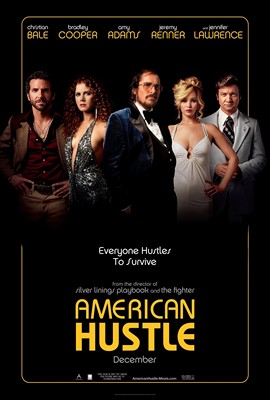
American_Hustle_2013_poster

American Hustle, directed by David O. Russell, is loosely based on the Abscam scandal of the 1970’s. This resulted from a sting operation in which the FBI developed the methods of entrapment it uses today against Muslims.

Irving Rosenfeld (Christian Bale) and Sydney Prosser (Amy Adams) are a couple of swindlers who are caught in an FBI sting operation led by Richard DiMaso (Bradley Cooper). DiMaso tells them that he will not press charges provided that they agree to help him catch white collar criminals, which they reluctantly consent to do. The three of them eventually set their sights on a powerful New Jersey politician, Carmine Polito (Jeremy Renner), who wants money to build casinos, which he believes will revive the state’s economy. They hook Polito up with a phoney sheikh (Michael Peña), who promises him money. The scheme begins to involve more people, including Victor Tellegio (Robert De Niro), one of the most powerful figures in organized crime. Meanwhile, Rosenfeld comes to believe that Polito, although somewhat corrupt, is basically a well-intentioned person, and he begins to regret the fact that he is setting him up. Rosenfeld’s woes are exacerbated by the erratic behavior of his wife, Rosalyn (Jennifer Lawrence), who nearly blows his cover.

American Hustle is an amusing comedy that benefits from strong perfromances (although Louis CK is not quite convincing as DiMaso’s boss). I have never been keen on Chirstian Bale in the past. His performances have struck me as either too operatic (The Fighter) or too understated (The Dark Knight Rises). In this movie, he strikes just the right balance, playing a character who is sleazy, but not totally devoid of empathy. And it’s fun to watch Jennifer Lawrence playing a character who is the human opposite of the one she plays in the Hunger Games films.

American Hustle questions whether the FBI’s sting operation actually accomplished anything. People have asked similar questions about the FBI’s sting operations against Muslim “terrorists”. (I have written about one of these cases here.)