Fearmongering

January 20, 2014

tokyo-fukushima-power-look-1

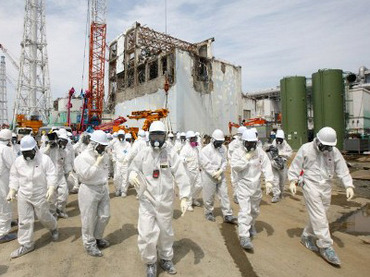
The Scientific American has posted an article debunking the story that there was a spike in infant mortality rates in the Pacific Northwest immediately following the Fukushima nuclear accident. This was the first in a series of alarmist stories that have come out about that disaster, the latest of these being that the floor of the Pacific ocean is covered with dead animals. (This has also been debunked.) An interesting question here is why do people make up these stories. The Fukushima disaster is something we should all be concerned, and outraged, about, and the people responsible for it should be held accountable, but what is accomplished by making false claims about it? Do some anti-nuclear activists think that they can advance their cause by making false claims? They are deluded if they think so.

Some people actually seem to take a perverse pleasure in the idea that the sky is falling. Consider the popularity of the patently absurd “Mayan Prophecy” hoax. Perhaps this helps to explain the popularity of conspiracy theories, which portray us as helpless victims of a small, secret group of individuals.

Jordan Belfort: “The Wolf of Wall Street”

December 29, 2013

Jordan-Belfort

Martin Scorsese has a new film out titled The Wolf of Wall Street. It is based on the memoirs of Jordan Belfort, who in the 1990’s ran a brokerage firm called Stratton Oakmont that did illegal “pump and dump” schemes that got Belfort thrown into prison. I’m debating in my mind whether or not I should go see this movie. I found Scorsese’s last film, Hugo, dull and over-long. The Wolf of Wall Street clocks in at two hours and forty minutes. This doesn’t look promising.

One person who did see the movie was Christina McDowell, the daughter of Tom Prousalis, one of Belfort’s business partners at Stratton Oakmont. She has written an open letter to the makers of the film, in which she states:

    Belfort’s victims, my father’s victims, don’t have a chance at keeping up with the Joneses. They’re left destitute, having lost their life savings at the age of 80. They can’t pay their medical bills or help send their children off to college because of characters like the ones glorified in Terry Winters’ screenplay.

    Let me ask you guys something. What makes you think this man deserves to be the protagonist in this story? Do you think his victims are going to want to watch it? Did we forget about the damage that accompanied all those rollicking good times? Or are we sweeping it under the carpet for the sale of a movie ticket? And not just on any day, but on Christmas morning??

    I urge each and every human being in America NOT to support this film, because if you do, you’re simply continuing to feed the Wolves of Wall Street.

Another argument against seeing this movie. The L.A. Weekly has an interesting article about Belfort. In it, we learn that Belfort has only paid $11.6 million of the $110 million he owes his victims.

I’m told that Belfort now works as a motivational speaker. What kind of advice can someone with his background give to people? “Don’t start a company that fleeces people out of their life savings”? Out of curiosity, I looked at Belfort’s website. On the home page, it says:

    Right From The Smash Blockbuster Movie, “The Wolf of Wall Street”…
    THE STRAIGHT LINE PERSUASION SYSTEM
    REAL PROFITS FOR YOU… OR HOLLYWOOD MYTH?
    Can You Really Use The Wolf of Wall Street’s Sales Tactics To Ethically Persuade People And Make Money?

So, Belfort is using his criminal past to promote his motivational business. How ethical.

According to the above-mentioned L.A. Weekly article:

    Five years ago, the Weekly accompanied Belfort to one of his first speaking gigs, with the Young Entrepreneurs of Los Angeles. During the Q&A following his talk, Belfort had a stock answer whenever anyone questioned the morality of what he had done to his investors. “Hey, at least no one got killed,” he said several times.

At least no one got killed. That’s how low the bar is set in the business world.

The Satire Glut

December 26, 2013

pope_francis_1_048-1

A story has been circulating on social media lately that Pope Francis declared that “all religions are true.” The problem here is that the Pope never said that. According to Snopes.com this story comes from a satirical website called Diversity Chronicles. This is not the first time I’ve seen people on social media mistake a satirical article for a real story. There has been a proliferation of satirical websites in recent years, inspired, no doubt, by the success of The Onion. The problem here is not just that most of these sites aren’t that funny, but that they’re leading to false stories and rumors circulating on the Internet. And there’s already a lot of false information on the Internet as it is. Perhaps what we need is a moratorium on new satirical sites.

The Ruling Class

December 19, 2013

Ruling_Class

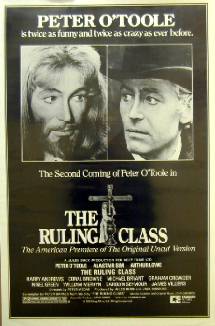
After the Irish actor, Peter O’Toole, died, some of my Facebook friends said that his best film was The Ruling Class. This piqued my curiosity, so I decided to watch it. (You can find the whole movie on Youtube.)

The Ruling Class is a 1972 film directed by Peter Medak, with a script by Peter Barnes, adapted from his own stage play.

The 13th Earl of Gurney (Harry Andrews) accidentally kills himself while engaging in autoerotic asphyxiation. His will leaves his entire estate to his only surviving son, Jack (Peter O’Toole). The problem here is that Jack believes he is Jesus Christ. He spends his time making speeches about love and hanging on a cross. This scandalizes the Gurneys and their aristocratic neighbors. Jack’s uncle, Sir Charles (William Mervyn) plots to take the estate away from him. He reasons that if he can get Jack to produce a male heir, he can then have Jack declared insane while having the Gurney line continue unbroken. Sir Charles persuades his mistress, Grace, (Carolyn Seymour) to woo Jack. Jack falls in love with her. They get married, and Grace soon gives birth to a son. Sir Charles’s plan, however, is complicated by the psychiatrist, Dr. Herder (Michael Bryant), who is determined to cure Jack of his delusion. After several failed attempts, Herder hits upon the idea of confronting Jack with a mental patient who also believes he is God. This appears to work; Jack seems to be restored to his old self. Sir Charles is still determined to have him committed, however, and he arranges to have a court-appointed psychiatrist interview Jack. The meeting gets off to a rocky start, but when Jack begins spouting reactionary and xenophobic political rhetoric, the doctor declares him to be sane.

The Ruling Class should have ended at this point. Instead, it goes into a lengthy coda, in which Jack convinces himself that he is actually Jack the Ripper, and he starts killing people. The joke here is that the “sane” Jack is actually a pathological murderer. This struck me as unnecessary, since it doesn’t build on the film’s previous ideas. What’s more, it makes the movie long: two-and-a-half hours. The characters and the situation simply aren’t strong enough to sustain one’s interest for that period of time. Satire is best done with a light, but sharp, touch. This movie does have many funny moments, though, and it benefits from strong performances. O’Toole is powerful and convincing as Jack.

It no doubt tells us something about O’Toole’s political views that he lobbied United Artists to make Barnes’s play into a film. He even went so far as to agree to do the part of Jack for no pay. The aristocratic Gurneys are portrayed as moral hypocrites. The movie strongly implies that Britain’s upper classes secretly yearn for fascism. Whatever his faults may have been, O’Toole was on the right side of history.
The Hunger Games: Catching Fire

December 14, 2013

Catching-Fire_poster

The Hunger Games: Catching Fire is the second installment of the films based on Joanne Collins’s young adult novels. Although I found it entertaining, I did not like it as much as the first film in the series. (You can read my review of that movie here. I will discuss the reasons for this below.

Catching Fire picks up where the previous film left off. Katniss (Jennifer Lawrence) returns to her home district after the game. She and Peeta (Josh Hutcherson) are about to go on a victory tour of the various districts. She meets with President Snow (Donald Sutherland), who warns her that she had better do as she is told, or there will be dire consequences. During the tour, it becomes clear to Katniss that she has become a symbol of resistance to the people. This is clear to the government as well. Snow’s henchman, Plutarch Heavensbee (Philip Seymour Hoffman) devises a scheme to solve this problem. They will make Katniss fight another Hunger Game, in which she will be made to kill people who have helped her. The aim is to disillusion people who see her as a heroine.

This is where I start to have a problem with this movie. When Katniss arrives at the Hunger Game, the government immediately tries to kill her, sending poisonous fog and giant babbon-like creatures at her, before she has a chance to kill anyone. It seems to me that the makers of this film were more concerned about having a lot of action than they were about maintaining narrative logic. Which is a problem with a lot of Hollywood movies.

The posters for this film feature the line: “Remember who the enemy is.” The line in the movie is actually “Remember who the real enemy is.” It occurs twice: Haymish (Woody Harrelson) says it to Katniss just before the Hunger Game, and a character whom Katniss mistakenly believes has betrayed her says it just before the film’s climactic scene. The word “real” is the most important word in the sentence. The Hunger Games create false enemies, when the real enemy is the government. The Hunger Games is a metaphor for how our society creates false enemies to distract us from our real enemy. This is why the story has had such a strong resonance with many people.

Chirs Hedges and Cynthia McKinney

December 9, 2013

Lauraflanders-GRITtvRoundtableCynthiaMcKinneyChrisHedgesMJRosenberg282

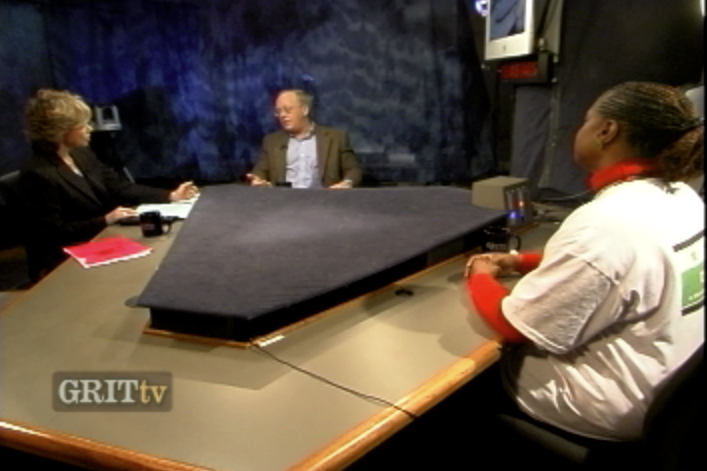
Chris Hedges has an article at Truthdig entitled Is America ‘Yearning for Fascism’? In it, he makes an argument that he’s been making on and off since 2008, which is that the United States is going to go down the same road that Yugoslavia did in the 1990’s. Hedges seems unfazed by the fact that this country is no closer to a civil war today than it was five years ago. The two biggest acts of violence of the last year, the Boston Marathon bombings and the Sandy Hook massacre, were both carried out by isolated misfits not associated with any political group.

One is, in fact, struck by the stability of U.S. society, especially considering the extreme inequality of wealth that exists in this country. The Occupy movement came and went without making even a dent in the status quo. It would perhaps be more useful for Hedges to try to analyze the reasons for this, rather than make dubious apocalyptic predictions.

What is strange about this article, though, is that Hedges suddenly and inexplicably quotes Cynthia McKinney – yes, that Cynthia McKinney, the one who earlier this year claimed that the Boston Marathan bombings were a false flag operation. Why would Hedges, or anyone else for that matter, care what this woman has to say (except perhaps as an example of a particular type of political lunacy)? Hedges writes:

    It is time for us to stop talking about right and left,” McKinney told me. “The old political paradigm that serves the interests of the people who put us in this predicament will not be the paradigm that gets us out of this.

Somebody as historically literate as Hedges must surely know that the claim of going beyond right and left is a common theme in fascist rhetoric. (Yes, I am implying that McKinney is leaning towards fascism. This is someone who repeats Alex Jones nuttery, after all.)

McKinney also says:

    I am a child of the South. Janet Napolitano tells me I need to be afraid of people who are labeled white supremacists but I was raised around white supremacists. I am not afraid of white supremacists. I am concerned about my own government. The Patriot Act did not come from the white supremacists, it came from the White House and Congress. Citizens United did not come from white supremacists, it came from the Supreme Court.

What did come from white supremacists were lynchings, sundown towns, racist police departments, and a black underclass. And McKinney wants to make common cause with these people.

I have always had deeply mixed feelings about Hedges. He sometimes makes good arguments, but there are times when he seems to have drifted off into the ether. (Here is an article in which I write about a talk that Hedges gave in Oakland a few years ago.)

Boondoggle

December 2, 2013

groucho-marx-horse-feathers-3

The Los Angeles Unified School District is prepared to spend $1 billion on iPads to be distributed to students and teachers. This is while the schools in Los Angeles are plagued by too large class sizes (40 or more students) and crumbling buildings. (A friend of mine who works as a high school teacher tells me that there is sometimes raw sewage in the hallways of the school where he works.) The iPads, which cost $647 each, will be obsolete in a few years, and in three years the district will have to spend $60 million to renew the licenses of the educational programs on the iPads. And the district apparently has no plans for what to do about iPads that get lost or broken.

This seems to me to be symptomatic of our society’s love of gimmickry when it comes to education. Standardized tests and charter schools are seen as magic solutions to our schools’ ills. Handing out iPads to students is the logical result of this shallow thinking.

Obamacare Rolls Out

November 21, 2013

Clive, Colin (Frankenstein)_02

After hearing all the horror stories about HealthCare.gov, I decided to use California’s exchange site, CoveredCa.com. I must say, it worked well, although it had an annoying habit of asking certain questions over and over again. (I’ve had this problem with websites before. Somebody needs to explain to web designers that it’s only necessary to ask a question once.) Within a matter of minutes I had applied for coverage. Not bad.

So how is it that the State of California, which has its own proud history of corruption and incompetence, was able to do a better job of the roll-out than the federal government was? The Obama Administration had over two years to prepare for this, and they did a lousy job. Perhaps this is a sign that Obama has never really cared about the health care crisis in this country. When he ran for president, he was pressured to come up with a health care proposal, so he opted for an idea that the Republicans came up with to try to derail calls for single payer. No doubt he decided it wasn’t worth the trouble to call for Medicare for All, and besides, that wasn’t what the insurance industry wanted.

Amour

November 18, 2013

Amour-poster-french

Besides Amour, I have only seen two other films by Michael Haneke: The Seventh Continent and The White Ribbon. On the surface, Amour appears to be different from the others, but it actually deals with similar themes, in particular the question of how it is possible for ordinary people to do terrible things.

Georges (Jean-Louis Trintignant) and Anne (Emmanuelle Riva) are an elderly married couple living in Paris. One day, Anne suffers a stroke. Her doctors perform an operation on her carotid artery, but it is botched, leaving her paralyzed on her right side. For a time, she seems to be improving, but then her condition starts to rapidly deteriorate. Georges is forced to take care of her, which increasingly puts an emotional burden on him. His daughter, Eva (Isabelle Huppert), urges him to have Anne put in a hospital, but he refuses, because he promised Anne that he would never do that.

From the beginning, one can see the tragedy that this situation is moving towards. At times, Georges seems to sense this himself, but he seems incapable of acting any way other than he does. His devotion to Anne becomes a trap both for himself and for her.

This film has an emotional resonance for me. During the last ten years of his life, my father, who suffered from Type 2 diabetes, was almost continuously ill. This put a terrible strain on my mother and on other members of my family. At what point does letting go become the most humane thing to do?

The Guardian Advocates Saudi Exceptionalism

November 4, 2013

saudi-women-2f834c8002f7d0ef

The Guardian is my favorite newspaper. It often has articles that I find informative and thought-provoking. Every now and then, however, the paper makes an editorial decision that I find inexplicable. On Saturday, November 2, they ran an article by a Saudi Arabian man named Ahmed Abdel-Raheem titled Word to the west: many Saudi women oppose lifting the driving ban. In it he writes:

    If you read any western coverage of the recent protest of Saudi Arabia’s female driving ban, you probably thought, “finally, the kingdom is waking up”. But the problem is, that’s not what many Saudis think, including Saudi women.

Raheem goes on to claim that he conducted an informal survey of female college students in Saudi Arabia. He says:

    To my surprise, 134 (out of 170) respondents said female driving is not a necessity and that it opens the door for sexual harassment and encourages women to not wear the niqab under the pretext that they cannot see the road when driving. Some also fear that it gives husbands a chance to betray and agree with the assertion that it creates sedition in society.

That’s an interesting word there: sedition. Not long ago Saudi Arabia helped crush an uprising in neighboring Bahrain. I’d be curious to learn about the social backgrounds of these women, particularly if any of them come from families connected with the government. Raheem quotes one respondent as saying:

    Honestly, I don’t like women to drive. This will create sedition … I agree that there are already different kinds of sedition we see every day, but the right place for a woman is her house; this will really save her from what is happening in the outside world.

Sedition seems to be a big concern among some people. Raheem then writes:

    This stresses that the continuous attempts from the west to impose its values elsewhere are pointless. Western feminism is not only unlikely to take hold in countries like Saudi Arabia, it is not what many women in the kingdom want. Consider what Amany Abdulfadl, member of the Egyptian Centre for Monitoring Women’s Priorities, said in a 2007 piece in Al-Ahram Weekly: the west’s ”definition of equality cannot work in our Arab world because neither will our women find jungles to cut wood in, nor our men ever have breasts to feed babies.’

You see, the best way to make a point is with a non-sequitur.

    People in Saudi Arabia have their own moral views and needs. What works in other societies may not fit in Saudi (sic), and the reverse. In short, instead of launching campaigns to change the driving laws in the kingdom, the west should first ask Saudi women if they really want this or not, and western countries should accept the result, even if it’s not to their liking.

The next day – Sunday, November 3 – The Guardian ran an aricle titled Saudi Arabia ‘arrests Kuwaiti woman for driving diabetic father to hospital’. It tells us:

    The English-language Kuwait Times said that the woman had been driving in an area just over the border, with her father in the passenger seat, when she was stopped by police. The woman, who said that her diabetic father could not drive and needed to be taken to hospital for treatment, was being held in custody pending an investigation, the paper said, citing police.

Yet another reason why women shouldn’t be allowed to drive is that they might be tempted to drive their diabetic fathers to the emergency room instead of letting them die. This might work in other countries, but it might not fit in Saudi Arabia. (And, who knows, it could lead to sedition.)

According to his bio, Raheem currently lives in Poland, where the women are allowed to drive, and the men do not have breasts. (I swear, this is true.)