The System is Broken

July 15, 2013

trayvon_martin

We should ask ourselves, as individuals and as a society, how we can prevent future tragedies like this.
– Barack Obama

One way to prevent future tragedies like this is by putting vigilante nutjobs such as George Zimmerman in prison. However, it should be clear by now that the state of Florida was never really serious about doing that. They only brought charges against Zimmerman because of public pressure, then they blew the case against Zimmermann. The state of Florida is perfectly happy to have deranged people with guns killing innocent teenagers, provided that latter have a certain skin color.

It’s worth noting that the prosecutors in the Zimmerman case are also responsible for this travesty:

    Last Friday, Jacksonville mother Marissa Alexander was sentenced by a Florida judge to 20 years in prison for firing what she says was a “warning shot” into the wall after a physical altercation with her husband, Rico Gray.

    The case has set off yet another controversy involving the state’s “stand your ground” law, which is under intense scrutiny after the shooting death of Trayvon Martin in February. Critics, including Congresswoman Corrine Brown (D-Fla.), are crying foul.

    How, they ask, could a 31-year-old woman in a relationship with a man who had a history of domestic violence, and whose actions did not result in any physical injury, be sentenced to two decades in prison while George Zimmerman, the man who shot and killed Martin, is out on bail?

A good question.

The system is broken. It is broken beyond repair.

Hotel California

July 8, 2013

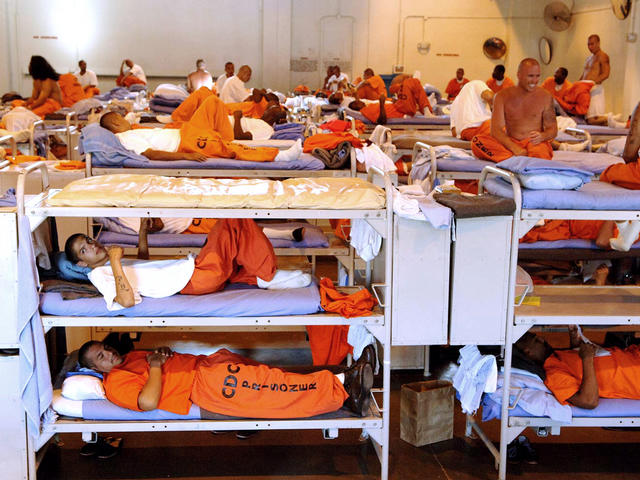
California Prisons

California’s prison system is a disgrace. Today, prisoners at the Pelican Bay prison are going on a hunger strike to protest the fact that they have been in solitary confinement for years, and in some cases, for decades. At almost the same time, there have been revelations that between 2006 and 2010, the prison system sterilized almost 150 women:

    Crystal Nguyen, a former Valley State Prison inmate who worked in the prison’s infirmary during 2007, said she often overheard medical staff asking inmates who had served multiple prison terms to agree to be sterilized.

    “I was like, ‘Oh my God, that’s not right,’ ” Nguyen, 28, said. “Do they think they’re animals, and they don’t want them to breed anymore?”

Eugenics is alive and well in the Golden State. Ah, but that is not the only problem. Gov. Jerry Brown has indicated that he will not comply with a court order that he reduce overcrowding in the state’s prisons, which are currently at 200% of their capacity. The courts have ordered the governor to reduce the prison population so that the prisons are at 137.5% capacity. That is, they are merely asking the state to make the prisons a little less overcrowded. Yet even that is too much for Gov. Brown, who wants to appeal the case to the Supreme Court a second time, even though the high court has already ruled that the state must comply with the lower court’s ruling.

Oh, and California is considered a “liberal” state.

Egypt’s Revolution is Not Over

July 5, 2013

Fireworks over Tahrir Square

I suppose it shouldn’t come as a surprise that writers at CounterPunch have taken a gloomy view of the recent events in Egypt. They point out that Morsi was Egypt’s first democratically elected president. True, he did win the election, but he did so in a problematic way. Remember that in the first round Morsi only won 24.78% of the vote. In the second round, in which Morsi’s only opponent was Ahmed Shafik, Morsi won 51.73% of the vote. And many people voted for Morsi simply because they didn’t want Shafik, the military’s candidate, to win. Morsi clearly didn’t have overwhelming support. And once in office, he continued the neoliberal economic policies that provoked the Egyptian people into rising up in the first place. So it should be no surprise that he is now out.

The fact that the military has intervened is worrisome. However, it is clear that the military is not the master of the situation, rather it is trying to contain it. The Egyptian people have come too far to return to the days of Mubarak. A lot depends at this point on what the people on the street choose to do next.

Obama Agonistes

July 4, 2013

krazy
Barack Obama and a liberal.

Liberals who talk about what a brilliant political strategist President Obama is are on a par with conservatives who talk about what a great war leader George W. Bush was. Consider the recent incident in which the plane carrying Bolivian president Evo Morales was diverted and forced to land, supposedly because somebody thought Edward Snowden might be on it. What did Obama hope to gain by doing this? (And it’s pretty clear that Obama must have been behind this.) Did he wish to show the whole world that he is willing to trample on international law just to punish a whistleblower? He just made himself look petty and ridiculous.

Or consider Obama’s recent decision to delay until 2015 implementing the requirement of the Affordable Care Act that companies with 50 or more employees supply them with health insurance. One website has hailed this as a brilliant tactical move that will rob the Republicans of a talking point during the 2014 congressional elections. In fact, the decision makes Obama appear weak. Also, it suggests that he lacks confidence in his own much ballyhooed health care bill. And then there’s the obvious fact that this decision is a betrayal of all those people who thought they were going to get employee health insurance in 2014. (I guess they will just have to cross their fingers and hope that they don’t get sick for another year.)

The sequester that Obama foolishly agreed to will likely kill off the weak economic recovery. The president and his party will be blamed for this, and the result will be Republican victories in congressional and local elections. That means more Republican officeholders with their reactionary social views and their anti-labor legislation.

Ah, but nothing can shake the admiration that some liberals have for Obama. Decades from now, liberal historians will be talking about the strategic brilliance of a president who accomplished virtually nothing.

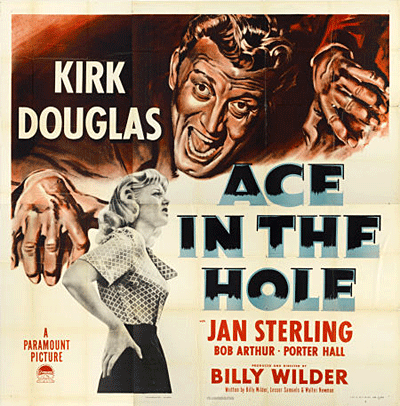
Ace in the Hole

June 30, 2013

AiH

Chuck Tatum (Kirk Douglas) is an ethically challenged reporter who has been fired from several big city newspapers. He has wound up broke in Alberquerqe, New Mexico, where he persuades a local newspaper to hire him. Tatum is looking for that one big story that will get him hired by a major newspaper. While on an assignment, he stops to get gas at a diner/souvenir store, where he learns that the owner, Leo Minosa (Richard Benedict), has just been trapped in a rock fall while exploring the nearby ruins of an Indian cave dwelling. Sensing that this could be a big story, Tatum inserts himself into the situation, becoming the one who brings food and water to the unfortunate Leo. Tatum writes a melodramatic account of this incident for his paper. He then teams up with the corrupt local sheriff, Kretzer (Ray Teal), who believes he can use this to guarantee his re-election, as well as with Leo’s callous wife, Lorraine (Jan Sterling), who sees the publicity as a way to improve business. Tatum persuades Kretzer to pressure the rescuers into trying to reach Leo by drilling through the mountain, rather than going through the tunnel, which would take much less time. Tatum reasons that the longer the rescue takes, the more drama he can put into this news reports, thus making it into a bigger story. As the days go by, curiosity seekers begin showing up. Eventually a carnival arrives and sets up rides outside where Leo is trapped.

Billy Wilder’s Ace in the Hole was not well received by critics when it came out in 1951. They apparently thought that it was excessively cynical. The Hollywood Reporter, for example, called it “… nothing more than a brazen, uncalled-for slap in the face of two respected and frequently effective American institutions – democratic government and the free press.” In recent years, however, critics have taken a much kinder view of the film. I think one reason for that is that in the age of CNN and Fox News, it’s hard for people to take the noble view of the “free press” that the Hollywood Reporter‘s critic took.

Bosley Crowther, however, did make a valid point when he wrote: “There isn’t any denying that there are vicious newspaper men and that one might conceivably take advantage of a disaster for his own private gain. But to reckon that one could so tie up and maneuver a story of any size, while other reporters chew their fingers, is simply incredible.” It is highly improbable that a single reporter could completely control events the way Chuck Tatum does in this film. However, a group of reporters can control the way people perceive a story. Consider, for example, how some reporters have turned the recent revelations about the N.S.A. from a story about government spying to a story about Edward Snowden’s “narcissism”.

In Ace in the Hole, we see people enjoying carnival rides, while only a few hundred yards away, Leo is suffering, his legs trapped under rocks. This film is also about our society’s tendency to turn events into spectacles. The public’s reaction to the recent Boston Marathon bombings (“Boston Strong!”) was a good example of that, but the classic case in my opinion was the O.J. Simpson trial. Remember the “Ito Dancers”? Is Wilder’s film really much of an exaggeration of how people behave?

Ace in the Hole has Wilder’s usual biting dialogue, and the underrated Kirk Douglas gives a powerful performance as Tatum.

Downfall

June 25, 2013

215px-Der_Untergang_-_Poster

Downfall is a 2004 German film about the final days of the Third Reich. It was directed by Oliver Hirschbiegel from a screenplay by Bernd Eichinger (who also wrote the screenplay for The Baader-Meinhof Complex). The film mostly takes place in the bunker where Hitler(Bruno Ganz) and other members of this government are hiding out as the Soviet army surrounds Berlin.

Ganz’s performance in this film caused some controversy. Some people objected to the idea of portraying Hitler as human. This argument doesn’t make sense to me. Hitler was human. Does it make sense to portray him as a supernatural monster? Would that help us to understand what happened? Obviously not.

One thing that struck me as I watched this film was how out-of-touch with reality the German leaders seem. (Himmler (Ulrich Noethen) talks about negotiating a ceasefire with Eisenhower. He wonders whether he should give him the Nazi salute or shake his hand.) The generals talk about “loyalty to the Fuehrer”, even after he accuses them of betraying them. At the end of the film, reality finally asserts itself in the form of Russian soldiers swarming over the city.

More than any other film I’ve seen, Downfall brings home the sheer lunacy of Nazism. Children and old men are sent into battle. Civilians are shot or hanged as “traitors”. We see Magda Goebbels (Corinna Harfouch) methodically murder her own children, because, she says, “life is not worth living without National Socialism”. Some of the scenes in this film have a surreal quality to them. We see drunken officers laughing and playing cards outside Hitler’s private quarters, while their Fuehrer is planning his suicide. And we see a drunken orgy in a hotel lobby while the Russians are closing in on the city. The scene is almost like something out of Bosch.

Downfall is a great film, and arguably the best film about World War II. Watching this film, however, I kept thinking “How did people like this come to rule an entire country?” It would be interesting if someone were to make a film about how Hitler became the Fuehrer.

M.I.A Knew about N.S.A. Spying Three Years Before News Media Did

June 23, 2013

MIA-006

In 2010, the British pop singer, M.I.A., released a song called “The Message”, which contains the line: “Your headphones connected to your iPhone / Your iPhone’s connected to the Internet / The Internet’s connected to the Google / The Google’s connected to the Government.” Which is an accurate description of what’s been going on.

The Justice Department has just announced its plans to charge Edward Snowden with espionage. It seems that the government and its supporters in the news media are outraged that an N.S.A. employee dared to tell the American people what any intelligent person could have guessed.

A Global Revolution?

June 19, 2013

brazil-protest-AP3937927989_610x344
Rio de Janeiro, Brazil

The recent protests in Turkey and in Brazil have brought some renewed optimism to this country’s perpetually gloomy Left. In The Daily Kos, Ray Pensador writes:

    We’re here folks. This is the real thing. The global revolution has started. What’s happening in Turkey, and Brazil, as a write this, are not unrelated events. The revelations about how corparatist cartels are using government institutions to cast a wide net of surveillance over the entire population (NSA spying) with the intent of using it as a tool to control, manipulate and exploit the citizenry, is part of the collusion.

I don’t want to sound like Mr. Downer, but I’ve heard this kind of talk before. I heard it after the “Battle in Seattle” in 1999. (I remember Alex Callinicos saying that Seattle was “a fork in the road”. It was more like a speed bump for neoliberalism.) I also heard this talk in the Occupy movement in the fall of 2011. Yet at some point the increasing corruption and criminality of our global economic system is going to produce some kind of sustained fightback. If not now, some time in the near future. Something has got to give.

What Were They Thinking?

June 12, 2013

Edward-Snowden-The-US-Is-Hacking-Everyone-Everywhere-2
Edward Snowden

To me, the most astonishing thing about the most recent scandal plaguing the government is that the Obama Administration actually believed that it could keep such an immense operation a secret. I remember that when I would argue with 9/11 conspiracy theorists, one of the points I would make was that the conspiracy they were describing would have involved so many participants that it would have been impossible to keep it a secret. (This argument is even more powerful when applied to the “moon landing was a hoax” conspiracy theory.) It now appears that those supposedly hard-nosed realists who control our national security apparatus are every bit as naïve as those 9/11 Truthers. A sobering revelation.

If Edward Snowden hadn’t spilled the beans about this, somebody else would have eventually done so. It was only a matter of time. This hasn’t prevented the punditocracy from vilifying Snowden, calling him, among other things, a “narcissist”, as if these people weren’t obvious narcissists themselves. It shows you how much the War on Terror has corrupted our society that many of our journalists don’t even pretend to care about civil liberties and government transparency any more.

One must also question the intelligence of the corporate executives who went along with this insane scheme. At least one person has pointed out that this scandal threatens the future of the whole U.S. Internet industry. I guess maybe these guys aren’t so smart after all.

It’s always good to see the one percent make fools out of themselves.

Spartacus

June 11, 2013

Spartacus_-_1960_-_poster

Spartacus is a 1960 film that stars Kirk Douglas as the leader of the ancient Roman slave rebellion. It was directed by Stanley Kubrick, from a screenplay by Dalton Trumbo, which was based on a novel by Howard Fast. Trumbo had been blacklisted during the early fifties. (Trumbo and Fast were both former members of the Communist Party.) At Douglas’s insistence, Trumbo was given an on-screen credit, in violation of the black-list. Spartacus is widely credited with helping to end the black-list in Hollywood.

Because Trumbo was black-listed, many people tend to interpret Spartacus as being about the Red Scare. (I have a deep reluctance to use the liberal term, “McCarthyism”. I will have to discuss that at some other time.) This does seem to apply to the famous “I am Spartacus” scene. There is, however, another way of looking at this film, that is more relevant to our current situation. A large part of the story details how the Roman general, Crassus (Laurence Olivier), uses the uprising to persuade the Roman Senate to give him dictatorial powers, in much the same way the Bush and Obama have used the threat of Al Qaida to persuade Congress to give them virtually dictatorial powers. Some things never change.

Spartacus has some powerful moments. The battle scenes are well done. The final battle between Spartacus’s army and Crassus’s is impressive to watch. And it’s fun to watch Charles Laughton and Peter Ustinov as a couple of scheming Roman politicians. I can’t, however, call Spartacus a great movie. It drags in some places and it is sentimental in others. A fight scene between Kirk Douglas and Tony Curtis towards the end of the film is contrived and unconvincing. And Alex North’s music score is repetitive and sentimental in places. Kubrick did not have complete artistic control over this film, which seems a shame to me. This could have been a truly great film.