Conspiracy Trolls Busy at Work

April 17, 2013

Mike_Big_SmileBW150
Mike Adams

Hardly had the smoke cleared from the bombs at the Boston Marathon, than our nation’s conspiracy trolls were hard at work, assuring us that this was another “false flag operation”. You see, any time a shooting or bombing happens, it’s a false flag operation by the government. It’s simply impossible for anything to happen in this country without the government being behind it.

Just ask Mike Adams (his friends call him the “Health Ranger”.) He is the editor of NaturalNews.com, which, I’ve been told, gets over 4 million unique hits each month. According to Wikipedia:

    Adams is an AIDS denialist, a 9/11 truther, a birther and endorses conspiracy theories surrounding the Sandy Hook Elementary School shooting.

So, name just about any stupid idea you’ve ever heard, and chances are that Mike Adams believes it’s true. (Yeah, you guessed it, he believes in chemtrails.) For Adams, life is just one long, bad episode of The X-Files.

Not long after the bombings, Adams wrote on his website:

    The official story of the bombing is that terrorists detonated two bombs at the marathon finish line and that the Boston bomb squad magically located a third bomb one mile away, identified the bomb, rigged it with explosives and initiated a “controlled explosion” all in less than an hour! (Absurd.)

No, that is not the official story, and it has never been the official story. Shortly after the bombings, there were news reports about a third explosion occurring at the JFK Library, but it later turned out that this was just a fire in the equipment room. The police did search the library for a bomb, but they never claimed to have found one. So, Adams invents an “official story”, and he then proceeds to punch holes in it. Brilliant.

Adams later tells us:

    …the mainstream media is pushing a new narrative that blames “right-wing extremists” for the bombing, even without a shred of evidence to back that up.

Really? I haven’t noticed. To be fair, Adams probably doesn’t actually pay attention to the mainstream media, since he knows that everything they say is a lie. He also notes:

    It is impossible for a bomb squad to have located, analyzed, rigged and detonated the third bomb in under an hour, especially when it was located one mile away, at the Kennedy Presidential Library.

Which is no doubt why the mainstream media don’t claim that they did any such thing.

Adams then comes to this shocking conclusion:

    Although it’s still a bit early to know for certain, this looks more and more like a planned event that was deployed by the Boston bomb squad, called a “drill,” then used as a pretext for the President to call for TSA agents to be on the streets at all future sporting events.

    And that, in turn, is the run-up to the TSA occupation of America, which has always been the goal of Obama. Remember that back on the campaign trail, he announced he wanted to build a “civilian national security force.”

That’s right! Obama can’t settle for the FBI, the CIA, the ATF, the National Guard, Homeland Security, the Federal Marshals, the Secret Service, and local police departments. No! He must have TSA agents groping us on the streets! Bwahahahahahahahahaha!

I gave in to my morbid curiosity and looked at some of the other posts on Adams’s website. I found one entitled Should you leave the USA before the collapse? Words of wisdom from someone who tried. (I wont’ comment on Adams’s use of capitals.) By “collapse”, Adams means that the US is becoming a police state. (I would argue that the US is already technically a police state, but I will leave that for some other time.) Adams begins by talking about how he has visited other countries and found them wanting in various ways. He then advises people to move to Texas instead:

    Because Texas has its own power grid unlike the rest of the nation. Texas can grow its own food. [Texas has also been known to have severe droughts.] Texas is the energy capital of the nation and can produce natural gas, diesel, oil and even jet fuel. Texas has masses of armed patriots who own more guns than they do pairs of shoes, and that makes Texas practically impenetrable to any invading force. [Does this guy know anything about history?]

    For example, suppose North Korea launches an ICBM into the high atmosphere over North America and unleashes an EMP weapon that destroys nearly all electronics.

    This could theoretically be followed by a naval invasion of forces from Red China [sic] and North Korea, both of which suffer from too many young males that can hardly be fed and might as well be thrown at some enemy nation as cannon fodder.

This could theoretically be followed by Martians landing in New Jersey and killing every human being, so they can then leave their dying planet and colonize Earth.

Life’s a bitch, huh?

The New York Times Beats the Drums of War (Again)

April 14, 2013

new-york-times-building

It was irresponsible of the New York Times to publish the op-ed piece by Jeremi Suri titled Bomb North Korea, Before It’s Too Late. Suri argues that the U.S. should take out North Korea’s missiles. He argues that this will not result in a war because:

    The North Korean government would certainly view the American strike as a provocation, but it is unlikely that Mr. Kim would retaliate by attacking South Korea, as many fear. First, the Chinese government would do everything it could to prevent such a reaction. Even if they oppose an American strike, China’s leaders understand that a full-scale war would be far worse. Second, Mr. Kim would see in the American strike a renewed commitment to the defense of South Korea. Any attack on Seoul would be an act of suicide for him, and he knows that.

First of all, it’s not clear how much influence China actually has over North Korea. Second, it’s just as possible that “Mr. Kim” would see the attack as a prelude to a ground invasion. And if it is true that “Mr. Kim” knows that a war with the U.S. is “suicide”, why should we worry about him having missiles?

Suri concedes that North Korea might attack South Korea:

    A war on the Korean Peninsula is unlikely after an American strike, but it is not inconceivable. The North Koreans might continue to escalate, and Mr. Kim might feel obligated to start a war to save face. Under these unfortunate circumstances, the United States and its allies would still be better off fighting a war with North Korea today, when the conflict could still be confined largely to the Korean Peninsula.

It think it worth noting that an estimated two million Koreans were killed in the last Korean war. It’s reasonable to suppose that at least that many would die in another Korean war. This is the price that Juri would be willing to pay to maintain “stability” in the Far East.

Since the U.S. clearly has not exhausted its diplomatic options in Korea, one can only wonder why the Times thought it worth running an article like this.

Crash

April 10, 2013

Crash_ver2

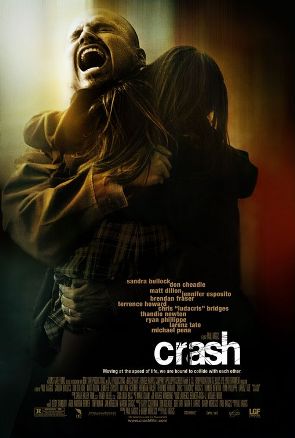
I recently learned through the Internet that some people are still seething over the fact that the 2006 Best Picture Oscar went to Crash instead of Brokeback Mountain. (Crash also won for Best Original Screenplay that year.) I missed Crash when it came out, but since I wasn’t all that impressed by Brokeback Mountain, I was curious to know why people though it was better than Crash, so I recently watched the latter film.

Crash is set in current day Los Angeles, and it tells the intertwined stories of a group of characters. These include: a black police detective, a Latina police detective, a racist white cop and his partner, a white district attorney and his wife, a black TV director and his wife, a Mexican locksmith and his daughter, an Iranian shopkeeper and his daughther, an Asian man involved in human trafficking, a black health care worker, and two black carjackers, one of whom spouts black nationalist rhetoric. The racial or ethnic identities of these characters are important, because this film is about the problem of racism.

This film is essentially a series of improbable coincidences that take place over a period of forty-eight hours. To take the most egregious example, the racist white cop and his partner pull over the black TV director and his wife as the latter are driving home. During the stop, the white racist cop sexually molests the wife. The next day, the racist white cop arrives at the scene of an accident. A woman is trapped in an overturned car. The racist white cop goes to rescue her, and – you guessed it – the woman turns out to be the same woman he molested the night before. What makes this scene offensive is that it seems to imply that being a racist and sexist pig doesn’t necessarily make you a bed person.

Coincidences do happen, but when a film presents us with one coincidence after another, it strains credulity. Furthermore, it’s lazy writing. Writers usually only resort to coincidences when they need to find some way to move the story along.

Another problem with this film is ham-handedness. Almost every conversation in it involves race in some way. When, for example, the Latina detective and the black detective have an argument after having had sex, she accuses him of having stereotyped ideas about Hispanics. In the world of Crash, people can’t even have a lovers’ quarrel without prejudice becoming the issue. Yes, racism is a problem in our society, but that doesn’t mean that people talk about it twenty-four hours a day.

There is also a problem of basic honesty. The black detective and the Latina detective are assigned to investigate an incident in which a white cop shot a black cop. The white cop claims that he acted in self-defense. Although it is unclear as to what exactly happened, the white district attorney pressures the black detective into filing a charge of murder against the white cop, because there is an election coming up and the district attorney wants to secure the black vote. Does anyone actually believe that this would happen in real life? District attorneys tend to be protective of the police, and (at least in L.A.) they don’t give a damn about the black vote. This part of the film is clearly inspired by an actual incident in which a white LAPD officer shot and killed a black LAPD officer. The white officer was acquitted of all wrong-doing.

Crash has a 75% “fresh” rating on Rotten Tomatoes, meaning that most critics liked it. It appears that people overpraised Crash because it deals with the issue of racism, just as people overpraised Brokeback Mountain because it deals with the issue of homophobia. There’s an old saying among artists that “good intentions are not enough”. Someone need to explain this to critics.

Breaker Morant

April 8, 2013

Breaker_morant

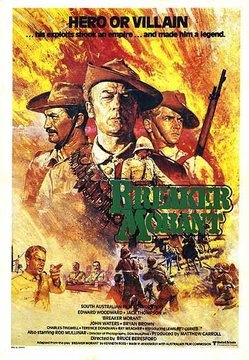
Breaker Morant is a 1980 Australian film that is a loosely fictionalized account of an actual incident that occurred during the Boer War. Lt. Harry “Breaker” Morant (Edward Woodward), Lt. Peter Handcock (Bryan Brown), and Lt. George Ramsdale Witton (Lewis Fitz-Gerald), who are officers in an elite British army unit called the Bushveldt Carbineers, have been accused of killing captured Boer guerillas, as well as a German missionary. Maj. J.F. Thomas (Jack Thompson), who has no previous legal experience, has been appointed to act as their attorney at the court martial. The film alternates between trail scenes and flashbacks of the events being discussed. Despite his lack of experience, Thomas makes a valiant attempt to defend the men, but it becomes clear that the court is determined to find the men guilty.

Bruce Beresford, the director of Break Morant, once said about it:

    The film never pretended for a moment that they weren’t guilty. It said they are guilty. But what was interesting about it was that it analysed why men in this situation would behave as they had never behaved before in their lives. It’s the pressures that are put to bear on people in war time… Look at all the things that happen in these countries committed by people who appear to be quite normal. That was what I was interested in examining. I always get amazed when people say to me that this is a film about poor Australians who were framed by the Brits.

This film does show that Morant and the others were corrupted by the war. However, Breaker Morant does go out of its way to give the impression that these men were used as scapegoats, and that the British singled them out because they were Australians. (The British officers repeatedly refer to them as “colonials”.) So, it’s perhaps not surprising that some people would interpret it as exonerating these men, even though that’s not what Beresford intended.

Breaker Morant is a good film that has some powerful moments. The scene in which Thomas gives his summing up speech is especially effective. However, as a depiction of the dehumanizing effect of war, it is not as strong as Apocalypse Now or Full Metal Jacket.

I should point out that Breaker Morant takes some liberties with the historical record. It changes some of the details of what happened, and it includes events that never occurred. In one scene, for example, the fort in which Morant and the others are being tried is attacked by the Boers. This never happened. In fact, the trial took place in Pretoria, far from the war zone. One can only assume that Beresford included this because he wanted to direct a battle scene. After he directed Breaker Morant, Beresford went to Hollywood. I suspect he wanted to show Hollywood producers that he could direct a “big picture”.

Roger Ebert (1942-2013)

April 5, 2013

ebert_obit_add_P5

The word “beloved” is almost never used to describe a critic, but, judging from the comments I’ve been reading about him, the late Roger Ebert seems to be the exception. I think this is because he managed to give the impression that he was basically a decent person, even when he was being waspish. He was willing to admit that he was not infallible (which is unusual for a critic), and he was courteous towards people who disagreed with him.

Pauline Kael and Andrew Sarris had far more influence among cineastes, but Ebert reached a much broader audience, because of his shrewd use of first television and then the Internet. When Ebert and Gene Siskel started their Sneak Previews TV show back in the 1970’s, there was much skepticism that people would want to watch a show that was basically two guys talking about movies. (Critics derided them as “the Fat Guy and the Bald Guy”.) Yet the show turned out to be hugely popular, and it was much imitated. Part of the attraction of the show was the sometimes tense relationship between Ebert and Siskel. (I have a suspicion that they may have deliberately played this up a bit. In that respect, it can be argued that Sneak Previews was the first “reality” TV show.) Their “thumbs up/thumbs down” gimmick irritated many of their fellow critics, but Ebert was in his own way an entertainer who knew how to get an audience’s interest.

Over the years, Ebert praised a lot of movies that I didn’t really think were that good, though in that respect he was no worse than most other critics. One thing I will say for Ebert is that he believed that it’s legitimate to criticize a film for moral reasons, which is something I completely agree with.

Paths of Glory

April 3, 2013

PathsOfGloryPoster

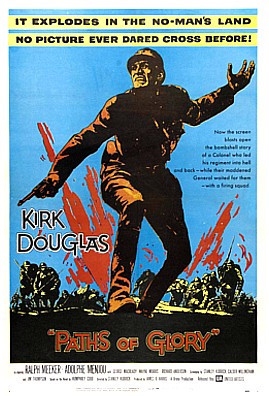
Stanley Kubrick’s 1957 film, Paths of Glory is one of the greatest war films ever made. Indeed, I would rank it as second only to Renoir’s Grand Illusion.

Colonel Dax (Kirk Douglas) is serving in the French Army during World War I. His commanding officer, the ambitious General Mireau (George Macready) orders him to lead his regiment in a suicidal attack on a heavily fortified hill. When Dax shows reluctance to do this, Mireau questions his patriotism. An incensed Dax tells Mireau that he will lead the attack. The next day, Dax leads his men into battle, but an intense artillery barrage forces them back into the trenches. Refusing to admit that the attack was a bad idea, Mireau claims that it failed because the soldiers were cowards. He orders that one soldier be picked from each battalion to be tried for cowardice. Dax, who was a lawyer in civilian life, announces that he will defend the men in court. The trial turns out to be rigged, however, and despite Dax’s best efforts, the men are condemned to death.

This film is filled with powerful images. There is, for example, a long tracking shot of Dax walking through the trenches just before the attack. The soldiers are lined up along the walls, and shells are exploding outside the trenches. We can see from the expression on his face that Dax has convinced himself that he can somehow make this insane plan work through sheer willpower. The scene is a striking depiction of the self-willed bravado that make war possible.

Paths of Glory is about bureaucratic corruption and incompetence. It makes the point that the military system actually rewards cynicism and ambition rather than courage and honor. (One can see this in the Army’s treatment of Bradley Manning.) In a scene between Dax and General Broulard (Adolphe Menjou), the latter assumes that Dax has opposed Mireau because he wants the latter’s position. When Dax tells him that he was actually trying to defend his men, Broulard reacts with a mixture of surprise and comtempt.

Paths of Glory is based on a novel by Humphrey Cobb that was inspired by an actual incident in the First World War. This film wasn’t shown in France for many, apparently because members of the French military objected to its portrayal of French army officers. (I guess these guys were a little touchy after their less than stellar performance during World War II.)

A great film.

Rehabilitating the Kingfish

March 25, 2013

J+B-164_Huey-Long-the-Kingfisher
Huey P. Long, a.k.a. The Kingfish.

Mike Whitney has posted an article on CounterPunch titled Our Chavez: Huey Long. There seems to be an effort in recent years on the part of some people to to try to portray the sometime governor of Louisiana and U.S.Senator as a great champion of the people, no doubt because of his ant-capitalist rhetoric. Yet when one takes a closer look at his life, it becomes clear that things were not that simple.

During Long’s lifetime, most of the Left regarded him with deep wariness, if not outright hostility. There were good reasons for that. First of all, he governed Louisiana as a virtual dictator. He even organized a secret police force to keep watch on his opponents as well as on his followers.

Long was also a white supremacist. He maintained Louisisana’s Jim Crow laws. (Long would sometimes smear his opponents by spreading rumors that they had “coffee blood”. This gives a bitter irony to calling him “our Chavez”.) Long’s apologists point out that he didn’t talk about white supremacy in his speeches. This was perhaps because he didn’t need to. In 1935, Roy Wilkins interviewed Long for The Criis. They discussed an anti-lynching bill that Long opposed in the Senate:

    How about lynching. Senator? About the Costigan-Wagner bill in congress and that lynching down there yesterday in Franklinton…”

    He ducked the Costigan-Wagner bill, but of course, everyone knows he is aganst it. He cut me off on the Franklinton lynching and hastened in with his “pat” explanation:

    “You mean down in Washington parish (county)? Oh, that? That one slipped up on us. Too bad, but those slips will happen. You know while I was governor there were no lynchings and since this man (Governor Allen) has been in he hasn’t had any. (There have been 7 lynchings in Louisiana in the last two years.) This one slipped up. I can’t do nothing about it. No sir. Can’t do the dead nigra no good. Why, if I tried to go after those lynchers it might cause a hundred more niggers to be killed. You wouldn’t want that, would you?”

    “But you control Louisiana,” I persisted, “you could…”

    “Yeah, but it’s not that simple. I told you there are some things even Huey Long can’t get away with. We’ll just have to watch out for the next one. Anyway that nigger was guilty of coldblooded murder.”

    “But your own supreme court had just granted him a new trial.”

    “Sure we got a law which allows a reversal on technical points. This nigger got hold of a smart lawyer somewhere and proved a technicality. He was guilty as hell. But we’ll catch the next lynching.”

    My guess is that Huey is a hard, ambitious, practical politician. He is far shrewder than he is given credit for being. My further guess is that he wouldn’t hesitate to throw Negroes to the wolves if it became necessary; neither would he hesitate to carry them along if the good they did him was greater than the harm. He will walk a tight rope and go along as far as he can. He told New York newspapermen he welcomed Negroes in the share-the-wealth clubs in the North where they could vote, but down South? Down South they can’t vote: they are no good to him. So he lets them strictly alone. After all, Huey comes first.

In 1934, Long created the Share Our Wealth Society, which had clubs all over the country. He chose as its national organizer Gerald L.K. Smith, an outspoken anti-Semite and a former member of a fascist group called the Silver Shirts. Long also formed a political alliance with the ant-Semitic radio broadcaster, Father Coughlin, who expressed sympathy for Hitler and Mussolini and who claimed that the Russian Revolution was the work of Jewish bankers. Lance Hill has argued that the Share Our Wealth movement was an incipient form of fascism.

According to Wikipedia:

    Long .. planned to challenge Roosevelt for the Democratic nomination in 1936, knowing he would lose the nomination but gain valuable publicity in the process. Then he would break from the Democrats and form a third party using the Share Our Wealth plan as its basis … The new party would run someone else as its 1936 candidate, but Long would be the primary campaigner. This candidate would split the progressive vote with Roosevelt, causing the election of a Republican but proving the electoral appeal of Share Our Wealth. Long would then run for president as a Democrat in 1940. In the spring of 1935, Long undertook a national speaking tour and regular radio appearances, attracting large crowds and increasing his stature.

This scheme came to naught, as Long was assassinated in 1935. The Share Our Wealth movement quickly dwindled after that. The reasons for this may be that the economic recovery of 1934-36 strengthened support for Roosevelt, and that the revitalized labor movement probably drew in people who might otherwise have been attracted to Share Our Wealth.

It is often tempting to idealize figures from the past, yet if we hope to actually learn from them, we have to look at these people for what they actually were.

Chinatown

March 23, 2013

Chinatownposter1

Chinatown, the 1974 film directed by Roman Polanski, from a screenplay by Robert Towne, tells the story of Jake Gttes (Jack Nicholson), a private investigator who mostly handles marital infidelity cases. One day, Evelyn Mulwray (Diane Ladd) shows up in his office and hires Gittes to find out whether her husband, Hollis Mulwray (Darrell Zwerling), who happens to be one of the most powerful men in the city of Los Angeles, has been cheating on her. Jake follows Mulwray and finds that he has been having an affair with another woman. When he tells Mrs. Mulwray, she gives the photos to the newspapers, causing a scandal. Then another woman shows up in his office and identifies herself as Evelyn Mulwray (Faye Dunaway). Shortly after this, Hollis Mulwray is found dead in a reservoir. Gittes becomes obsessed with trying to find out who used him and why.

Polanski and Towne were influenced by Raymond Chandler in their making of this film, although Gittes is a more cynical and less polished character than Chandler’s Philip Marlowe. And the film is actually bleaker than any of Chandler’s works. (Although, come to think of it, The Lady in the Lake is an extremely bleak novel.) The film benefits from Polanski’s intimate style of direction. He often has the camera follow people from room to room and from place to place. This has the effect of making one feel almost as if one were being physically drawn into the action. This contributes to the emotionally devastating effect of final scene.

The story of Chinatown was inspired by an actual series of events known as the California Water Wars. In the early decades of the twentieth century, the city of Los Angeles fought with local farmers for control of water in the Owens Valley. Los Angeles eventually managed to acquire the rights to all of the water in the valley, and Owens Lake was turned into a dust bowl. The character of Hollis Mulwray is loosely based on William Mulholland, a key player in the Water Wars. Mulholland, an Irishman, was a self-taught engineer. He was the superintendent of the Los Angeles Department of Water and Power. He deliberately underestimated the amount of water available to the city in order to whip up public support for the idea of building an aqueduct from the Owens Valley. Mulholland also falsely told the residents of Owens Valley the city would only take water for domestic use and not for commercial use. Mulholland conspired with Mayor Frederick Eaton to enrich themselves and their friends at the expense of the public.

Like many other American cities, Los Angeles was built through greed and corruption. Maybe this is a universal phenomenon. In Capitalism and Slavery, Eric Williams points out that many cities in Britain were built from the wealth generated by the slave trade. Much of the modern world has unsavory origins.

The Wind That Shakes the Barley

March 20, 2013

The_Wind_That_Shakes_the_Barley_poster

One of my Facebook friends suggested that instead of drinking green beer and getting violently drunk on St. Patrick’s Day, people should watch The Wind That Shakes the Barley. I decided to take this advice, and I’m glad I did. Ken Loach’s film about the Irish War of Independence is a remarkable work. Not only is it a stirring depiction of armed struggle against oppression, but it is also a disturbing examination of the moral dilemmas that such a struggle entails.

The year is 1920. Damien O’Donovan (Cillian Murphy) is a young doctor about to leave for London to work in a hospital there. When a friend of Damien’s is murdered by the Black and Tans, his friends urge him to join the Irish Republican Army, but he dismisses their cause as hopeless. At a train station, however, he sees British soldiers beat up some railway workers who refuse to let them on the train. He changes his mind and joins the IRA, where his brother, Teddy (Pádraic Delaney), is an officer. Together, they fight against the British. When the Anglo-Irish Treaty is signed, Teddy supports it. He argues they have no choice but to accept it, since the British threaten all-out war if it is rejected. (Considering that Churchill was not opposed to genocide, I don’t think this was an idle threat.) Damien, however, sees it as a betrayal of the Republican cause. They find themselves on opposite sides of the ensuing civil war.

It seems that in every revolution, there comes a moment when one group decides that it has gone as far as it can possibly go, while another group is equally convinced that the revolution must go further. The most famous example is the split between the Girondists and the Jacobins during the French Revolution. What is less appreciated is that such a split actually happened three times during the Russian Revolution: first between the Mensheviks and the Bolsheviks, then between Lenin and the Workers’ Opposition, and finally between Stalin and Trotsky. The Wind That Shakes the Barley illustrates how the Irish War of Independence followed this pattern, with tragic results for those involved. This film doesn’t present either side as being entirely right or entirely wrong. Like Brecht’s The Good Woman of Szechuan, it presents us with an open-ended question.

Pope Francis

March 14, 2013

The newly elected Pope Francis I waves to the crowds from St Peter's basilica.

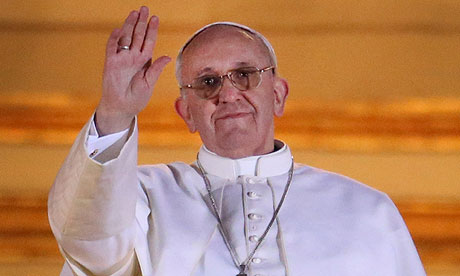
The college of cardinals has selected a new pope. He is an Argentinian named Jorge Bergoglio, but he will rule under the name Francis, in honor of St. Francis of Assisi. The Guradian reports:

    Inside the Sistine Chapel after the final vote was cast, the most junior of the cardinals, James Harvey, a former prefect of the papal household, called in the secretary of the college of cardinals, Monsignor Lorenzo Baldisseri, and the master of papal liturgical ceremonies, Monsignor Guido Marini, to witness the new pope’s acceptance of one of the most daunting jobs on Earth.

Daunting? Really? I imagine being a coal miner would be a daunting job, as would being a factory worker at Foxconn. But being Pope? You mostly just have to wear funny clothes and make reactionary statements. Sounds like a sweet gig to me. The Guardian also reports:

    No indication of how or why the new pope was chosen was expected to emerge. On Tuesday, before the start of the conclave, the cardinal-electors took an oath of secrecy, as had those Vatican employees and officials involved in the election.

    Additional precautions included a sweep of the Sistine Chapel to ensure that no listening devices had been planted inside and the use of electronic jamming techniques.

If history teaches us one thing, it’s that people who obsess over secrecy are usually up to no good. And when one looks into the background of this man, Bergoglio, one can see that he has good reasons for secrecy. According to another article in the Guardian:

    The main charge against Bergoglio involves the kidnapping of two Jesuit priests, Orland Yorio and Francisco Jalics, who were taken by Navy officers in May 1976 and held under inhumane conditions for the missionary work they conducted in the country’s slums, a politically risky activity at the time.

    His chief accuser is journalist Horacio Verbitsky, the author of a book on the church called “El Silencio” (“The Silence”), which claims that Bergoglio withdrew his order’s protection from the two priests, effectively giving the military a green light for their abduction.

Actually, the election of Bergoglio makes perfect sense to me. With the church besieged by accusations of money laundering and child abuse, who better to have as Pope than a criminal?

Ratzinger – er, I mean Pope Benedict XVI – got a lot of grief for having been a member of the Hitler Youth as a child. In my view, that’s negated by the fact that he refused to serve in the German army during World War II. But what are we to make of a man who aided and abetted a murderous regime? And what should we make of a church that promotes such a man to its highest position?