Immigration

January 30, 2013

Blog_Immigration_Sign

A bipartisan group of Senators has called for legislation that would grant legal status to most of this country’s 11 million undocumented immigrants. President Obama has also put forward a proposal for immigration reform. I hope that I’m not being too optimistic in hoping that this signal the beginning of the end to all the fear-mongering on the topic of immigration that has been going on.

Unfortunately, both the Senators’plan and the President’s plan call for “securing” the border. There needs to be a national recognition that the U.S.-Mexican border is a purely artificial construct. It is the result of a war that was regarded even by some people who carred it out as illegal and immoral. This arbitrary boundary has acquired a supra-historical – even mystical – significance in the eyes of many people. Ambitious proposals for building an enormous fence all along the border – tall enough to prevent people from climbing over it, while extending deep into the ground to prevent people from digging under it – have periodically been touted by various people. The border has often been portrayed as the source of all our ills. Stories of people with infectious diseases streaming over the border have been often been spouted by the Right. The Democrats have not always been better in this regard. One of the many low points in John Kerry’s 2004 presidential campaign came when he suggested that members of Al Quaida were coming across the Mexican border.

The economies of the U.S. and Mexico are deeply intertwined. California’s agribusiness largely depends on undocumented workers from Mexico and from Central America. The drug cartels that have been terrorizing Mexico buy most of their arms from U.S. gun dealers. Yet there are people who talk about Mexico as if it were another planet. This has to change.

Greg Palast Has a Man-Crush on Alex Jones

January 21, 2013

And you thought that Alex Jones is just a loud-mouthed buffoon. According to Greg Palast, Jones, who promotes 9/11 conspiracy theories, as well anti-immigrant racism, is “the host of one of the only intellectually substantive, fact-heavy forums on American radio”.

Palast likes Jones a lot. How much does Palast like Alex Jones? He tells us:

    I love Alex Jones. If I were a woman, I’d appear on his show in my highest heels and shortest mini-skirt.

Palast also tells us that Jones has “iron balls”.

Some things simply defy satire.

Why does Palast like Jones so much? It has to do with a story he once did. He tells us:

    While the BBC ran the story regardless of the threat, my investigations of Singer, despite gaining the cover of Nation, were suddenly pulled from US airwaves, including Piers’ CNN. A major news service said it was spiked not by editors, but by “high up”. Even MSNBC said, coyly, that the story was “too complex for our viewers”.

    But not Jones’ audience. “This is complex,” Jones told me, “so we’ll give you a full hour to explain it.” Which is part of the reason Alex is such a hero in the US – he has the cojones to venture where the mainstream media fear to tread.

So what? The people who listen to Jones’s conspiracist rants aren’t going to build a movement for social change. They’re going to stock up on assault rifles and wait for Armageddon to come. Palast, however, is so vain, he is willing to slobber all over Jones just for letting him talk on his show.

To be fair, Palast says he doesn’t agree with everything that Jones says. Which is nice to know.

Vice.com promises us that this article is the first of a three-part series, in which, among other things, Greg Palast will talk about his penis. I can hardly wait.

You can find out more about Alex Jones here.

Paranoid Stylings: American Politics in the Twenty-first Century

January 18, 2013

conspiracy_theorists

    This glimpse across a long span of time emboldens me to make the conjecture—it is no more than that—that a mentality disposed to see the world in this way may be a persistent psychic phenomenon, more or less constantly affecting a modest minority of the population. But certain religious traditions, certain social structures and national inheritances, certain historical catastrophes or frustrations may be conducive to the release of such psychic energies, and to situations in which they can more readily be built into mass movements or political parties. In American experience ethnic and religious conflict have plainly been a major focus for militant and suspicious minds of this sort, but class conflicts also can mobilize such energies. Perhaps the central situation conducive to the diffusion of the paranoid tendency is a confrontation of opposed interests which are (or are felt to be) totally irreconcilable, and thus by nature not susceptible to the normal political processes of bargain and compromise. The situation becomes worse when the representatives of a particular social interest—perhaps because of the very unrealistic and unrealizable nature of its demands—are shut out of the political process. Having no access to political bargaining or the making of decisions, they find their original conception that the world of power is sinister and malicious fully confirmed. They see only the consequences of power—and this through distorting lenses—and have no chance to observe its actual machinery. A distinguished historian has said that one of the most valuable things about history is that it teaches us how things do not happen. It is precisely this kind of awareness that the paranoid fails to develop. He has a special resistance of his own, of course, to developing such awareness, but circumstances often deprive him of exposure to events that might enlighten him—and in any case he resists enlightenment.

    – Richard Hofstadter, The Paranoid Style in American Politics

It seems that everything that happens in America nowadays is part of some sort of conspiracy. A small, but very vocal group of people are now claiming that the Sandy Hook massacre was faked, that it was a “false-flag operation”, carried out so that President Obama can have an excuse to “take away our guns”. One witness to the shootings has received threatening phone calls and e-mails accusing him of being in the pay of the government. There are also conspiracy theories about the Aurora Shootings.

You can laugh (or cry) all you want about this, but is it really any sillier than some of the claims made by the 9/11 “Truth” movement? I don’t know how many times I read somebody on Indymedia or some other website claiming that the “hole” in the Pentagon could not possibly have been made by an airplane, as if this person had spent his life observing planes crashing into buildings. And a surprisingly large number of Americans think that the Apollo moon landing was faked. One wonders why they just don’t go all the way and claim that everything on the news is faked.

In his essay, The Paranoid Style in American Politics, Richard Hofstadter argued that there is a long history of conspiracist thinking in the U.S. He discusses anti-Masonry and anti-Catholicism in nineteenth century America, and he draws a direct line from them to the anti-Communism of the 1940’s and 1950’s. A common characteristic of these movements is a belief that the U.S. is under threat from secretive forces, usually of foreign in origin. (Think of how birthers try to claim that Obama wasn’t born in the U.S.) Hofstadter sees these movements as being mainly rural in character. This may have been true of earlier movements, but it can’t really be said of the 9/11 “Truth” movement. It seems to me that the paranoid style is beginning to become so pervasive in this country that it is starting to crowd out reasonable critiques of our political and economic system.

Some Thoughts on the Crisis in the British SWP

January 15, 2013

I’ve been following the discussions on the crisis in the Socialist Workers Party of Britain on the threads at Lenin’s Tomb and at The North Star. I’m reminded of the fact that this not the first time that a “democratic centralist” organization has imploded. In the 1980’s, this happened to both the American SWP and the British WRP. These implosions happened for different reasons, which suggests to me that these types of organizations are inherently fragile. Building up a layer of cadre who are financially dependent on the organization perhaps creates a structure that does not stand up to internal stress. There is also a problem, I think, in trying to build and maintain an organization with revolutionary politics during a non-revolutionary period. The promise of revolution underlies the group’s activities, but when year after year goes by without the promise being fulfilled, it can be dispiriting for some people and can perhaps create an inward-looking mentality among others. I am curious as to what other people think about this.

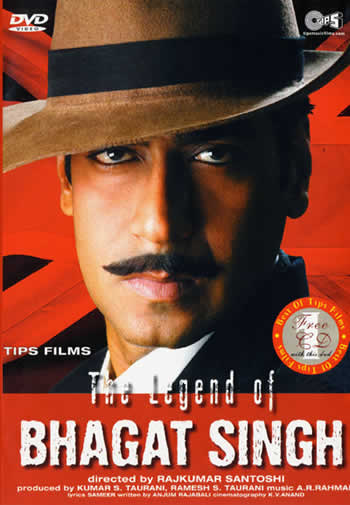
The Legend of Bhagat Singh

January 13, 2013

Bhagatsinghlegend

After reading my review of The Baader Meinhof Complex, a friend of mine recommended that I watch the 2002 Indian film, The Legend of Bhagat Singh, which also touches upon the question of what tactics should be used in the struggle against injustice. Although Bhagat Singh (1907-1931) is little known in the U.S., he is famous in India for his role in the Indian independence movement. He rejected Gandhi’s notion of non-violent resistance. He was a founding member of the Hindustan Socialist Republican Association, which sought to organize a mass uprising against the British. When the Indian writer, Lala Lajpat Rai, died after being beaten by the police, Singh and his comrades killed a British police officer in revenge. Later, they threw bombs in the Indian National Assembly, with the intent of getting themselves arrested. Singh hoped that his speeches at the trial would inspire the Indian people to rise up against their colonizers. His trial received considerable attention, and for a time he became as popular as Gandhi. However, this did not stop the British from executing him.

This film shows Gandhi in an unflattering light. It accuses him of dropping his demand that the Viceroy commute Singh’s death sentence so that he could get a political pact with the British granting limited rights to Indians. Given all the adulation given to Gandhi in both India and the West, it’s interesting to see a film that portrays him in a negative manner. In effect, it accuses him of being willing to sacrifice principle in order to get an agreement with the British.

The director, Rajkumar Santoshi, paints the story of Singh’s life in broad strokes. He doesn’t spend much time on character development. Singh (Ajay Devgan) appears fearless and wise almost from the time of his birth. And in true Bollywood fashion, there are musical numbers. Singh sings. He sings (twice) while he is on a hunger strike, and he sings while he is going to his execution. The Legend of Bhagat Singh emphasizes Singh’s advocacy of Hindu-Muslim reconciliation. (Singh came from a Sikh family, but he became an atheist at an early age.) Santoshi clearly wanted to remind his fellow Indians of Singh’s politics, which are more relevant than ever with the sectarian violence that has sometimes taken place in that country in recent years. No doubt Santoshi thought that following the conventions of Bollywood would give the film more appeal, although I’m told that it actually did not do well at the box office. In all honesty, I could have done without the singing, but I found this a compelling film nonetheless.

Since When is Rape an Organizational Matter?

January 10, 2013

I have always had a strange fascination with the British Left. Perhaps this is because it seems more lively than the US Left, which is sodden with hippy platitudes, conspiracy theories, quack “alternative” medicines, and anarchist posturings.

The British website, Socialist Unity, has posted an internal document from the Socialist Workers Party of Britain. Although I don’t care for SU’s politics, they have a right to publish any document from any organization that falls into their hands. The document in question concerns an accusation of rape against a member of the SWP. Charlie Kimber, the National Secretary of the SWP wrote an e-mail to SU protesting against their decision to post the document, which he as a right to do. SU has posted his e-mail. When I read it, I was troubled by the following passage:

    Organisations [sic] that have to deal with personal cases and allegations of this sort deserve the right to privacy about the details of the proceedings. Do you think that trade unions, for example, should publish transcripts of such cases? [I do, as a matter of fact. – SP]

Whenever a woman is raped, that is everybody’s problem, not just the business of some organization that she happens to belong to.

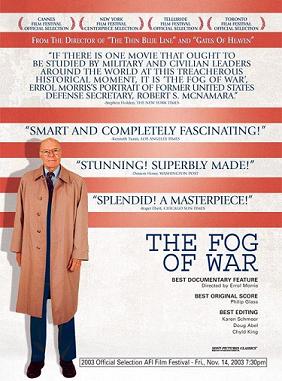
The Fog of War

January 6, 2013

Fog_of_war

I just got around to watching Errol Morris’s 2003 documentary, The Fog of War. I didn’t see this film when it first came out, probably because 2003 was a busy year for me. I found it somewhat disappointing. Much of it consists of McNamara trying to justify his actions. I should have expected that, but the reviews I read led me to believe it would be much more than that. Still, the film does have some interesting moments, and it gives some insight into the way one member of the ruling class thinks. I don’t think this is a minor thing. I think that perhaps the reason so many people on the Left are suckers for crackpot conspiracy theories is that they don’t have much understanding of how the ruling class thinks.

The film begins with McNamara, who is shown in tight close-ups most of the time, discussing the Cuban Missile Crisis. McNamara repeatedly points out the U.S. and the Soviet Union came extremely close to a nuclear war. McNamara uses his account of the crisis to illustrate one of the “eleven lessons” he talks about in the course of The Fog of War; in this case, “empathize with your enemy”. McNamara tells how a diplomat named Tommy Thompson, who knew Krushchev well, persuaded a skeptical Kennedy that the Soviet premier would be willing to cut a deal over Cuba, which turned out to be the case. This raises the question of why there was a crisis at all, though, unfortunately, Morris doesn’t ask this question. McNamara also uses this incident to illustrate another one of his “lessons”: “rationality will not save us”. McNamara insists that the governments of the U.S., the Soviet Union, and Cuba all behaved in a “rational” manner, even though they brought their countries to the brink of nuclear annihilation. So, if this is rationality, then what is irrationality? And if rationality will not save us, then what will? Morris doesn’t ask, and McNamara doesn’t say.

The Fog of War then goes into a discussion of McNamara’s early years. During the Second World War, he served as an analyst for the Army Air Corps. Under the command of Gen. Curtis LeMay, McNamara helped plan the fire bombing of Tokyo, which killed 100,000 people. This leads to the film’s most startling moment: McNamara frankly states that he and Gen. LeMay were war criminals. Still, he expresses no regrets about what he did.

The largest section of the film is devoted to the Vietnam War. McNamara doesn’t say much about the strategic justification for the U.S.’s intervention in Vietnam; he seems to consider this to be self-evident. McNamara admits that there was some confusion over what actually happened in the Gulf of Tonkin Incident; nevertheless, he and President Johnson used it as justification to launch an intensive bombing campaign in North Vietnam. McNamara also gives a discussion in which he tries to distance himself from the use of Agent Orange in Vietnam. To illustrate his “lesson” of “empathize with your enemy”, McNamara talks about how years after the war he met the former foreign minister of North Vietnam. McNamara says he was surprised to learn from this man that his government viewed the U.S. as a foreign colonial power trying to take control of their country. Reall? It never occurred to McNamara that the Vietnamese might view the U.S. in this way? If McNamara was being honest here, then he was every bit as self-deluded as the people who led us into the Iraq War. (It so happens that this film was released the same year as the U.S. invasion of Iraq.)

McNamara casually discusses the deaths of millions of people, yet he gets choked up when he recounts how he helped pick out the grave-site for John F. Kennedy. One is reminded here of Stalin’s dictum: “One death is a tragedy, but a million deaths is a statistic.” I don’t think it is a stretch for me to say that McNamara had some of Stalin’s bureaucratic mind-set.

Another of McNamara’s “lessons” is “in order to do good, you may have to engage in evil”. One wonders if McNamara ever questioned whether what he was trying to do was actually good.

The Baader Meinhof Complex

December 31, 2012

Baader_meinhof_komplex

The 2008 German film, The Baader Meinhof Complex, directed by Uli Edel from a screenplay by Bernd Eichinger, tells the story of the Red Army Faction, better known as the Baader Meinhof Group, a terrorist group active in Germany from the 1970’s through the 1990’s. The group had broad support in its early years. It appealed to young people disillusioned with post-war German society. They were particularly opposed to the Vietnam War and the West German government’s passive support for it, which they viewed as being analogous to Germans who had allowed the Holocaust to happen. The death of Che Guevara had also inspired many of these people.

The film begins with a demonstration against the Shah of Iran during his visit to Berlin in 1967. The police attack a crowd of student demonstrators, resulting in the death of Benno Ohnesorg. Shortly afterwards, Andreas Baader (Moritz Bleibtreu) and Gudrun Ensslin (Johanna Wokalek) fire bomb a department store, protesting the political complacency of German society. Baader is eventually arrested by the police. A journalist, Ulrike Meinhof (Martina Gedeck), interviews him in prison. Meinhof is frustrated by what she sees as the inability of her journalism to bring about any change. Meinhof agrees to help Baader to escape from prison, which she does. She then joins Baader’s gang, which he has christened as the Red Army Faction (RAF).

The rest of the film starts out as farce and ends as tragedy. The RAF leaders flee Germany to a Fatah camp in Jordan, to be trained in guerilla warfare. The RAF consider themselves to be in support of “Third World” liberation struggles. Once in the camp, however, they begin behaving like a bunch of spoiled teenagers. (This is the best way I can describe it.) They quarrel with the Fatah leaders, and they violate Palestinian social norms by, among other things, doing nude sunbathing in the middle of the camp. They return to Germany, where they carry out a series of daring bank robberies and bombings. However, the police capture or kill members of the RAF one by one. They eventually capture Baader, Meinhof, and Ensslin. However, a “second generation” of RAF members springs up. They use terror methods to try get their leaders released, culminating in the highjacking of an airliner in 1977. When army troops succeed in freeing the hostages, Baader and the others despair of ever getting out of prison, so they kill themselves.

Edel and Eichinger try to compress a complex series of historical events into a two-and-a-half hour film with predictably uneven results. New RAF members suddenly appear out of nowhere, and at times it’s hard to tell who is doing what. The film touches upon some complex issues without addressing them in satisfying ways. For example, some people have raised reasonable doubts as to whether the RAF leaders actually killed themselves, suggesting that they might have been murdered. (According to Wikipedia: “… Baader was supposed to have shot himself in the base of the neck so that the bullet exited through his forehead; repeated tests indicated that it was virtually impossible for a person to hold and fire a gun in such a way. In addition, three bullet holes were found in his cell: one lodged in the wall, one in the mattress, and the fatal bullet itself lodged in the floor, suggesting that Baader had fired twice before killing himself. Finally, Baader had powder burns on his right hand, but he was left-handed.”) While the film mentions that there were doubts about the suicides, it doesn’t really discuss this matter. Also, the film ends with the RAF’s killing of the industrialist, Hans Martin Schleyer in 1978, although the RAF remained active well into the 1990’s.

This film is a grim reminder that terrorism doesn’t work. Germany is not a better place today because of the Baader Meinhof group. The 9/11 attacks resulted in the expansion of U.S. imperialism. Terrorism actually strengthens the state by providing it with an external enemy. (“War is the health of the state”, as Randolph Bourne once put it.) Only mass movements have ever brought about any progress.

Reds

December 24, 2012

Redsposter

Warren Beatty’s 1981 film, Reds, tells the story of John Reed and Louise Bryant, two American journalists who were witnesses to the Russian Revolution. Beatty wrote the screenplay with Trevor Griffiths. Watching this film, one is impressed by the personal courageousness of Reed and Bryant, as well as by their commitment to social justice. They were interesting and inspiring people, so I wish I could give this film an unqualified endorsement, but unfortunately it has a number of problems with it.

At nearly three hours, Reds is too long, mainly because the first half largely consists of scenes of Reed (Warren Beatty) and Bryant (Diane Keaton), who were married, bickering with each other, as well as scenes of Bryant having an affair with Eugene O’Neil (Jack Nicholson). The film doesn’t get interesting until about halfway through when Reed and Bryant go to Russia. Beatty and Griffiths seemed to have had trouble making convincing characters out of historical figures. O’Neil, for example, mostly just drinks a lot and glowers at people. It’s hard to see why Bryant is attracted to him.

Lenin and Trotsky appear only briefly. Zinoviev (Jery Kosinski) and Radek (Jan Triska) are the only Bolshevik leaders depicted in any detail. Reed’s feud with Zinoviev provides much of the drama in the second half of the film. Zinoviev comes across as a bit of a bully and somewhat dishonest, although personally brave. Reed, on the other hand, comes across as a bit ultra-left. He opposes the idea of communists trying to work within the American Federation of Labor, for example. Unfortunately for the film, their conflict is left unresolved because of Reed’s untimely death.

Reds does not romanticize the Russian Revolution. There are discussions about the collapse of the Russian economy and the high-handed methods of the Bolsheviks. Yet the film also points out that sixteen foreign armies (including the U.S. army) invaded Russia. This is a point that often gets conveniently ignored in discussions about the Russian Revolution.

Beatty does possess skill as a director. The scene in which Bryant’s home is raided by government agents, for example, is effectively done, as is the scene in which White Army soldiers attack a train on which Reed is traveling.

The film includes interviews with “witnesses”, people who knew Reed and Bryant. Most of their comments are unilluminating, and some are downright inane. (George Jessel is inexplicably allowed to sing.) They mostly serve as a distraction from the story. I think the film would actually have been better if these had been left out.

While we are on the topic of historical portrayals, I must say I always thought Patrick Stewart would make a good Lenin. So you can imagine my pleasant surprise when I learned that Stewart actually did play Lenin in a BBC TV-series in the early 1970’s entitled The Fall of Eagles. Here is a clip from the series that depicts Lenin’s return to Russia in 1917:

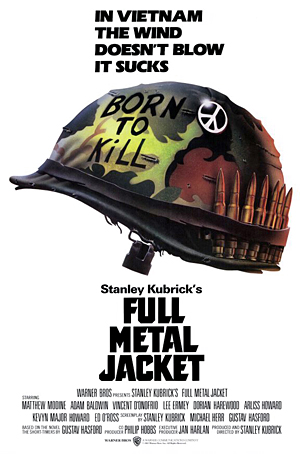
Full Metal Jacket

December 20, 2012

Full_Metal_Jacket_poster

Stanley Kubrick’s Full Metal Jacket is an examination of the meaninglessness and amorality of war. It is also a critique of the military and its values. This film is based on the writings of two Vietnam war veterans, Gustav Hasford and Michael Herr.

The film tells two stories that subtly mirror each other. The first half of the film depicts the basic training experience of James T. “Joker” Davis (Matthew Modine) at the Marine Corps base on Parris Island during the Vietnam War. He and a group of other recruits are under the command of a drill instructor, Sgt. Hartman (R. Lee Ermey, who was a Marine D.I. before he became an actor). Hartman aims most of his insults at Pvt. Lawrence (Vincent D’Onofrio), a hapless recruit who can never seem to do anything right. Hartman gives him the nickname “Gomer Pyle” and proceeds to make his life miserable. His taunting of Lawrence has tragic results for both of them.

There were several things that struck me about this half of the film. The first is that on several occasions Hartman either slaps or punches people. In one scene, he chokes Lawrence. I was always under the impression that officers and N.C.O.’s are not allowed to hit soldiers. (Didn’t Gen. Patton almost get fired for doing that?) I have since learned from various sources that D.I.’s sometimes get away with hitting recruits, even though technically they are not supposed to do it. Another thing that struck was religious indoctrination. Hartman sometimes talks about religion to the recruits. In one scene, Hartman asks Davis if he believes in the Virgin Mary. When Davis says no, Harman punches him in the stomach. Among other things, Hartman merely asking that question violates the First Amendment. People in the military take an oath swearing to defend the Constitution. The issue of religious indoctrination in the military is one that crops up in the news every now and then. There have been attempts at the United States Air Force Academy to convert people to fundamentalist Christianity. I guess a belief in Biblical literalism helps one to drop bombs on people.

This film also depicts how misogyny and homophobia are instilled in recruits during basic training.

The second half depicts Davis’s experiences during the Battle of Hue. Full Metal Jacket manages to avoid the clichés of war movies. It leads to a harrowing climax in which the members of Davis’s platoon are picked off one by one by a sniper. For all their savage training, the soldiers turn out to be just frightened men dealing with a terrifying situation. The lone sniper turns out to be a woman. When Davis kills her, we are reminded of Lawrence killing Sgt. Harman. Full Metal Jacket ends with a scene of Marines marching through the ruins of Hue while singing the theme song of The Mickey Mouse Club. There is perhaps no better metaphor for U.S. imperialism.