Prometheus

June 18, 2012

Ridley Scott’s latest film is a prequel to Alien. After the Star Wars fiasco, one would think that directors would be leery of prequels. Scott is apparently a gutsy man.

Elizabeth Shaw (Noomi Rapace) and Charlie Holloway (Logan Marshall-Green) are archaeologists who have discovered evidence that early humans had contact with extraterrestrials, whom they call “Engineers”. They have also discovered a star map that they believe shows where these beings came from. They then persuade Peter Weyland (Guy Pearce), the elderly CEO of Weyland Corporation, to fund an expedition to find the Engineers. Weyland is impressed by their evidence (although I wasn’t). He spends a trillion dollars to send Shaw and Holloway and fifteen others to a moon orbiting a far distant planet. The trip takes over two years, and they spend most of the time in stasis. An android, David (Michael Fassbender) runs the ship in the meantime. When they reach their destination, Shaw and Holloway explain to the others what the trip is about. (These people agreed to a two-year trip billions of miles into space without knowing what it’s about? I find that hard to believe.) They come across a large mound that appears to be artificially constructed. The mission director, Meredith Vickers (Charlize Theron) tells Shaw and Holloway not to try to make contact with the Engineers without her permission. This is our first intimation that they are being used for ulterior motives.

The H.R. Giger sets and slimy monster are fun to look at. Prometheus, however, ultimately leaves one feeling vaguely dissatisfied. The similarities between this film and Alien (a malevolent android, people meeting unpleasant ends at the mercy of alien creatures) make it feel a bit familiar at times. Also, there too many things in this film that either are not adequately explained or simply don’t make sense. For example, no one seems to notice when David goes off exploring by himself. And the character of Vickers makes no sense. Her only motive seems to be jealousy of David, who is Weyland’s confidant. Late in the film it is revealed that she is Weyland’s daughter, though it’s not clear why this has been kept a secret. And why would she go on a dangerous expedition with uncertain prospects when she could be managing her ailing father’s corporate empire back on Earth? As for David, he displays an extreme vindictiveness that is never really accounted for. Is it really just because he feels unappreciated by the other characters, or is there something more going on with him? Or maybe they just haven’t gotten all the bugs out of the android design yet? (Fassbender delivers his lines in a quiet voice that is clearly meant to remind us of HAL the computer in 2001: A Space Odyssey.)

As with many science fiction films nowadays, the events in this film are driven by a corrupt capitalist. Yet it turns out that Weyland’s real motives are not profit, but his belief that the Engineers can prolong his life. (And why should he assume this?) And the ending is implausible. After everyone else is killed off, Shaw decides that, instead of returning to Earth, she will find out why the Engineers want to kill humans. Could this be the set-up for a sequel?

At one point in Prometheus, Shaw is impregnated with an alien creature. At a time when Republicans are ramming through anti-abortion legislation in many states, it’s nice to see a Hollywood film that makes a good argument for abortion rights.

Darling Companion

June 15, 2012

I must confess to bearing a grudge against Lawrence Kasdan. It was bad enough that his over-hyped film, The Big Chill, turned out to be thoroughly mediocre. Even worse was the fact that it seemed as though at every party I went to when I was in my early twenties, someone would play the Big Chill soundtrack. When I was in high school, I had to listen to Joy to the World (Jeremiah Was a Bullfrog) about a million times, and now here I was, an adult, Mr. Would-be Hipster, listening to that same stupid song another million times.

I do not forget, and I do not forgive.

Still, I tried to keep an open mind while I was watching Kasdan’s latest film, Darling Companion. Beth Winter (Diane Keaton) and her daughter, Grace (Elisabeth Moss) find a stray dog along the side of the road. Over the objections of Beth’s husband, Joseph (Kevin Kline), they adopt the dog and name him Freeway. A year later, Grace has her wedding at her parents’ second home in the Rockies. Joseph’s sister, Penny (Dianne Wiest ) attends, along with her fiance, Russell (Richard Jenkins), and her son by a previous marriage, Bryan (Mark Duplass). Both Bryan and Joseph are wary of Russell, who they suspect is trying take financial advantage of Penny.

The next day Joseph takes Freeway for a walk in the woods. Freeway chases a deer and runs off. Joseph is unable to find him. When he tells Beth about this, she is immediately upset, especially since she has always suspected Joseph of not really liking Freeway. Penny, Russell, and Bryan all volunteer to stay longer to help find Freeway. The Winters’ housekeeper, Carmen (Ayelet Zurer) tells them that she is half Gypsy, and, as a result, she has psychic powers. In spite of Carmen’s not quite convincing accent, they believe her. It was not clear to me whether Kasdan was trying to poke fun at a stereotype of Gypsies, or whether he was simply using this as a plot device. Unfortunately, I suspect the latter. Carmen has “visions” of Freeway’s whereabouts, which inspire the others to go off looking in various places. They are sometimes assisted by gruff, but lovable, Sheriff Morris (Sam Shepard). (From my own experiences with sheriffs, I would say that while they are often gruff, they are rarely lovable.) During these excursions, the characters “grow”, as they say in the screenwriting business. Beth and Joseph are eventually reconciled. Bryan realizes that Russell is really not a bad guy. It’s all very pat and predictable. And of course they finally find Freeway in an extremely improbable manner.

So, a misfortune brings a group of people together on a journey of self-discovery. This film is basically The Big Chill all over again, only instead of formerly radical thirty-somethings, we have fifty-somethings who haven’t yet joined the Tea Party. (I’m sure they will, eventually.)

The actors in this film all try hard, but they can’t overcome Kasdan’s by-the-numbers approach to screenwriting.

Sound of My Voice

June 13, 2012

Sound of My Voice is the second film I’ve seen in the past year that portrays a Manson-type cult. (The other was Martha Marcy May Marlene.) I don’t know whether this is a coincidence or whether it says something about our current political and economic climate. Perhaps with the erosion of our civil liberties people are beginning to feel as though they are trapped in a cult. (At least I feel that way sometimes.)

Sound of My Voice was co-written and directed by Zal Batmanglij. It was co-written by, and stars, Brit Marling, who also co-wrote and starred in Another Earth. Peter (Christopher Denham) and Lorna (Nicole Vicius) are aspiring film makers working on a documentary about cults. Peter supports them by working as a schoolteacher. They infiltrate a cult, whose leader, Maggie (Brit Marling) claims to be from the future. (2054 to be exact.) The members of the cult meet in the basement of a house in the San Fernando Valley. Peter and Lorna don’t know its exact location because they are always blind-folded when they are driven there. Maggie speaks vaguely about a coming civil war, and she tells her followers they must prepare themselves for it. She makes them undergo a series of increasingly humiliating rituals. Peter’s behavior during one of these meetings causes Lorna to suspect that he is starting to buy into Maggie’s claims. Maggie has a private meeting with Peter, in which she asks him to bring one of his students, Abigail (Avery Pohl) to her. When he asks her why, she says that Abigail is her mother. When Peter suggests to Lorna that they actually do this, she walks out on him.

Shortly after that, Lorna meets Carol Briggs (Davenia McFadden), who tells her she is with the Department of Justice. She says she knows Maggie’s true identity and that Maggie is wanted for armed robbery and for arson. (Presumably, the government has been spying on Peter and Lorna, since Briggs knows all about them.) Briggs persuades Lorna to help her. At Briggs’s suggestion, Lorna devises a plan with Peter (who doesn’t know that Lorna is now working for the government) to bring Abigail on a field trip to a museum, where she will meet Maggie. Briggs plans to have Maggie arrested there. The twist to this whole thing is that just before Maggie is arrested, something happens that suggests she may really be from the future.

Sound of My Voice leaves so many questions unanswered, that at the end one feels as though one has only watched the first half of the movie. Is Maggie really from the future? If so, why does she try to start a cult, and what does she intend to do with it? Did Maggie really commit armed robbery and arson, or are the police mistaken? Or does the government have an ulterior motive in arresting her? There are moments in the film that suggest that more is going on than what the characters are telling us, though nothing ever comes from this. I suppose some will say that this ambiguity is the point, but what is the good of raising questions that have no answers? It’s all too easy to use ambiguity to make a film seem more clever or more profound than it actually is. (Kiyoshi Kurosawa, for example, sometimes does this.)

Brit Marling is believable as Maggie, and the cult scenes create a deep sense of unease, but I wish the story had more meat on its bones.

Ray Bradbury and ‘Fahrenheit 451’

June 10, 2012

When I was in junior high school I read Ray Bradbury’s The Martian Chronicles. It made a very strong impression on me. I immediately began reading everything I could find by Bradbury. I was surprised to discover that most of his writings were neither science fiction nor fantasy, even though his books were always located in the science fiction section in bookstores. (This was back when bookstores were a fairly common sight, before Barnes & Noble and Amazon pretty much killed off the book retail business.) I dutifully read each one, however, hoping to find something that would affect me the way The Martian Chronicles did, but that never happened. What’s more, it seemed to me that his writings became increasingly sentimental as he got older, so I eventually stopped reading them.

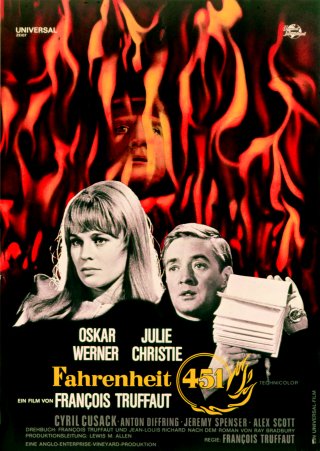
Fahrenheit 451 is Bradbury’s most famous book, even though it is not his best, and it is even atypical of his work, since it is his only dystopian fantasy. It is set in a future in which the government burns books and most people spend their free time watching gigantic television screens. When I heard about Bradbury’s recent death at the age of 91, I decided to watch Truffaut’s 1966 film adaptation of Fahrenheit 451. Truffaut’s film is not as bleak as Bradbury’s novel (the latter ends with society being destroyed by nuclear war), but it suffers from the same basic problem that the book does: it is a political story without any politics in it.

Guy Montag (Oskar Werner) works as a “fireman”, which is actually a policeman who finds and destroys books. The government has passed a law outlawing all books, regardless of their content. Montag is married to Linda (Julie Christie), his stay-at-home wife who spends most of her time watching vapid TV shows. Montag’s captain (Cyril Cusack) thinks highly of him and recommends him for a promotion. One day, while taking the monorail home from work, he meets Clarice (also played by Julie Christie), whose free-spirited and inquisitive personality he finds oddly appealing. She seems to plant some seeds of doubt in his personality, for at a book burning he snatches a copy of David Copperfield and brings it home to read it. He begins bringing other books home and reading them as well. This causes tensions between him and Linda, who disapproves of reading. At a book burning at an old woman’s house, the woman (Bee Duffell) sets herself on fire along with her books. This incident leaves Montag feeling profoundly disturbed, which leads to a confrontation with Linds. She informs on him. Montag is forced to flee.

Clarice has told him about a group of people living outside the city known as the “book people”. Montag goes to them. They are people determined to preserve the world’s books by memorizing them. Each person is required to memorize one book word for word and then destroy it. Why destroy the books? Because, we are told, so the police can’t destroy them. I have a serious problem with this. What real difference is there between them destroying the books or the firemen destroying them? And having people memorize books is an obviously impractical way of preserving them. Wouldn’t it make more sense to record the books on microfilm, or some other medium that can easily be hidden?

For that matter, why does the government burn books? The captain tells Montag that it’s because books make people “anti-social” and “unhappy”, which isn’t really true, so what’s the real reason? We’re never told. In fact, we’re told almost nothing about the government itself. It’s clearly a police state, but we’re told nothing about its ideology. Some would argue that is the point: people are so busy watching TV that no one cares what the government is doing. And yet there are some people who still read books. The firemen seem very busy in this film. So why does the government regard these people as a threat, even if they read books that are not political at all?

The book burnings in Fahrenheit 451 are clearly meant to remind us of the book burnings in Nazi Germany. The Nazis, however, burned only certain books, and they did so for reasons that were explicitly political.

The lack of politics in the story is a serious weakness. George Orwell”s 1984 is compelling because of its political ideas, even though these ideas are flawed. By comparison, Fahrenheit 451 seems flat.

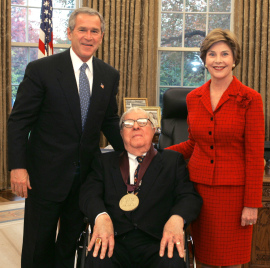
Fahrenheit 451 is thought of as an anti-censorship novel, but it is actually an anti-television novel. Bradbury himself said as much. (Bradbury sometimes wrote for television, so his feelings about the medium were apparently mixed.) It depicts a world that has declared war on the printed word. Interestingly, Bradbury wrote Fahrenheit 451 in the early 1950’s, when many of the pulp magazines he wrote for in his youth were going out of business, largely because they couldn’t compete with the still relatively new medium of television. One suspects that there was an element of resentment fueling this novel. Six years after he wrote Fahrenheit 451, Bradbury wrote Dandelion Wine, a sentimental fictionalized account of his childhood in 1920’s Illinois. (A book that owes a lot to Thomas Wolfe, though it has none of Wolfe’s sharp social commentary in it.) It perhaps shouldn’t be surprising then that Bradbury became a political reactionary in his later years, expressing admiration for Ronald Reagan and for George W. Bush. Considering this, it’s perhaps just as well then that there are no politics in Fahrenheit 451.

Despite the weaknesses of its story, Truffaut’s film is nonetheless entertaining to watch. Truffaut greatly admired Hitchcock, and this film has a Hitchcockian look and feel to it: claustrophobic rooms and hallways, with a subtle and mounting feeling of dread. The book burning scenes are disturbing to watch, as they should be.

Triumph of the Will

June 6, 2012

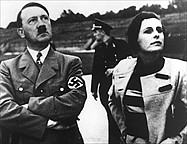
I recently saw Triumph of the Will. I felt obligated to watch it because it is considered the penultimate example of a political propaganda film. Such is its notoriety, that when Michael Moore’s Fahrenheit 911 first came out, right-wing pundits immediately tried to smear it by comparing it to Triumph of the Will. Of course, they only revealed their intellectual poverty by doing so, since Moore’s approach to film making is nothing at all like Leni Riefenstahl’s.

The early scenes depict Hitler’s arrival in Nuremberg for a party rally. The creepy thing about these scenes is how normal they seem. Take away the gaudy uniforms and raised arms and Hitler could be just your ordinary politician, shaking hands with people, smiling for the camera, and engaging in small talk with the plebeians. It’s not until Hitler addresses the Reichsarbeitsdienst, a sort of paramilitary construction group, that we begin to sense that something profoundly weird is going on here. From a visual standpoint, this is the best part of the film, because there is something slightly surreal about the sight of hundreds of uniformed men marching around with shovels as if they were rifles. This cuts to a spooky scene of storm troopers gamboling in the woods at night. (At least I think that’s what they’re doing. It’s hard to tell.) Unfortunately, it’s all downhill from there: seemingly endless scenes of people marching around, with an inexplicably large number of them carrying Nazi flags, occasionally interspersed with speeches by Hitler.

The most striking thing about this film, however, is how physically unimpressive the Nazi leaders are. Many of them are fat: Goering, Wagner, Ley, Streicher. Wagner, Rosenberg, and Ley sweat profusely. Schirach has sweaty armpits. Hess, however, looks underfed, and he has a strangely high-pitched voice. (I must say, though, he did know how to give a crisp salute.) Lutze also has an annoyingly high-pitched voice. (Did Hitler have a thing for male sopranos?) Goebbels looks like a weasel. As for Himmler, why didn’t they just put at bag over this guy’s head? Seriously, he could have had a lucrative career as a character actor in Hollywood, playing ignorant rubes who get taken in by the likes of W.C. Fields. (“Here’s all my life’s savings, mister. Give me all the bottles you can of that there miracle elixir!”) Even the storm troopers and SS men are unimpressive. They look a bit scrawny, and their uniforms often don’t seem to fit quit right. Hitler, however, looks well-fed. Yet the plumpness of his face makes you uncomfortably aware of how silly his tiny moustache looks. And he has too much Brylcream in his hair. (Or whatever was the German equivalent of Brylcream in the 1930’s.) And his uniform makes his ass look huge. (This is true of some of the other people in this film. I wonder, did Hitler think that having a big ass was a sign of racial superiority?)

The reason I bring all this up is that it has often been said that Triumph of the Will was a highly effective advertisement for Nazism. I find this hard to believe. This film is mostly boring. A lot of it is just people marching around to bad music. Riefenstahl knew that rapid cutting and moving the camera around can make things appear more interesting than they actually are, but these tricks can only do so much, and sometimes they can even be counter-productive. When, for example, we see the stage at a rally from a camera that’s being lifted upwards, the effect is merely showy. Indeed, it actually seems a bit naive. True, this was the 1930’s, but they were already using more sophisticated techniques than this in Hollywood – or in Germany’s own cinema, for that matter.

Early in the film, there are evocative shots of the amazingly beautiful city of Nuremberg. Alas, these are marred by the ubiquitous presence of Nazi and German imperialist flags.

Even the speeches are not all that interesting. There are repeated calls for “national unity”, as well as a lot of talk about how the Nazi Reich will last thousands of years (heh, heh). I must say, though, that Hitler did occasionally inflect his voice in interesting ways. There are, however, some ominous references to the notion of “racial purity” in the speeches of Hitler and of Streicher.

In her later years, Riefenstahl collected many awards from film festivals. (Her fellow propagandist, Streicher, was hanged.) Since Triumph of the Will was, far and away, her most famous movie, one must wonder about the people who decided to give her all these honors. Riefenstahl claimed that she was a neutral observer, but this assertion is contradicted by her own film. At the beginning, it says it is Das Dokument der Reichsparteitag 1934 – hergestellt im Auftrage des Fuehrers. (The Documentary of the Reich party conference of 1934 – produced according to the Fuehrer’s instructions.) Well, you can’t get any more explicit than that, can you? Also, it’s clear just from watching this film that Riefenstahl could not have made it without plenty of help from the Nazis. Also, there are some scenes that were clearly staged specifically for the camera.

There’s one scene in the film in which we see Hitler and his cronies watching soldiers riding around on horseback. While I was watching this, I was reminded of the fact that during World War II, 90% of the German army’s supply transport was horse-drawn. The truth was that Germany was actually under-prepared for the war. My father rarely talked about his wartime experiences, but one story he did tell more than once was about when his unit captured a German army base. In the mess hall there was a gigantic soup tureen, which was apparently what everyone ate from. It always amazed my father that a government that could only afford to feed its soldiers gruel actually believed it could conquer the world.

We Need to Talk About Kevin

June 2, 2012

We Need to Talk About Kevin, directed by Lynne Ramsay from the novel by Lionel Shriver, has been receiving mostly favorable reviews, I must say though that I found it oddly unsatisfying. The story, which is mostly told through flashbacks, is about Eva (Tilda Swinton), who has had a difficult relationship with her son, Kevin (Ezra Miller), since the latter’s infancy. He spurns her attempts at affection, and he is often willfully disobedient towards her. Kevin’s father, Franklin (John C. Reilly), however, sees nothing wrong, because Kevin always behaves himself when he is around. During his senior year, Kevin takes an archery bow that Franklin gave him and kills a number of his teachers and fellow students with it. He also kills his father and his sister, Celia (Ashley Gerasimovich).

Those hoping that this film will teach them something about the psychology of a school shooter will be disappointed. Kevin’s behavior is never explained. The biggest weakness of this film – and it’s a very big weakness in my view – is that we are told absolutely nothing about Kevin’s relationships with his fellow students or with his teachers. Are we really supposed to believe that Kevin kills these people just because he has an unhappy relationship with his mother? I don’t buy it. And why does he kill Franklin and Celia, who are both kind to him?

Of course, this film is really about Eva and not Kevin. It is about her attempts to make sense out of what has happened. After the killings, Eva remains in the town so she can visit Kevin at the nearby prison. The people either shun her or are openly hostile to her. (Apparently the fact that her own husband and daughter were killed doesn’t elicit the least amount of sympathy from them. This is another detail in the film that I found a bit hard to believe.) When a woman smashes Eva’s eggs at the supermarket, Evan insists on buying them and eating them anyway. This suggests that Eva feels responsible for what her son did. In the final scene, Eva hugs Kevin before he is taken to Sing Sing prison. She has forgiven him. But are there not some things that are unforgivable? After all, Kevin caused suffering to many people, not just his mother. It’s a problematic ending to a nearly two-hour film about people being extremely unpleasant to one another.

Norwegian Wood

May 29, 2012

Norwegian Wood is a film by Tran Anh Hung, a Frenchman born in Vietnam, based upon the novel of the same name by Haruki Murakami. I’ve been told that this was the biggest selling novel in Japan during the twentieth century.

The film is set in Tokyo in the 1960’s. Watanabe (Ken’ichi Matsuyama), a high school student, is friends with Kizuki (Kengo Kora) and with Kizuki’s girlfriend, Naoko (Rinko Kikuchi). One day, Kizuki kills himself without any explanation. Watanabe and Naoko are shocked by his death. Watanabe goes to a university and tries to forget his grief by burying himself in his studies. The school he is attending is being wracked by student demonstrations, but Watanabe refuses to get involved. One day he runs into Naoko. They begin seeing each other. On Naoko’s twentieth birthday, they make love. After that, however, Naoko disappears. Watanabe looks for her. He eventually learns that she has had a mental breakdown. She is now living in a sanitarium in a remote area. He goes to visit her, and he meets her roommate, Reiko (Reika Kirishima), a freindly but somewhat strange woman.

Naoko clearly has conflicted feelings towards Watanabe. At times, she is welcoming towards him, but at other times she tells him to go away. Her favorite song is the Beatles’ Norwegian Wood, which is about a one-night stand that ends badly. The song speaks to her fear of emotional commitment. Clearly, she is still traumatized by the death of Kizuki. Watanabe can’t forget Kizuki either. He insists on asking Naoko intimate questions about her relationship with him.

Back in Tokyo, Watanabe becomes involved with Midori (Kiko Mizuhara), a brash, outspoken woman who is in many ways Watanabe’s opposite. He also becomes friends with the womanizing Nagasawa (Tetsuji Tamayama) and with his long-suffering girlfriend, Hatsumi (Eriko Hatsune). Midori wants Watanabe to commit himself to her, but he can’t bring himself to let go of Naoko.

The student demonstrations figure prominently in some of the early scenes. This led me to believe that they would play an important role in the story, but they don’t. I haven’t read the Murakami novel on which this film is based, but the friend that I saw it with has. She told that in the book the demonstrators are portrayed in a highly critical manner. She also told me that some of the minor characters are more fleshed out in the novel than in the movie. I can only guess that Tran wanted to focus on Watanabe’s relationships with Naoko and with Midori. I think the film might have been more interesting if it showed the story’s political context. Surely, that must have been important to Murakami if he included it in the novel.

Even so, Norwegian Wood is a beautifully made and subtly erotic film. The music editor, Jonny Greenwood, has put together a soundtrack that perfectly complements the film and skillfully sets the mood for each scene.

Chronicle

May 25, 2012

Chronicle, directed by Josh Trank from a screenplay by Max Landis, gives a clever twist to the superhero formula. Andrew (Dane DeHaan) is a high school student who lives with his abusive father (Michael Kelly) and his terminally ill mother (Bo Peterson). At school, Andrew is bullied by other students. He buys himself a video camera, and begins taping all of his experiences. His cousin, Matt (Alex Russell) takes him to a rave party. Matt gets bored with the party, so he and his friend, Steve (Michael B. Jordan) go wandering in the woods outside, where they find a cave. They persuade Andrew to videotape them exploring it. Inside they find some glowing rocks. Days later, the three find that they can move objects with their minds. Their powers increase over time, until they can fly through the air. Instead of dressing up in costumes and fighting super-villains, however, they play pranks on people. Then they try becoming performers. Things start to unravel, however, when Steve is killed by lightning while flying. Andrew then begins using his powers to get even with the school bullies and then with his father. When Andrew is unable to pay for a prescription that his mother desperately needs, he goes on a crime spree to raise the money. This has tragic results.

The film is done in a “found footage” style similar to that used in The Blair Witch Project and in the Paranormal films. This seems gimmicky at first, but it ends up giving the film a degree of verisimilitude that is unusual for this type of fantasy film. (Though when Matt flies in through Andrew’s bedroom window, it seems a bit too much like something out of the old Superman TV series.)

This film could be interpreted as being about Lord Acton’s dictum that “power corrupts”, but it is actually Andrew’s powerlessness that drives his rage and his growing megalomania. It could be argued that powerlessness actually corrupts as well.

Cory Booker: Mitt Romney’s Best Friend

May 22, 2012


Cory Booker sharing a laugh with his good buddy, Chris Christie, the morbidly obese governor of New Jersey.

The Democrats have always been an extraordinarily feckless lot, but Newark Mayor Cory Booker has set a record for sheer stupidity. The most potent weapon in the Obama campaign’s meager arsenal is Romney’s history of sleazy business dealings. So, what does Booker do? He goes on Meet the Press and says of the Obama campaign’s criticism’s of Bain Capital, “It’s nauseating to the American public. Enough is enough.” In almost no time, the Republicans put out a campaign ad featuring Booker’s comments. They also put out an online petition urging people to “Stand with Cory”. What Booker did was the political equivalent of hitting Obama in the knee with a tire iron.

Booker now complains that the Republicans have “manipulated” his comments. Well, duh. Booker attacks his own party’s electoral strategy, and he is surprised when the Republicans take advantage of this. Oh, please.

The Democrats are a joke. Always have been, always will be.

Third party anyone?

The Raid: Redemption

May 21, 2012

One of the many perks of being a film buff is that you’re always learning something new. (Another one is that you have an excuse to eat a lot of popcorn.) For example, as a result of seeing Gareth Evans’s film, The Raid: Redemption, I now know that Indonesia has its own style of martial arts known as pencak silat. (Bet you didn’t know that, did you?) It’s origins are shrouded in mystery. (I’ve waited many years for an excuse to use the phrase, “shrouded in mystery”.) For centuries, it was handed down as an oral tradition among the tribesmen of Indonesia. According to Wikipedia:

    The earliest evidence of silat being taught in a structured manner comes from the Sumatra-based empire of Srivijaya where folklore tells that it was created by a woman named Rama Sukana who witnessed a fight between a tiger and a large bird. By using the animals’ movements, she was able to fend off a group of drunken men that attacked her. She then taught the techniques to her husband Rama Isruna from whom they were formally passed down.

That Rama Sukana must have been a tough cookie, for pencak silat is one badass way of fighting. It’s so badass, that the characters in this film often prefer to use it instead of simply shooting one another. That is badass.

Jakarta’s biggest crime boss, Tama Riyadi (Ray Sahetapy), has his headquarters in a huge apartment building, in which most of the units are rented out to criminals who work for him. Lieutenant Wahyu (Pierre Gruno) is a corrupt and not too bright police officer who orders a SWAT team to break into the building and capture Tama. This turns out to be not a good idea, since most of the cops are killed within a few minutes. One of the few who are left alive is Rama, played by Iko Uwais, who is considered one of the best pencak silat fighters in Indonesia. He and the other survivors must figure out a way to get out of this death trap.

Although it has the requisite amount of double-crossing, The Raid: Redemption has a fairly simple story. It basically serves as an excuse for almost two hours of fight scenes. If you like martial arts movies, you will thoroghly enjoy this movie. If you don’t care for martial arts movies, not so much. Needless to say, I liked it.