General Strike in Egypt
November 23, 2011J. Edgar
November 14, 2011
Clint Eastwood has certainly come a long way from Dirty Harry. His new film about J. Edgar Hoover, from a screenplay by Dustin Lance Black, will upset many right-wingers. I wish I could give this movie an unqualified endorsement, but I have some reservations about it.
The film portrays Hoover (Leonardo DiCaprio) as a repressed homosexual, and it suggests that this repression was the source of his obsessive behavior. He and his number two man, Clyde Tolson (Armie Hammer), have a relationship similar to that between Burns and Smithers on The Simpsons. When Hoover tells Tolson that he intends to propose to Dorothy Lamour, the two of them have what amounts to a lovers’ quarrel. Their relationship, however, is never consummated. Hoover is portrayed as being obsessed with his domineering mother (Judi Dench), while being emotionally estranged from his father. Some will no doubt make the valid complaint that this reproduces an all too common “explanation” of homosexuality. You must admit, however, that this fits with what we know about Hoover.
Hoover is portrayed as petty and jealous. He deliberately wreaks the career of an F.B.I. agent named Melivin Purvis, because the latter has received more publicity than he has. He is also extremely prone to self-delusion. He says things like “love is the most powerful force in the world” without the least trace of irony. He tells people that he saved the U.S. from a “Bolshevik” revolution in 1919. In one scene, Hoover complains that newly elected president Richard Nixon wants him to do things that are illegal, oblivious to the fact that he has been doing illegal things all his life.
The film reminds us that Hoover began his career as a librarian. (Yes, it’s true.) He helped the Library of Congress develop a new system of organizing books. In one particularly eerie scene, the young Hoover tells his future secretary, Helen Gandy (Naomi Watts) that he wishes he could organize and identify people the same way he does books. “Information is power”, he tells her.
I found this movie fascinating to watch and even darkly funny at some moments. The acting is very good (DiCaprio is brilliant). However, it seemed a bit over-long. One weakness of the film is that it devotes far too much time to the Lindbergh kidnapping. Eastwood and Black apparently wanted to make the point that Hoover claimed to have solved the case when he actually hadn’t. (All the F.B.I. proved, really, was that Bruno Hauptmann was somehow connected to the crime.) This is a valid argument, but it skews the film towards a relatively minor episode of his career. For that matter, the film devotes too much time to the “Hoover was a closet queen” theory. This would have been a better film if it had spent more time on COINTELPRO and the way it destroyed people’s lives.
The posters for this movie call Hoover “the most powerful man in the world”. This is an enormous exaggeration. Hoover was actually an extremely ruthless and shrewd courtier, one who built his own fiefdom inside the U.S. government. This film attributes Hoover’s power to his knack for blackmailing people. There is a good deal of truth to this, but there was more to it than that. Many powerful people defended Hoover (or at least looked the other way), because they knew he was defending the interests of the ruling class. This could have been a more powerful film if it had made this point in some way.
Why Occupy?
November 10, 2011
Saturday, November 5, Occupy Eugene moved from Millrace park to Washington-Jefferson park. This is reportedly a temporary location. Occupy Eugene will decide later this month whether to move to another location.
On Wednesday, November 9, a teach-in titled “Why Occupy?” was held at Harris Hall in downtown Eugene. It was sponsored by We the People Eugene, an organization that is dedicated to bring about a constitutional amendment prohibiting “corporate personhood”. The hall was filled to capacity. Fergus Maclean (I hope I’m spelling his name right), a member of We the People, made a brief opening speech. He noted that the early capitalist economists saw global capitalism as a “transitory phase”. Smith believed it would last about 200 years. Maclean said the Occupy movement is a “reaction against an exhausted, collapsing paradigm”.
Daniel Pope, a history professor at the University of Oregon, moderated the panel. He pointed out that the 99% movement belongs to a long tradition of radical struggle in the United States. He called it a “reawakening of populism”.
Joseph Lowndes, professor of political science at the UO, pointed out that social movements arise at times of crisis. He called the 99% movement the broadest popular movement since the 1930’s. (Broader than the civil rights movement? I’m not sure I agree with that.) He praised the 99% meme, saying that it is inclusive, yet it draws a clear enemy. He said that the movement indicates a desire for public good over private good. The Tea Party is for the politics of privatization; it is the opposite of the 99% movement. On the downside, he pointed out that the tactic of occupation is costly in terms of resources. He also expressed the fear that it could lead to the movement becoming “culturally insular”. Overall, however, his comments were positive.
Stan Taylor, who chairs the Lane Community College Peace Center, said that the 99% movement is “revolutionary” in its goals. He argued that the younger generation needs to lead the movement.
William Wise talked about the devastating effects that government budget cuts have had on people in Lane county. He reminded people of the suffering caused by Bill Clinton’s “Welfare Reform” bill. He expressed hope that the 99% movement would lead to a society that is more “fair”.
Lauren Regan, an organizer with Occupy Eugene, took issue with the idea of a leaderless movement. She said everyone in the Occupy movement is a leader. She said the strength of the Occupy movement is its broadness. “We should push for the most radical demands we can make,” she said. She talked about how the movement has reached out to homeless people. “It’s amazing what can happen with homeless people when you give them a place to sleep and food to eat.” She talked about how hard people in the occupation have worked and how the community has supported them. She predicted the movement will continue to grow. Referring to the growing environmental crisis, she said, “Absolute necessity mandates greater growth [of the movement].”
Jamil Jonna, another organizer, said that homeless people began to join the occupation as soon as it began. In response to Lowndes’s concerns, he said that the occupations are central to the whole movement. They create a space where people can meet and discuss issues face to face. The occupations make possible “empowerment and inclusiveness”.
An organizer whose name was only given as Karen talked about why she joined the occupation. “This movement is connecting the whole world through radical change,” she said. “It’s about people taking responsibility.”
The overall tone of the meeting was upbeat and optimistic.
Bellflower
November 9, 2011
Bellflower is one of the most remarkable films I have seen in recent years. Indeed, it’s not quite like any other film I have ever watched.
Woodrow (Evan Glodell) and Aiden (Tyler Dawson) are friends who have recently moved from Wisconsin to Southern California. There, they indulge in apocalyptic fantasies. They imagine that a war will one day destroy most of the human race. They will then form a gang called “Mother Medusa”, which will use flame throwers and other weapons to conquer the world. (They are both fans of the Mad Max movies.) To prepare for this eventuality, they build a flame thrower in Aiden’s garage. When they’re not tinkering with weapons and motor vehicles, they spend most of their time getting drunk and stoned. Neither one of them has a job, yet they have plenty of money to spend on weapons and cars. Although the film never makes it explicit, they clearly come from wealthy families. (Their names suggest that they are from upper class backgrounds.)
When I was young, I knew people like the characters in this film. No, they didn’t build flame throwers, but they did practice other types of obsessive behavior (such as forming untalented rock bands). These people didn’t have jobs, yet they seemed to always have money. They spent much of their time getting drunk and stoned (“partying” as they called it).
Woodrow meets a girl, Milly (Jessie Wiseman), who shares his inclination towards impulsive, reckless behavior. They go on a road trip to Texas, and when they get back, Milly moves in with him. One day, however, Woodrow discovers her having sex with Mike (Vincent Grashaw), which immediately leads to a fight. Afterwards, Woodrow is injured in a motorcycle accident. While he is recovering, he begins to have a relationship with Milly’s best friend, Coutney (Rebekah Brandes). There is a growing spiral of violence as Woodrow seeks to get even with Milly. I won’t say much else about the story except that this is one of those films in which part of what you are seeing is being imagined by one or more of the characters. Although some things in this film are far-fetched, the characters nevertheless come across as thoroughly believable.
Bellflower is a criticism of our society’s fascination with violence, with weaponry, with apocalyptic fantasies, and with revenge fantasies.
This film, written and directed by Glodell, has a unique look to it. This is partly because the cinematographer, Joel Hodge, used a new type of camera that Glodell built from scratch.
This is Glodell’s first feature film. It is a most impressive debut. It is the kind of movie that you just have to talk about after you see it. Glodell has a promising future as a director.
You can find a trailer for this film here.
The Future
November 7, 2011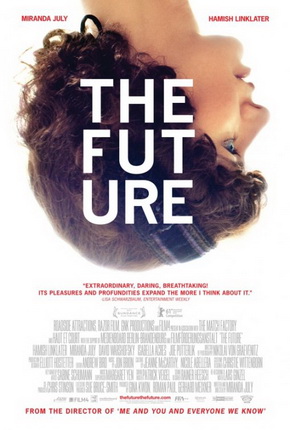
I was not familiar with the work of Miranda July before I saw The Future. She is a filmmaker, performance artist and short story writer. Her work has provoked sharply divided reactions from people. Some critics have dismissed her work as shallow and empty, while her defenders say that her work is “whimsical”. This a word that makes me wary. Americans are not good at whimsy. When Americans try to be whimsical, the results are usually abominations such as Forrest Gump. Americans should leave whimsy to the French, who have given us directors such as Jacques Tati and Jean-Pierre Jeunet. The only American director who has even come close to being good at whimsy is Terry Gilliam – and he can be unbearable at times.
The Future is about a thirty-something couple, Sophie (Miranda July) and Jason (Hamish Linklater). They decide to adopt a cat in one month. They talk about this as something that will change their lives as much as having a baby would. Perhaps this is meant to be a joke, but it isn’t funny; it merely makes them seem vacuous and shallow. They decide that they have one month to “experience life” before their lives become slavishly devoted to a feline. They do this in different ways. Jason gets a job selling trees, while Sophie has an affair with another man. (Clearly Sophie is the more ambitious of the two.) Sophie begins her seduction by calling up a man she has never met – Marshall (David Warshofsky) – and asking him strange questions over the telephone. She then pretends to be a client for his sign-making business. Right away, she leaves Jason and moves in with Marshall and his young daughter, Gabriella (Isabella Acres). Not surprisingly, this arrangement doesn’t last very long. One evening, Gabriella buries herself up to her neck in the backyard and announces that she is going to spend the whole night like that. Sophie tries to talk her out of this (as any human being would), but Marshall says that this is okay. Later that night, an enormous shirt crawls into the house. This clearly symbolizes Sophie’s past life. Sophie puts the shirt on with her legs through the sleeves and pulls it over her head. When Marshall sees her like this, he is shocked and horrified. This is a man who finds nothing wrong with the idea of his daughter spending the night buried up to her neck in dirt, yet he is repulsed by the sight of a woman with a shirt over her head. I guess this is supposed to be whimsical.
As for Jason, he has the ability to stop time. (Or at least he thinks he does. The film is not really clear about this.) He also talks to the Moon, and the Moon talks back to him. (Again, this could be imaginary.) Oh, and there’s a talking cat. Since I watched too many Disney movies when I was growing up, the last thing I want to see in a film is a talking cat, especially if it’s a film about a thirty-something couple having a mid-life crisis. It’s interesting to note here that July is married to Mike Mills, whose film, Beginners, which I saw earlier this year, has a talking dog in it. (Well, he doesn’t actually talk. Subtitles appear in front of his face.) So, are talking or semi-talking animals the hip new thing in movies nowadays? Someone please tell me this isn’t so.
There are a few surreal moments in this film, as when we see Gabriella buried up to her neck in her father’s backyard. For the most part, however, this is simply a tepid romantic comedy with some fantasy elements and some pretentious dialogue in it. It can safely be said that I am not one of Miranda July’s fans.
John Carlos
November 3, 2011
l. to r., Peter Norman, Tommie Smith, John Carlos.
We live to make history!
– John Carlos
John Carlos came to speak at the University of Oregon. He was one of two athletes – the other being Tommie Smith – who protested against racism in the U.S. at the 1968 Olympics by raising their fists during the playing of the national anthem. Carlos has recently published his autobiography, The John Carlos Story, co-written with Dave Zirin, who also spoke at this event.
Carlos started out by talking about his childhood. He grew up in Harlem. His mother worked as a nurse, his father owned a shoe shop. Carlos was offered a track and field scholarship to East Texas State University. It was there that he first encountered Jim Crow, finding segregated restrooms. “In Texas, my name suddenly became ‘Boy'”, he recalled. He eventually transferred to San Jose State University. The Olympics were coming up. Some people were organizing an Olympic boycott, to protest how the U.S. used the Olympics to create the false impression that Blacks are treated as equal citizens. Carlos was invited to meet with Martin Luther King, Jr., who told him that the boycott would be a great move. When Carlos expressed doubts, King used the metaphor of a lake: if you drop one rock in it, it creates ripples. During their conversation, King mentioned that he was going to Memphis to support a garbageman’s strike there. When Carlos asked him why he was doing that, King replied: “I have to stand for those who can’t stand for themselves.” Carlos recalled that when he looked in King’s eyes, he could see “no fear” in them. Ten days later, King was dead from an assassin’s bullet.
Carlos said that the lesson he learned from this is that one has to “make a total commitment.” At the Olympics, people began backing out of the boycott. It ended up with just him and Tommie Smith raising their fists during their medal ceremony. Peter Norman, the silver medal winner from Australia, wore an OPHR (Olympic Project for Human Righs) button as a sign of solidarity. Carlos said of Norman: “He is my blood brother, because he did the right thing.” Smith and Carlos were told to leave the Olympics early. They were both harshly criticized in the media, and they received death threats. Carlos also said that the Olympic committee put out the false story that their medals were taken away. He said they invented this story to intimidate any future athletes who might get out of line.

John Carlos today.
During the question and answer session, someone asked Carlos how he managed to have so much courage. He said, “I found me. Most people don’t know who they are.” In response to another question, he reminded the audience that 2,000 people were massacred by the Mexican government just before the Olympics. A student brought up the university’s recent plans to defund ethnic studies. “We need to know each other’s histories,” said Carlos. He also talked about the Occupy movement. He said that the movement is giving people courage to stand up for themselves. Another observation he made: “We’re going to have struggles for eternity.”
Occupy Eugene Moves to the University of Oregon
October 29, 2011On Tuesday, October 25, it was decided at a General Assembly meeting that Occupy Eugene should move to a new location. There was dissatisfaction with Alton Baker Park, the main complaint being the lack of visibility to the community. The following evening it was decided at a G.A. that they should move to the quadrangle at the University of Oregon. On Thursday at noon there was a march from Alton Baker Park to the university, where there was a rally. The university and the Eugene Police Department then announced that people would not be arrested if they camped out at the Millrace, a park directly across the street from the university. It is highly visible to street traffic. After a lengthy discussion, the protestors decided in the evening that they would move to the Millrace. People are now camped out there, a kitchen and other infrastructure have been set up.
Support the 99%!
The Oregonian
October 26, 2011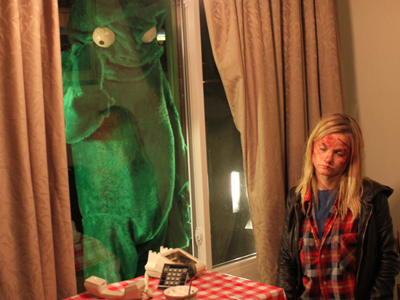
Oregon has a reputation for being home to some, well, odd people. (Here is one decidedly odd person. Here is another one. Oh, and there’s this guy). I suppose it was inevitable that somebody would make a film that’s basically about meeting strange people in Oregon.
Calvin Lee Reeder’s new film, The Oregonian is billed as an “experimental horror” film. Aside from some faint echoes of Carnival of Souls, however, there is not much horror in it. It is actually a surreal fantasy. A young woman who is identified only as “the Oregonian” (Lindsay Pulsipher) is living on a farm and involved in an abusive relationship. One day she gets into a car accident on a lonely country road. Although she is injured, she can still walk, so she goes looking for help. She never finds it. Instead, she wanders through a deserted town and meets some strange characters. These include a creepy old woman, a man who urinates in different colors and who obsesses over making omelettes, a man wearing a furry green frog costume, a group of hippies who drink gasoline, and various women who scream for no apparent reason.
Some parts of this film work better than others. The scenes of the Oregonian arguing with her husband are unconvincing and only detract from the trippy feel of the rest of the film. At times the film seems to be making fun of hippies, although I’m not sure that was the intention. (I know I’m not supposed to say these things, but this might be a good movie to watch when you’re stoned.)
The Oregonian has gotten a hostile response from some people. I’m told that at its premiere at the Sundance Film Festival, a quarter of the audience got up and walked out. The main complaint made against the film is that it doesn’t “mean” anything. Well, I would argue that it isn’t necessary for a film to “mean” something. Andre Breton once defined surrealism as: “Dictation of thought in the absence of all control exercised by reason, outside of all aesthetic and moral preoccupation.” That certainly describes this film. I found this movie interesting enough to want to watch it all the way to the end, which is more than I can say of some critically acclaimed films (for example: Chariots of Fire, Forrest Gump, Never Let Me Go).
People who don’t like this movie need to, as we say in Oregon, chill out.
Thank You, WikiLeaks
October 25, 2011

Julian Assange Bradley Manning
The admirable Glenn Greenwald has written an aritcle about why the Obama Administration’s efforts to extend the occupation of Iraq failed. It seems that the release by WikiLeaks of a cable that revealed a war crime by the U.S. military turned the Iraqi parliament against the idea of giving legal immunity to U.S. troops. Greenwald explains:
- That cable was released by WikiLeaks in May, 2011, and, as McClatchy put it at the time, “provides evidence that U.S. troops executed at least 10 Iraqi civilians, including a woman in her 70s and a 5-month-old infant, then called in an airstrike to destroy the evidence, during a controversial 2006 incident in the central Iraqi town of Ishaqi.” The U.S. then lied and claimed the civilians were killed by the airstrike. Although this incident had been previously documented by the U.N. special rapporteur on extrajudicial, summary or arbitrary executions, the high-profile release of the cable by WikiLeaks generated substantial attention (and disgust) in Iraq, which made it politically unpalatable for the Iraqi government to grant the legal immunity the Obama adminstration was seeking. Indeed, it was widely reported at the time the cable was released that it made it much more difficult for Iraq to allow U.S. troops to remain beyond the deadline under any conditions.
This is why, as I explained in an earlier post, leftists are opposed to government secrecy. When people know what governments are actually trying to do, they will tend to oppose those actions.
Game over in Iraq. Unfortunately, the imperialist beast is still far from dead.
Occupy Eugene Continues
October 22, 2011Occupy Eugene has successfully moved from downtown Eugene to Alton Baker Park. This was necessary to avoid a conflict with the Saturday farmer’s market, which is a popular fixture in Eugene. The move went smoothly. There have been no problems with the police (so far). This space isn’t as visible as the downtown park, but it is much bigger. It is a place where the movement and its supporters can gather until a better location is possibly found.
I will write more about this later when I am less tired.

 The Spanish Prisoner