Eugene Occupation Begins

October 17, 2011

On Saturday, October 15, about 2,000 people marched through Eugene as part of the 99% movement. It began with a rally at Wayne Morse Plaza. (John Bellamy Foster was one of the speakers.) There were all sorts of people there. It wasn’t just “hippies”. People then marched to the Ferry Street Bridge and back. Marchers stayed on the sidewalk and were careful not to block traffic. The line stretched out for a mile at one point. I’m told that this was the largest demonstration in the history of Eugene. On the bridge, passing drivers were honking their horns in solidarity. There were no problems with the police. At one point, police were directing traffic to facilitate the march. When the march reached a downtown park, it was announced that this was where the occupation would take place. I was impressed by how well organized it was. It was clear that people had carefully planned things out. The occupiers announced that they will be holding general assemblies every day at 7 AM and at 7 PM.

You can find photos of the march here.

You can find a website for the occupation here.

You can find a live stream of the occupation here.

How the Fire Fell

October 15, 2011

In 1902, a man named Edmund Creffield showed up in Corvallis, Oregon. He began to preach a militantly fundamentalist form of Christianity. He quickly attracted a small, but intensely devoted group of followers, most of them women. He named his sect the “Bride of Christ Church”. Rumors started to circulate that Creffield was having sex with his female followers. Creffield eventually announced that Esther Mitchell, who came from one of Corvallis’s most respected families, would become the “Second Mother of Christ”. To make a long story short, Esther’s brother, George, shot Creffield in the back of the head while the latter was walking down a street in Seattle. Although there was no doubt as to whether he did the killing, a jury found George Mitchell not guilty. (This was clearly a case of an “honor killing”.) Later, as George was boarding a train, Esther shot him in the back of the head, exactly as he had shot Creffield.

This story is true. You can read about it here. You can find a more colorful telling here.


Edmund Creffield, while he was serving a prison sentence for adultery.

The Portland-based filmmaker, Edward P. Davee, has written and directed a film based on these events, How the Fire Fell. The film is in black & white, and much of it was shot in Corvallis. There is not much dialogue, although there are numerous scenes of Creffield (Joe Haege) preaching. The film is atmospheric, with lingering shots of forests, fields, and people lost in thought. Some of the imagery is clearly meant to be symbolic. In one scene, for example, while Creffield is preaching to his flock, there is a cutaway shot to flies caught in a spider’s web. Haege is quite good as Creffield. Davee was clearly limited by a very low budget in what he could do, but nevertheless there are some powerful scenes.

I found this film fascinating to watch, though I wish I could have learned more about the characters. Why were they so attracted to Creffield? At the screening I attended, there was a question-and-answer session with Davee and with the film’s director of photography, Scott Ballard. Davee said he wanted to “keep a sense of mystery alive” about the Creffield story. He also said he preferred to tell stories using images rather than dialogue. He expressed no strong feelings either for or against religion. (He said that some of the actors in the film are devout Christians.) Davee did say he found it disturbing that people could blindly follow a leader.

As I watched How the Fire Fell, I was reminded of the undertone of eroticism in many of the practices of evangelical Christian groups. (I remember H.L. Mencken commenting about this in one of his articles.) It may be that Creffield simply crossed a line that other evangelicals (apparently) do not cross.

How the Fire Fell has had a very limited release, mainly being shown at film festivals and at scattered venues in the Pacific Northwest. Let us hope that this film gets the wider audience it deserves.

You can find a trailer for the film here.

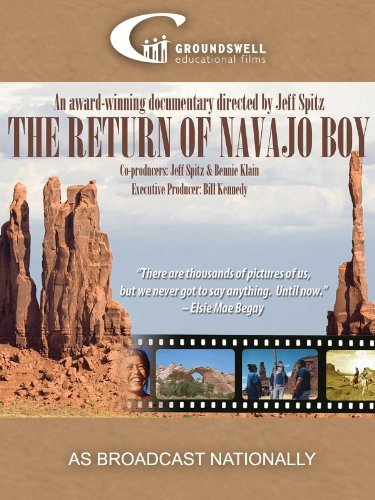
The Return of Navajo Boy

October 11, 2011

The Multicultural Center at the University of Oregon recently held a screening of the documentary, The Return of Navajo Boy. The director, Jeff Spitz, spoke beforehand. He told about how in the late 1990’s a man named Bill Kennedy approached him with a film that his recently deceased father had made in the 1950’s. It was a half-hour documentary about the Navajos (Diné) called Navajo Boy. Kennedy asked Spitz to help him preserve his father’s work. Spitz could make no sense out of the film, which had no sound. He took the film to a library in Chicago that had an extensive collection of literature and films related to Native Americans. The people at the library told him that the film showed a ceremony that, according to Navajo religious belief, should never be filmed. They advised him to destroy the movie. Spitz couldn’t bring himself to do this. Instead, he and Kennedy decided to locate the people in the film and ask them what should be done with it.

The documentary begins with Kennedy talking with Lorenzo Begay, a descendent of the family in the film. (We’re not told how Kennedy managed to locate him.) He lives with his family on a reservation in the austerely beautiful Monument Valley in Utah. He takes Kennedy to meet his uncle and his mother, Elsie Mae Cly Begay, both of whom appear as children in the film.


Elsie Mae Cly Begay in the 1950’s.

He shows the movie to the Begay family. They seem pleased to see themselves in it. We are then told about the family’s history. During the 1950’s, they supported themselves by raising sheep, which they still do today. They were also paid by a local merchant to pose for photographs that would be used for postcards. (They also appeared as extras in John Ford’s The Searchers). Elsie Mae’s mother, Happy Cly, was believed to be the most photographed woman in America at that time.


Happy Cly

Some members of the family also worked in the uranium mines. The Navajo workers were not warned about the health hazards of radiation exposure. One of Elsie Mae’s brothers worked in the mines, and he later developed cancer. The film discusses his efforts to get compensation from the government. Also, radioactive tailings from these minds contaminated the ground water. Elsie Mae’s hogan was built using rocks from the mines. Later it was found to contain 80 times the acceptable level of radiation, so it was destroyed. Two of Elsie Mae’s sons died of cancer, and a third has recently developed it. Happy Cly died from cancer. It turns out that the ceremony shown in the documentary by Bill Kennedy’s father is that of a medicine man trying to cure her.

Elsie Mae had a baby brother, John Wayne Cly, who also appears in Kennedy’s movie. When Happy Cly died, the family was unable to take care of him, so they gave him to white missionaries who promised to bring him back when he was older. They never did. When Kennedy’s documentary is shown at a Navajo museum, John Cly, who was then living in New Mexico, reads about it in a newspaper. The film ends with an emotional reunion between him and his family. There is also a postscript that relates how Elsie Mae now travels the country and to other countries to tell people about what uranium mining did to the Navajo nation.

This is an interesting and important film. Incredibly, the government wants to reopen some of these mines to provide fuel for a new generation of nuclear reactors. This is more evidence that nuclear energy is a bad idea.

You can learn more about this film at NavajoBoy.com.

Occupy Eugene

October 9, 2011

Earlier this evening I went to an organizing meeting for Occupy Eugene. I did not know what to expect. I initially did not plan to stay long because I have a bad cold. However, I found it so interesting that I ended up staying the full three hours.

About 150 people showed up, which is a very large turnout for Eugene. They were mostly young people, although there were some older people as well. Some faces were familiar, but there were a lot of people I couldn’t recall seeing before.

The meeting began with someone reading the declaration by Occupy Wall Street. Then someone proposed that we should use a consensus approach to making decisions. I wasn’t keen on this idea, since consensus can be an unwieldy and time-consuming method. Someone from the floor pointed out that Occupy Wall Street uses a 90% consensus approach, which is also used by Occupy Portland. During the discussion, I initially thought that I should argue for a simple majority vote approach. It quickly became clear, however, that there wasn’t any sentiment for that position. So when it was my turn to step up to the microphone, I argued instead for modified consensus. I pointed out that this approach has worked well for Occupy Wall Street, and it is being used by our comrades in Portland. We should learn from the experiences of other groups. This argument seemed to get a good reception. Several other people, however, suggested that we should first try a full consensus approach, and if this didn’t work out well, then we should go to a modified consensus. This argument carried the day.

A woman got up and taught us hand signals that the Portland group has been using. These included a signal to let a speaker know that he or she is going on too long. Very useful.

There was then a fifteen minute breakout for committee meetings. Everyone was encouraged to join one or more committees. These were: Community Outreach, who are concerned with building support in the community and raising money. Communications, concerned with making flyers and posters, writing press releases, and spreading the word through the Internet. Sexy Sanitation, concerned with doing clean-up after events. Morale, concerned with developing chants and other methods of raising spirits. Legal & Research, concerned with legal matters and with researching what has worked for other occupy groups. Medical, concerned with the health and safety of occupiers. Facilitative, concerned with facilitating meetings and events. There were also some sub-committees. Engineering, for example, would be concerned with making structures for people camping out at the occupations. I joined Communications, which seemed logical, since I know graphic design. After the breakout, each committee reported on what it had decided. Morale, for example, reported that they had decided to build a Wall Street Bull piñata.

We then took a vote on whether on not to get legal permits, which other occupy groups don’t do. A woman expressed concern that people on probation might be reluctant to come if there were no permits. Another woman who was a lawyer pointed out that the police are required to warn people to leave before they can arrest them. It was voted not to get permits. There was a discussion about photographs. It was agreed that if someone asked not to be photographed, the person with the camera should respect that. There was also a discussion about whether we should issue demands before or after the first occupation. The debate went back and forth. It was decided to table the vote until the next meeting.

I was impressed by the high level of discussion and the lack of rancor. It helped a lot that there were no sectarian groups jockeying for position. (This was often a problem at activist meetings I attended when I lived in Los Angeles.) Since this was Eugene, I was afraid there would be some people there who would be, to put it politely, strange. Fortunately, it appeared that only one such person had bothered to beam down. He was an old guy who had a U.S. flag draped over his front and a Soviet flag draped over his back. (Was he nostalgic for the Cold War? Was he intellectually conflicted? Or did he forget to do his laundry?) He went up to the microphone and started talking about Nietzsche. He got a chilly reception.

I am excited about this new movement.
Occupy Fox News

October 5, 2011

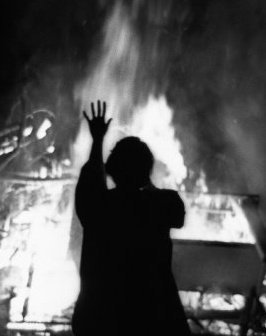
Heh, heh.

I’m told Fox News didn’t air this. What are they afraid of?

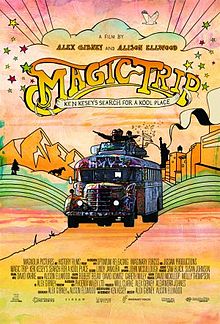
Magic Trip

October 4, 2011

In the early 1960’s, Ken Kesey and the Merry Pranksters decided they would make a film about a cross-country trip they would undertake. After the journey, when they tried to edit the film, they found they couldn’t synchronize the sound and the images. Perhaps this had something to do with the fact that they were tripping on LSD most of the time they were filming. Recently, Alison Ellwood and Alex Gibney used the surviving footage as the basis for a documentary about Kesey and about the 1960’s.

In 1964, Kesey and a group of his friends, inspired by Jack Kerouac’s On The Road, decide to travel across the country from California to New York. They renovate an old school bus and paint it bright colors. They name it “Further”, and they call themselves “The Merry Pranksters”. They manage to get Neal Cassady – the “Dean Moriarty” from On The Road – to be their bus driver. Cassady is on speed much of the time, so he talks incessantly and is constantly gesturing with his arms. The trip is largely a success, but it is not without problems. A woman has a mental breakdown and has to be sent home. Another woman, who is pregnant, eventually decides that she is not enjoying herself and eventually drops out. When the pranksters reach New York, they seek out their hero, Jack Kerouac, only to get a decidedly chilly reception from him. They go to the World’s Fair, thinking it will be a good place to trip, only to find it a bit dull. They then travel to upstate New York, where Timothy Leary has a mansion, where he and others carry out experiments with LSD. When the Pranksters arrive, however, most of the people there, including Leary, hide from them. (One of the Pranksters comments that these people seem “upper class”.) The only one who talks to them is Richard Alpert (“Ram Dass”), who creeps them out.

When the Pranksters return to California, they begin holding parties called “acid tests”. These start to attract large numbers of people. The Pranksters become disenchanted with Cassady, who seems to be all talk and nothing else. One day he is found dead lying alongside a railroad track in Mexico. Kesey eventually seems to sour on the drug culture he helped create, although he never expresses any regrets about what he did. He moves to Oregon, where he settles down on a farm with his wife and children.

It’s funny how society tries to appropriate artists after they die. A statue of Kesey now stands in downtown Eugene, where environmental activists have sometimes been brutalized by the police. At least one of these incidents took place across the street from the statue.

Magic Trip is part road movie, part cultural history, and part morality tale. I highly recommend seeing it.

Occupy Brooklyn

October 3, 2011

Alexander Cockburn Gets Peak Oil Theory Wrong

October 2, 2011

Yesterday, I turned to Alexander Cockburn’s CounterPunch Diary to see if he had anything to say about the highly critical comments people have been making about CounterPunch contributors Gilad Atzmon and Israel Shamir. Instead, I found a (mostly) good article about the Keystone XL pipeline. Cockburn rightly argues that the whole thing is a boondoggle. It will not make domestic oil cheaper, for the obvious reason that the whole purpose of the pipeline is to pump oil to refineries in Port Arthur, Texas, so the resulting products can be shipped overseas.

Unfortunately, Cockburn begins his article this way:

    I’ve never had much time for “peak oil” (the notion held with religious conviction by many on the left here, that world oil production either has or is about to top out – and will soon slide, plunging the world’s energy economies into disarray and traumatic change.) In fact there’s plenty of oil, as witness the vast new North Dakota oil shale fields, with the constraints as always being the costs of recovery. Oil “shortages” are contrivances by the oil companies and allied brokers and middlemen to run up the price.

    Contrary to the lurid predictions of declining US oil production, disastrous dependence on foreign oil and the need for new offshore drilling, not to mention the gloom-sodden predictions of the “peak oil” crowd, the big crisis for the US oil companies can be summed up in a single word that drives an oil executive to panic like a lightning bolt striking a herd of snoozing Longhorns: glut.

The fact that the global economic slump has resulted in an oil glut does not in any way disprove peak oil theory, which is concerned with a long-term trend. (One would think that a Marxist would be able to understand the concept of a trend.) Moreover, Cockburn gives the impression that the North Dakota oil shales are a new discovery. They aren’t. Geologists and engineers have known about them and the Canadian oil sands for decades. (The rate of new oil discoveries has been declining since the 1960’s, by the way.) For a long time, the high cost of recovering oil from these sources made it economically unfeasible to do so. In recent years, however, high oil prices have made such recovery profitable, which is why these sources are now being tapped. Also, it’s because of the high price of oil that companies like BP are willing to undertake risky off-shore drilling ventures – such as the one that led to the Gulf oil spill – especially since the price is expected to continue rising in the future.

Domestic oil production has increased during the Obama administration, yet gasoline prices have remained high in the midst of the worst recession since the 1930’s. This is because the technology required to recover the remaining oil in largely tapped out wells has become increasingly expensive. That’s why it’s delusional for Michele Bachmann to claim that she can bring back $2 a gallon gasoline by allowing more oil drilling. Barring a total collapse of the world economy, we will probably never see $2 a gallon gasoline again.

Cockburn should stay away from scientific issues. From global warming to anti-vaccine quackery, he has shown that he doesn’t understand science. He even seems to have an animus toward science. Every time, for example, that evolution comes up, he starts droning on about how William Jennings Bryan didn’t believe in evolution, which has nothing to do with anything.

And don’t get me started on Atzmon and Shamir.

Occupy Wall Street

September 28, 2011

There seems to be an almost total media blackout on this. So far as I know, only MSNBC has covered it at all.

Louder Than A Bomb

September 25, 2011

Every year over six hundred teenagers from schools in Chicago and its suburbs take part in a poetry competition. I find this amazing. At the rich, white high school I attended, if you had suggested having a poetry competition, you would have been laughed at. It was the considered opinion of my classmates – some of whom went on to Ivy League schools – that only “faggots” read poetry. These students from Chicago clearly don’t have such preconceptions.

The students are formed into teams representing their individual schools. The teams have coaches. At the competition, which is called “Louder Than A Bomb”, audience members clap and cheer almost as if they are at a sporting event.

This documentary by Greg Jacobs and Jon Siskel follows several students during the six month period when they are preparing for the competition. Perhaps the most affecting of them is Nova, who was physically abused by her alcoholic father, and who is intensely devoted to her developmentally disabled younger brother. Her poems have an honesty about them that is deeply moving. Much of the film is devoted to the team from Charles Steinmetz High School, who call themselves the “Steinmenauts”. Their mentor, Coach Sloan, is a stern disciplinarian who nonetheless genuinely cares about his students. At one point, the team undergoes a crisis when three members act up at a meeting, resulting in their being kicked off the team. They are readmitted after they deliver an emotional apology. The high point of the film comes when some members of this team perform a group poem about gang violence. Overall, I was deeply impressed by how talented the students in this film are. Their poems are much better than anything I could have written when I was their age.

Louder Than A Bomb is not for everyone. It will be deeply offensive to people like Barack Obama and Michelle Rhee, as well as the producers of Waiting for “Superman”. No doubt they will angrily demand that these students should be studying for standardized tests instead of writing poetry.

I highly recommend seeing this film.