The Trip

September 24, 2011

In Michael Winterbottom’s film, The Trip, the British comedians, Steve Coogan and Rob Brydon, play fictionalized versions of themselves. Coogan has been hired by the Guardian to do a series of articles about restaurants in the North of England. He plans to bring his girlfriend, Mischa (Margo Stilley), along on a five-day trip. At the last minute, however, she decides that they need a break in their relationship, and she leaves for America instead. Coogan asks several different people to come along, but they all turn him down. He then reluctantly asks Rob Brydon to join him.

The film doesn’t have much of a story. It is mostly concerned with the give-and-take between two men who are similar in many ways, but nonetheless have very different personalities. Rob Brydon seems perfectly happy with his modestly successful show business career. (He hosts a radio quiz show.) Steve Coogan, a well-known comic actor in Britain, feels dissatisfied with his life. He aspires to become a “serious” actor. He wants to make what he calls “art house films”. Yet he is merely offered a role in a fatuous TV series. Interestingly, Coogan is willing to portray himself in a negative manner. He worries that his girlfriend might be cheating on him, yet he engages in a couple of one-night stands. One senses that he finds these encounters unsatisfying, but he feels compelled to do them anyway. At times, he is a bit churlish towards Brydon. The latter, on the other hand, seems well-adjusted and content in his marriage. As the film goes on, however, one begins to get the uncomfortable feeling that there is some truth to Coogan’s insinuations that Brydon’s approach to life is shallow and complacent. Yet there are moments when Coogan seems to wonder if perhaps Brydon knows something he doesn’t.

This film deals, in an oblique manner, with the age-old question of whether one should accept things the way they are, or strive for something better. The film offers no definitive answer to that question. Instead, it suggests that there are serious consequences for whichever choice one makes.

I’m told that this film was cobbled together from a TV series that appeared on the BBC. No doubt that explains why some of the scenes make no sense chronologically. There are, however, no contrived scenes of the kind that one finds in the typical Hollywood road movie. There are, though, some spectacular shots of the Northern English countryside. (I had no idea that some of these places existed in England.) There is an amazing deadpan scene in a ludicrously pretentious restaurant. The film’s ending seems anti-climactic at first, but then you realize it makes sense. At the screening I attended, there was a moment of silence, then the audience burst out in applause.

I highly recommend seeing this film.

The Murder of Troy Davis and the Culture of Death

September 22, 2011

I was hoping I would not have to write another post about Troy Davis, but the Supreme Court has ensured that I would.

The State of Georgia has murdered Troy Davis. It was interesting to hear government officials deny that the fact that witnesses recanted their testimony was of no importance. They seemed to believe that saying that you committed perjury was an involuntary action, like the hiccups. Numerous studies have found that eyewitness testimony can be unreliable. Yet the criminal justice system seemed to determined to kill Davis rather than admit that witnesses are not infallible.

At a recent Republican debate, the audience burst into applause when it was pointed out that Rick Perry has presided over 234 executions since he became governor of Texas. The same people applauded when Dr. Ron Paul said that people who can’t afford health insurance should die. It seems we are developing a culture that holds human life in contempt.

Rise of the Planet of the Apes

September 16, 2011

I initially did not intend to see the latest Planet of the Apes movie. I saw the original series when I was a kid, and I don’t remember much about it, except for that famous iconic scene in which Charlton Heston screams “God damn you all to Hell” at the Statue of Liberty. (Nowadays he would be investigated by Homeland Security for doing that.) I figure the movies probably weren’t that good if that’s all I remember. (I didn’t see Tim Burton’s remake of Planet of the Apes. I have always been somewhat ambivalent about Burton, and the thought of him doing a remake sent me into ambivalence overdrive.) However I heard a lot of good things about this new Planet of the Apes movie. A friend of mine told me he thought it was a better film than X-Men: First Class. So I knew then I should check it out.

Will Rodman (James Franco) is a scientist working for Gen-Sys, a pharmaceutical company. (The film grounds itself in reality by portraying a pharmaceutical company as a cynical and corrupt place.) Rodman is trying to develop a viral cure for Alzheimer’s Disease, which his father (John Lithgow) suffers from. After an experiment involving chimpanzees goes seriously awry, the company’s CEO, Steven Jacobs (David Oyelowo) orders Rodman to have the chimps killed. However, Rodman’s assistant, Robert Franklin (Tyler Labine) persuades him to spare the life of a baby chimp. Rodman takes the chimp home and his father, an admirer of Shakespeare, names him “Caesar”. Right away, Caesar exhibits signs of extraordinary intelligence. Rodman realizes that Caesar has in his blood the viral agent that his mother was given. However, when Caesar attacks a neighbor who threatens Rodman’s father, he is taken away by the authorities and placed in a primate shelter.

I won’t say much more about the story except to say that Machiavelli would have admired the way that Caesar makes himself into the leader of the other apes at the shelter. And there is something deliriously entertaining about the sight of apes running amok through the streets of San Francisco. (Not many people get hurt, except for some who deserve it.) Oh, and there is an evil capitalist (the aforementioned Jacobs) in it. It always improves a film immeasurably when you add an evil capitalist to it. (Back in the 1990’s, it seemed as though every movie had a serial killer in it. Boring. Evil capitalists are a lot more fun.)

I’m told that this film has all sorts of references in it to the earlier Planet of the Apes films, but I didn’t pick up on any of them. This is just as well, since I hate these sorts of inside jokes in movies. (Nobody screams “God damn you all to Hell” at the Statue of Liberty. I suppose this would have been hard to fit in, since the movie takes place in San Francisco.)

By the way, when I was a kid, I read the Pierre Boulle novel on which the original Planet of the Apes movie was based. The ending is different from the movie’s. Instead of the hero finding that he has been on Earth all along, he returns to Earth and finds that apes have taken it over while he was on the other planet. It’s always something, isn’t it?

I have been told that a sequel is planned. I find this ominous, since sequels are (almost) never as good as the first film. This movie would be pretty hard to top. However, I did not think that this is a better movie than X-Men: First Class; the latter has more interesting characters and a more complex story. Still, Rise of the Planet of the Apes meets and exceeds all other expectations.

Save Troy Davis

September 12, 2011

The state of Georgia is getting ready to execute Troy Davis, an innocent man. Davis was convicted of murdering an off-duty police officer, Mark MacPhail in 1989. There was no physical evidence against him. He was convicted based on the testimony of nine eyewitnesses, seven of whom later recanted. Others have testified to hearing another man confess to the murder. You can read about it here.

There will be an international day of solidarity for Davis on Friday, September 16. You can read about it here.

Update: To save Troy Davis, call Judge Penny Freesemann at 912-652-7252 to withdraw the death warrant. It’s his last chance.

Another Earth

September 10, 2011

Another Earth, directed by Mike Cahill and written by Cahill and Brit Marling, is an unusual type of science fantasy film, one that is mostly concerned with human relationships rather than with telling an adventure story. Rhoda (Brit Marling) is a teenager who has just been accepted into M.I.T. However, she gets into a drunk driving accident in which she hits a car with a family in it, killing a mother and her son. After spending time in prison, she is released. She gets a job working as a janitor at a high school. She goes to the house of the father who survived the crash, John (William Mapother) to apologize. He doesn’t recognize her, because he was in a coma at the time of her trial. She can’t bring herself to apologize, so instead she makes up a story about looking for work as a maid. He hires her, and she begins going to his house every week to clean, still unable to bring herself to tell him the truth.
Eventually, they become romantically involved. At the same time this is going on, a previously unknown planet appears in the sky. It looks like the Earth, and it turns out to be an exact replica of this planet. Fascinated with the idea of meeting another version of herself, Rhoda enters a contest for people who wish to travel to this second Earth. Now and then there are voiceovers discussing the philosophical implications of a second Earth.

I mostly liked this film. The relationship between Rhoda and John develops in a believable manner. The scenes with an Earth in the sky have an eerie beauty to them. And I liked Brit Marling’s performance as Rhoda. However, the philosophizing gets woozy at times; the movie would have been better without it. And there is a subplot about one of Rhoda’s fellow janitors deliberately blinding himself that doesn’t really work.

A flawed but nonetheless enjoyable film.

Incendies

September 6, 2011

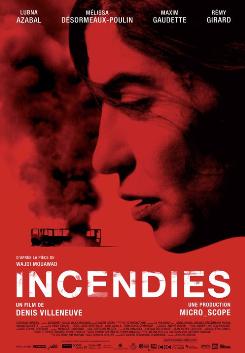
Incendies is a film by Canadian director, Denis Villeneuve, based on the play, Scorched, by Wajdi Mouawad. It is in French and Arabic. It was nominated for an Academy Award for best foreign language film, but it lost to In a Better World. I find this baffling, for Incendies is clearly a vastly superior film.

Nawal Marwan (Lubna Azabal) is a Lebanese immigrant living in Montreal, where she works as a secretary for a notary, Lebel (Rémy Girard). After Nawal dies, Lebel reads her will to her twin children, Jeanne (Mélissa Désormeaux-Poulin) and Simon (Maxim Gaudette). She tells them that their father is still alive and that they have a brother. They had previously not known about these things. She tells them that before they can place a marker over her grave, Jeanne must find her father and Simon must find his brother. Simon refuses to go along with this, but Jeanne decides to go to Lebanon to find her father. The film jumps back and forth between scenes from Nawal’s life and Jeanne’s search. The story is complicated, and I won’t go into any more detail about it except to say that it combines the themes of how the past remains with us, the desire for revenge, and the need to find love. I found this film powerful and moving, and quite unlike any other movie I’ve seen.

In his critique of this film, As’ad AbuKhalil claims: “Arabs in the movie come across as barbarians”. That was not the impression that I got from watching this film. Yes, there are some Arab Christian militiamen who do behave like barbarians. (“Barbarians” is actually putting it mildly.) However, most of the Arab characters in this film come across as sympathetic. Nawal is actually portrayed as a heroic person. (Strangely, AbuKhalil says nothing about the fact that this film is based on a play by a Lebanese.) AbuKhalil also complains that the characters never mention Israel. This is true. It is, for example, implied that the prison in which Nawal is raped and tortured is run by the Israelis, but the film never makes this explicitly clear. I suspect that these omissions may have something to do with the fact that most of the scenes were shot in Jordan, which has a tense, but “friendly”, relationship with Israel. (I suspect that the reason this film failed to win an Academy Award is that some academy members picked up on the anti-Israeli implications of the prison scenes.) AbuKhalil also complains that the film contains “disturbing thoughts and twists”. Well, yeah, but the same could be said about King Lear and The Sound and the Fury. We live in a world in which disturbing things happen, so art inevitably reflects this. AbuKhalil often makes valid criticisms of the way Arabs are portrayed in the Western media, but in this case I think he went off the rails.

I highly recommend seeing this film.

Feeding at the Trough at the University of Oregon

September 5, 2011


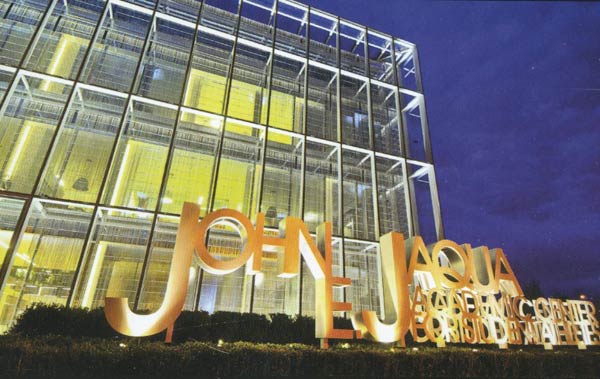
The John E. Jaqua Academic Center, whose upper floors are off limits to most students. A result of the brilliant planning of UO administrators.

The Register-Guard has just revealed that three months ago the University of Oregon awarded raises totaling $1.9 million a to 390 administrators. This is after university staff were forced to take a pay cut. The is at a time when the state of Oregon is in the midst of a budget crisis, and the official unemployment rate in Oregon is 9.5%. (The real unemployment rate is no doubt higher.)

What have these administrators done to deserve this raise? Let’s look at some of the things they’ve done in recent years. They spent almost a quarter of a billion dollars to build a new basketball arena that the school doesn’t need. They spent $41 million to build the gaudy and pretentious Jaqua Center, which serves no real purpose. They built the Ford Alumni Center, which, according to its website, is intended to serve as “the gateway to the university” (whatever that means). They also built an ugly and garish electrical sign in of front the new basketball arena facing busy Franklin Boulevard. (This thing is so bright that it hurts your eyes when you look at it at night. Seriously, you could use this thing instead of a lighthouse to guide ships at sea.) They wanted to create a huge neon sign saying “University of Oregon” in the middle of Portland, which is over a hundred miles from the main campus. (The people of Portland rightly stopped this.) They devised a scheme to gradually privatize the school, which will make a college education more inaccessible to people in Oregon. They have demanded that the campus police be allowed to carry guns and tasers that they don’t need. Meanwhile, the athletic department has been plagued by scandals.

And these people think they deserve a raise for all this.

One is reminded here of the banksters who gave themselves raises and bonuses after they wreaked the economy. It seems that in twenty-first century America, the way to succeed is to fail. What is important is no longer the results one gets, but one’s ability to hype oneself. (No doubt this explains the aforementioned idiotic plan for a neon sign.)

The 135-year history of the University of Oregon has followed an interesting trajectory. The place was originally conceived as a sort of mini-Harvard for people too lazy to take the week-long train ride to the East Coast. Although the school had academic pretensions (some faculty members belonged to the Klu Klux Klan), it was an open secret that the place was really a playground for the pampered sons of Oregon’s rich. These future captains of industry would amuse themselves by devising elaborate hazing rituals that invariably involved spankings. (I will leave it to the reader to try to figure out why budding capitalists would enjoy spankings.) Things changed drastically after the Second World War, largely as a result of the G.I. Bill. The university was forced to throw open its doors to members of the lower orders. The school’s fine old traditions were smashed as a result of the place being flooded by vulgar, coarse youths who actually wanted to learn about things like physics and art history. It became necessary to hire professors and instructors who knew something about the topics they were teaching. As a result, the concept of a “college education” acquired a weight and gravity that it had never previously possessed. Now, however, as tuition continues to rise and privatization looms, the university seems to be coming full circle. It appears to be becoming once again a playground for the rich.

Perhaps the idea that education is something valuable and important was merely the fleeting result of a transitory phase in the evolution of capitalism. Just look at the current campaign to destroy public education through standardized testing and charter schools. Perhaps we are returning to a situation like that in the Middle Ages, when learning was something done by a few oddballs in monasteries.

My advice to young people who want to get a college education is that they had better have a lot of money.

And it will help if they learn to enjoy being spanked.

The Libyan Revolution

August 26, 2011

Some on the left (Glen Ford, for example) have taken the view that the Libyan revolution is nothing more than a NATO-driven coup d’etat. I cannot share this view. Clearly, the rebels could not have succeeded without support from a substantial portion of the Libyan population. One thing we learned from the Afghanistan war is that dropping a lot of bombs and sending in special operations forces do not guarantee a victory. Civilian support – which the U.S. clearly lacks in Afghanistan – is an important factor.

No doubt the Western governments will try to profit as much as they can from the current situation in Libya. Some members of the ruling class are openly calling for a U.S. occupation of Libya. Richard Haas has written in the Financial Times:

    Nato’s airplanes helped bring about the rebel victory. The “humanitarian” intervention introduced to save lives believed to be threatened was in fact a political intervention introduced to bring about regime change. Now Nato has to deal with its own success. Some sort of international assistance, and most likely an international force, is likely to be needed for some time to restore and maintain order. Looting must be prevented. Die-hard regime supporters will have to be defeated. Tribal war must be averted. Justice and not revenge need to be the order of the day if Libya is not to come to resemble the civil war of post-Saddam Iraq in the first instance, or the chaos (and terrorism) of Somalia and Yemen down the road.

Haas, a diplomat, apparently did not notice that the U.S. military completely failed to stop the sectarian civil war in Iraq. I suspect Haas’s real concern is guaranteeing for the U.S. easy access to Libyan oil. Despite his knowing use of quotation marks, it is clear that Haas is actually making a more sophisticated version of the “humanitarian intervention” argument. I doubt, however, that Obama will take Haas’s advice. Among other things, the current political mood in the country is not favorable for such a move.

Is the revolution an unqualified victory for the U.S.? Bear in mind that the U.S. did not get everything it wanted in Iraq, and it certainly did not get what it wanted in Afghanistan. The U.S. may find Libya also hard to control.

In a Better World

August 21, 2011

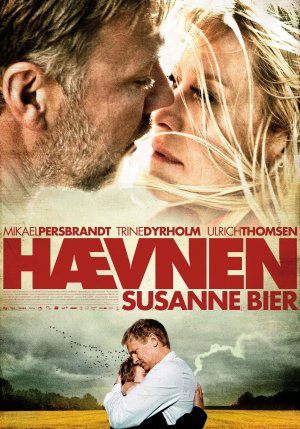
The Danish film, In a Better World, directed by Suzanne Bier, was awarded this year’s Oscar for best foreign language film. However, in all honesty I must say that I was not all that impressed by it. (I thought Biutiful was a better film.) Although I liked some of the early scenes, I ultimately found it disappointing.

Anton (Mikael Persbrandt) is a Swedish doctor who does volunteer work in a Sudanese refugee camp. He is estranged from his Danish wife, Marianne (Trine Dyrholm). She lives with their son, Elias (Markus Rygaard), in a small village in Denmark. Elias is bullied by some of his classmates. A new student, Christian (William Jøhnk Nielsen) arrives, and he immediately takes sides with Elias. He severely beats one of the bullies and threatens him with a knife. The bullying then stops. This convinces Christian that the way to deal with conflicts is to use force. He and Elias later see Anton get into an argument with Lars (Kim Bodnia). When Lars slaps Anton, the latter refuses to hit back, because he is a pacifist. Christian then decides to build a bomb and blow up Lars’s van, to teach him a lesson. He persuades Elias to help him. However, Elias is injured in the blast.

This film’s central conflicts are resolved in a manner that struck me as too familiar and contrived. I actually began to feel as though I were watching one of those After School Specials that they used to show on TV when I was growing up. It ends up being just another story about mixed-up adolescents. This was a comedown, because the early scenes seem to promise something more than this.

This film has a subplot that takes place in Africa. The refugees are terrorized by a local warlord, who commits shocking crimes. One day, he shows up in the camp and demands that Anton treat his wounded leg. This could have been an interesting dramatic situation. Unfortunately, the warlord is such a cartoonish character that he simply isn’t convincing. These African scenes are apparently meant to serve as a dramatic counterpoint to the scenes in Denmark, but they end up being merely a distraction.

All in all, a disappointing film.

X-Men: First Class

August 13, 2011

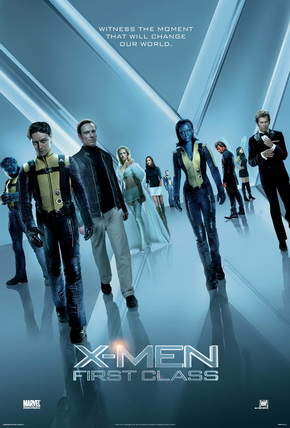
After watching such highbrow fare as The Tree of Life and Hobo with a Shotgun, I felt the need for something light, so I went to see X-Men: First Class. I have to admit that I was never really into the whole X-Men thing. I belong to a generation for whom Spiderman and the Fantastic Four were the really cool superheroes. So I probably didn’t get all the in-jokes, although I noticed some moments that clearly had that in-joke feel to them. Personally, I don’t like it when they put in-jokes in movies, but they seem to be a requirement with these genre films.

X-Men: First Class gets off to a slow start. The problem is that it spends too much time establishing the origins of the main characters. About twenty minutes in, however, it starts to take off, and soon it’s like a roller coaster ride. I won’t go into too much detail about the story. Basically it takes place in the early 1960’s, and it’s about a group of evil mutants who try to start a nuclear war between the United States and Russia. They want to destroy non-mutants so that they and other mutants can rule the world. They are opposed by a group of good mutants, who at the end become the “X-Men”. As you may have guessed by now, the words “mutants” and “mutations” get tossed around a lot in this film. I guess this is supposed to sound scientific, although I’m not aware that it’s possible for a mutation to allow one to violate the laws of physics, as the characters in this film frequently do.

One of the things I liked about this film is that some of the characters are remarkably complex for an action movie. Indeed, the characters in this film have more depth than the characters in some supposedly “adult” movies such as Horrible Bosses. Even though they have super powers, they can't help feeling like misfits who aren't wanted. I suspect this is the secret to the comic books' success: they appeal to adolescents who feel they aren't appreciated for their talents.

This film mixes historical events with fictional ones in a manner that I did not find objectionable. Indeed, I was struck by the fact that the movie makes it clear that it was the U.S.'s decision to place Jupiter missiles in Turkey that led to the Cuban missile crisis. When I was young, if you had pointed that out to someone, he might very well have called you a "traitor". It's funny how things have changed since the end of the Cold War.