More Thoughts about Obama’s Budget Deal

August 7, 2011

The raucous debates that preceded the budget deal have led some to the conclusion that the U.S. ruling class is in a state of crisis. The wars in Iraq, Afghanistan and Libya have not gone they way they hoped. The recovery from the last recession has been extremely weak. They are desperately trying to find a way to increase profits while maintaining the empire, but they are divided on how to do it. Some, like the Koch Brothers (the driving force behind the Tea Party), want to simply destroy whatever is left of workers’ living standards, effectively making the U.S. into a “Third World” country. Others favor less drastic measures. The people at Standard & Poor’s are trying to impose their own ideas on the government by downgrading their credit rating. None of these people seem to see unemployment as a problem, even though the more intelligent members of the ruling class must realize that chronic unemployment will eventually lead to social unrest. (The Wisconsin uprising may be a foreshadowing of this.) Yet they are unwilling to accept any New Deal-type reforms that might assuage public anger.

Again, what we need is a movement of unemployed people.

Hobo with a Shotgun

August 5, 2011

Years ago, I had a group of friends who liked to watch bad movies. No, I don’t mean “so bad it’s good” movies like Plan 9 from Outer Space or Robot Monster. I mean movies that are just bad. I’m talking about low budget exploitation films that make you feel unclean while you’re watching them. The idea seems to have been that these guys would get together and share a common feeling of smug superiority towards the people who made these films, sneering at the bad acting and the inept camera work. Try as hard as I could, I was never able to buy into this aesthetic. I would sit squirming in my chair, wanting to say, “ Wouldn’t it be more fun to watch a good movie?”

Hobo with a Shotgun seems to belong to a similar aesthetic, although the attitude here seems to be one of morbid fascination rather than smug superiority. The main reason I went to see this film is because I thought the trailer was funny. Considering that even the trailers for Hollywood “comedies” aren’t funny, I thought this had to be a promising sign. I have since learned that it originally was one of a series of joke trailers that were made for the Robert Rodriguez-Quentin Tarantino concoction, Grindhouse, which I haven’t seen. I have, however, seen Rodriguez’s Machete, which also started out as one of these joke trailers. Although I liked that this film takes the side of immigrants, I must admit that I didn’t think it was very good. The characters were too cartoonish to be interesting, and the action sequences weren’t well done. (Well-done action sequences, in my opinion, are the bare minimum requirement for a good action film.) I suppose some would argue that this film’s badness is the whole joke, although, in my opinion, it is a joke that wears thin pretty quickly.

Hobo with a Shotgun, directed by Jason Eisener and written by John Davies, is the second of these Grindhouse spin-offs. The film has a 1970’s look and feel to it. (I take it the seventies were a sort of Golden Age of exploitation films.) The basic plot is an example of a peculiarly American genre. It’s that type of story in which a stranger arrives in a corrupt city or town and, using ruthless methods, proceeds to clean the place up. (The best example of this type of story is Dashiell Hammett’s Red Harvest.) One morning, a hobo (Rutger Hauer) arrives in Hope Town, which is known by its residents as either “Scum Town” or “Fuck Town”. (In keeping with the rules of the genre, we are never told the hobo’s name, just as we are never told the name of Hammett’s Continental Op.) The hobo finds that there is rampant crime in the city. The place is run by The Drake (Brian Downey), who is a combination gangster, preacher and carnival barker. The Drake holds public executions of people who displease him, including his own brother. The police are completely under The Drake’s control. The hobo befriends a prostitute, Abby (Molly Dunsworth), who is far and away the most sympathetic character in the film. When he sees a robber threatening to kill a baby, the hobo snaps. He gets a shotgun, and soon the bodies start to pile up.

Hobo with a Shotgun is the most violent film I have ever seen. Eisener and Davies cram as much gratuitous violence as they can into each scene. There are depictions of torture, disembowelment, mutilation and people being burned alive. Yet the film has a Grand Guignol feel to it that makes it hard to take seriously. Everything is so ridiculously overdone that I couldn’t help laughing at times. Other people in the audience reacted the same way. However, several people got up and left.

I have deeply mixed feelings about this film. I can’t say that I didn’t find it entertaining, yet I can’t really recommend it. It has no redeeming value, even though Eisener and Davies try to inject some social consciousness into it. In one scene, for example, Abby makes a speech defending homeless people. The problem is that when you present an argument like that in the cynical context of an exploitation film, it rings hollow.

I have a suggestion for Rodriguez, Eisener and Davies: wouldn’t it be more fun to make good movies?

Obama’s Budget Deal

August 4, 2011

Readers of my blog know that I have never been keen on conspiracist thinking, but I’m starting to get a bit paranoid after these recent budget negotiations. Watching them was like watching that old magician’s trick, in which the audience is made to look in one direction while the important thing that’s happening is in the other direction. For weeks we listened to one Tea Party Republican after another talk about how they must wreak the economy just to spite Obama. Meanwhile, few noticed that Obama actually proposed making cuts in Social Security and Medicare.

Think about it, and the conspiracy makes sense. First, find the stupidest members of the white middle class. Tell them that Obama is a socialist and a fascist and a Muslim. Then organize them into demonstrations and let them make fools out of themselves. So the rest of the country gawks at these people and no one pays attention to what Obama is doing. They don’t realize just how conservative Obama is, and how he is waging war on the working class and the poor.

It is becoming clear that the ruling class have decided that they can live with a permanent state of high unemployment. Indeed, they may even view that as preferable. And if it is fine with them, it is fine with Obama.

What we need in this country is a movement of unemployed people.

Forks Over Knives

July 31, 2011

Recently I was diagnosed with diabetes. My doctor recommended I eat more fruits and vegetables and less meat and processed foods. I changed my diet accordingly, and since then my blood sugar level has gone down and I feel more energetic. So I was naturally interested when I heard about Lee Fulkerson’s documentary, Forks Over Knives, which argues that if people were to switch to a plant-based diet, the incidence of heart disease, cancer and diabetes would go down. The film mainly follows the careers of two doctors, T. Colin Campbell and Caldwell Esselstyn. Campbell did a nutrition study in the Phillippines, where he discovered to his surprise that children from wealthy families had a higher incidence of liver cancer. He noted that these children tended to consume more meat and dairy products than poorer children did. He later conducted a study in China, in which he found that in areas where people had adopted a “Western diet” – increased consumption of meat, dairy products and processed foods – there was a higher incidence of cancer. This led him to the conclusion that large amounts of animal protein can trigger the development of cancer cells in some people.

Esselstyn was a surgeon who specialized in coronary bypass surgery. His work with heart attack patients led him to the conclusion that a plant-based diet reduces the incidence of heart disease. He argues that improved diet can reduce the need for surgery (hence the film’s title: “forks over knives”.) The film features various interviews with people who have adopted plant-based diets. It also follows Fulkerson as he tries this same diet.

It has been largely forgotten that up until the twentieth century most people did not consume a lot of animal protein. I remember years ago reading Karl Marx’s The Eighteenth Brumaire of Louis Bonaparte. At one point Marx says that Bonaparte bribed the soldiers in the French army by giving them sausages. I remember thinking that those soldiers were awfully easy to please. What I didn’t realize at the time was that in nineteenth century France sausages were probably a luxury for most people. Go into any supermarket nowadays and you will find row after row of sausages in the meat section. What has changed is that modern refrigeration has made it cheaper and easier to store and transport meat and dairy products. Also the development of factory farms has made these foods cheaper. The result is that many people now eat more animal protein than is really good for them.

I highly recommend seeing this film.

The Norway Attacks

July 24, 2011


This is how the media want us to behave all the time.

Nothing I can remember has been more disgusting than the media’s response to the terrorist attacks in Norway. Right away many in the media jumped to the conclusion that it was the work of an Islamist group, even though there was not a shred of evidence to support that idea. All along the Norwegian police were saying they believed the attacks were “domestic” in origin. Indeed, considering that the attacks targeted members of a left-wing party, it was reasonable to assume that they were the work of a right-wing group.

The Norwegian police have announced that the attacks were the work of Anders Behring Breivik. The Los Angeles Times describes him as:

    …a “right-wing Christian fundamentalist” who frequented extremist websites and left a trail of passionate, sometimes obscure rants that reflected strong anti-Islamic views, deep skepticism about the mixing of different cultures and animosity toward socialism.

In other words, this guy holds the sort of nativist views that the media assiduously try to cultivate among Americans. Funny how things turned out that way.

The Price of Sugar

July 23, 2011

I recently saw the 2007 documentary, The Price of Sugar, which was directed by Bill Haney. It depicts the plight of Haitian farm workers on sugar plantations in the Dominican Republic. These workers have no legal status, and they live in appalling conditions in small villages called baretes, which are guarded by goons hired by the plantation owners. These Haitians are regarded with suspicion and sometimes hostility by many Dominicans, even though they perform work that the Dominicans refuse to do. Does this sound familiar? This is similar to the situation of Mexican and Central American farm workers in the U.S. It seems that the practice of demonizing the lowest paid workers in order to more thoroughly exploit them and other workers is not confined to the U.S. Indeed, I would not be surprised if this is a common practice in the capitalist world.

The film focuses on a Catholic priest, Christopher Hartley, who brought volunteer doctors from the U.S. to treat the Haitians, and who urged the Haitians to organize to make demands for better working and living conditions. This brought him into conflict with the Vicini family, who own many of the sugar plantations in the Dominican Republic, and who are a powerful political force in that country. The Vicinis organized demonstrations in which people accused Hartley of bringing Haitians into the country and of trying to “Haitianize” the Dominican Republic. (Again, doesn’t this sound familiar?) I have learned that after this film was made, Hartley was relieved of his position by the Catholic Church. I suspect this was in response to political pressure.

At one point in this film, we are told by the narrator, Paul Newman, that the U.S. has a trade agreement with the Dominican Republic, which stipulates that U.S. will buy sugar from that country at twice the world market price. I saw this film with a law professor who specializes in trade issues. I asked him why the U.S. would want to buy sugar at twice the market price. He told me that by making sugar prices artificially high, the U.S. government creates a demand for corn syrup. In effect, this is a subsidy for U.S. agribusiness, one that is carried out on the backs of Haitian workers.

I highly recommend seeing this film.

Katia Kabanova

July 21, 2011

Recently I saw a film of Leoš Janáček’s opera, Katia Kabanova. It was a production by the Teatro Real in Madrid, directed by Robert Carsen. The opera is based upon a nineteenth century Russian play, The Storm, by Alexander Ostrovsky. The theme of the work is the destructive effect of middle class moralism on people’s lives. This has renewed relevance for our time, thanks to the Tea Party.

The opera takes place in a Russian village on the Volga River. Katia (Karita Mattila) is married to a merchant, Tichon, whose widowed mother, Marfa, is constantly lecturing him about how he must assert his authority over his wife, or she will be unfaithful to him. (This is not far-fetched. From Phyllis Schlafly to Michele Bachmann, the fiercest advocates of patriarchy have been women.) Katia, however, has caught the eye of Boris, who is constantly being berated by his uncle, Dikoj, who controls his inheritance. When Tichon goes away on a trip, Varvara, a foster daughter of Tichon’s family who is sympathetic to Katia, persuades her to secretly meet with Boris. Katia does so several times, and she and Boris make love. Not surprisingly, Marfa turns out to be a hypocrite (isn’t that always the way?), for she is having a torrid affair with Dikoj at the same time. When Tichon returns, Katia is seized with guilt, and she confesses her infidelity before the entire village. Dikoj orders Boris to leave for Siberia. Overcome with grief, Katia drowns herself in the Volga.

Carsen has the stage covered with water. An important motif in the opera is the dual nature of water, which can bring both life and death. The actors stand and walk on narrow wooden platforms, which are moved around by women dancers wearing white dresses. The narrowness of these structures represents the constricted nature of the character’s lives. Janáček’s music is agitated and sometimes harsh, reflecting the inner turmoil of the characters. Yet there are passages of soaring lyricism, which not only reflect the fleeting moments of happiness in these people’s lives, but also hint at the possibility of a better way of life. I highly recommend seeing this film if you get a chance.

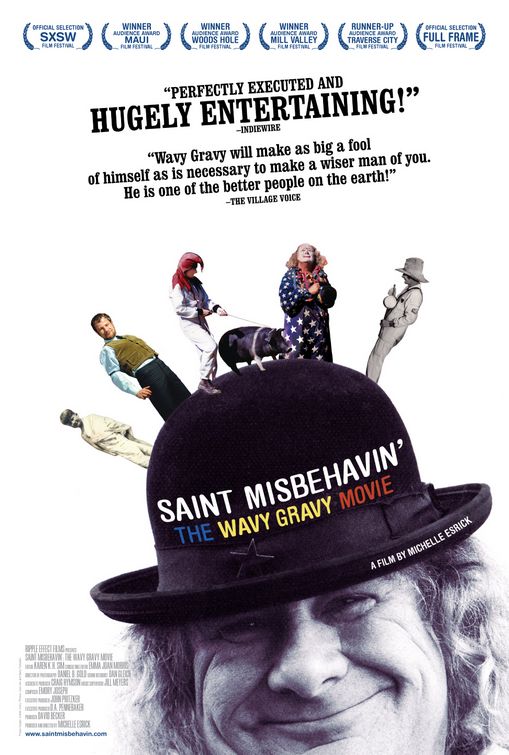
Saint Misbehavin’: The Wavy Gravy Story

July 17, 2011

Michelle Esrick has directed a documentary about Hugh Romney, better known as Wavy Gravy, the peace activist, clown and archetypal hippy. Romney’s early career is in many ways highly representative of how hipsterism evolved from the 1950’s to the 1970’s. In the fifties, he was reciting poetry at the Gaslight Cafe in Greenwich Village. Inspired by Lenny Bruce, he began doing stand-up comedy, and he released a comedy album. In the early sixties, he moved to California. There he met Ken Kesey. He joined the Merry Pranksters and experimented with LSD. (He gives good advice on how to deal with someone who’s having a bad trip: keep telling the person that what he’s seeing isn’t real and that it will soon end.) He then founded a commune outside of Los Angeles called the Hog Farm. While touring with fellow members of the Hog Farm, he was asked to help organize the Woodstock music festival, and he became the MC. It was shortly after this that B.B. KIng gave him the name “Wavy Gravy”. He took part in numerous anti-war demonstrations. On at least one occasion he was severely beaten by the police, with the result that he suffers back problems to this day. W.G. found that if he dressed as a clown, the police would not hurt him. So that is the public persona he has adopted to this day.

Wavy Gravy comes across as a likable person in this film, but for all his supposed zaniness and irreverence, he seems strangely bland and – dare I say it? – even a bit dull at times. The problem is that, aside from the Vietnam War (which he rightly calls genocide), he never expresses any really strong opinions about anything. There is, strange to say, no discussion in this film of any of the U.S.’s military interventions since Vietnam. An extraterrestrial watching this film might well get the impression that human history came to an end during the 1960’s. (I’ve met some elderly hippies who seemed to believe this.)

A lot of this has to do with Wavy Gravy’s concept of spirituality. The film begins with W.G. entering a room that is filled all sorts of religious icons – Christian, Buddhist, Hindu, with toys mixed in. (There is a multi-armed Donald Duck figurine. No doubt this represents the multiple aspects of Donald’s powers.) W.G. then recites a prayer in which he names all sorts of famous religious figures (including Lenny Bruce). It’s a spirituality in which various religious traditions are mixed together in a sort of feel good froth. W.G. emphasizes the importance of providing food and shelter to the poor and unfortunate. He argues that if we are kind and decent to people, it will create a ripple effect that will eventually spread through the whole world.

Wavy Gravy does some good things. He helped found a charity that provides eye care to poor people. He runs a children’s summer camp called Camp Winnarainbow that, judging from this film, looks as though it’s a hell of a lot more fun than the fascistic summer camp I went to as a kid. Still, we live in a world that’s being destroyed by capitalism, in which imperialist wars are being fought. Just being nice to people is not enough.

Casey Anthony and the Price of Hysteria

July 14, 2011

In my earlier discussion of the Casey Anthony trial, I expressed my fear that the public hysteria over the trial’s verdict would lead to more unnecessary “tough-on-crime” legislation. Well, clearly my powers as a Nostradamus are vastly greater than those of Phil McGraw, for this has come to pass. In state legislatures across the country, “Caylee’s Law” legislation is being considered. These laws would make it a felony crime if a parent or guardian fails to report the death or disappearance of a child within a twenty-four period, regardless of the circumstances. So more people will be going to prison. All this just because people didn’t like one verdict in one trial.

The U.S. already incarcerates a larger percentage of its population than any other industrialized nation. California’s prison system is in crisis because it cannot adequately house and feed all its prisoners. Inmates at Pelican Bay State Prison have gone on a hunger strike to protest the inhuman conditions in which they live. This is how Wikipedia describes the place:

    Pelican Bay State Prison (PBSP) is a supermax California Department of Corrections and Rehabilitation state prison near Crescent City in unincorporated Del Norte County, California. The 275-acre (111 ha) facility is explicitly designed to keep California’s alleged “worst of the worst” prisoners in long-term solitary confinement, under conditions of extreme sensory deprivation.

Uh, isn’t sensory deprivation a form of torture? Wikepedia also tells us:

    Pelican Bay was built with little legislative or judicial oversight. The California legislature delegated building and design decisions to Department of Corrections administrators. These administrators toured high-security prisons across the United States. They identified Florence, Arizona’s Secure Management Unit (SMU), as a “model” prison and collaborated with prison architects to copy its floor plan and high tech design for PelicanBay’s SHU [Secure Housing Unit]. (Pelican Bay was one of 21 new prisons built in California in the 1980s and 1990s.)

    Correctional administrators purchased land in rural Del Norte County, California, on the northernmost border with Oregon. Its lengthy distance away from most prisoners’ families was considered a plus. It is in a remote forested area 13 miles from the California-Oregon state line and far from California’s major metropolitan areas, 370 miles north of San Francisco and more than 750 miles north of Los Angeles. One of the few legislative comments recorded about the institution concerns whether to call it Dungeness Dungeon or Slammer by the Sea. There was no legislative discussion of the novel punitive design of Pelican Bay nor that it would be the site of indefinite SHU commitments. The original planners did not contemplate that some prisoners would spend decades there.

    Federal district courts in California first heard about the prison after it opened in the early 1990s, when they started receiving letters and legal complaints from Pelican Bay prisoners detailing the draconian conditions at the institution, along with the egregious constitutional violations taking place there. Originally designed to house 2,550 prisoners, as of 2006, Pelican Bay houses 3,301 prisoners.

Of the Secure Housing Unit, we’re told:

    The 8 x 10 foot cells of the Pelican Bay SHU, or Secure Housing Unit, are made of smooth, poured concrete. They have no windows. Instead, there are fluorescent lights, which stay on 24 hours per day. For at least twenty-two hours every day, prisoners remain in their cells, looking out through a perforated steel door at a solid concrete wall. Food is delivered twice a day through a slot in the cell door.

We live in a society that believes that locking people up is the solution to every problem. This inevitably leads to abominations like Pelican Bay.

Glenn Beck and Israel

July 13, 2011

Glenn Beck has dabbled in anti-Semitic conspiracy theories. He has expressed admiration for the anti-Semitic writers Elizabeth Dilling and Eustace Mullins. Yet he was recently invited to speak before a committee of the Israeli Knesset, where he was well received and lauded as one of “Israel’s great friends”.

We live in a society in which anyone who criticizes Israel is labeled as an “anti-Semite”. Yet the Israelis have made it clear that they regard a genuine anti-Semite as one of “Israel’s great friends”.

What does this tell us about Israel?