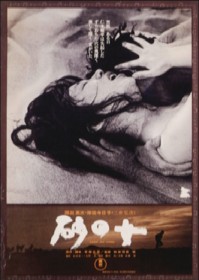
The Woman in the Dunes

January 7, 2011

The Woman in the Dunes is a 1964 film directed by Hiroshi Teshigahara, with a screenplay by Kōbō Abe, based on his own novel. Junpei Niki (Eiji Okada) is an amateur entomologist who is collecting insects in dunes near the sea. He misses his bus back to town, so he asks some people from a nearby village if there is a place where he can spend the night. They take him to a pit with a house at the bottom of it. They tell him the woman who lives there (Kyoko Kishida) will put him up for the night. Junpei doesn’t find anything strange or suspicious about this. He climbs down a rope ladder into the pit. He learns that the woman (we’re never told her name) digs sand, which is then hauled up with a rope. The villagers sell the sand. The next morning, he finds that the villagers have pulled up the ladder. They want him to remain in the pit and dig sand with the woman. He refuses to dig and demands that they let him go. The villagers withhold water from him for several days until he finally gives in.

Junpei and the woman develop a sexual relationship. (I can’t really call it a romance, especially since he never asks her what her name is.) Junpei escapes from the pit, but he gets stuck in quicksand and the villagers capture him. Months go by and Junpei becomes resigned to his situation. One day he asks the villagers if he can be allowed to leave the pit for a half hour at a time, so he can look at the sea. They tell him they will let him do it on one condition: that he and the woman have sex in front of them. The woman is revolted by this idea. Junpei, however, is so debased at this point that he tries to rape her – but he is unable to go through with it.

Later Junpei discovers a way to draw water from the sand. He feels immensely pleased with himself. The discovery gives him a sense of self-respect in his humiliating situation. One day, the woman becomes ill. Junpei displays genuine concern for her. He persuades the villagers to take her to a doctor. They lift her out of the pit with a rope. When they are done with this, they forget to pull up the rope ladder. Junpei climbs out of the pit. He walks along the beach for a while, and then he climbs back into the pit. He gazes admiringly at his water trap. He tells himself that he will one day tell the villagers about this discovery, then he will escape. The film ends with a shot of a police bulletin saying that Junpei has been missing for seven years.

The message of this film is that we don’t try to free ourselves because we take consolation in petty achievements. I think there is some truth in this idea. An office worker prides himself on getting the corner office, instead of trying to get rid of the capitalist system that exploits him.

This film is beautifully done. There are many shots of shifting sand. I never before realized that sand can move in surprisingly complex and interesting ways. The sex scenes are subtly erotic and tastefully done.

Tamara Drewe

January 5, 2011

Tamara Drewe is a British comedy directed by Stephen Frears, with a screenplay by Moira Buffini, based on a graphic novel by Posy Simmonds. The film opens at a writers’ colony in Dorset. It is run by Beth Hardiment (Tamsin Greig), who is married to a philandering crime novelist, Nicholas Hardiment (Roger Allam). The lodgers include an American academic, Glen McCreavy (Bill Camp), who is writing a book about Thomas Hardy. Beth is assisted around her farm by a handyman, Andy Cobb (Luke Evans). When Tamara Drewe (Gemma Arterton), a comely young woman sporting a recently surgically shortened nose, moves into the farmhouse next door, Andy (her erstwhile boyfriend) and the lecherous Nicholas both take notice. However, Tamara launches into a romance with a rock star, Ben Sergeant (Dominic Cooper). This draws the attention of two bratty teenagers, Jody and Casey (Jessica Barden and Charlotte Christie), who are obsessed with Sergeant. Their attempts to intrude into the lives of Ben and Tamara set off a chain of events that have consequences for the other characters that are both comic and tragic.

Tamara Drewe is a thoroughly delightful comedy. There is a light-heartedness about it that is just wonderful. Even when, towards the end, the tone of the film suddenly turns serious, there is still a feeling of joie de vivre about it. It never sinks into melodrama, the way The Kids Are All Right does. The acting is uniformly good. I especially liked Roger Allam and Tamsin Grieg. Allam does a very good job of conveying his character’s smug cynicism and complacency. Grieg makes the long-suffering wife very real and sympathetic.

There is a touch of class consciousness in the film, in that Andy’s family was forced to sell the house that Tamara now lives in. More than once Andy refers to himself as a “peasant”. Perhaps not coincidentally, he is the most level-headed character in the film. Having experienced poverty, he has fewer illusions than the other characters do.

I highly recommend this film.

So Long, Arnold

January 4, 2011


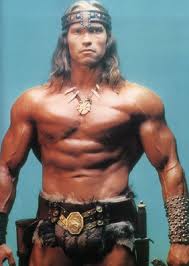
Arnold the Mighty, fearless defender of wealth and privilege.

Arnold Schwarzenegger’s term as Governor of California has ended. He leaves that state the same way he found it, mired in a budget crisis. Schwarzenegger could always have solved that crisis by raising the income tax rate on the richest one percent of Californians, but he steadfastly refused, on principle, to do such a thing. You may recall that several years ago there was a lot of talk of Arnold running for president. There was talk of amending the Constitution so that someone born outside the U.S. could become president. That’s all gone now. Arnold sacrificed his political career just so the richest people in California wouldn’t have to pay higher taxes.

What a guy.

You may recall that Arnold was elected as part of the recall of Governor Gray Davis. Peter Camejo ran as the Green Party candidate in that election. He ran on a solidly left-wing platform, and he actually received a fair amount of attention from the media, something virtually unheard of for a left-wing candidate in the U.S. A strong showing by Camejo would have sent a powerful message. However, some on the left started screaming that Schwarzenegger is a fascist – which he isn’t – and that was enough to stampede people back into the Democratic Party’s fold. So leftists wasted their votes trying to save the sorry ass of the corrupt and incompetent Davis. Once again, we see the self-defeating effect of the “lesser evil” argument.

Arnold’s successor is Jerry Brown, on whom Alexander Cockburn has a man-crush. In his inaugural address, Brown said, “The year ahead will require courage and sacrifice.” I assume he means courage and sacrifice on the part of the working class. Isn’t that always the way it is?

Now Arnold can go back to doing what he does best, which is appearing in action movies. Note that I said “appearing” and not “acting”. This is a guy who gets paid millions of dollars just to show up for film shoots. A lot of working class people voted for Arnold, yet it was too much to hope that someone with his background would have any sympathy or understanding for people who actually work for a living.

When Stan Tookie Williams was facing execution, Arnold could have done the courageous thing and commuted his sentence, but Mr. Action Hero is actually a coward. Another example of the gap between reality and dreams in Hollywood.

Inception

January 2, 2011

I finally got around to seeing Inception. I recently learned that there is a cinema near where I live where you can see a movie that’s been out for a while for a $1.25. So expect some belated movie reviews in the future.

Dominick Cobb (Leonardo DiCaprio) is an industrial spy who enters people’s dreams in order to get information from them. He is hired by a businessman, Saito (Ken Watanabe), to implant an idea into the head of a rival businessman by entering his dreams. Cobb employs a team of people to help him with his plan, but the success of his endeavor is threatened by Mal (Marion Cotillard), Cobb’s subconscious representation of his deceased wife, whom he is accused of having murdered. (Trust me, it will make sense when you see the movie.)

I found Inception entertaining, even though it runs into the same problem that the Matrix movies ran into, which is that it is hard to really care about what is happening when you know that it’s a dream. This especially becomes a problem towards the end, when the action starts to get confusing.

The basic idea in Inception is similar to that of a Japanes anime film, Paprika, which was directed by the late Satoshi Kon. There is a sense of wonder in Paprika that is lacking in Inception. This is because the latter is more concerned with being an action film than with exploring the possibilities of entering people’s dreams.

Inception is one of a number of Hollywood films that take it for granted that governments and trans-national corporations are corrupt. Although it’s nice to see these films acknowledge this, they present this idea in a casual manner that is likely to engender cynicism rather than anger. What’s more, in Inception we are expected to believe that a billionaire can, with just one phone call, immediately negate an arrest warrant for murder. This is in keeping with the conspiracist view of the world, which holds that George W. Bush could, with one phone call, get people to blow up the World Trade Center. Fortunately we have Wikileaks to remind us that the world isn’t that simple.

True Grit

December 28, 2010

True Grit is the Coen Brothers’ remake of the Henry Hathaway film that starred John Wayne. I haven’t seen the earlier film, but I have read the Charles Portis novel that it is based on. Although I liked the novel’s narrative voice, I ultimately found it disappointing. I thought Portis could have done a lot more with the characters and the situation than he did. It ends up being a very conventional Western novel.

Mattie Ross (Hailee Steinfeld) is a fourteen-year-old girl living in Arkansas during the 1870’s. When her father is shot to death by Tom Chaney (Josh Brolin), she swears to get revenge. With some difficulty, she persuades Rooster Cogburn (Jeff Bridges), a U.S. marshal with a sinister past, to pursue Chaney with her. They are joined by a Texas Ranger, LaBoeuf (Matt Damon), who is after Chaney for a separate murder. They follow Cheney into Choctaw Territory, where he has joined an outlaw band led by “Lucky” Ned Pepper (Barry Pepper).

The Coen Brothers have boasted that their film is faithful to Portis’s novel. In fact, they have taken enormous liberties with it. In the film, both Mattie and LaBoeuf speak a heavily stilted English. This is not how these characters talk in the book. I suppose the Coen Brothers thought this was funny; I just found it annoying. Also, we are expected to believe that contractions weren’t yet invented in the 1870’s. I lost count of how many times I heard someone begin a sentence with “Let us…”

Some of the changes are more troubling. In the novel, there is a Native American sheriff who helps Cogburn, LaBouef and Mattie at one point. This character has been completely written out of the movie. (The novel also has a Mexican character who is completely written out of the script.) In the film, Cogburn kicks two Native American boys who are tormenting a mule. If I remember correctly, in the novel the boys are white. Also, there is a scene in the novel of a public hanging. A Native American man is allowed to make a short speech before he is hanged. In the movie, he is dropped through the trap as he starts to speak. (There was some nervous laughter from the audience at this.) Considering that there are so few Westerns that present Native Americans in a positive light, one can only wonder why the Coens made these changes.

I found the movie moderately entertaining, in spite of the cutesy fake Shakespearean English and the problematic politics. Jeff Bridges is appropriately gruff as Cogburn, though at this point in his career he could probably play a gruff character in his sleep. Hailee Steinfeld and Matt Damon do the best they can with their awful lines. It could have been a much better film.

Rare Exports: A Christmas Tale

December 26, 2010

I’m not fond of Christmas movies, just as I am not fond of most Christmas music. I find It’s a Wonderful Life a bit too cute. And I’ve always wondered what the big deal is about Miracle on 34th Street. (This film pretends to be a parody of the commercialization of Christmas, while subtly endorsing it.) The only Christmas movie I can say that I really enjoyed was A Christmas Story, based on stories by Jean Shepherd, because of its realness and lack of sentimentality.

Leave it to the Finns to come up with a Christmas movie that will put a grin on every Grinch’s face. Rare Exports: A Christmas Tale, a film by Jalmari Helander, begins with a rich industrialist leading an expedition to drill in the Korvatunturi mountain on the Russo-Finnish border. The industrialist is convinced that the historical Santa Claus is buried here. (If there’s an historical Jesus, why not a historical Santa Claus?) He turns out to be right, but the historical Santa Claus turns out to be different from the one in modern myth. Instead of bringing gifts to good children, he would punish bad ones. The drilling awakens Santa and his army of elves, just as atom bombs awakened Godzilla. Santa’s helpers kill the drillers and proceed to terrorize a local village, until some of the villagers figure out a way to fight back.

Rare Exports starts out as a seemingly serious horror film, but gradually turns into a comedy. I was still laughing when I left the theatre. This film is a good cure for the Chirstmas blues.

Black Swan

December 24, 2010

Black Swan, a psychological thriller directed by Darren Aronofsky, tells the story of an aspiring ballerina, Nina Sayers (Natalie Portman), who lives with her obsessive, domineering mother, Erica (Barbara Hershey), in New York. Nina dances in a troupe directed by the demanding Thomas Leroy (Vincent Cassel). Thomas is planning a production of Swan Lake, and he needs someone to replace the troupe’s (unwillingly) retiring star dancer, Beth MacIntyre (Winona Ryder), in the starring dual roles of the white swan and the black swan. When Nina auditions for the roles, Cassel tells her that she is fine as the white swan, but that she lacks the passion to play the black swan (who is supposed to be evil). When Nina goes to Thomas’s office to plead for the roles, he makes a pass at her, and she bites him and runs away. After this, he changes his mind and gives the roles to Nina. However, she begins to feel threatened by a new and promising young dancer with the troupe, Lily (Mila Kunis). Nina begins to believe that Lily is actively plotting to steal her roles from her.

Black Swan starts out as an interesting study in the psychological stress that can be engendered in an art form as physically demanding and as intensely competitive as ballet. When Nina begins having hallucinations, these seem like the natural result of the stress she is under. However, the film becomes increasingly melodramatic, so much so that it starts to seem like a bad horror film, with bloody apparitions and people stabbing themselves in the face. At times I almost expected Freddy Krueger to emerge from the shadows. It was so overdone that there were moments when I laughed out loud. Other people in the audience reacted the same way.

I don’t know if I can recommend Black Swan. The film seemed silly to me, but I can’t say that I didn’t find it entertaining. I enjoyed it sort of the way that I enjoyed Starship Troopers, though I think Black Swan was actually meant to be serious.

I’m told that Black Swan has gotten mostly favorable reviews. I suppose if you’re the sort of person who thinks that I Am Love is a great film, you will probably think that Black Swan is a masterpiece.

Is Hawaii Really a Part of the United States?

December 22, 2010


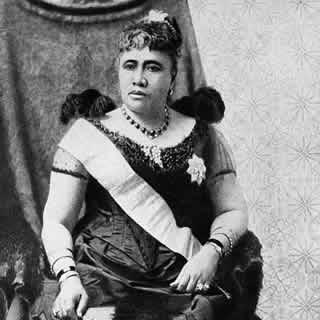
Queen Liliuokalani

Paul D’Amato directed my attention to this article in Truthout.org. The article is about David Keanu Sai, a historian who argues that Hawaii is not now, and never has been, a part of the U.S. The article is worth reading in its entirety, but his argument boils down to this: during the nineteenth century, many countries, including the U.S., recognized Hawaii as a sovereign nation. In 1893, President Grover Cleveland signed an agreement with Queen Liliuokalani in which the U.S. recognized her government as the legitimate government of Hawaii. However, in 1898 Congress passed a joint resolution declaring the annexation of Hawaii. Sai points out that a joint resolution is confined to the boundaries of the United States. Since the U.S. had recognized the independence of Hawaii, the resolution could not apply to it. Therefore, Hawaii is a sovereign nation and not a part of the U.S.

One of the many ironies here is that the Birthers are right in claiming that Obama was not born in the U.S., but not for the reasons they claim. However, since the Birthers will never admit that Hawaii is not part of the U.S., they can only base their arguments on nonsense.

I think it worth noting that Obama’s opponent in the 2008 election, John McCain, was born in the Panama Canal Zone, so he was not really born in the U.S. either. I’ve always thought that the rule that president has to have been born in the U.S. is silly. It’s absurd to argue that the result of an election should be overturned simply because the winner was born outside the country. If lawmakers had any sense, they would pass an amendment to overturn this part of the Constitution. However, I don’t expect this to happen, especially since they still haven’t gotten rid of the Electoral College.

Frank Zappa

December 21, 2010

Frank Zappa would be seventy years old if he were alive today. I guess that’s a good excuse to listen to some Zappa. It seems strange that he’s been gone from us for so long.

Steve Landesberg (1945-2010)

December 21, 2010

Steve Landesberg has died. He was best known for playing Arthur Dietrich on Barney Miller, which was a funny TV show, even though it did whitewash the New York City police department. (Isn’t that always the way? You’re never going to see a TV series about a corrupt cop or a racist cop, but I digress.) I remember before that he was in a short-lived series called The Paul Sand Show. Landesberg was the only reason for watching that program. He had a dry, understated delivery that could make material seem better than it was.

As is often the case with an actor who appears in a successful TV series, his subsequent career was disappointing. Mainly he just did bit parts here and there. When I lived in Hollywood, on more than one occasion I heard someone ask, “Whatever happened to Steve Landesberg?” It’s a shame the entertainment industry didn’t use him more.