What Donald Trump Tells Us About Ourselves

July 23, 2015

trump-hair

I normally don’t watch CNN, but they show it on the TV at the food court at my local Gelson’s, so I couldn’t help watching it while I was waiting to use the men’s room. Donald Trump had given a speech at a retirement community somewhere, and he had gotten a good reception. However, one woman who was interviewed said, “He frightens me.” When asked why she gone had to see his speech anyway, she said, “He’s a celebrity.” Trumps’ candidacy shows the triumph of celebrity in our society. Trump is a celebrity, so he must be listened to. Fame trumps all other considerations.

Trump first came to national attention during the 1980’s. The eighties were a decade of make-believe. President Reagan presided over a humiliating military retreat from Lebanon, nevertheless we were told that he had made America “great again”; he had shown the world that we were not to be trifled with! Trump was another fantasy. A man who filed for bankruptcy three times, he was touted as a financial wizard, a man who had mastered “the art of the deal”. Does the re-emergence of Trump suggest that we are heading into another period of make-believe? Perhaps we don’t want to deal with the disappointments we’ve had. The wars in Afghanistan and Iraq were a bust. Obama’s promised “hope and change” have merely been a weak economic recovery and a deeply flawed health care bill. Trump offers us a fantasy world in which one only has to proclaim oneself great, and – hey presto! – one is automatically great.

The election of Ronald Reagan was seen as a symbol of how movies have come to dominate our culture. Trump promises to do the same thing for tacky reality TV shows.

Cartel Land

July 20, 2015

11393600_1645615949002569_3051946987291055909_o-600x889

The “War on Drugs’ continues to take a heavy toll not only on our country but on Mexico as well. The drug cartels that terrorize that country grew up to feed the underground US drug market. Matthew Heineman’s documentary, Cartel Land, examines this situation.

The film begins with a scene of Mexican cartel members cooking meth. One of them frankly informs us that most of their meth will go to the US. We are then shown a funeral for several members of a Mexican family. When the owner of a lime farm refused to pay money to the Knights Templar cartel, they responded by killing the workers on his farm, as well as their families. We are then introduced to Jose Mireles, a doctor, who has organized a vigilante group, Autodefensas, to fight the Knights Templar in the Mexican state of Michoacán. The go from town to town and drive away any cartel members that they find. In one scene, an army squadron shows up and tries to disarm the Autodensas. The people of the town come to the aid of the vigilantes, and the army is forced to back down. The Autodefensas grow rapidly in size and power. There are inevitably abuses, and in some cases outright criminality. Mireles tries to reassert control over the group, but one gets the impression that he is in over his head. He suspects that the Autodefensas have been infiltrated by the Viagra cartel, and it soon becomes clear that this is exactly what has happened. The Autodefensas become “legal” by joining the federal police, with cartel members in their ranks. Fearing for his life, Mireles goes into hiding. He is eventually arrested by the government for illegal firearms possession, and he is now in prison. We are shown members of the Viagra cartel, some of them wearing federal police uniforms, cooking meth.

This story is interspersed with another story about a US vigilante group, Arizona Border Recon, which claims to be “defending” the border. (The Southern Poverty Law Center has identified these people as a hate group.) Their leader is Tim “Nailer” Foley, who lives in Arizona’s Alta Valley. Foley claims that Mexican drug cartels have taken over this area, although he provides no evidence to prove this claim. We see Foley and his followers patrolling the desert, with nary a cartel member in sight. (This is marked contrast to the gun battles we see in some of the Michoacán scenes.) In one scene they come across some immigrants, and they promptly turn them over to the Border Patrol. That is all the “invasion” that we see. One gets the uncomfortable feeling that the people in ABR get their ideas from watching Fox News. This is clearly another situation that can’t end well.

This film is deeply disturbing to watch. Seeing the Autofefensas turned into their opposite shows just how powerful and corrupting the drug trade is. The only possible solution is to legalize and regulate the sale of “recreational” drugs.

3 1/2 Minutes, Ten Bullets

July 1, 2015

MV5BMTA0NjE0NjMzOTBeQTJeQWpwZ15BbWU4MDI5MzE1NzUx._V1_SY317_CR0,0,214,317_AL_

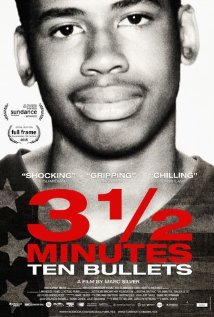
3 1/2 Minutes, Ten Bullets is a documentary about the 2012 murder of Jordan Davis and the subsequent trial of his killer, Michael Dunn. Dunn shot and killed Davis after the latter refused to turn down his car radio in a gas station parking lot. Dunn also shot at the other three people who were in the car with Davis.

This film largely consists of interviews with Davis’s parents and with his friends, as well as scenes from Dunn’s trial. Davis is portrayed as a good kid, who was well liked by his friends, even though he wasn’t very good at playing basketball. It’s the trial scenes, however, that are the most interesting. Dunn’s lawyer does a good job of cross-examining the prosecution’s witnesses, but he makes a crucial mistake when he puts Dunn on the witness stand. (Perhaps he felt he had to call Dunn because there were few witnesses, and because Davis’s friends seemed credible on the stand.) The prosecution catches Dunn in a lie, which undermines his claim that Davis had a gun. In spite of this, the jury dead-locked on the question of whether Dunn committed first degree murder. They did find him guilty of three counts of second degree murder, for shooting at Davis’s friends as they were trying to get away from him.

Dunn’s lawyer tells the jury that the trial is not about race. There is no evidence that Dunn used racial epithets at the time of the shooting. Yet one can’t help but wonder if he would have shot at three white boys playing loud music. I would have liked to learn more about Dunn: his background, his political beliefs, etc. At the end of the film, he shows no remorse for what he did, and he even claims to be the “real victim” in this case. Dunn kept a loaded gun in his car, and I suspect that he was secretly wishing that he would one day have an excuse to use it. He was an accident waiting to happen.

Testament of Youth

June 20, 2015

Testament_of_Youth_(film)_POSTER

I believe that violence is sometimes unavoidable. (I support the struggle of the Kurds, for example.) As I grow older, however, I find myself becoming increasingly sympathetic to pacifism. Back in 2003, I watched in amazement and bafflement as supposedly sane people called for an obviously illegal and immoral war against Iraq. Those of us who rightly argued against this were called “traitors”. The current chaos in the Middle East shows we were more right than we even imagined at the time.

To give another example of why my thinking has been moving in this direction, not long after Russia’s illegal seizure of the Crimea, I got into a Facebook argument with a left-wing Putin-hater, who boasted about how much he welcomed a war between Ukraine and Russia. (I hate Putin myself.) When I pointed out the possibility that Ukraine might lose such a war, he ignored me and kept going on about how much he would love see Putin be given a comeuppance. Yes, I would love to see Putin given a comeuppance, but how many innocent people would have to be killed in order to do that?

I think I don’t need to even mention here our society’s complacent and morally corrupt response to Israel’s assault on Gaza last year. History will never forgive us for this.

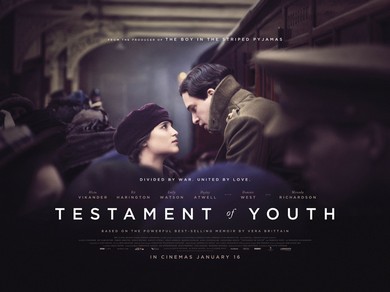
Testament of Youth, directed by James Kent and written by Juliette Towhidi, is based on the autobiography of Vera Brittain, who became a well-known pacifist. It depicts her experiences as a volunteer nurse in army hospitals during World War I. In the course of the war, her fiance, her brother, and two of her friends were killed. At one point in the war, she served near the front in a hospital treating captured wounded German soldiers. Some of the scenes in the film are wrenching to watch. This film benefits from strong acting, most of all from Alicia Vikander, who plays Vera Brittain. (Vikander, who is Swedish, does an English accent in this film, and she does an American accent in Ex Machina, and she’s completely convincing doing both.)

With all the militarism that currently pervades our society, it’s good to see to some subtle pushback in the form of such films as Good Kill and Testament of Youth. On the other hand, American Sniper was a huge box office hit. We have a long way to go.

Good Kill

June 9, 2015

Good_Kill_poster

Our recent strategy in the War on Terror is similar to our strategy in Vietnam: keep killing the enemy until there are none left. That strategy didn’t work in Vietnam, and it’s not working today. The Taliban have made a comeback in Afghanistan, and Daesh now control large parts of Syria and Iraq. Is it time for our policymakers to try something else?

This question is posed by the recent film, Good Kill, written and directed by Andrew Niccol. It tells the story of Thomas Egan (Nathan Hawke), an Air Force pilot who has been reassigned to being a drone pilot. After two children are inadvertently killed in a drone attack, he begins to have doubts about his job. The emotional stress that Egan is under starts to cause strains in his marriage to Molly (January Jones).

Things get worse when Egan’s group is placed under the direct control of the CIA, whose rules of engagement are looser than those of the military. They have a policy of a “double tap”: firing a missile at the first responders to an attack, on the theory that most such people are likely terrorists themselves. The CIA considers it an acceptable risk that innocent people will almost certainly get killed. The characters argue about this. Egan’s fellow crew member, Vera (Zoë Kravitz), makes the case that drone attacks are causing people to side with the terrorists, while Egan’s commanding officer, Col. Johns (Bruce Greenwood) makes the “we can’t risk losing one American’s life” argument. The debate is never resolved one way or another. At the end, however, when Egan literally walks away from his job, it’s clear that we’re expected to see this as a moral redemption for Egan. Although it seems an empty victory, since we know that the military will simply replace him with somebody else.

Good Kills is a well-made film that raises a number of troubling questions, but its feel-good ending cant’t conceal the fact that it doesn’t offer any answers.

The ISO: Where the Personal Becomes Political

May 31, 2015

791px-Red_stylized_fist.svg

Lately, I have been thinking about an incident that happened when I was a member of the Los Angeles ISO branch in the late 1990’s. I think it illustrates a problem that far left groups sometimes run into.

One Saturday afternoon I received a phone call from a woman who was a member of the branch committee. She told me there was going to be an emergency branch meeting that evening and everyone was required to attend. When I asked her what this emergency was, she refused to tell me. This greatly annoyed me, because I had already made plans for the evening. However, being the “Leninist” that I thought I was, I felt obligated to go.

The meeting was held in the apartment of one of the branch members. There were about ten of us. There weren’t enough chairs, so some people sat on the floor. It turned out that the “emergency” consisted of this: two people (one of whom was the woman who called me on the phone) had been assigned the task of designing a flier for an upcoming event. One of them, the woman who called me on the phone, had gone ahead and made the flier and distributed it without consulting the other person. When this person complained to another branch committee member about this, he responded by calling her a “Menshevik”. (I’m not making this up. People in the ISO actually say things like this.)

So, this was the “emergency” that had caused me to cancel my plans. What struck me was how incredibly seriously everyone took this. (Everyone with the exception of me, that is.) A branch committee member read passages from Lenin and from James Cannon. He then lectured us about what a “cadre” is. (I swear, I’m not making any of this up.) He then claimed that there was a faction within the branch. (In the ISO, factions are considered to be very bad things.) I don’t remember much else about what was said. My mind had pretty much tuned out at this point.

When I drove home that night, I felt angry with myself for having allowed these people to waste my time with such nonsense. I was tempted to quit the ISO. But I didn’t. (The woman who was called a “Menshevik” left the ISO shortly afterwards.) I think this was because I liked the ISO’s politics, even though I didn’t always agree with what they did in practice. And I didn’t know of any other groups that had quite these same politics.

The point I’m trying to get at here is that one of the pitfalls of working in a small group is that people tend to develop strong personal ties to one another in this situation. A disagreement over a flier becomes an “emergency” that threatens to tear the group apart. It seems to me that the best way to try to avoid this sort of thing is to try to organize on as broad a basis as possible. I admit that’s not an easy thing to do, especially considering the deep divisions that exist on the Left at the moment. But I don’t see any other way to move forward.

Dark Star: The World of HR Giger

May 23, 2015

Dark-Star-Giger

HR Giger (pronounced geeger) was a Swiss artist who was known for the dark subject matter of his works. They depict the weird and the bizarre, often with a subtle, and sometimes blatant, eroticism. Belinda Sallin’s documentary about him was made shortly before his death. In it, he comes across as taciturn, but nonetheless likable. (He looked a bit like Brother Theodore.) He lived in a house that looked like a museum of the macabre. In one scene, Giger shows us a skull that he says his father gave him when he was a child. (He says that his father, a pharmacist, was given the skull by Ciba-Geigy, a pharmaceutical company. I would have liked to learned more of the details about this.) He says that he would pull the skull along the street with a string. He did this in order to try to lessen his fear of it. This film subtly suggests that this anecdote can be seen as a metaphor for Giger’s career.

Giger’s ex-wife tells us that he never really grew up. In one scene, we see him riding around on a miniature railroad that he built in his backyard. (Not suprisingly, he liked cats.) Giger tells us that he had a happy childhood. He was apparently close to his mother, although he says he found his father a “mystery”. The only tragic part of his life concerned the death of his one-time lover, the actress Li Tobler, who committed suicide. Giger admits to be being haunted by the question of whether he could have done something to prevent this.

I have to admit that I’m not a great admirer of Giger’s work. I find the recurring themes and images, and unrelenting bleakness, a bit monotonous after a while. However, this film gave me a certain respect for the man. He was determined to follow his own vision, and he managed to acquire a devoted following.

About Elly

May 16, 2015

About_elly_xlg

About Elly is a 2009 Iranian film by Asghar Farhadi, who also directed A Seperation, which won an Academy Award for best foreign language picture.

Three couples go on a three-day trip to a resort on the shore of the Caspian sea along with their children. One of them, Sepideh (Golshifteh Farahani), brings along her daughter’s kindergarten teacher, Elly (Taraneh Alidoosti). She wants to introduce her to her friend, Ahmad (Shahab Hosseini), who has recently divorced from his German wife. Things go well the first day, although Elly sometimes seems a bit uncomfortable. On the second day, she disappears, and people fear that she may have drowned. The characters gradually begin to blame one another for what happened. Much of the blame centers on Sepideh, as it becomes clear that she hasn’t been completely honest about some things.

About Elly is a subtle and complex drama that touches upon many different ideas: the fact that good intentions can have bad results, the fragility of human relationships, how small deceptions can a devastating effect on people. This is the most powerful and troubling film that I have seen in quite a while.

One thing that struck me about this movie is that the men and women interact in a more-or-less equal manner. (The men have subtle advantages over the women, although one could make that argument about our society as well.) Iran is an Islamic theocracy, like Saudi Arabia. Yet, based on what I know about the latter country, I can’t imagine people there behaving in quite this way. (I certainly can’t imagine people in areas controlled by ISIS acting in this way.) This can be seen as evidence that Islam is a more complex religion than many self-styled “experts” on Islam are willing to admit.

It’s clear that the influence of Muslim and Iranian cultural notions about honor, propriety, and the role of women lead to Sepideh’s deceitful behavior, with grievous consequences for Sepideh herself. She is a great tragic figure.

F for Fake

May 9, 2015

F_for_Fake_poster

Orson Welles called F for Fake a “film essay”. That is, while it isn’t a narrative film, it’s not a documentary, because it doesn’t claim to be entirely factual. Welles seemed to think that he invented this genre, but many film historians would disagree. For example, many view Vertov’s 1929 film, Man with a Movie Camera, as a film essay. Regardless of this, F for Fake is innovative in that it uses the medium of film to question the truthfulness of film itself.

F for Fake touches on a wide range of topics, but it is mainly concerned with the story of Elmyr de Hory, a French-Hungarian art forger, and the writer, Clifford Irving. Irving wrote a biography of de Hory, and then he committed a forgery of his own, writing a fake autobiography of Howard Hughes. Handwriting experts declared the manuscript to be real. (Welles suggests that de Hory forged Hughes’s handwriting.) Both de Hory and Irving express a dismissive attitude towards “experts”. One gets the sense that this film may have been meant as a subtle dig at the critic, Pauline Kael, who wrote an essay about Citizen Kane, in which she claimed that Welles didn’t write any of the script.

F for Fake uses a variety of visual tricks. There are scenes in which Irving and de Hory seem to be talking to each other, but they are actually shots from two different interviews that have been spliced together. This film serves as a demonstration that we can take nothing at face value.

The Criterion Collection DVD of this film includes the documentary, Orson Welles: The One-Man Band, which was co-directed and co-written by Welles’s girlfriend, Oja Kodar. This film concentrates on Welles’s later years and includes scenes from many of the unfinished films he made, as well as from the unreleased film The Other Side of the Wind. (And the fact that this film remains unreleased is a scandal.) Among other things, we learn that Welles was obsessed with Moby Dick. Over the years he shot numerous scenes of himself reciting passages from this work, although it was unclear what he intended to do with these. Welles seemed to identify with the character of Ahab. Like Ahab, he spent much of his life pursuing something – in his case success – he could never quite achieve.

Welles also made this bizarre nine-minute trailer for F for Fake:

Tangerines

May 2, 2015

Tangerines_film

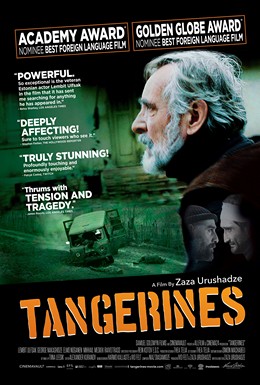
Tangerines, written and directed by Zaza Urushadze, is set during the War in NiAbkhazia (1992–93). Ivo (Lembit Ulfsak) lives in an Estonian settlement in Abkhazia. After war breaks out between Georgia and Abkhazia, most of the people in the village go back to Estonia, but Ivo stays to help Margus (Elmo Nüganen) harvest his tangerine orchard. A gunfight between Georgian and Abkhazian soldiers takes place near his home. He and Margus find only two soldiers still alive, but wounded. One is Ahmed (Giorgi Nakashidze), a Chechen mercenary fighting for the Abkhazians, and the other is Niko (Mikheil Meskhi), a Georgian. Ahmed is determined to avenge the death of his friend, Ibrahim, who was killed in the fight. However, Ivo makes him promise that he won’t harm Niko so long as he is under Ivo’s roof. Ivo then has to maintain an uneasy truce between the two men.

Tangerines is the most deeply moving film I have seen in a long time. Much of the film’s emotional power is due to the strong performances of the actors, especially Ulfsak and Nakashidze. This film is a denunciation of the destructive effect of mindless nationalism. It is one ranks alongside of Grand Illusion and Paths of Glory as one of the great war films of all time.