Two Films About Journeys: Kumiko and Jauja

April 24, 2015

KTH_Poster

Recently I saw two films, each with a Herzogian story about a person who undertakes an ill-advised journey.

Kumiko, the Treasure Hunter directed and co-written by David Zellner, is, I’m told, based on a Japanese urban legend. Kumiko (Rinko Kikuchi) has a dreary job as a personal assistant to a Tokyo businessman. Yearning to escape from her humdrum life, she dreams of becoming a treasure hunter. She finds an old VHS tape of the Coen brothers’ Fargo, and she becomes convinced that it tells a true story. She believes that the money buried by one of the characters is lying in a field somewhere in Minnesota. She steals her boss’s credit card and uses it to purchase a plane ticket to Minneapolis. From there, she sets out for Fargo, convinced that she will somehow find the field she saw in the film. Along the way, she meets a number of different people who try to help her.

This film’s “happy” ending is not quite ironic and not quite cynical. Zellner is clearly aiming for a fairy tale effect here. He succeeds in this largely because of Kikuchi’s convincing and moving performance.
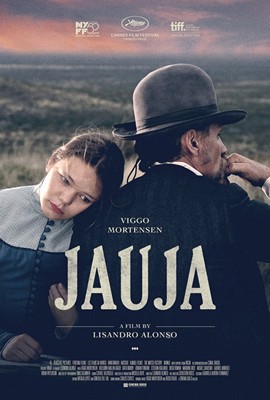
Jauja_poster

The trailer for Jauja gave me high hopes, but I found the film itself disappointing.

The film is set in Argentina in the 19th century. The Argentine government is waging a genocidal war against the indigenous people of Patagonia. Gunnar (Viggo Mortenson) is a Danish doctor who has been hired by the Argentine army. He has brought his daughter, Ingeborg (Viilbjørk Malling Agger), from Denmark with him. When Ingeborg runs off into the desert with a soldier, Gunnar goes in pursuit of them. He finds the soldier murdered. While he is searching the area, an Indian steals his horse, so Gunnar is forced to continue his search on foot. He comes across an old woman who lives by herself in the desert.

Jauja‘s early scenes have a stark beauty and simplicity about them that reminds one of Herzog’s films. However, it suddenly turns into a Bergmannesque fantasy about a spooky old woman living in a cave. Like Kumiko, this film aims for a fairy tale effect, but it merely ends up being opaque. I found this disappointing, because I really wanted to see Gunnar’s quest lead to something. Instead, we have what feels like two different films stuck together. In addition, Jauja touches upon the racist attitude of the whites towards the Indians, but it doesn’t really have anything to say about this. It’s just a perplexing and unsatisfying work.

George Lucas and Star Wars Redux

April 22, 2015

140624-george-lucas-1851_7cc45fd8bc75d2b49b61dea85fc143b6

There has been a good deal of talk recently about the JJ Abrams reboot of the Star Wars franchise. This prompted a friend of mine to comment on Facebook: “I haven’t had the chance to get all excited about the new Star Wars trailer, what with me being an adult and all.” Judging from some of the comments on her thread, it appears that some people weren’t pleased with her comment. Yet I think there is an arrested development aspect to this whole Star Wars phenomenon. Most of us first encountered these movies when we were young and our tastes were still largely unformed. Since then, we insist on believing that there is something magical about these films, even though they’re actually not that good. I think we have all had the experience of going back to a favorite book or movie or TV show from our childhood and being dismayed to find that it’s not nearly as good as we remember it being. Our continuing obsession with Star Wars, and our desire for more Star Wars films seem to be an attempt to deny this experience.

What bothers me about the Star Wars films is that they invite us not to think. Because when you think about them, you begin to realize that there are all sorts of things in them that don’t really make sense. (Science fiction purists hate these movies because they make a mockery of the notion that sci-fi is about “ideas”. By the way, the recent film, Ex Machina shows that science fiction really can be thought-provoking.) So, better not to think and to just be awed by the spectacle of it all. As someone who has always valued films that challenge me to think, I can’t help but see Star Wars as a denial of what I most value about cinema.

Lucas has occasionally been compared to Wagner, which is not always meant as a compliment. For example, Lucas is, like Wagner, obsessed with prequels. (Wagner had originally set out to write just an opera about Siegfried, but he felt he had to explain everything that happened before, which resulted in the Ring cycle.) But the comparison isn’t just about size. Critics have accused Wagner of cheapening the myths upon which his operas are based. Likewise, the afore-mentioned science fiction purists have accused Lucas of cheapening the genre. They object to the way these films wallow in all the hackneyed conventions of comic books and Hollywood B-movies.

Perhaps the single best comment I’ve heard about these films came from my father. He was an engineer, and he went to see the first Star Wars film when it first came out. I asked him what he thought about it, and his only comment was: “The spaceships banked when they turned. Why? They’re in a vacuum. Why would they bank?”

He should have been a film critic.

1915

April 19, 2015

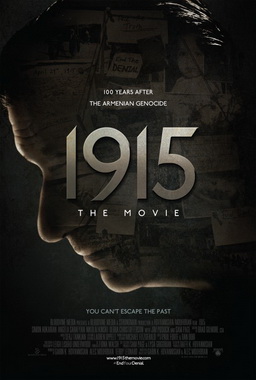
1915_(film)_poster

1915, written and directed by Garin Hovannisian and Alec Mouhibian, tells the story of Simon (Simon Abkarian), who is directing a play he has written about the Armenian genocide of 1915. His wife, Angela (Angela Sarafyan), who plays the lead character, immerses herself in her role in a manner that begins to disturb the other cast members. The play is controversial, and the director and producer receive death threats. It gradually becomes clear that Simon and Angela have a dark secret.

1915 starts off with a promising premise, but it turns into a bombastic psychological thriller, filled with implausibilities. There is, for example, a silly subplot in which one of the male characters disguises himself as a woman for no apparent reason. However, this film deals with the theme of denial in a manner that is both poignant and pointed. To this day, the Turkish government refuses to admit that the genocide happened (no doubt so they won’t have to pay reparations). And our own government refuses to officially acknowledge it happened. (Because Turkey is our ally!)

One hopes that 1915 will create greater awareness of the Armenian genocide.

Lunch with Orson Welles

April 15, 2015

Orson Welles

I just finished reading My Lunches with Orson, which is the most interesting and entertaining book that I have read in a while. From 1983 to 1985, Welles would sometimes have lunch with his friend, Henry Jaglom, at Ma Maison, which at that time was the most fashionable eatery in Los Angeles. Jaglom had Welles’s permission to tape record their conversations. Peter Biskind had these tapes transcribed and then edited them into this book. The result is a treasure. It would be hard to imagine a more ideal lunch companion than Welles, who was both a genius and a raconteur (a rare combination).

The conversations cover a wide range of topics, and Welles gives his opinions on various matters. Among other things we learn that he thought Hitchcock’s American films weren’t very good. (I can just hear the howls of outrage emanating from film schools across the country.) Just as he had strong opinions about films, he had strong opinions about people. (Among those he liked were Carole Lombard, Marlene Dietrich, Erich von Stroheim, and Sam Goldwyn. Among those he didn’t like were Irving Thalberg, Woody Allen, Louis B. Mayer, David O. Selznick, Joan Rivers, and John Landis.) The conversations also touch upon Welles’s left-wing political views. One of the book’s more poignant moments occurs when Welles expresses regret over writing a negative review of Ivan the Terrible, because Eisenstein was subsequently persecuted by Stalin.

Welles also discusses his negotiations with producers over various proposed film projects of his. In the final conversations, he seems at wit’s end. His deals have all fallen through. He is in desperate financial straits. He can no longer get commercial work. One suspects that the stress he was under may have contributed to his fatal heart attack. A sad ending, but at least he led a full and rich life.

The Hillary Clinton Juggernaut

March 31, 2015

Image: File of U.S. Secretary of State Hillary Clinton delivering remarks at the State Department  in Washington

Recently I’ve noticed a disturbing trend on social media. Whenever somebody makes a legitimate criticism of Hillary Clinton, there is always someone who responds by effectively saying, “So, you want the Republicans to win?” The assumption here seems to either be that Clinton has already won the Democratic nomination or that she is the only Democrat who can beat a Republican. The first is obviously false, the second is probably wrong.

Let’s discuss the first assumption. We’re a year away from the Democratic primaries, and yet many people seem to assume that Clinton has it all wrapped up. Many people made that same assumption back in 2008, when she lost to a brash young upstart named Barack Obama. The election is still a year away. A lot can happen between now and then.

As for Clinton being the only Democrat who can beat a Republican, that’s a weird assumption to make considering how much baggage Clinton is carrying. Has anyone carrying so much baggage ever been elected to the presidency before? Richard Nixon comes to mind, but he had been out of the public spotlight for a few years, so people had begun to forget what a turd the guy was. (He packaged himself as the “New Nixon”.) Clinton has been in the public eye almost continuously since 2008. During that time, she presided over the fiasco of the intervention in Libya. You can be sure the Republicans are going to talk about that.

As for the e-mail controversy, it’s not as trivial as some people claim. Clinton deleted over 30,000 e-mails. She says that they were strictly private in nature. Maybe, but we only have her word for it. Common sense dictates the government business should be conducted through government e-mail accounts. At the very least, Clinton showed poor judgment. And Clinton has a history of showing poor judgment, from Whitewater to the invasion of Iraq.

Back in 2003, it was clear to me that invading Iraq was a bad idea, but Clinton thought the plan was just swell. I’m supposed to trust the foreign policy judgment of someone like this? You’ve got to be kidding.

Conspiracy Theories

March 21, 2015

conspiracy_theorists

I have often been critical of conspiracy theories on this blog, so I think I should make it clear that I think conspiracies do happen. (There is, for example, good reason to believe that the “October Surprise” conspiracy was real.) The problem is that it’s all too easy for people to imagine a conspiracy behind every single thing that happens in the world. One can spin a conspiracy about almost anything. (Is Vladimir Putin really the president of Russia, or is he really the tool of a CIA-Mossad false flag operation?) The “Everything You Know is Wrong” spiel has a strong attraction for some people.

It is worth remembering that anti-Semitism is based on a conspiracy theory: the idea that Jews are trying to take over the world or are in some way plotting against the rest of us. (The Nazis really believed this. They accepted it as an article of faith.) And when you look at some of the more extreme conspiracy websites, you begin to find anti-Semitic ideas. (Veterans Today is a good example of this.) This is something that people who are inclined toward conspiracy theories should ponder.

One of the more curious theories is the idea that the moon landing was faked. The idea that the landing was filmed in a Hollywood sound studio is naive to anyone who knows anything about film and video. I’m waiting for the day when someone claims that World War II was faked. (Of course, it was filmed on a Hollywood back lot!) There is no idea so stupid that someone won’t believe it.

The Diminishing of Christopher Hitchens

March 14, 2015

article-2047572-0E51BF0A00000578-924_468x617

A foundation has recently announced that it will be handing out an annual journalism award named after Christopher Hitchens. One of the judges for this award will be Christopher “Thanks, Dad!” Buckley, so you know beforehand that this will be yet another meaningless award that we can all safely ignore.

I stopped paying attention to Hitchens back in 2001, when he wrote that the 9/11 attacks gave him a feeling of “exhilaration”. (Katha Pollitt rightly called this “childishness”.) At the time, I made the naive, but nonetheless reasonable, assumption that everyone else had done the same thing. I gradually became aware that I was sadly mistaken about this. (Personal disclosure: I never met Hitchens, but he once spat a cigarette at a friend of mine.) Hitchens became a noisy advocate for the illegal invasion of Iraq. In spite of this, Hitchens is greatly admired today, but he is admired for the wrong reasons.

Hitchens’s most important work is also his least influential: The Trial of Henry Kissinger, in which he convincingly argued that Kissinger is a war criminal and possibly a traitor as well. Today, Kissinger is widely feted, and he even makes appearances on comedy shows. When an anti-war group recently interrupted Kissinger’s testimony before a Senate Committee, Sen. John McCain called them “low-life scum”. McCain apparently doesn’t mind the fact that he spent six years in a North Vietnamese POW camp because Nixon and Kissinger prolonged the Vietnam War. Such forgiveness is truly touching to see. (This same McCain once said that he wouldn’t mind if US troops were in Iraq for the next 100 years. This is masochism as foreign policy.)

According to Vanity Fair: “… the foundation intends both the prize and the award ceremony to celebrate and draw public attention to the values that marked Christopher Hitchens’s life and career…” What it will actually celebrate is the moral bankruptcy of our society.

Don Juan Comes to Hollywood

March 8, 2015

Cc1962
Carlos Castaneda

When I was writing my review of Maps to the Stars, I was intrigued to learn that the screenwriter, Bruce Wagner, was a disciple of Carlos Castaneda. In case you don’t know, Castaneda was the author of a series of books that were hugely popular in the 1970’s. In them, Castaneda claimed that he had had a series of encounters with a Yaqui sorcerer named Don Juan. This shaman introduced Castaneda to a “separate reality”, in which he could talk to animals and fly through the air. These books were eventually exposed as a hoax, yet they continue to be sold as “non-fiction” to this day. I felt a personal connection here, because I read the Don Juan books when I was in high school, and for a time I came under their spell, so to speak. However, I eventually came to the conclusion that they were basically bullshit. Yet I still vividly recall some some episodes and bits of conversation from them. I actually remember them more fondly than The Lord of the Rings, which I read at roughly the same time.

The debunking of the Don Juan books didn’t hurt Castaneda though. He went on to a lucrative career as a self-help guru. (Contrast this with how James Frey got beat up for embroidering some details of his life.) Castaneda went on to found an organization called Cleargreen, which teaches something called “Tensegrity”. And what is Tensegrity? Cleargreen’s website explains:

    Tensegrity® is the modern version of the navigator’s way—practices and principles that support finding and traveling a path with heart—that don Juan Matus taught his four students: Carlos Castaneda, Florinda Donner-Grau, Taisha Abelar and Carol Tiggs. Don Juan was a Yaqui Indian seer and a leader of a group of men and women seers whose lineage begins in Mexico of ancient times.

And I’m sure the men and women seers of ancient Mexico used trademarks whenever they could.

But let’s get back to Bruce Wagner. According to Salon, Wagner once had the following role in Cleargreen:

    A major player in promoting Tensegrity was Wagner, whose fifth novel, “The Chrysanthemum Palace,” was a finalist for the PEN/Faulkner prize (his sixth, “Memorial,” was recently released by Simon and Schuster). Wagner hadn’t yet published his first novel when he approached Castaneda in 1988 with the hope of filming the don Juan books. Within a few years, according to Jennings and Wallace, he became part of the inner circle. He was given the sorceric name Lorenzo Drake — Enzo for short. As the group began to emerge from the shadows, holding seminars in high school auditoriums and on college campuses, Wagner, tall, bald and usually dressed in black, would, according to Geuter and Wallace, act as a sort of bouncer, removing those who asked unwanted questions.

From bouncer to novelist. An interesting career path.

In Maps to the Stars, several characters recite a poem by Paul Eluard entitled ‘Liberty’. The poem begins this way:

    On my notebooks from school
    On my desk and the trees
    On the sand on the snow
    I write your name

    On every page read
    On all the white sheets
    Stone blood paper or ash
    I write your name

The name is ‘Liberty’. At the end of the film, two of the characters recite this poem just before they commit suicide. The implication here is that they see death as a release from the prison of their lives. What bothers me about this is that when Castaneda died, several of his female disciples, including the three women mentioned on the Cleargreen website, disappeared. Some people believe they may have committed suicide. (You can read about this in the article I linked to above.)

At the end of Castaneda’s book Tales of Power, Don Juan urges Castaneda to jump off a cliff, in order to show that he has finally become a sorcerer. I’ve noticed that a recurring motif in Hollywood films that I’ve watched in recent years is someone jumping off a building in order to prove a point. The most recent example of this is in Birdman. (This also occurs in The Matrix.) Castaneda reportedly frequented Hollywood parties, and he no doubt discussed some of his ideas with people at these gatherings.

The fact that someone like Castaneda may have had an influence on popular films is a sobering thought.

Maps to the Stars

March 2, 2015

Maps_to_the_Stars_poster

David Cronenberg has a reputation for making dark and disturbing films. His most recent work, Maps to the Stars, based on a screenplay by Bruce Wagner, will certainly not disappoint in that regard. Set in contemporary Los Angeles, it is the most unflattering depiction of Hollywood that I have seen since Robert Altman’s The Player. It suggests that the culture of Hollywood encourages narcissism and selfishness, as well as reckless and self-destructive behavior.

Maps to the Stars has several plot lines that eventually converge. Agatha (Mia Wasikowska) is a young woman just arrived in Los Angeles. She becomes romantically involved with Jerome (Robert Pattinson), an aspiring actor and writer. Benjie (Evan Bird) is a child actor who starred in a popular movie but then developed a substance abuse problem. He is now making a comeback by appearing in a sequel. His mother, Cristina (Olivia Williams), is a driving force behind his career. Havana (Julianne Moore) is a well-known movie actress. Her mother, Clarice (Sarah Gadon) was also in movies. Havana is trying to get a role in a film that is a remake of a film her mother was in. She begins seeing Clarice’s ghost. She has therapy sessions with a self-help guru, Stafford (John Cusack), who happens to be Benjie’s father. Agatha gets a job working as a personal assistant for Havana. It is eventually revealed that Agatha is actually Benjie’s sister. Seven years earlier, she burned down the family’s house and almost killed Benjie during a psychotic episode. She was put in an asylum, but has now been released. Stafford has never forgiven her, and he is determined to keep her away from the rest of his family.

This film’s critique of Hollywood is intertwined with a grimly fatalistic story about incest, madness, and ghosts. (The supernatural elements may be due to the fact that the screenwriter is a disciple of Carlos Castaneda. I will have something to say about Castaneda in a future post.) These elements somewhat blunt its social criticism. However, the most striking thing about this movie is its lack of sympathy for its characters (although one feels a bit sorry for Agatha at times). Almost all of them come to bad ends. It doesn’t hold out any possibility that people can overcome their illusions or morally improve or escape their past. It ultimately feels suffocating.

Two Days, One Night

February 25, 2015

Deux_jours,_une_nuit_poster

Two Days, One Night is a Belgian film directed by the Dardenne brothers. It tells the story of Sandra (Marion Cotillard), who works in a factory that manufactures solar panels. Management has told her fellow workers that they can have a bonus that year, but only if Sandra is laid off. They are to have the vote on this on a Monday. Sandra has one weekend in which to try to persuade her co-workers to reject their bonuses in order to save her job.

Two Days, One Night is reminiscent of the Italian neo-realist films with its simple, straightforward story and its non-condescending, non-romantic portrayal of working class people. It also benefits from strong performances, particularly from Cotillard, who is completely convincing as Sandra.

Although Sandra fails to save her job, this film ends on a quietly optimistic note, which is far more emotionally satisfying than the contrived “feel good” endings so many Hollywood films.