I think it’s become clear by now that the Sony hack was not carried out by North Korea. (See here, here, and here.) Yet the Obama Administration continues to insist that North Korea was behind the hack. There are several possible explanations for this, none of which speak well for the administration. The kindest explanation is that these people simply aren’t very bright. However, I believe these people do know what they are doing. So, the next explanation is that Obama simply decided to use this hack as an excuse to apply more sanctions on North Korea. (Sanctions that haven’t brought down the government and probably never will.) Or perhaps Obama has decided to use this as an opportunity to show that he is tough with the US’s enemies. Or perhaps both. Whichever is the case, the President is acting in a cynical and dishonest manner.
Obama and the Sony Hack
January 5, 2015Some Thoughts on Reading ‘The Origins of Totalitarianism’
December 28, 2014Lately, I have been reading Hannah Arendt’s The Origins of Totalitarianism. This book is dense with ideas, so I have decided to write some blog posts about it, in which I will discuss some of the issues that the book raises.
The Origins of Totalitarianism is divided into three sections, the first of which is titled’Antisemitism’. Arendt devotes a lengthy discussion to this topic because she sees anti-Semitism as being at the center of Nazi ideology (unlike some historians who treat it as a side issue for the Nazis). Arendt begins by making a distinction between antisemitism (Arendt’s spelling), which she sees as a modern phenomenon, and the Medieval religious prejudice against Jews (which Arendt calls “Jew-hatred”). The former sometimes borrowed language and imagery from the latter, but it was nonetheless a distinct historical development.
Arendt is contemptuous of the ‘scapegoat” theory of anti-Semitism – the idea that Jews are made into scapegoats to distract people from the real sources of their problems. Arendt argues that this idea fails to explain the genocidal fury of anti-Semitism, while it ignores the historical roots of anti-Semitism.
According to Arendt, Jewish financiers played an essential role in the creation of the powerful monarchies of the eighteenth century, particularly in France and in Prussia. (The Rothschilds were the most famous and influential of these financiers.) Indeed, Arendt claims that the development of modern Europe would have been impossible without these people. (She quotes Diderot: “Thus dispersed in our time… [the Jews] have become instruments of communication between the most distant countries. They are like the cogs and nails needed in a great building in order to join and hold together all other parts.”) With the development of the modern nation state, which began with the French Revolution (which gave equal political rights to Jews), these financiers became an essential support for these new powerful states. (Arendt notes that the financial provisions of the peace treaty that ended the Franco-Prussian War were negotiated by two Jewish financiers: Gerson Bleichroeder representing Germany, and a Rothschild representing France.)
As a result of this, people began to associate Jews with the state. This made them an object of resentment for two groups. The first was the aristocracy, who bemoaned the loss of their feudal rights under the new nation-states. The second was the lower middle class (small landowners, guild artisans, small tradesmen), who saw their economic positions threatened by the developing capitalism that the nation-states enabled. Among these groups, the notion of a “Jewish conspiracy” began to make sense. Of course, they were aware that there were Jews who were poor, but that only made the success of some Jews seem sinister to them.
Arendt notes that the antisemitic parties that appeared in Germany towards the end of the nineteenth century all claimed to a “party above all parties”. Their aim was “… to become the representative of the whole nation, to get exclusive power, to take possession of the state machinery, to substitute themselves for the state.” From early on, the whole trend of antisemitism was towards totalitarianism.
Arendt ends this section with a discussion of the Dreyfus Affair, which foreshadowed Nazi Germany in some ways. “Kill the Jews” became a political slogan. Mobs attacked Jews on the streets and looted Jewish-owned stores.
Some have tried to draw an analogy between nineteenth century antisemitism and twenty-first century Islamophobia. The two things are similar in that each posits the existence of an inexplicable Other that poses a possibly existential threat. That’s about as far as the similarity goes, however. Antisemitism has anti-state and anti-capitalist overtones that are absent in Islamophobia. Indeed, Islamophobes tend to be strong supporters of the government, especially its military wing, which they see as a necessary bulwark against an expansive Islam. (This pro-government stance was particularly striking in the late Christopher Hitchens, who, before his religious conversion, was actually something of a radical.) Hitchens and Sam Harris endorsed the invasion of Iraq, which they (wrongly) believed was part of some sort of war on Islam. (Richard Dawkins, the most intelligent of the Islamophobes, opposed the invasion, correctly arguing that it was exactly what bin Laden wanted the US and Britain to do.)
The second section of Arend’s book is titled “Imperialism”. I plan to write about that soon.
Why I’m Glad That ‘The Colbert Report’ Has Come to an End
December 23, 2014Stephen Colbert is a talented guy who has often made me laugh, but I must admit that I’m glad his faux-news show has come to end. On his final show, one of Colbert’s guests was Henry Kissinger. This was Kissinger’s second appearance on the Report. Earlier this year he appeared in a comedy sketch with Colbert. So, Colbert has had the rare distinction of doing comedy with a war criminal.
This shows us the limitation of Colbert’s approach to political satire. Through it, politicians come to be seen as simply funny people who say and do funny things that Colbert gets to poke fun at. What gets lost sight of here is that these people make decisions that hurt other people. And Kissinger made decisions that caused unimaginable suffering.
I wish Colbert good luck with his new talk show. I just hope that he leaves political satire to people who actually care.
The Supremes
December 15, 2014In a recent case, Integrity Staffing Solutions v. Busk, the Supreme Court ruled that a company doesn’t always have to pay its workers.
Employees at Amazon are required to be screened before they can leave at the end of the day. This is so they can’t steal merchandise. The wait time to be screened can last up to twenty-five minutes. The workers are not paid for this time. Some workers sued to have this changed. (They sued Integrity Staffing Solutions, which supplies Amazon with workers.)
The court ruled against the workers, 9-0. That’s right, the liberal justices, including the recently beatified Ruth Bader Ginsburg, joined this decision. The opinion was written by Clarence Thomas. Thomas explained that the workers were not eligible to be paid, because the screenings were not “integral” to their work. Of course, if an employee refuses to submit to the screening, he will be fired, and so he will not be able to work for the company any more. So, in that sense, the screening is integral to his work, and he should be paid for it. What’s more, it’s an imposition on his time, which is reason enough that he should be paid for it.
George Orwell once pointed out that coal miners don’t get paid for the time they spend walking to their work stations, even though they may walk as much as a mile underground to get to them. Years ago, I had a job working for a restaurant. I remember that the cooks were not paid for the time they spent getting into and out of their uniforms. The owner was always bitching and moaning that the cooks were clocking in before they put their uniforms on. He was always threatening to fire people for it.
- Clarence Thomas just put into a court decision that workplace issues involving compensated time must be handled in negotiations, the cornerstone of collective bargaining and unions, and not the courts. By blocking the courts, but with FLSA itself upheld This also means that companies can no longer fail to engage in negotiations, relying upon the courts to handle such matters – the Supreme Court just ordered them to the bargaining table. Tactics to block unionizing now can, and will be considered unconstitutional per this decision.
I think that this is reading a lot more into the decision than is really there. I suspect that if pressed on the matter, Thomas will deny that this is what he intended. This, after all, is a man who supported the Hobby Lobby ruling.
The ruling class is determined to nickel and dime us to death.
After Ferguson
December 7, 2014The widespread anger at the verdicts in the Michael Brown and Eric Garner cases is striking. Back in the 1990’s, I was involved with a group that organized around police violence in Los Angeles. We would hold panels at which people would tell heartrending stories about their loved ones being killed by the police. For the most part, the media didn’t pay much attention to this. We would organize demonstrations against police violence, sometimes gettting several hundred people at these events, but they were never anywhere near as large or as militant as the protests we are now seeing.
I think there are several reasons for this change. The most obvious difference between now and then is the development of social media. People now share on the Internet stories that used to get buried in the back pages of local newspapers, which has created greater awareness of the problem of police violence. There is also the alarming militarization of the police, a process that has accelerated since the 9/11 attacks. Stories about no-knock raids ending in tragedy have become almost a regular feature of the news. There is the obvious fact that racism is involved with these killings. And it seems that people are finally just getting fed up. The inspiration for all this are the demonstrations in Feguson, where a largely black population has been living in a virtual state of occupation by a white police force.
It’s hard to say at this point where all this will lead. The protests will likely peter out after a while, but they may start up again with the next killing of an unarmed black man by the police. (And you know this will happen sooner or later, probably sooner.) These demonstrations challenge two fundamental aspects of our criminal justice system: the virtual immunity of the police to prosecution, and the targeting of poor and minority communities. The resistance to change will be fierce, not just by the police, but by the entire government and much of the media.
When Bad Things Happen to Bad People
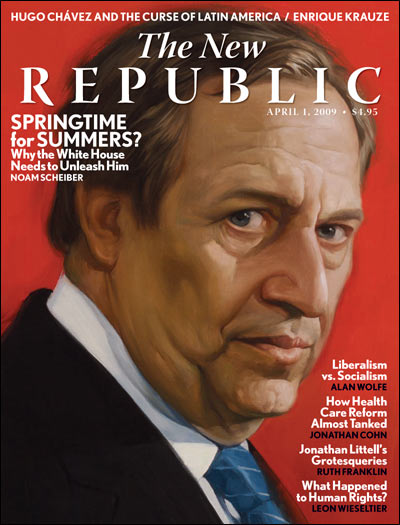
December 6, 2014The Silicon Valley billionaire, Chris Hughes, has bought The New Republic. He has fired two of the editors, Franklin Foer and Leon Wieseltier, and he has announced he is going to transform the journal into a “digital media company”. This has provoked a great gnashing of teeth and howls of outrage from journalists. “One of journalism’s great publications” (according to The Daily Beast) is being destroyed. I, for one, can only say “Good riddance”. This illiberal “liberal” magazine has been an eyesore on newsstands for as long as I can remember. The writers and editors at TNR have been wrong on almost every major issue of the past thirty years. They supported the contras. They supported the welfare “reform” act. They supported the invasion of Iraq. TNR did, however, provide us with some schadenfreude when its best writer was exposed as a pathological liar, which was the only good it ever did. So, more power to you, Chris Hayes. Burn this house down!
Rumor has it that National Review is also in trouble. Let’s keep our fingers crossed.
Kurmanjan Datka, Queen of the Mountains
December 1, 2014Kurmanjan Datka, also known as Queen of the Mountains is a Kyrgyz film by Sadyk Sher-Niyaz. It tells the story of the woman who was the leader of the Kyrgyz during the latter part of the nineteenth century.
The young Kurmanjan is forced to marry a man she doesn’t like. After she runs away, she eventually comes to the attention of the feudal lord, Alimbek, who marries her. When Alimbek is killed by a political rival, Kurmanjan becomes the leader of the Krygyz. When the Russian empire begins to intrude upon the Kyrgyz, Kurmanjan realizes that they simply aren’t powerful enough to defeat the Russians. She pursues a policy of accommodation, which is opposed by some of her countrymen, including members of her own family.
Kurmanjan is credited with enabling the Kyrgyz to maintain their identity and culture in the face of Russian imperialism. I imagine some will argue that this was due to her willingness to make concessions to the Russians. However, it seems to me that the Kyrgyz were lucky. The Russians apparently weren’t interested in colonizing their mountainous land. Others were not so lucky. For example, the Russians drove the Circassians off their land and sent them into exile. Last year’s Winter Olympics in Sochi were held on land that once belonged to the Circassians.
Kurmanjan Datka is hard to follow at times. I can only assume that Sher-Niyaz intended this film for Kyrgyz audiences who would already know about the events depicted. The early scenes, which show a young Kurmanjan struggling against the patriarchal strictures of Kyrgyz society, have feminist overtones to them. The battle scenes are well done, and there are beautiful shots of the magnificent Kyrgyz countryside. Aside from that, though, I can’t really recommend this film. Perhaps some day someone will make a film that does justice to this remarkable woman.
Citizenfour
November 29, 2014Citizenfour is a documentary by Laura Poitras about the recent revelations of NSA spying on US citizens. For those who have been following this scandal, this film will reveal nothing new. It is primarily of interest as an historical document. There is footage of the first meeting between Snowden and Greenwald and Poitras in hotel room in a Hong Kong. In these scenes, Snowden appears confident, yet one sometimes senses a feeling of anxiousness in him. He is clearly concerned about what might happen to him. (Snowden has been criticized for seeking refuge in Russia, which is a dictatorship. This film tells us that he had intended to fly from Moscow to Ecuador. He no doubt had to give up this idea in the face of the US’s manhunt for him. A plane carrying Bolivian president Evo Morales was forced down because it was suspected that Snowden might be hiding on board.)
Citizenfour ends by hinting that there are even bigger revelations to come. Yet it never really addresses the question of why the government is doing so much spying. Is it really about the “War on Terror”, or does the government have a deeper motive? In one scene, Jacob Appelbaum suggests that the government collects this information so that it can target people who get too much out of line. This may sound conspiracist to some people, but it should sound plausible to anyone familiar with the FBI’s Cointelpro program.
You are being watched. Always remember that.
Whiplash
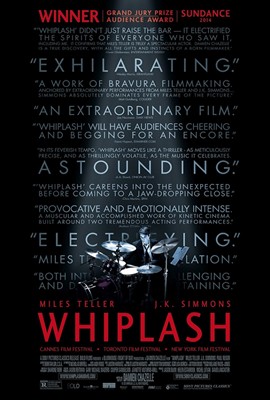
November 24, 2014Whiplash, written and directed by Damien Chazelle, tells the story of Andrew Neiman (Miles Teller), an aspiring young jazz drummer who is attending a highly prestigious music conservatory in New York. He is picked to be in the school’s premiere jazz band, which is led by Terence Fletcher (J.K. Simmons). When Neiman attends his first band practice, Fletcher shows up and immediately begins acting like a sadistic bully. He humiliates Neiman in front of the other band members, slaps him repeatedly, and throws a chair at his head (this is in a crowded room). Over time, Neiman becomes obsessed with trying to live up to Fletcher’s exacting standards. He practices until his hands bleed. He dumps his girlfriend, Nicole (Melissa Benoist), telling her that she’s a distraction from his becoming a great musician. He is rude and insulting to members of his own family. However, Fletcher’s abusive behavior leads to a violent confrontation, which results in Neiman being expelled from the conservatory and Fletcher being fired.
Later, Neiman runs into Fletcher in a jazz club. To Neiman’s surprise, Fletcher is friendly towards him. Fletcher explains (not convincingly) that the reason he was such an asshole was that he was trying to get Neiman to “break through” as a musician. He tells a story about how Joe Jones once threw a cymbal at Charlie Parker’s head when the latter wasn’t playing well. (That wasn’t really what happened, but I’ll let that go.) This motivated Parker to work harder and become a better musician. Fletcher then tells Neiman that he is going to be conducting a band at a jazz festival, and he needs a drummer. He assures Neiman that they will be playing pieces he is familiar with. When Neiman shows up for the performance, however, Fletcher has the band play a piece that Neiman doesn’t know. Neiman realizes that he has been lured into a trap, that Fletcher wants to humiliate him in front of an audience.
Now, I have a few problems with this. First, we are expected to believe that when Fletcher bumps into Neiman, he immediately concocts a scheme to get even with him. We are also expected to believe that Fletcher, an obsessive perfectionist, would deliberately sabotage his own band’s performance – and in front of an audience that has record company executives in it. (And the fact that Fletcher didn’t have him rehearse with the band should have tipped off Neiman that something wasn’t right.) In fact, I found the film’s whole premise – that a teacher would try to inspire his students by acting like a raving lunatic – impossible to believe.
I’m sure that a musician’s life can be stressful and difficult at times. (I imagine this is particularly true in a competitive field like jazz.) Instead of trying to depict this, however, Chazelle has given us an overheated melodrama.
The Hunger Games: Mockingjay
November 22, 2014The Hunger Games: Mockingjay, directed by Francis Lawrence, picks up where the last installment in the series left off. Katniss (Jennifer Lawrence) has been taken from the Hunger Game by the rebels. (These rebels have a set-up that would make Che Guevara’s head explode: a vast underground city and fighter planes. It is never explained where these rebels get their resources from, in what appears to be a tightly run police state.) The rebels want Katniss to become the “Mockingjay”, the symbol of their revolution. Katniss refuses unless the rebels promise to rescue her sometime boyfriend, Peeta (Josh Hutcherson), who has been taken prisoner by the government. (Some revolutionary. Imagine Robespierre saying, “If you don’t rescue my Fifi from the Austrians, you’ll have to find yourselves another Incorruptible!”)
When Katniss sees government planes destroy a hospital, she seems to finally embrace her role as the Mockingjay. Soon after, however, she goes back to moping and whining about how she wants her Peeta back, until, to make this prima donna happy, the rebels send a group into the capitol to rescue him.
What makes all this somewhat distasteful is that we see rebels sacrifice their lives to fight the government, yet our main concern is supposed to be that Katniss is worried about her sweetheart. The revolution will not be televised, but it will be made into a teenage romance.