Some Thoughts about Bill Cosby

November 21, 2014

1101870928_400

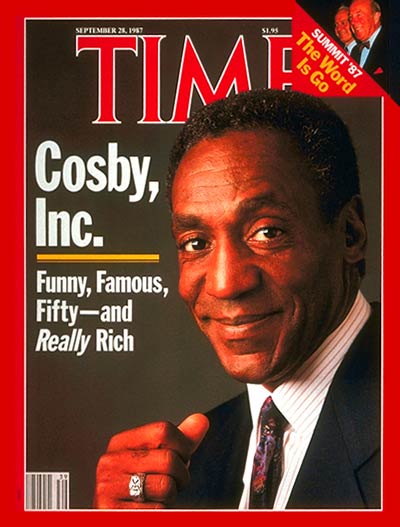
The accusations against Bill Cosby have left me feeling conflicted. I grew up listening to his early comedy albums and watching his TV specials. I would listen to his records with my friends and my brothers and sometimes with my whole family. I recently re-listened to some of the routines from those old albums, and I must say that they hold up pretty well.

During the 1970’s, however, I began to lose interest in Cosby. First, he produced a Saturday morning cartoon show called Fat Albert and the Cosby Kids, which flattened all the subtlety and nuance that had made his childhood stories funny. (The fact that the show was “educational” only made it worse. Comedy isn’t supposed to be educational.) Then there were the TV commercials. Jello pudding and Jello pudding pops. He did a commercial for Hi-C, in which, with a perfectly straight face, he assured us that this soft drink is good for us because it contains “ten percent real fruit juice”. He was the pitchman for Coca-Cola during the “New Coke” fiasco. (Spy magazine once called Cosby “grimly unavoidable”.) It seemed to me that Cosby had ceased to be a comedian and had become a brand. (It’s perhaps worth noting that the accusations against Cosby date back to this period.)

I never watched Cosby’s 1980’s TV show. For all I knew, it may have been funny, but I didn’t really care. For me, Cosby was someone who had started out being really cool and had become uncool. I could never get over my disappointment.

Whether or not the accusations against Cosby prove to be true, I will always think fondly of his early comedy. It seems to me that he is someone who got lost.

Kill the Messenger

November 16, 2014

Kill_the_Messenger_poster

Kill the Messenger, directed by Michael Cuesta from a screenplay by Peter Landesman, tells the story of Gary Webb, the journalist who reported on contra drug-dealing in the US, and who was blacklisted by the news media for his efforts. The film follows Webb (Jeremy Renner) as he gradually uncovers the story and then writes about it for the San Jose Mercury News. The article causes a sensation, but then it immediately comes under attack from major news outlets, such as The New York Times, The Washington Post, and The Los Angeles Times. Webb then struggles to defend the article, as well as his reputation.

An interesting question here is: why was Webb’s article so controversial? I remember during the 1980’s hearing rumors that the contras were running drugs. A Senate committee eventually confirmed this as true. So why did Webb’s revelations upset so many people? I can only guess it was because Webb drew an explicit connection between the contras and the crack cocaine epidemic that swept South-Central Los Angeles in the 1980’s. I remember at the time, some journalists expressed fear of “black anger” as a result of Webb’s article.

This film suggests another possible motive: reporters at major newspapers were incensed that they had been scooped by a mid-size paper. Webb was, in that respect, a victim of the news media pecking order. What this movie also makes clear is the extraordinary vindictiveness of these people: even after the CIA admitted that Webb’s story was basically true, he was unable to get work at any newspaper.

Kill the Messenger is a tribute to a courageous reporter.

Interstellar

November 12, 2014

Interstellar_film_poster

Having sat through The Dark Knight Rises, I wasn’t sure I wanted to see Christopher Nolan’s latest film. However, having seen it, I am pleased to report that Interstellar is a better film than The Dark Knight Rises. It is, however, pretentious, melodramatic, overlong, and ultimately silly.

Interstellar is set in a dystopian future. A blight is killing food crops and threatens to starve the human race. Cooper (Matthew McConaughey) is a retired astronaut living on a farm with his family in a region that is plagues by dust storms. One day he notices the dust forming a pattern on the floor of his daughter’s room. It seems to him to be a binary code for a GPS location. When he goes to the location, he finds a secret NASA facility. There he finds his former teacher, Prof. Brand (Michael Caine), as well as Brand’s daughter, Amelia (Anne Hathaway). Brand tells Cooper that NASA has found a wormhole orbiting Saturn. Brand has devised a plan to transport the human race from the dying earth through this wormhole to another galaxy (shouldn’t this film be Intergalactic?) where they will settle on another planet, once he has solved the “problem of gravity”. (Wouldn’t it be easier just to find a way to kill the blight? One thing I’ve noticed about Nolan’s films is that no one ever does anything the easy way.) NASA has already sent astronauts through the wormhole to find habitable planets. Brand tells Cooper that he wants him to pilot a mission to go through the wormhole and find which astronaut has discovered a habitable planet.

I found most of the second half of this film entertaining, but the first half is a hard slog. There are scenes of people philosophizing about such things as man’s destiny and the true nature of love. There’s a subplot about Cooper’s relationship with his daughter, Murphy (Jessica Chastain). Michael Caine recites a Dylan Thomas poem. And there is a wisecracking robot, who, I take it, is meant to serve as comic relief. (Nolan has apparently forgotten that the comic relief is supposed to be funny.) It’s not until Cooper, Amelia, and the other astronauts travel through the wormhole that this film finally starts to pick up steam, and even then there’s a long lull after they visit the first planet. It seems to me that Nolan wants to be seen as a director with ideas. The problem is that his ideas aren’t very good. (The ideas in The Dark Knight Rises are terrible.) Interstellar could have been a nifty sci-fi adventure. Instead, it’s an ungainly hodgepodge of a a film.

Birdman

November 11, 2014

Birdman_poster

Birdman is the latest film by the Mexican director, Alejandro González Iñárritu.

Riggan Thomson (Michael Keaton) is an aging movie actor who twenty years earlier played a superhero character named Birdman. Riggan has written, and is directing and starring in, a play based on a short story by Raymond Carver. Thomson is hoping the play will revive his career as well as his reputation. He begins to worry, however, that another cast member, Mike Shiner (Edward Norton), an egotistical method actor, will overshadow him. At the same time, he is trying to reconnect with his emotionally estranged daughter, Sam (Emma Stone). His girlfriend, Laura (Andrea Riseborough), tells him that she is pregnant. Riggan begins hearing a voice inside his head, the voice of his old Birdman character, telling him that he is wasting his time with this play.

Birdman is a black comedy and a satire of show business. As someone who used to work in the theatre, there were many things in this film that were familiar to me. Its depictions of the competitiveness of the acting profession and the petty humiliations suffered by actors all ring true. Iñárritu and cameraman Emmanuel Lubezki have contrived to make it appear that the film is almost entirely one long tracking shot. This is more than just a gimmick, for it sometimes gives one the feeling that one is almost part of what is happening.

Birdman also contains fantasy elements. I did not mind them at first, and some of them are funny, but they overwhelm the story towards the end, culminating in an ending that I found unsatisfying. Iñárritu’s previous film, Biutiful, also had fantasy elements that I found distracting from the main story. I would like Iñárritu better if he stuck to the realistic storytelling that he does best.

For all its flaws, though, Birdman deserves to be seen.

Against the “Don’t Vote” Argument

November 8, 2014

prisons

Over the past few days, I have read a number of articles that have posited various reasons for why the last election turned out the way it did: low turnout, Republican gerrymandering, the weak economy, the stupidity of the Democrats, etc. I think there is some truth to all of these arguments. What I would like to address here, though, is an argument that some of my leftist friends made, which is that we shouldn’t vote. I can understand why people would feel this way, since our political system is such a scam. Yet I think the argument is seriously lacking in some ways.

In the last election, Oregon, Alaska, and D.C. all voted to legalize marijuana. Massachusetts passed a paid sick days law. Denton, Texas, outlawed fracking. Here in California, voters passed Proposition 47, which reduces many non-violent crimes, including drug possession, from felonies to misdemeanors. This is a major blow against what the late Alexander Cockburn called “the prosecutorial state” – in other words the warehousing of human beings who committed petty crimes. This vote indicates there has been a huge shift in consciousness since the 1990’s, when Californians passed the god-awful “Three Strikes” law, which resulted in people being sentenced for life for such trivial offenses as stealing a slice of pizza. People are beginning to realize that mass incarceration is not only not the solution to our society’s problems, but it actually makes them worse.

Should you vote? I would argue it depends on the circumstances and what’s on the ballot. Yes, we have a terrible political system, but we should take advantage of what little room to maneuver that we have.

St. Vincent

November 5, 2014

St_Vincent_poster

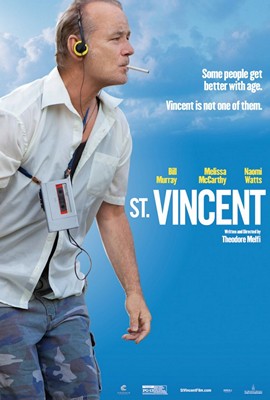
Last Saturday, I went to see Nightcrawler. When I got to the ticket booth, I was told that it had just sold out. I didn’t feel like going home. I saw that St. Vincent, which I had heard was receiving good reviews, was playing at the same time, so I decided to see that. After watching it, I felt that I might just as well have gone home.

Bill Murray plays Vincent MacKenna, a grouchy old coot who spends most of his time at bars and racetracks. Maggie (Melissa McCarthy), moves in next door to him with her son, Oliver (Jaeden Lieberher). Just as you expect, Vincent ends up befriending Oliver. After a series of misadventures and scenes of Vincent being an asshole, Oliver realizes that Vincent isn’t really a bad person, and everyone lives happily ever after.

The early scenes in this film gave me some hope that it would not be just another run-of-the-mill “feel good” movie. Alas, writer/director Theodore Melfi decides to play it safe, while appearing to be “edgy” by having Vincent make racist comments. Also, he leaves loose ends. In one scene, Vincent steals a large amount of money from Oliver. Neither Oliver nor any of the other characters refer to this later in the film.

As I have mentioned previously on this blog, I don’t care for this whole genre of “feel good” movies. Yes, life is worth living, and, yes, most people are not entirely bad. My question is this: why is it so hard for Hollywood filmmakers to make this point in a way that is not contrived and dishonest?

Nightcrawler

November 3, 2014

Nightcrawlerfilm

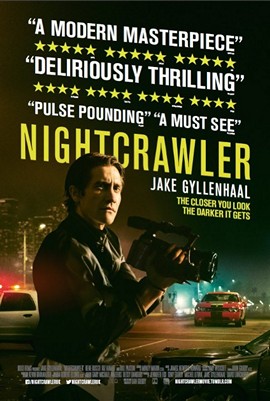
Filmmakers seem to have it in for the news media nowadays. First there was Gone Girl, and now there is Nightcrawler, written and directed by Dan Gilroy. (There is also Kill the Messenger, about the media’s trashing of Gary Webb, which I have yet to see.)

Louis Bloom (Jake Gyllenhaal) is a petty thief living in Los Angeles. One night he sees a freelance camera crew filming an accident. He gets the idea that he might be able to make a living this way. He steals an expensive bicycle, and he takes it to a pawn shop and trades it in for a camcorder and a police scanner. He struggles at first, but then he manages to get some graphic footage of a crime scene. He takes it to a local TV station. The station manager, Nina Romina (Rene Russo) buys the film, and she offers him advice on what things to look for. Louis then hires an assistant, Rick (Riz Ahmed). Louis sees an enormous opportunity for himself when he arrives at a home invasion before the police do.

Louis Bloom speaks in a mixture of self-help cliches and technocratic jargon. At times he sounds almost as though he were giving a TED talk. (I have had bosses who have said some of the same things to me that Bloom says to people.) He is an embodiment of our society’s penchant for hype and boosterism. Yet underneath his glib facade is a man with no empathy for other people, who is willing to commit murder just to get ahead. The film implies that it is these very qualities that make it possible for Louis to be so successful at what he does.

Nina tells Louis that her station promotes the idea that urban crime is spreading into suburban areas. She tells him that she prefers him to cover crimes in wealthy neighborhoods in which the victims are white. She is open and honest about the station’s fearmongering.

Nightcrawler is a powerful indictment of the news media.

Gone Girl

October 29, 2014

gone-girl-40653-poster-xlarge

Gone Girl is a film directed by David Fincher, with a screenplay by Gillian Flynn, based upon her own novel. The film is a thriller with elements of social criticism in it.

Nick Dunne (Ben Affleck) returns home one day to find that his house has apparently been broken into and that his wife, Amy (Amanda Pike) is missing. During the subsequent police investigation, Nick makes conflicting statements, and it is gradually revealed that he was emotionally estranged form Amy. Because Amy is the daughter of a writer of a popular series of children’s books, the case draws national attention. Suspicion begins to grow among both the police and the public that Nick murdered Amy. Nick’s sister, Margo (Carrie Coon), is suspected of being his accomplice.

What I found most interesting about this film is its devastating portrayal of the news media. Many of the events in this film are driven by a cable news reporter named Ellen Abbot (Missi Pyle), a character who is clearly modeled after Nancy Grace. Her sensationalist and biased reporting on the case help to create a lynch mob atmosphere in the small town in which Nick and Margo live. Gone Girl depicts the destructive effects of news reporters who try to identify “good guys” and “bad guys” in every situation, even though reality is rarely ever that simple. (I would argue that a similar criticism could be made of the Left, but I won’t go into that here.)

SPOILER ALERT. I AM ABOUT TO GIVE AWAY AN IMPORTANT PLOT TWIST

The early scenes create a strong feeling of suspense, as well as of foreboding. However, when, about halfway through the film, we learn what actually happened to Amy, it becomes basically a melodrama, and a somewhat cynical one at that. The film implies that the reason for Amy’s destructive behavior is that she is an emotionally needy sociopath. There is, however, a vague class consciousness here as well. Amy has a trust fund from her parents, and it appears that a sense of entitlement is part of her emotional make-up.

There is some psychological nuance, however. When Amy sees Nick apologize to her on TV for his behavior towards her, she decides to go back to him. Later, Nick tells Amy that he didn’t really mean it when he made that apology. She tells him she doesn’t care, that she would be happy to have him pretend to be the person he was at that moment. It’s clear at this point that Amy sees little distinction between fiction and reality. This may have something to do with the fact that Amy’s mother used her as the fictionalized subject of her children’s books.

And there is a deeper social criticism here as well. This film implies that many of us are like Amy: we are attracted to fake sentiment. After Amy returns, the media accept her implausible story of being kidnapped. People want to believe her story is true. Someone suggests that Nick and Amy should be in a “reality” TV show. Later, when Nick threatens to leave their loveless marriage, Amy tells him that the public will hate him for it. At this point, the public has become an almost tangible presence in their household. They are aware that they are constantly being watched by the media. Their fake marriage appeals to a society that watches obviously staged “reality” TV shows. At one point, Margo suggests to Nick that he too has come to like the spectacle of their fake marriage.

This movie goes on a bit long. Some things could have been cut out of it. Still, for all its flaws, Gone Girl is the most interesting and thought-provoking American film that I have seen in a long time.
Objectively Worse?

October 26, 2014

Isfahan_Royal_Mosque_general

There is an argument that I have seen some of my Facebook friends make recently. The argument is that Islam is “objectively worse” than other religions. (A claim popularized by Richard Dawkins.) When one looks at the behavior of ISIL, or the Saudi government for that matter, this can seem to make sense. However, this argument is a slippery slope in a couple of ways. First, it can be viewed as a backhanded endorsement of other religions. Second, it can be used as an excuse to justify attacking Muslims. This is an important point. There are ongoing persecutions of Muslim minorities in countries such as Sri Lanka and Myanmar. Whatever one may think of Islam, there should be no excuse for punishing people for their religious beliefs.

Moreover, this argument is not constructive. There are 1.6 billion Muslims in the world. Does anyone really believe that these people are going to change their religious affiliation just because some of us think their religion is crappier than others? I don’t think so. We need to find ways to unite people, rather than emphasize artificial distinctions.

What is the US Doing in Syria?

October 10, 2014

TOPSHOTS-SYRIA-CONFLICT

There has been a proliferation of conspiracy theories since ISIS captured Mosul last June. This should not be surprising, considering the way that ISIS just seemed to appear out of nowhere, though what actually happened is that the Western media simply didn’t pay any attention to them up until that point.

One of the most popular conspiracy theories holds that the US deliberately created ISIS to give itself an excuse to send troops back into Iraq. CJ Werleman has put forward a somewhat more plausible theory, which holds that the US and Saudi Arabia have conspired to create a sectarian army that would attack Iran’s allies in Iraq and Syria, and perhaps eventually Iran itself. But if this is the US’s plan, wouldn’t the US now be attacking Assad, who is Iran’s ally?

I’ve have grown wary of conspiracy theories as I’ve gotten older, but I still have to wonder if we’re being told the truth about what is going on. A recent article in The Guardian reports that:

    No coalition strikes have been made to help or relieve rebel forces where they were facing either Isis or government troops. Emile Hokayem of the International Institute of Strategic Studies said Assad has been able “to give his troops a break while surveying the landscape and looking for opportunities.”

We also learn that:

    Coalition hits on grain silos and a gas plant in Manbij and Deir al-Zor drew warnings of a humanitarian disaster – and the risk of playing into Isis’s hands, as shortages during the winter will be blamed on the international community. The Hazm movement – backed by the US and supplied with advanced anti-tank weapons – publicly denounced the intervention but was quickly silenced by Washington, rebel sources say. Attacks on Jabhat al Nusra (another al-Qaida-linked jihadi group and a rival to Isis) have backfired, and are said to have brought it new recruits.

    Civilian deaths caused by coalition attacks clearly risk a backlash. “We had 10 martyrs when they targeted Al-Riqa,” said Zeid Al-Jabli, a student from Zawiya in the Idlib area. “There had been a base for Jabhat al-Nusra but they pulled out a long time ago and the civilians were killed instead. Shelling by the regime has intensified because of the coalition. We have martyrs and wounded every day.”

The Guardian also reports that Kurdish fighters are saying the air strikes are doing no good:

    He [a Kurdish spokesman] said Isis had adapted its tactics to military strikes from the air. “Each time a jet approaches, they leave their open positions, they scatter and hide. What we really need is ground support. We need heavy weapons and ammunition in order to fend them off and defeat them.”

The US is following a strategy that is not only not working, but which is actually counterproductive. One can spin all sorts of conspiracy theories about this, but I suspect the problem is really just that our policymakers have no idea what they are doing.