Horrible Bosses

July 11, 2011

Imagine a bad TV sitcom that lasts an hour and a half and which has raunchy language in it. That’s pretty much what Horrible Bosses is like.

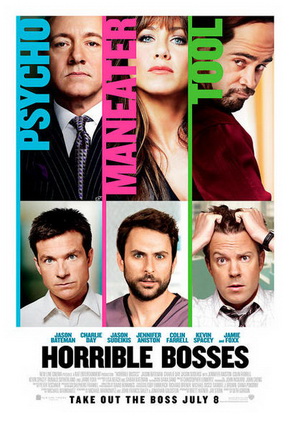
Nick (Jason Bateman) has a sadistic boss, Dave Harken (Kevin Spacey), who likes to play mind games with people. Dale (Charlie Day) is a dental assistant whose boss, Julia Harris (Jennifer Aniston) is continually coming on to him and tries to blackmail him. Kurt (Jason Sudeikis) is a chemical company executive who gets along with his boss (Donald Sutherland). However, when the latter dies, the company is taken over by his obnoxious cokehead son, Bobby Pellitt (Colin Farrell). Nick, Dale and Kurt like to get to together at a bar and commiserate with one another. They are so desperate that they decide to kill their bosses. They hire a “murder consultant”, Jones (Jamie Foxx), to help them.

I was hoping this film would be a satire on corporate life, but instead it’s a slapstick comedy and not a very good one. The main problem with this film is that the characters are so cartoonish that you simply don’t believe them. Of course, comedy inevitably involves a certain amount of exaggeration, but the characters have to be believable on some level. The only characters in this film who are at all believable are Harken and Jones. The rest one couldn’t care less about. I also had a problem with the way this film trivializes the problem of sexual harassment in the workplace. (And would an executive at a chemical company hang around with a dental assistant? This is an example of Hollywood’s tone deafness when it comes to matters of class.)

One of the reasons I went to see this film is because Roger Ebert gave it three and a half stars. Perhaps I should ask Ebert to reimburse me for the cost of my ticket.

Casey Anthony

July 7, 2011

The media are all in a frenzy because of the verdict in the Casey Anthony trial. During all this blather, I fear no one will ask whether it is really a good idea to give so much attention to a single sensational murder trial. CNN, for example, had almost around the clock coverage during the days just prior to the verdict. (Anderson Cooper had the pop psychologist, Phil McGraw on his show. This Nostradamus told the credulous Cooper that Anthony’s unemotional demeanor during most of the trial would make a bad impression on the jury, likely resulting in a guilty verdict. An uncanny prediction, no?) And they have had almost around the clock coverage since the verdict. Is there nothing else for these people to talk about?

The Casey Anthony trial has given people a distorted view of our criminal justice system, just as the O.J. Simpson trial did. She had experienced trial lawyers who agreed to work pro bono. Your average criminal defendant has an overworked public defender. Over ninety percent of criminal trials end in guilty verdicts. Yet I fear that because of this one verdict, we are going to hear renewed calls for “tough on crime” legislation, such as mandatory minimum sentencing laws, sentence enhancement laws and so on, which will result in the further growth of that vast warehouse of human beings known as the U.S. prison system. Of course, all this will do nothing to prevent mentally ill people from killing their children.

I am curious to know why the media have been so concerned about the murder of Caylee Anthony, whereas they have largely ignored the murder of Brisenia Flores. Would it be cynical of me to suggest that this might have something to do with the fact that Caylee Anthony was white? Do you really think the case would have received any attention at all if Caylee had been African-American? I honestly can’t see it. In the eyes of the media, murders are only important when they happen to white people.

The Tree of Life

July 4, 2011

Terrence Malik’s latest film has been the source of a great deal of controversy, provoking sharply divided opinions. (Several days ago, a friend of mine posted on Facebook about how much he hated it.) My own feeling immediately after watching this film was similar to how I felt after watching Enter the Void, which was that what I had just seen was perhaps too much to absorb in a single viewing. There are many different kinds of images in this film, and their meanings and connections to one another are not always clear. Malick seems to be using them to try to convey philosophical and possibly even religious ideas.

The film is basically about an architect, Jack (Sean Penn), who sometimes reflects upon his experiences in life, sometimes thinks about the creation of the Earth and the origins of life, and at other times is simply fantasizing. A large chunk of the film is devoted to Jack’s experiences growing up in Waco, Texas during the 1950’s. (It so happens that Malick grew up in Waco during the 1950’s. It seems reasonable to assume that this film is at least partially autobiographical, though Malick is clearly trying to do more than just depict scenes from his life. By the way, Sean Penn is a little young for his role, but that’s not a big problem.) Jack’s father (Brad Pitt) is a stern disciplinarian, while his mother (Jessica Chastain) is indulgent and forgiving. Young Jack (Hunter McCracken, who looks like an adolescent Sean Penn) sometimes thinks about killing his father, while feeling close to his mother. What lifts this above Freudian cliché is that the characters seem real and complex. (Chastain and Pitt both give very good performances.)

As I mentioned before, part of the film is devoted to a depiction of the creation of the Earth and the evolution of life. (The special effects, which are very good, were partly done by Douglas Trumbull, who worked on 2001: A Space Odyssey over forty years ago.) The juxtaposition of this with the scenes from Jack’s childhood is a bit jarring. It seems to me that Malick is trying to do two different things at the same time here. First, he is trying to convey the idea that Jack’s efforts to make sense out of his childhood are part of his efforts to try to make sense out of existence itself. Second, Malick is trying to reconcile evolution with an essentially religious view of the world. (This puts him in opposition to a lot of people in our society.) The film is peppered with religious ideas. It opens with a quote from the Book of Job. Both of Jack’s parents are deeply religious. His mother sounds almost mystical at times. In what I can only assume is one of Jack’s fantasies, we see his mother giving water to a man who has just been arrested by the police. (It may be that Jack’s parents represent the dual nature of religion, which is both judgmental and a source of solace.)

The film ends with a scene of Jack wandering on a beach, where he meets his parents and other people from his past. No doubt this represents Jack’s reconciliation with his past.

The Tree of Life is a great film. It shows that cinema can be more than just a storytelling medium. It can also be meditative, evocative and impressionistic. Films can challenge us and make us think as well as entertain us. I highly recommend seeing this film.

If A Tree Falls

June 27, 2011

Marshall Curry and Sam Cullman have made a film about the Earth Liberation Front. This group was very active in Eugene, Oregon, where I currently live; so I was naturally interested in seeing this film. Marshall Curry says he learned from his wife one day that the police had arrested an employee at her company for being an “eco-terrorist”. He immediately became interested, and he eventually decided he wanted to make a film about this person. The employee was Daniel McGowan, whose story serves as the central thread of this film. A round-faced, soft-spoken man, he seems an unlikely person to become a violent criminal. The son of a New York cop, he grew up on Rockaway Beach. In his youth he became interested in environmental issues. He eventually gravitated towards Eugene, a hotspot for environmental activism. The film does a short history of the environmental movement in the Pacific Northwest, recounting how non-violent protests have sometimes been met with police violence. Faced with such a response, it was inevitable that some activists would conclude that they should resort to violence themselves. A cell of the Earth Liberation Front was formed in Eugene, and McGowan, frustrated by the lack of progress by environmentalists, was eventually drawn into it.

McGowan’s first job was to serve as a lookout when ELF torched the offices of a lumber company. His second job was helping ELF destroy a tree farm that was allegedly growing genetically modified trees. Only it turned out afterwards that the trees were not GMO’s. At the same time ELF set fire to the office of a University of Washington professor who was involved in genetic engineering. The fire grew out of control and did a lot of damage that ELF didn’t intend. In the aftermath, the cell underwent a crisis and disbanded. McGowan became disillusioned with ELF’s methods, while still retaining his radical environmental views. He returned to New York, where he got a job with a group dealing with domestic violence issues.

The film then deals with police efforts to solve the crimes. For years they got nowhere. Then, by sheer dumb luck, they stumbled upon Jacob Ferguson. He just happened to be the weakest link in the ELF cell, since he was a heroin addict and therefore vulnerable to legal pressure. The police outfitted him with a wire and flew him to different parts of the country to have conversations with his former comrades. He showed up in New York to talk to a surprised McGowan. The latter thought there was something odd about this, especially since Ferguson seemed “talkative”, whereas McGowan remembered him as being quiet. McGowan spoke to him any way, which was a fatal mistake. McGowan was later arrested and found himself facing a possible sentence of life plus 350 years. He eventually made a plea deal in which he confessed to the arsons but did not name any accomplices. He was sentenced to eight years, but received a “terrorism enhancement”, meaning that he was put in a special high security prison built for “terrorists”. He can only receive one fifteen minute phone call a day and one visitor a month. The film documents the emotional anguish that this experience has inflicted upon McGowan and his family.

The filmmakers interview many people involved in these events, including the prosecutor and police detectives who pursued the ELF members. People with different viewpoints are allowed to state their positions. Although the filmmakers maintain a neutral tone, it’s clear that they feel that McGowan and other members of ELF were dealt with unfairly. Ferguson, who was involved in more arsons than anyone else, did not receive a prison sentence. He betrayed his friends solely to save himself, and the system rewarded him for that. Someone makes the point that capitalists who destroy the environment, such as the executives at BP, are never punished for what they do.

I highly recommend seeing this film.

Whitey Bulger

June 25, 2011

James “Whitey” Bulger, who is alleged to have murdered at least 19 people, has been arrested. This is a redemptive act for the FBI, just as the finding of Bin Laden was a redemptive act for the CIA. Bulger spent the 1980’s working as an informant for the FBI, at the same time he was building his criminal empire in Boston. It was an FBI agent who tipped Bulger off that the police were about to arrest him in 1994. Ever since then the feds have been trying to wipe that particular egg off their face.

Police have searched all over the world for Bulger, but it appears that he has spent the last 14 years living in a rent-controlled apartment in Santa Monica, along with his girlfriend, Catherine Greig. Judging from what I’ve seen of the building in the TV reports, it is one of those drab, ticky-tacky apartment buildings that are all too common in the Los Angeles area. Comfortable enough to live in, but it is not something you would find particularly enjoyable or satisfying. (The place is called the “Princess Eugenia”, which fits in with L.A.’s long tradition of giving silly, pretentious names to drab apartment buildings.) Bulger didn’t own a car. According to their neighbors, Bulger and Greig would go shopping at the local 99 Cents Only Store. (I’m not making this up.) Police found hundreds of thousands of dollars in cash in Bulger’s apartment. No doubt this is all because Bulger was afraid that if he spent all this money, he would draw attention to himself. It was too risky for him to even put his money in a bank account. Bulger’s frugal way of life is probably the reason why it took the police so long to find him. No doubt the feds were looking for a big spender.

It appears that Bulger’s only luxury was that he happened to live within walking distance of the beach. He killed nineteen people for that? Bulger was born in poverty, which is presumably why he turned to a life of crime. Yet in the end, for all his machinations, his life was like that of a typical retiree living on a fixed income.

Bulger illustrates what I call the paradox of the criminal life. For example, a guy robs a million dollars from a bank, but then he can’t spend it without making the police suspicious. Al Capone’s fellow mobsters chided him for his opulent way of life, and they were right, for it was the IRS that finally brought him down.

James M. Cain touches upon this paradox in his novel, Double Indemnity. The protagonist has an affair with another man’s wife. He persuades her that they should kill her husband and make it look like an accident, so they can collect his life insurance. After they kill the guy however, they find they can’t have any contact with each other without arousing suspicion. The novel ends with the main character losing his mind.

I’m curious to know about the state of Whitey’s mind.

Bill Cunningham New York

June 23, 2011

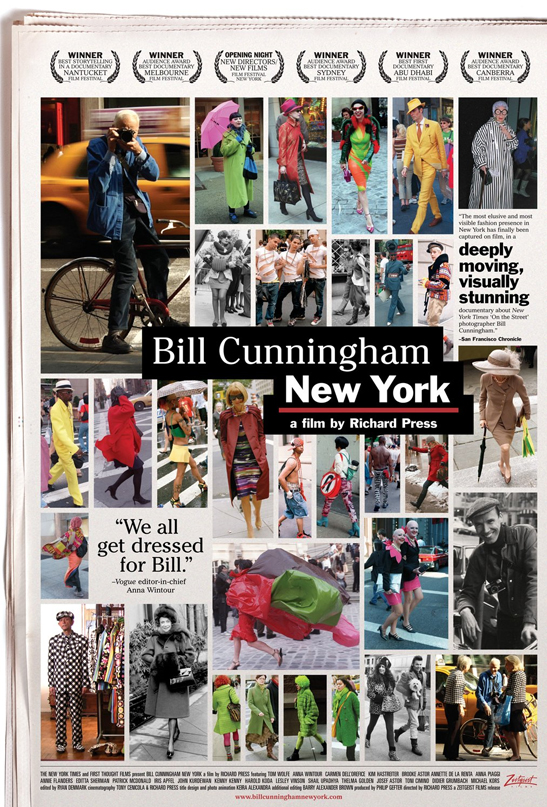
Richard Press has made a documentary about Bill Cunningham, the fashion photographer and writer. Since I have never been terribly keen on fashion, I was not sure I would find this film interesting, but I found Cunningham an engaging and likable person. He is now about eighty-years-old, yet he still rides around Manhattan on a bicycle, looking for people wearing striking clothes.

In the film, Cunningham defends the concept of fashion by saying that he regards clothing as “armor” that helps people deal with the vicissitudes of life. Cunningham’s own armor consists of a plain blue jacket that he seems to wear at all times. His non-descript appearance is in sharp contrast to the flamboyantly dressed people he likes to photograph on the streets of New York. (As a photographer myself, I was pleased to see that Cunningham still uses film.) No doubt Cunningham tries to draw as little attention to himself as possible, so as to get the candid pictures that he is famous for.

Cunnigham is a deeply private person, and Press respects this – perhaps too much so, because by the end of this film Cunningham is still something of a mystery. He claims, for example, that he doesn’t accept money for his work, so as to maintain his independence. Where then does he get the money to support himself? We’re never told. His friends all believe that he comes from a wealthy background, but Cunningham says his family is working class. We’re told that he once worked as a milliner, but we’re not told why he left that. We learn that Cunningham goes to church every Sunday, but he refuses to discuss religion. He refuses to discuss his love life. The closest we get to a personal revelation is when Cunningham tells us that his parents disapproved of his interest in fashion, because they didn’t think it was a proper pursuit for a man.

Cunnigham often takes pictures at fancy dinner parties where many of New York’s rich and famous people go, yet he leads a Spartan life. He lives in a studio crammed with filing cabinets full of negatives. He sleeps on a mattress on top of milk crates. We see him in a deli eating a bacon-and-egg sandwich. “They have such good sandwiches here,” he enthuses. When a party is held in his honor in Paris, he shows up with his camera and takes pictures as if he were on another one of his assignments.

At the time this film was made (2010), Cunningham was living in the Carnegie Hall Studios. The film discusses how he and other residents were about to be evicted, so their studios could be turned into office spaces. We see Cunningham with a couple of other residents of the studios, who have lived there since the 1940’s. (I’m not making this up.) This gives the film a bittersweet feel; Cunningham seems to belong to a world that is coming to an end.

The Edge

June 21, 2011


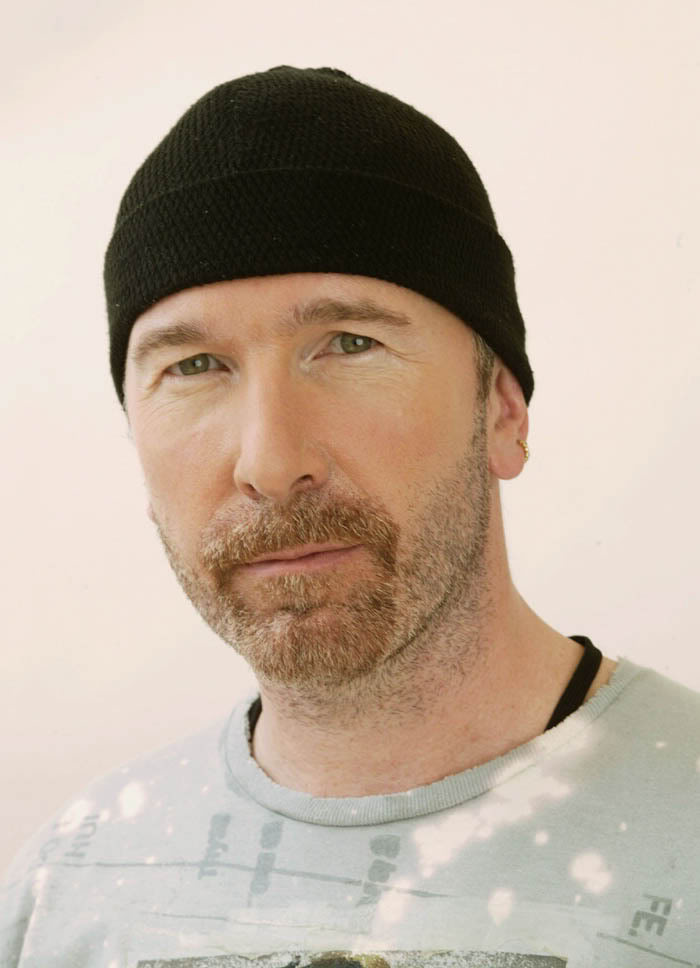
David Evans – a.k.a. “The Edge” – going for that “face in the police line-up” look.

It seems that rock stars almost always become bores as they get older. I’m not exactly sure why this is. It seems that rock & roll is a music of youth. As these guys get older, they inevitably lose the spark that initially made their music interesting.

The Irish band, U2, have carried this to a new level. Not content with being bores, they have tried to make themselves into a nuisance as well. Bono goes around posing for photos with war criminals, which is apparently their reward for flicking some dollars towards Africa. Bono and The Edge have written the music for a Broadway musical about Spiderman, which has resulted in several actors suffering severe injuries.

Now we learn that The Edge (whose real name is David Evans) wants to build a five-mansion compound in the pristine Santa Monica mountains near Malibu, overlooking the Pacific Ocean. Peter Douglas, executive director of the California Coastal Commission, has said of The Edge’s proposal:

    In 38 years of this commission’s existence, this is is one of the three worst projects that I’ve seen in terms of environmental devastation. It’s a contradiction in terms — you can’t be serious about being an environmentalist and pick this location.

“One of the three worst projects that I’ve seen in terms of environmental devastation”. Mind you, this is in Southern California, where environmental devastation is practically a way of life. A project must be mind-blowingly stupid just to raise eyebrows there.

The California Coastal Commission has rejected The Edge’s proposal. However, Steve Lopez, of the Los Angeles Times reports: “Evans has made it clear he’s going to try to exploit a legal loophole by arguing this isn’t a single five-mansion project, but five separate projects.”

Now, the question I have is this: WHAT THE FUCK DOES HE NEED A FIVE-MANSION COMPOUND FOR? Is he going to start a cult? I mean, what else do you do with a five-mansion compound? If Evans – uh, I mean The Edge – just wants to enjoy the beauty of the Santa Monica mountains, why doesn’t he live in a trailer, like the guy who made that silly I Am movie?

Oh, did I mention that The Edge (I wonder, do his friends call him “The”?) says that he is an environmentalist?

Since The Edge can afford to hire a whole army of lawyers, it’s not impossible that he may find a way to build his Pleasure Dome. Some day The Edge and his followers may be drinking unsweetened Kool-Aid and giving a collective finger to people sitting in traffic on the Pacific Coast Highway.

This may be the worst thing to happen since Rattle and Hum.

The Best and the Brightest

June 19, 2011

It’s funny how the people who are trying to shove the standardized testing snake oil down our throats send their children to fancy private schools that encourage personal growth rather than rote learning. President Obama sends his children to such a school. Could this be because he knows better than to believe his own nonsense?

I was thinking about this when I went to see the new comedy The Best and the Brightest, directed by Michael Shelov, and written by Shelov and Michael Jaeger. Jeff (Neil Patrick Harris) and Samantha (Bonnie Somerville) are a young couple who have just moved to New York from Delaware, along with their five-year-old daughter, Beatrice (Amelia Talbot). Not trusting the public schools in New York, they decide to enroll their daughter in a private school. They hire an agent, Sue Lemon (Amy Sedaris) to help them get their daughter into an elite school. Sue learns that a school run by the snooty headmistress, Katharine Heilmann (Jenna Stern), has one remaining available space. Sue persuades Jeff and Samantha that they should try to impress Heilmann by telling her that Jeff is a poet. Jeff and Samantha leave their daughter with their idle rich friend, Clark (Peter Serafinowicz) while they go to the interview. Their meeting with Heilmann goes well, and the latter seems inclined to admit their daughter. However, in a completely nonsensical scene, Clark appears out of nowhere, and, for no apparent reason, calls Heilmann a “douche”, causing her to reject their application. (This is simply bad writing.) Sue then tells Jeff and Samantha that their only hope now is to persuade the members of the school board that Jeff is an important up-and-coming poet. This leads to a series of increasingly humiliating impostures. At one point, Jeff and Samantha get disgusted with what they are doing and decide to move back to Delaware. It would have made sense if the film had ended with that. Instead, for no clear reason, they change their minds. They eventually resort to blackmailing one of the board members to get their daughter into the school.

So Jeff and Samantha end up completely buying into the rotten values that this film is supposedly satirizing. This wouldn’t be a problem were it not for the fact that we are clearly supposed to sympathize with these two. Indeed, we are supposed to root for them as they degrade themselves. This is not good comedy, and it certainly isn’t good satire.

For the most part, this film just is not funny. The characters are too broadly drawn to be believable for one minute. The actors do the best they can with their one-dimensional roles, although I must say that I found Amy Sedaris extremely annoying. Every time she appears on the screen, it’s almost as if you’re getting punched in the face. The problem is that she never modulates her voice. She delivers every line in the same in-your-face manner.

A woefully misguided film.

Arianna Huffington Reloaded

June 18, 2011

As you may have guessed from my last couple of posts, I’m in the mood for hating on Arianna Huffington. I could talk about how her website, The Huffington Post habitually refers to Hugo Chavez as a “dictator”, or how it’s filled with inane celebrity gossip, or how it tirelessly promotes Sarah Palin and her family. (When Palin’s husband won a fishing contest, the HuffPo featured an article about it.) Instead, I’m going to talk about what Huffington really cares about: money.

The Newspaper Guild and the National Writers Union have called upon bloggers not to contribute to the Huffington Post, until it agrees to pay them. This is what is known as a strike. So far, Huffington has refused to meet with the union leaders about this. It appears that Mrs. Huffington doesn’t like people telling her how to run her plantation.

It’s not a new thing for companies to try to get people to do things for no pay. I remember when I was working for Universal Studios, they were always trying to get employees to “volunteer” to do things, such as construct a float for the Tournament of Roses Parade. HuffPo has, however, carried this to a new level, because it was built upon unpaid labor, a fact acknowledged by the site’s new owner, AOL:

    In a Forbes magazine article, AOL executives were quoted as saying that AOL CEO Tim Armstrong “talked a lot about the importance of recruiting hordes of free bloggers…. “It was always, ‘Arianna does it. That’s what she’s built her business on. Why don’t we do it, too?’” says a former AOL editor-in-chief.”

This is what makes the HuffPo so poisonous. People see what Huffington has done, and they get the idea that maybe they too can make money by not paying people. This idea becomes like a cancer that spreads.

The Confederacy was abolished over 140 years ago, but the struggle for unpaid labor goes on.

Shepard Fairey Reloaded

June 17, 2011

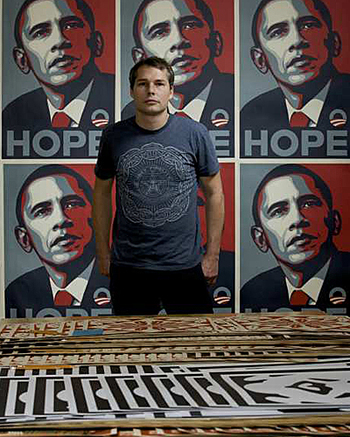
I started this blog by writing about Shepard Fairey. There hasn’t been much new on the Fairey front for a while, so I was pleased to find this. TMZ has a video of him churlishly admonishing his wife after she effectively tells someone that he no longer does his own wheatpasting. Does this surprise anyone? Fairey rakes in so much money, he can afford to hire a whole army of wheatpasters. Hell, I’m so desperate for work, I’d be willing to do it myself. (Shep, my hours are flexible.)

Mat Gleason, a critic for Coagula Art Journal, has a snarcky article about this in the Huffington Post. It begins:

    What is the difference between graffiti and paparazzi? Both are annoying invasions of public space. Whenever a cry to regulate either of these behaviors is heard, civil society acknowledges that it would take too much erosion of personal liberty to stop one or both. Therefore we tolerate and occasionally celebrate these rogue exercises on the fringes of free speech.

One should never criticize graffiti without also criticizing outdoor advertising. The latter is a far more pervasive and annoying invasion of public space. I’m no fan of Shepard Fairey, but I would rather look at one of his silly “Obey” signs than an advertisement for deodorant or toothpaste. When I lived in Los Angeles, I spent a large chunk of my time sitting in traffic with nothing to look at except enormous billboards urging me to watch Judge Judy (“Gotcha!”) or Dr. Phil (“You’ve Got Your Battles, He’s Got Your Back!”) or some other insipid TV show. So, no, you’re never going to hear me complaining about graffiti, not even when it’s done by a pompous fraud like Fairey.

Gleason ends his article with this:

    If cash-starved local governments look up their own old laws still on the books and, having seen Fairey’s own wife confirming on the record that the family fortune was based on advertising in these civic-controlled public spaces, will cities and counties all across America unite to collect fees from the Obey Empire with her admission as a pretext to write up an invoice? Imagining this were your empire, would you tell her to shut the fuck up?

This is high-minded talk coming from someone who writes for the Huffington Post, which is notorious for not paying people, while its owners get rich. People who live in glass houses…