William S. Burroughs: A Man Within

December 19, 2010

There seems to be a resurgence of interest in the Beats. This is the second time in a week that I’ve seen a film about a Beat writer.

William S. Burroughs: A Man Within is a documentary by Yony Leyser. It features interviews with many people who knew the writer. The film is well-made and provides many details, including film footage of the author himself, yet, when it was over, Burroughs was still something of a mystery to me. It’s still not clear to me what made the man tick. For example, the film discusses at length Burroughs’s obsession with firearms. We learn that he always carried a loaded gun and that he slept with a loaded pistol under his pillow. Yet the movie never succeeds in explaining this behavior. Did Burroughs have an experience that caused him to feel threatened? The film never indicates that he did.

Burrough’s fondness for weapons was bound up with a propensity for reckless behavior. He shot his wife, Joyce Vollmer, to death. (Not surprisingly, their son grew up to be a basketcase who drank himself to death at the age of thirty-three.) He nearly killed himself while doing target practice in his backyard. He shared needles with other addicts. He got himself bit while playing with a venomous snake. One of Burroughs’s friends expresses amazement that he lived as long as he did. The film discusses all these things dispassionately, though I think some moral judgement would have been appropriate here. Just because you’re a genius doesn’t give you the right to be an irresponsible asshole.

Critics have accused Burroughs of romanticizing drug use, but the film makes it clear that he hated being an addict. He quit several times, but he always eventually went back to his habit. As someone who has seen some of his friends develop addictions, I could relate to this part of the movie.

The film devotes a great deal of attention to Burroughs’s influence on the punk rock movement. There are interviews with several musicians, including Patti Smith. Since I’m not a huge fan of punk rock, I can’t say that I found this terribly impressive. I would have liked it if the movie had talked more about Burroughs’s influence on other writers, especially Beats such as Kerouac and Ginsberg.

The film does provide some human moments. We learn, for example, that Burroughs liked cats and that he shared recipes with his friends. Still, for the most part the film confirmed my previous impression of Burroughs as a cold and aloof person.
Captain Beefheart (1941-2010)

December 18, 2010

The Controversy Over TSA’s Body Searches Continues to Grow

December 18, 2010

Howl

December 16, 2010

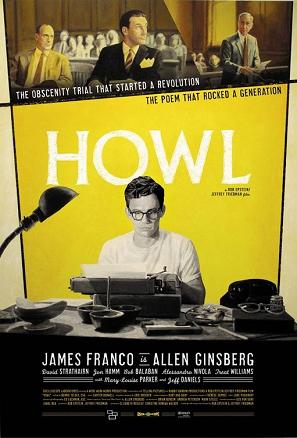
Howl, a film by Rob Epstein and Jeffrey Friedman, examines the circumstances surrounding the publication of Allen Ginsberg’s famous poem and the critical reaction to it. The film has been described by some as a cinematic form of literary criticism.

Much of the film is devoted to the obscenity trial of Lawrence Ferlinghetti (Andrew Rogers), who published Howl. Equal attention is given to an interview that Ginsberg (James Franco) gave at the time of the trial. There is a re-enactment of the famous reading of the poem that Ginsberg gave in 1955 in San Francisco, and there are also scenes from Ginsberg’s early life. There are animated sequences that accompany the reading of the poem.

I found Franco convincing as Ginsberg. Overall, I thought the film was intelligently done, but, except for the some of the animation, I did not find it emotionally engaging. I think that this was due to the device of telling the story of Ginsberg’s life mostly through his interview. People who had a strong influence on Ginsberg (Jack Kerouac, Neal Cassady, Carl Soloman) appear only in flashbacks, and we never hear them speak. (We never even hear Ferlinghetti speak during his trial). Ginsberg refers to his parents repeatedly (he feared his his father’s disapproval), but we don’t really learn much about them. Defenders of the film argue that it is meant as literary criticism, not as an attempt to fictionally portray Ginsberg’s life. Maybe so, but I prefer films that affect me on an emotional as well as an intellectual level.

One thing I can say for the film is that it did make me want to read more of Ginsberg’s writing.

Liberal Fear-mongering

December 11, 2010

I was reading the Register-Guard – Eugene’s laughable excuse for a hometown newspaper – and I saw this cartoon. It shows a fat, bald man, labeled “The Left”, watching Sarah Palin being sworn in as president. A though balloon over the man’s head reads: “Guess we showed Obama!”

Never mind that polls show that most Americans don’t think that Palin is qualified to be president. This is a typical example of liberal fear-mongering. The message is that we had better keep our mouths shut and let the Democrats screw us over, lest one of those awful Republicans gets into the White House. Of course, this merely guarantees that the Democrats will continue screwing us over.

Obama’s so-called “tax cut compromise” is actually an attack on Social Security. As Michael Hudson has pointed out in CounterPunch:

    …the tax giveaway includes a $120 billion reduction in Social Security contributions by labor – reducing the FICA wage withholding from 6.2 per cent to 4.2 per cent. Obama has ingeniously designed the plan to dovetail neatly into his Bowles-Simpson commission pressing to reduce Social Security as a step toward its ultimate privatization and subsequent wipeout grab by Wall Street….

    “The bottom line is that after the prolonged tax giveaway exacerbates the federal budget deficit – along with the balance-of-payments deficit – we can expect the next Republican or Democratic administration to step in and ‘save’ the country from economic emergency by scaling back Social Security while turning its funding over, Pinochet-style, to Wall Street money managers to loot as they did in Chile….

The Democrats are not on our side.

The Portland “Bomb Plot”

December 10, 2010

The FBI have claimed that on November 26, they foiled a bombing attack on a Christmas tree lighting in Portland. The attack was allegedly to be carried out by a nineteen-year-old named Mohamed Osman Mohamud. It now appears that this “terrorist attack” was almost entirely planned and executed by the FBI. This has inevitably raised questions from some circles about the FBI’s handling of the case. I think it can be argued that what the feds did amounted to entrapment.

I have some other reservations about this case. According to people who knew him, Mohamed Osman Mohamud drank gin and played video games as well as a card-collecting game called Magic: The Gathering. This doesn’t sound like your stereotypical Muslim fanatic. Rather, it sounds like a mixed-up teenager who was being pulled in different directions. Wouldn’t it have been better for the FBI to steer him in the direction of counseling, rather than cultivating his most destructive fantasies? The feds even went so far as to carry out an explosives demonstration for him in a remote area of Oregon. (Your tax dollars at work.)

Assuming that what the FBI says about Mohamud is true, what they did was irresponsible and dangerous. What certainty did they have that their proddings wouldn’t set this troubled youth off on violent acts of his own initiative? They had none. In effect, they were gambling with people’s lives. (If the FBI claim that there was no chance of such a thing happening, then they are effectively saying that Mohamud wasn’t dangerous.) The FBI’s gamble has had other effects. Someone recently tried to set fire to a mosque in Corvallis, where Mohamud lived.

The FBI are more interested in promoting themselves and their “War on Terror” than in serving the community.

Glenwood: Occupied City

December 9, 2010

The place where I work is located in Glenwood, which is situated between Eugene and Springfield (where the Simpsons live). Glenwood is an unincorporated area, meaning that it has no actual city government. It has a Eugene postal address, and it is patrolled by Springfield’s police. The main strip in Glenwood is Franklin Boulevard, a drab expanse of rental places, used car lots and pawn shops. I guess this is what happens when you have no government. I have seen other unincorporated areas in Oregon, and they all look pretty much the same. This is one of the reasons why I’ve never been able to buy the argument that government is inherently a bad thing.

There are people living in Glenwood, though you might not guess this from driving down Franklin Boulevard. I have not been able to find any estimates of the population. I guess this is due to the place having no government. Glenwood has a reputation for being home to hippies, eccentrics and low income people. There are several trailer parks in the area.

For a while I was without a car. I would get to work using a Eugene bus that goes through Glenwood. I get out of work in the evenings after dark. One night it was pouring rain. I was wearing a poncho. I was walking down the street that takes me to a bus stop on Franklin Boulevard. I was coming up to the intersection with Franklin. There were railroad tracks on my left. On my right was a towing garage that looked as though it had gone out of business. On the other side of the intersection was a trailer park. A Springfield police car came along on Franklin, and it came to a sudden stop in the middle of the intersection. I could see a police officer looking in my direction. I looked behind me, but I could see nothing. The police car then drove a short way down the street, pulled into a parking lot and turned around. I began to think that this perhaps had something to do with me, but I told myself I was being paranoid, and I tried to put it out of my mind. I turned on to the sidewalk on Franklin and crossed underneath a railroad bridge. The cruiser pulled into a parking lot ahead of me. A police officer got out and walked towards me. He was quite tall. He wanted to know what I was doing. I told him I had just gotten out of work, and I was walking to the bus station. He smirked at me as though he didn’t really believe me. However, he got back in his cruiser and drove away.

Although nothing came of this incident, it left me feeling disturbed. I have lived in Boston, New York, Jersey City and Los Angeles. This is the first time I have ever been stopped and questioned by a policeman just for walking down a street. When I told my friends about this, they said the cop probably thought I was looking to buy drugs from somebody. Apparently, Glenwood has that kind of reputation. Of course, there are a lot easier ways to get drugs in the Eugene area than by walking around Glenwood in the pouring rain, though I suppose the Springfield Police may not be aware of this.

Since then, I’ve often wondered if people who live in Glenwood often get stopped and questioned by the Springfield Police. Since the people there have no say in Springfield’s government, this amounts to an occupation. One of the drawbacks to not having a government is that eventually you find yourself at the mercy of some foreign entity. Such as the Springfield police.

Julian Assange

December 6, 2010

The U.S. government has stepped up its campaign against Julian Assange, pressuring the Swedish government to issue a warrant for Assange’s arrest for an alleged sex crime.The international community has gotten into the act, with Interpol issuing a warrant for Assange’s arrest. No doubt this is because the release of diplomatic cables undermines the time-honored practice of secret diplomacy. Leftists are opposed to secret diplomacy as a matter of principle. People who live under “moderate” Arab governments have a right to know that their leaders have been urging the U.S. to attack Iran. The American people have a right to know that Hillary Clinton has ordered U.S. diplomats to act as spies. After the October Revolution, one of the first things the Bolsheviks did was publish the secret treaties. They believed that the people of Europe had a right to know how their governments’ planned to carve up the continent.

Assange is hated by the mainstream media, who believe in the government’s right to keep secrets from the people. The world has changed since the days when the New York Times published the Pentagon Papers. The Times and other media outlets have become willing participants in the government’s current imperial project. They helped the Bush Administration with its “weapons of mass destruction” deception during the build-up to the invasion of Iraq.

We should support Assange in his struggle to bring truth to the people.

Arcadia Lost

November 30, 2010

Phedon Papamichael’s film, Arcadia Lost begins with the story of Charlotte (Haley Bennett), who is unhappy that her widowed mother has remarried. What’s more, she doesn’t care for her new stepbrother, Sye (Carter Jenkins), who is obsessed with photographing things. During a trip to the Arcadia region of Greece, the family’s car goes off a cliff and into the ocean. Charlotte and Sye manage to escape from the car and swim to shore. There they meet Benerji (Nick Nolte), who spouts New Age gobbledegook and talks vaguely about finding a road. Benerji doesn’t seem very concerned when Charlotte and Sye tell him about what’s happened to their parents. For that matter, they don’t seem too terribly concerned themselves. For reasons that aren’t clear, they decide to follow Benerji around. During their wanderings, Charlotte meets an Australian hunk named Raffi (Lachlan Buchanan) and decides to go off with him. However, she soon realizes that he doesn’t really love her, so she goes back to Sye and Benerji. They then meet Gorgo (Dato Bakhtadze), a creepy guy who wears a monk’s outfit. At this point, Benerji, who doesn’t seem to care for Gorgo (who can blame him?) decides to take off by himself. Gorgo then tries to rape Charlotte, but Sye rescues her. After they escape from Gorgo, Sye announces to Charlotte that they must go to a place called Parnonas, but he doesn’t really explain why. He doesn’t know how to get to Parnonas, but he knows that they will find a way. They then wander around Greece for a while, until they finally arrive at Parnonas, where they immerse themselves in a lake. The film’s ending is ambiguous: it seems to suggest that it was all a dream, but then again, maybe it wasn’t.

This film is clearly symbolic. Benerji represents spirituality, while Gorgo represents materialism. Charlotte and Sye represent the innocence and restlessness of youth. The film is beautifully shot, with lots of gorgeous views of the Greek countryside. The characters undergo growth in the course of the film. Sye becomes less of a geek, and Charlotte becomes more thoughtful and serious. Still, I found it hard to care about them, since it was often unclear what their motives were. What’s more, they seemed strangely blasé about their parents’ deaths. And I found Benerji just annoying. Overall, this film doesn’t seem to accomplish its goal – whatever that is.

Crispin Glover

November 27, 2010

Crispin Glover performed at the Bijou Art Cinemas in Eugene last week. The first part of the show consisted of a slide show in which he read passages from old books that he had rearranged into stories. The stories were surreal, mysterious and funny. (One of the books Glover used is titled Studies in Rat Catching. I will have to add this to my reading list.)

In the second half he showed a film he had made entitled It is fine! EVERYTHING IS FINE. The film was written by, and starred, Stephen C. Schwartz, who was born with a severe case of cerebral palsy. It is basically about a man with cerebral palsy who fantasizes about having sex with women and then murdering them. That’s pretty much all there is to this film. (Oh, and he fantasizes about necrophilia as well.) The movie is a little over an hour long, but watching it seems like an eternity.

Glover did a question and answer session after the film was over. I would have stayed for this, but it was getting late and I had to get up early to go to work the next morning. Instead I read an interview with Glover in the Eugene Weekly. The interviewer asked him about another film he made, titled What Is It?, which employs actors who have Down’s Syndrome:

    Much has been made, and I’m sure critics have been divided, about the issue of using actors with Down syndrome in the films. How would you weigh in on this debate? Is it your intention to shock your audience or to make the viewer uncomfortable?

    Most of the actors in What is it? have Down syndrome, but the film is not about Down syndrome at all. The actors in the film are not necessarily playing characters that have Down syndrome. It was and is extremely important to me that all of the actors in the film were and are treated respectfully. What is it? is my psychological reaction to the corporate restraints that have happened in the last 20 to 30 years in filmmaking — specifically, anything that can possibly make an audience uncomfortable is necessarily excised or the film will not be corporately funded or distributed. This is damaging to the culture because it is the very moment when an audience member sits back in their chair, looks up at the screen and thinks to themselves, “Is this right what I am watching? Is this wrong what I am watching? Should I be here? Should the filmmaker have made this? What is it?” And that is the title of the film.

    What does it mean to the culture when it does not properly process taboo in its media? It is a bad thing when questions are not being asked because these kinds of questions are when people are having a truly educational experience. For the culture to not be able to ask questions leads towards a non-educational experience and that is what is happening in this culture. This stupefies this culture and that is of course a bad thing. So What is it? is a direct reaction to this culture’s film/media content.

    Steve [screenwriter Steven C. Stewart, who died within a month after filming on It is fine! EVERYTHING IS FINE. was completed] had been locked in a nursing home for about 10 years when his mother died. He had been born with a severe case of cerebral palsy, and he was very difficult to understand. People who were caring for him in the nursing home would derisively call him an “M.R.,” short for “mental retard.” This is not a nice thing to say to anyone, but Steve was of normal intelligence. When he did get out he wrote his screenplay. Although it is written in the genre of a murder detective thriller, truths of his own existence come through much more clearly than if he had written it as a standard autobiography.

Well, It is fine! EVERYTHING IS FINE did make people uncomfortable. There was nervous laughter throughout the film, and I could hear people squirming in their seats. Some people got up and left, though they eventually came back. The film is disturbing because it was clear that Schwartz was acting out his own resentment and anger towards women, and this anger and resentment were were intimately bound up with his having cerebral palsy.

This brings me to an important question: is it sufficient for a work of art to be merely disturbing? (I would argue that the best works of art are disturbing on some level.) The world offers us an abundance of disturbing images, disturbing events, disturbing arguments, etc. Art that is merely disturbing just adds to the noise.

Subtract the shock value from It is fine! EVERYTHING IS FINE and you’re left with nothing. The film doesn’t even succeed on a purely technical level: the acting and direction are amateurish, and the sets and costumes look embarrassingly cheap.

Glover should stick to doing slide shows.